
Reduce Ad Spend, Increase Sales: The ROI of AI Content Marketing
Key Takeaways
- Defining AI Content ROI: Return on Investment from AI content marketing is measured by weighing cost savings (reduced labor/agency fees) and revenue gains (increased leads/sales) against the cost of AI tools.
- Major Cost Reduction: AI can slash content production costs by 30-40% compared to traditional methods like hiring freelance writers or agencies, democratizing professional content for SMEs.
- Accelerated Production: AI reduces content creation time from days or weeks to mere minutes, enabling a consistent publishing schedule that is crucial for SEO momentum.
- Enhanced SEO Performance: AI tools excel at data-driven keyword research, on-page optimization, and identifying topics with high traffic potential, leading to better search engine rankings.
- Measurable Growth Metrics: Key KPIs to track include organic traffic growth, lead generation from content, conversion rates, and a lower Customer Acquisition Cost (CAC).
- Human-AI Collaboration is Key: The best results come from using AI to handle the heavy lifting of drafting and data analysis, while human experts provide strategic direction, editing, and brand alignment.
- Low-Risk Entry: Many businesses can start with AI content at a low cost, and some platforms even offer free trials to prove ROI before committing to a budget.
In today's digital-first economy, the pressure on business owners to establish a dominant online presence is immense. You know you need to be visible on Google, you know you need to publish content, but who has the time? For many established business owners, the daily demands of running your company leave little room for mastering the complex and time-consuming world of SEO and content creation. It often feels like a choice between neglecting your online presence or sacrificing precious time you simply don't have.
This is where a transformative technology comes into play: Artificial Intelligence.[1] Imagine being able to produce high-quality, search-engine-optimized blog articles for your website in minutes, not weeks. This isn't science fiction; it's the reality of AI content marketing. This article will serve as your comprehensive guide to understanding, implementing, and, most importantly, measuring the Return on Investment (ROI) of AI-powered content. By strategically leveraging AI, you can break free from resource limitations, dramatically improve your online visibility, and achieve a significant, measurable return that boosts your bottom line.
The Shifting Landscape of Content Marketing for Businesses
For decades, marketing revolved around outbound tactics—interrupting potential customers with advertisements. Today, the power has shifted to the consumer. Modern customers don't want to be sold to; they want to be informed. They use search engines like Google to find answers, solve problems, and discover businesses. This is why organic search and high-quality content have become the cornerstones of sustainable customer acquisition.
However, excelling at content marketing presents significant challenges, especially for small and medium-sized enterprises (SMEs):
- Time Constraints: As a business owner, your time is your most valuable asset. Crafting a single, well-researched article can take 8-10 hours, a luxury most entrepreneurs cannot afford.
- Budget Limitations: Hiring a skilled in-house writer or a marketing agency can cost thousands of dollars per month, putting it out of reach for many businesses.
- Expertise Gaps: Effective content requires more than just good writing. It demands expertise in SEO, keyword research, topic ideation, and performance analysis—skills that take years to develop.
This gap between the ambition to grow online and the resources required to execute has left many businesses struggling. The need for an innovative solution that is efficient, affordable, and effective has never been greater. AI is that solution.
Defining AI Content Marketing and Its Core Capabilities
At its core, AI content marketing refers to the use of artificial intelligence technologies to assist and automate the process of creating, optimizing, and analyzing marketing content.[2] It's not about replacing marketers but about equipping them with a powerful co-pilot. Think of it less as a self-driving car and more as an advanced GPS that suggests the fastest, most effective routes to your destination.
Key Functions of AI in the Content Lifecycle
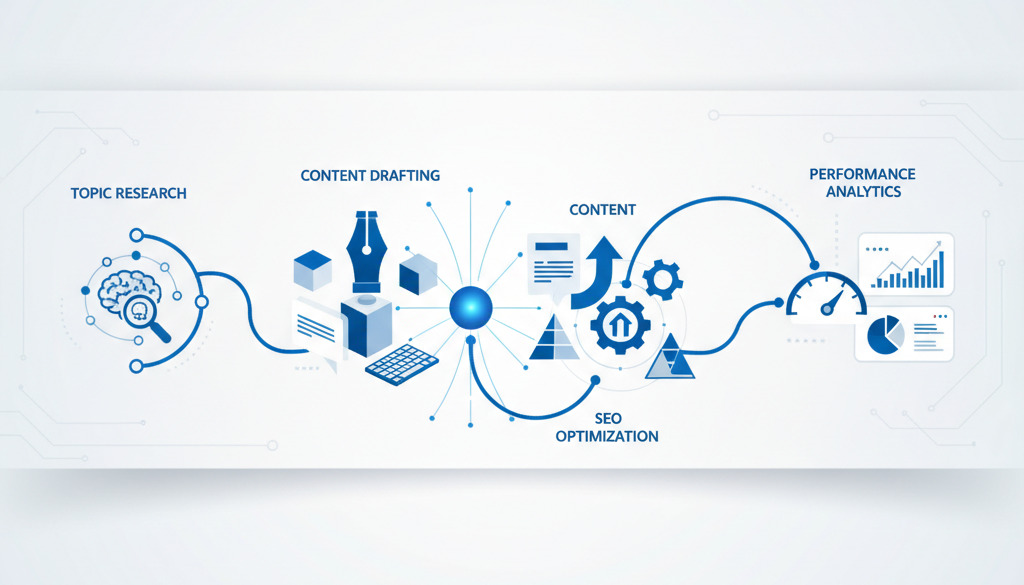
AI tools can intervene at every stage of the content process:
- Ideation and Research: AI can analyze millions of articles, social media trends, and search queries in seconds to identify topics that your target audience is actively searching for.
- Content Generation: AI models can generate drafts of articles, social media posts, emails, and product descriptions based on a simple prompt, complete with logical structures and relevant information.
- SEO Optimization: AI excels at performing complex keyword analysis, suggesting optimal keyword placements, generating meta descriptions, and even recommending internal linking strategies to boost your search rankings.
- Personalization and Distribution: More advanced AI can help tailor content to specific audience segments and even suggest the best channels and times for publication to maximize engagement.
AI-Assisted vs. Fully Automated Content
It's crucial to understand the distinction between fully automated "spam" content and professional, AI-assisted content. The former involves generating massive volumes of low-quality text with no human oversight, a practice that Google penalizes. The latter, and the focus of this article, is about using AI as a tool. A human provides the strategy, the prompt, and the final review, while the AI handles the heavy lifting of research and drafting. The result is a high-quality piece of content produced in a fraction of the time.
The Direct Link Between AI Content Creation and Cost Reduction
One of the most immediate and compelling benefits of integrating AI into your content workflow is the dramatic reduction in costs. Content marketing traditionally generates 3x more leads than outbound marketing at a 62% lower cost, and AI further amplifies this cost advantage. Recent data shows AI can lower content production costs by an additional 30-40%.
A Comparative Cost Analysis
Let's break down the typical costs of producing four 1,500-word blog posts per month—a common goal for businesses serious about SEO.
| Method | Typical Monthly Cost (USD) | Description |
|---|---|---|
| In-House Writer | $4,000 - $6,000+ | Salary, benefits, and overhead for a full-time employee. This is often the most expensive option. |
| Marketing Agency | $2,500 - $10,000+ | Agencies offer expertise but come with high retainer fees and management costs. |
| Freelance Writer | $800 - $2,000+ | Hiring on a per-article basis. Quality can vary, and finding and managing freelancers takes time. ($200-$500 per article is common). |
| AI Content Platform | $50 - $300 | Subscription-based software that allows you to generate dozens of articles for a low monthly fee. This represents a 90-98% cost saving over traditional methods. |
As the table clearly shows, the financial barrier to entry for professional content marketing has been virtually eliminated by AI. What was once a significant budget item, affordable only to larger companies, is now accessible to any business owner, regardless of size. This democratization of content creation is leveling the playing field, allowing you to compete with much larger players in your industry.
Accelerating Content Production: From Weeks to Minutes
Beyond cost, the single biggest bottleneck in content marketing is time. The speed at which you can research, write, edit, and publish is directly tied to the results you see. Search engines like Google favor websites that publish fresh, high-quality content consistently. AI transforms this challenge into a significant competitive advantage.
A task that would typically take a human writer several hours or even days—like drafting a comprehensive blog post—can be accomplished by an AI in just a few minutes.
This incredible acceleration isn't about sacrificing quality for speed. It's about efficiency. For busy SME owners who are not digital natives, this is a game-changer. You no longer need to find 10 hours in your already packed schedule to write an article. Instead, you can dedicate 30-45 minutes to providing a strategic prompt, reviewing the AI-generated draft, and adding your unique insights. This is where services that specialize in this efficiency shine. For example, platforms like Pro-SEO AI Writers have built their entire model around this principe, using a proprietary AI that can generate a complete, professional SEO article specifically designed to rank on Google in a matter of minutes.
Use Cases for Rapid Content Creation
- Consistent Blog Publishing: Go from publishing sporadically to maintaining a weekly or even multi-weekly blog schedule, building topical authority and SEO momentum.
- Social Media Calendars: Generate a month's worth of social media posts in under an hour.
- Email Marketing Campaigns: Quickly draft entire email sequences for newsletters, promotions, or lead nurturing.
- Website & Product Copy: Instantly create compelling descriptions for new products or refresh the copy on your website pages.
Enhancing Content Quality and Relevance with AI
A common misconception is that AI-generated content is generic and lacks substance. While early iterations of the technology may have had this issue, modern AI platforms are incredibly sophisticated. They are designed to enhance, not diminish, content quality by leveraging data at a scale no human can match.
Data-Driven Topic Selection
How do you know what to write about? In the past, this was based on guesswork or tedious manual research. AI tools analyze real-time search data, competitor content, and customer questions from forums like Reddit and Quora. This ensures that you are creating content that people are actively looking for, guaranteeing a baseline level of audience interest and search demand before you even start writing.
Ensuring Factual Accuracy and Brand Voice
Many advanced AIs are now connected to the internet and can pull in recent data and sources to ensure factual accuracy. Furthermore, by providing the AI with examples of your existing content or a style guide, you can train it to write in a consistent brand voice. A human editor should always perform a final fact-check and brand voice polish, but the AI provides a remarkably accurate and high-quality foundation to work from. This focus on quality is critical, as the end goal is to attract customers. Using a service specifically designed to produce professional articles, optimized for SEO, directly impacts the quality and relevance needed to convert readers into leads.
Optimizing Content for Search Engines: The AI Advantage
Creating great content is only half the battle; people need to be able to find it. This is where Search Engine Optimization (SEO) comes in, and it's an area where AI provides a decisive advantage. SEO is a technical, data-heavy discipline, making it perfectly suited for artificial intelligence.
Advanced Keyword Research
AI can move beyond obvious "head" keywords and uncover valuable long-tail keywords. These are longer, more specific phrases that indicate a user is closer to making a purchase. For example, instead of just targeting "roofing," an AI might identify "cost of asphalt shingle roof replacement in Austin, Texas." AI can analyze thousands of these variations to find opportunities with high search volume and low competition, which are the goldmines of organic traffic.
Perfecting On-Page SEO
AI tools automate the most tedious parts of on-page SEO. They can:
- Generate SEO-Optimized Titles: Craft headlines that are attractive to both readers and search engine algorithms.
- Write Meta Descriptions: Create compelling summaries that appear under your title in Google search results to maximize click-through rates.
- Ensure Keyword Density: Suggest where and how often to include your target keywords in the text for optimal relevance without "keyword stuffing."
- Recommend Internal Links: Analyze your existing website content and suggest relevant internal links to build a strong site architecture, which is a key ranking factor.
By handling these technical details, AI ensures that every piece of content you publish is perfectly primed to rank on Google, removing the guesswork from SEO.
Boosting Organic Traffic and Customer Acquisition through AI Content
The logical outcome of producing high-quality, SEO-optimized content at an accelerated pace is a significant increase in organic website traffic. This is the top-of-the-funnel ROI that directly leads to bottom-line results.
Here’s the simple, powerful equation: Better SEO → Higher Rankings → More Clicks → More Visitors → More Leads.
By consistently publishing AI-assisted content that targets relevant keywords, you build topical authority in the eyes of Google. This means Google starts to see your website as a credible expert in your industry. As your authority grows, your rankings improve across the board, not just for the specific articles you published but for your entire website. This creates a compounding effect where your visibility and traffic grow exponentially over time.

Measuring the Uplift in Organic Traffic
To measure this, you can use free tools like Google Analytics and Google Search Console. Before you start your AI content strategy, take a baseline measurement of your average monthly organic traffic. Then, after consistently publishing for 3-6 months, compare the new numbers to your baseline. You can directly attribute the percentage increase in visitors to your new content efforts. This traffic growth is the first tangible sign of your AI content marketing ROI.
Measuring and Quantifying AI Content Marketing ROI: Key Metrics
As Forbes Council notes, the ROI from AI is no longer an abstract concept; it is embedded in measurable engagement. To prove the value of your investment, you must track the right Key Performance Indicators (KPIs). While a staggering 67% of marketers now use AI daily, only 19% track AI-specific KPIs. Closing this measurement gap is where you can gain a serious competitive edge.
The Most Important KPIs to Track
Set up a simple dashboard to monitor these metrics before and after you begin using AI for content creation:
- Organic Website Traffic: The total number of visitors arriving at your site from search engines.
- Search Engine Rankings for Target Keywords: Are you moving up from page 10 to page 1 for the keywords you're targeting? Use a rank tracking tool to monitor this.
- Lead Generation: The number of people who fill out a contact form, sign up for a newsletter, or call your business from a blog post. This ties content directly to potential revenue.
- Conversion Rate: What percentage of visitors from your content become leads or customers?
- Customer Acquisition Cost (CAC): Calculated as (Total Marketing Spend) / (Number of New Customers Acquired). Your AI content strategy should significantly lower your CAC over time compared to paid ads.
- Content Production Cost: How much are you spending (in both time and money) per article? This number should plummet with AI.
- Time to Publish: How long does it take from idea to published article? This metric demonstrates your new efficiency.
Calculating the Financial Return: A Practical Approach
Once you are tracking your KPIs, you can calculate a hard financial ROI. While it can seem daunting, a simple formula can give you a clear picture of your return.
A Step-by-Step ROI Calculation
You can use this simplified formula:
ROI (%) = [ (Value of Leads from Content - Cost of AI tools) / Cost of AI tools ] x 100
Let's walk through a practical example for a small business:
- Step 1: Determine the Cost. Let's say you subscribe to an AI content platform for $100/month. So, your annual cost is $1,200.
- Step 2: Determine the Value of Leads. Look at your historical sales data. Let's say you know that for every 10 leads you get, you close one sale, and the average customer lifetime value (LTV) is $2,000. This means each lead is worth $200 ($2000 / 10).
- Step 3: Track Leads from AI Content. After 12 months, you check your analytics and find that your AI-powered blog posts have generated 50 new leads for your business.
- Step 4: Calculate the Total Value Generated. 50 leads x $200/lead = $10,000 in potential revenue value.
- Step 5: Calculate Your ROI.
ROI = [ ($10,000 - $1,200) / $1,200 ] x 100
ROI = [ $8,800 / $1,200 ] x 100
ROI = 733%
An ROI of over 700% is a powerful testament to the effectiveness of the strategy. Even better, some platforms offer a risk-free way to test the waters. For example, some services like Pro-SEO AI Writers allow you to generate your first five articles completely free, providing a perfect opportunity to calculate potential ROI with zero initial investment before committing any budget.
Case Studies: Real-World AI Content Marketing Success Stories
Theory and formulas are helpful, but seeing how this strategy impacts businesses like yours is even more powerful. Here are a few anonymized case studies based on common outcomes for SMEs.
Case Study 1: The Local Home Services Company
- The Business: An established plumbing company in a competitive suburban market. They relied almost entirely on word-of-mouth and expensive local ads.
- The Challenge: Their website got almost no traffic, and their ad spend was high with unpredictable returns.
- The Solution: They adopted an AI content tool to create 2 blog posts per week targeting long-tail keywords like "emergency plumbing repair for leaking pipe" and "how to choose a new water heater."
- The Results (After 6 Months): They achieved a 400% increase in organic website traffic. They began generating 10-15 qualified leads per month directly from their blog content, allowing them to reduce their pay-per-click ad spend by 50% while increasing overall sales.
Case Study 2: The B2B Consulting Firm
- The Business: A small financial consulting firm for tech startups.
- The Challenge: The partners were experts in finance, not marketing. They had no time to write the thought leadership articles needed to build credibility.
- The Solution: They used AI to draft articles on complex topics. The partners would spend 30 minutes creating a detailed prompt and another hour reviewing and adding their unique insights to the AI-generated draft.
- The Results (After 1 Year): They built a library of over 50 expert articles. Their website began ranking for high-value B2B search terms, their LinkedIn engagement soared, and they secured three major new clients who all cited the blog as a key factor in their decision to reach out. The ROI on these clients alone was over 5,000% of their AI software cost.

Overcoming Skepticism: Addressing Common Concerns about AI Content
It's natural to be skeptical of new technology, especially one that touches on the creative process of writing. Many business owners worry about a lack of human touch, originality, or even ethical implications. These are valid concerns that are best addressed head-on.
"Will AI Content Sound Robotic and Soulless?"
This is the most common fear. The key is to view AI not as a content *creator*, but as a content *assistant*. The initial draft from the AI is your starting point, not your final product. Your job is to infuse it with your personality, your stories, and your unique perspective. Add a personal anecdote, a strong opinion, or a case study from your own experience. This human layer is what turns a good article into a great one.
"Is the Content Original or Plagiarized?"
Reputable AI writing tools are designed to generate original content. They don't copy-and-paste from other sources. Instead, they have learned the patterns, structures, and information of language from a vast dataset, and they use this knowledge to construct new sentences and paragraphs from scratch. That said, it is always a best practice to run the final draft through a plagiarism checker to be 100% certain, just as you would with a human writer.
"Is Using AI for Content Ethical?"
The ethics of AI content hinge on transparency and intent. It is unethical to use AI to create deliberately misleading information or to generate low-quality content at a massive scale to manipulate search rankings. However, it is entirely ethical to use AI as a productivity tool to help you write a helpful, accurate, and informative article for your audience more efficiently. The goal is to provide value to the reader, and AI is simply a new tool to help you achieve that goal.
The Role of Human Expertise in an AI-Powered Content Strategy
The most successful AI-powered content strategies are not fully automated. They are human-led and AI-assisted. Emphasizing this point is crucial: AI is a tool to augment human intelligence, not replace it.
Your expertise as a business owner is irreplaceable. The AI doesn't know the nuances of your customer relationships, the story behind your company's founding, or the specific pain points your clients face every day. The most potent content combines the efficiency and data-processing power of AI with the wisdom, empathy, and strategic direction of a human expert.
Where Humans Add the Most Value
- Strategy & Planning: An AI can suggest topics, but a human must decide which topics align with the company's business goals.
- Prompt Engineering: The quality of the AI's output is directly proportional to the quality of the human's input (the prompt).
- Editing & Fact-Checking: A human editor must review the content for accuracy, tone, and brand voice.
- Adding Original Insight: Weaving in unique stories, opinions, and proprietary data is what will differentiate your content from competitors.
- Building Relationships: AI can write content, but it can't engage with comments, build partnerships, or network with other industry professionals.
By letting AI handle the 80% of content creation that is repetitive and time-consuming, you free up your valuable time to focus on the 20% that requires high-level strategy and human connection.
Integrating AI Content into Your Existing Marketing Workflow
Adopting any new tool can feel disruptive, but integrating AI content generation can be a seamless process if you approach it systematically. You don't need to overhaul your entire marketing strategy overnight.
A Phased Approach to AI Adoption
- Phase 1: Experimentation (Weeks 1-4): Start small. Choose one AI content tool and commit to creating one or two blog posts. Use it for a low-stakes task. The goal here is simply to get comfortable with the interface and learn how to write effective prompts.
- Phase 2: Integration (Months 2-3): Once you're comfortable, start building a process. Create a simple content calendar. Develop a workflow: Human researches and creates the prompt → AI generates the draft → Human edits, adds unique insights, and optimizes → Post is published.
- Phase 3: Scaling (Months 4+): With a proven workflow, you can now increase your publishing velocity. Ramp up to two, three, or even four posts per week. Expand your use of AI to social media content, emails, and ad copy. At this stage, you are operating an efficient content machine.
Remember to provide some basic training for anyone on your team who will be using the tools. A short session on prompt writing and your brand's style guide can ensure consistency and quality from the start.
Choosing the Right AI Content Marketing Tools for Your Business
The market for AI content tools has exploded, and the sheer number of options can be overwhelming. When selecting a solution, it's important to look beyond the marketing hype and focus on the features that will deliver the most value for your specific business needs.
Key Factors to Consider
- Ease of Use: As a business owner who isn't a digital professional, you need a tool with an intuitive interface. You shouldn't need a degree in computer science to generate an article. Look for a clean, straightforward user experience.
- Output Quality & Focus: Is the tool a general-purpose writer, or is it specialized? A tool designed specifically for generating long-form, SEO-optimized blog posts will almost always produce better results than a jack-of-all-trades tool if SEO is your primary goal.
- Features: Does the tool include built-in features for keyword research, SEO scoring, and plagiarism checking? An all-in-one solution can save you from having to subscribe to multiple different tools.
- Pricing Model: Most tools operate on a monthly subscription based on word count. Choose a plan that aligns with your publishing goals. Be wary of "unlimited" plans that may have hidden fair-use policies.
- Customer Support: When you're learning a new system, good customer support is invaluable. Check for tutorials, documentation, and responsive human support.
For many businesses in the US, finding a tool whose AI understands market nuances and is fine-tuned for high-quality SEO article creation offers a distinct advantage. This is why specialized services often outperform generalist writing assistants.
The Future of Content Marketing: AI as a Strategic Imperative
The adoption of AI in marketing is not a passing trend; it is a fundamental shift in how businesses operate and compete. Looking ahead, AI will become even more integrated into our strategic processes.
Emerging Trends to Watch
- Hyper-Personalization at Scale: AI will enable websites to dynamically change content based on who is visiting, creating a truly one-to-one experience for every user.
- Predictive Analytics: AI will not only tell you what topics are popular now but will predict which topics will be trending in the future, allowing you to get ahead of the curve.
- AI-Powered Content Audits: AI will be able to analyze your entire website, identify underperforming content, and automatically suggest updates, rewrites, or consolidations to improve overall SEO performance.
- Multimodal AI: The same AI that writes your blog post will also be able to generate a summary video for TikTok, a slide deck for a presentation, and an audio version for a podcast, all from the same initial prompt.
Businesses that embrace AI now are not just solving a short-term resource problem; they are positioning themselves for long-term, sustainable growth. Delaying adoption is no longer a neutral choice; it is a decision to fall behind.
Getting Started with AI Content Marketing: A Practical Action Plan
Reading about AI content marketing is one thing; implementing it is another. Here is a simple, actionable plan for a business owner to get started this week.
- Define ONE Goal: Don't try to do everything at once. Your first goal could be "Publish one high-quality, SEO-optimized blog post per week" or "Increase organic traffic by 20% in the next quarter."
- Choose Your First Tool: Select a user-friendly AI writer that specializes in SEO content. Look for one with a free trial or a low-cost introductory plan.
- Identify 5-10 Core Topics: What are the most common questions your customers ask you? Write each one down. These are your first article topics. Use the AI tool to research long-tail keywords related to these questions.
- Generate Your First Article: Pick one topic and write a detailed prompt for the AI. Include your target keyword, target audience, and key points you want to cover. Generate the draft.
- Review, Edit, and Personalize: Spend 30-60 minutes refining the AI's output. Add a personal story. Check the facts. Make sure the tone reflects your brand. This is the most critical step.
- Publish and Promote: Publish the article on your website. Share it on your social media channels and with your email list.
- Measure and Repeat: Set up Google Analytics to track your traffic. At the end of the month, review your progress. Then, repeat the process. Consistency is key.
Conclusion
For the busy business owner, AI content marketing is the bridge between knowing you need a stronger online presence and actually having the resources to build one. The benefits are clear and measurable: dramatic cost savings, unprecedented speed, enhanced content quality, and superior SEO performance. All of this culminates in a tangible, impressive Return on Investment that flows directly to your bottom line in the form of more traffic, more leads, and more sales.
By adopting AI, you are not just automating a task; you are investing in a scalable engine for growth. You are freeing yourself from the constraints of time and budget to finally execute the content strategy you know your business deserves. By leveraging these tools, you can join the ranks of smart businesses who are already seeing the benefits, allowing customers to find them organically on Google through professional, AI-written SEO content. The future of marketing is here, and it is more accessible and powerful than ever before.
Frequently Asked Questions
Q1: Is AI-generated content penalized by Google?
A: No. Google's official stance is that it rewards high-quality content, regardless of how it is produced. Google penalizes spammy, low-quality content that is created to manipulate search rankings. As long as you are using AI as a tool to create helpful, informative, and original articles for your readers, it is perfectly acceptable and will not be penalized.
Q2: How much does AI content marketing really cost for a small business?
A: The costs are surprisingly low. Many powerful AI content platforms have pricing tiers that start around $50-$100 per month. Compared to the thousands of dollars it costs to hire a freelance writer or an agency, AI software offers a massive cost saving, often reducing content expenses by over 90%.
Q3: Can AI really understand the nuances of my specific business niche?
A: Yes, with the right guidance. Modern AI models have been trained on a vast portion of the internet and have knowledge of most industries. The key is in "prompt engineering." By providing the AI with detailed instructions, context about your business, specific terminology, and your target audience, you can guide it to produce highly relevant and knowledgeable content for your niche.
Q4: How much human effort is still needed when using AI for content?
A: You should plan on being involved. A good rule of thumb is the 20/80 rule: the AI does 80% of the work (researching, outlining, drafting), and a human does the final 20% (strategic direction, editing, fact-checking, and adding unique insights). This human touch is essential for ensuring quality and differentiating your content from competitors.
Q5: What is the fastest way to see a return on investment from AI content?
A: Focus on "bottom of the funnel" keywords first. These are long-tail keywords that signal strong purchase intent (e.g., "best emergency plumber near me" instead of "plumbing tips"). While these articles may get less traffic overall, the visitors they attract are highly qualified and more likely to convert into immediate leads, demonstrating a quick and clear ROI.
Keep reading
Hand-picked guides that go deeper — open the one you need next:
- Scaling Your Content with AI: Volteruno for Growing Businesses
- Before You Hire: Why AI Writing Outperforms Freelancers
- Mastering the AI Content Creation Process: 2026 Guide
- Content Creation in Minutes: The AI Solution for Busy Entrepreneurs
→ Read the full AI Content guide