
Elevating Your Brand: Crafting Authoritative AI Blog Content

The artificial intelligence sector is no longer a futuristic promise; it is a present-day industrial revolution.[1] As organizations across the globe pivot toward a machine-learning-centric operational model, the demand for credible, expert-led information has surged. However, we have entered an era of "content saturation" where the noise-to-signal ratio is at an all-time high. Recent data suggests that while over 7.5 million blog posts are published daily, only a fraction of that content provides the technical depth and strategic foresight required to capture the attention of high-level decision-makers.
For the modern AI expert, blogging is more than just a marketing tactic; it is an act of digital diplomacy and intellectual leadership. Distinguishing your voice in a landscape dominated by generic, AI-generated summaries requires a commitment to originality, ethical transparency, and profound technical authority. This article provides a comprehensive strategic framework for developing AI expert blog content that resonates with sophisticated audiences, fosters institutional trust, and establishes your brand as a primary source in the intelligence economy.
Understanding Your AI-Conscious Audience
The first step in crafting authoritative content is moving beyond the "general reader." In the AI space, the audience is highly fragmented. To communicate effectively, you must segment your readers into distinct psychographic profiles. On one end, you have the Technical Practitioners—data scientists and ML engineers—who care about model architecture, latency, and training efficiency. On the other end, the C-Suite is looking for ROI, risk mitigation, and competitive advantage. Writing for both in the same breath often results in satisfying neither.
Anticipating information needs requires staying ahead of the "hype cycle." While the general public may still be exploring basic generative AI prompts, an expert audience is likely grappling with the complexities of Retrieval-Augmented Generation (RAG), vector database security, or the transition from pilot projects to production-grade implementation. Your content must address these specific pain points by providing high-level conceptual frameworks for executives while offering "under the hood" insights for technical leads.
Effective profiling also involves understanding the anxiety of the audience. Business leaders are often paralyzed by the "fear of missing out" (FOMO) on AI developments while being simultaneously terrified of implementation failure. Expert content should act as a stabilizing force, replacing hype-driven anxiety with data-driven confidence. By tailoring your language—using "strategic scalability" for executives and "hyperparameter optimization" for engineers—you demonstrate a nuanced understanding of their world.
Strategic Framework for AI Content Development
Consistency in the AI space is not just about frequency; it is about thematic coherence. A strategic framework must begin with Content Pillars. These are the broad categories where your expertise shines. For a consultancy, pillars might include Governance & Compliance, Generative AI in the Enterprise, and Automation Architecture. By defining these pillars, you ensure that your blog doesn't become a scattershot of random trend-chasing but remains a structured repository of specialized knowledge.
Operating without a rigorous content calendar is a recipe for irrelevance in the fast-moving AI sector. However, unlike traditional industries, an AI content calendar must remain fluid. While you may have a series planned on "The Ethics of Facial Recognition," a breakthrough in "Small Language Models" (SLMs) might require an immediate tactical shift to capitalize on the news cycle. A "70/30" rule is often effective: 70% evergreen expert insights and 30% reactive analysis of industry shifts.
Finally, your blog should serve as the "intellectual hub" of a larger ecosystem. A deep-dive article on LLM halluncination mitigation can be decomposed into a series of LinkedIn insights, an executive summary for an email newsletter, and the foundational script for a technical webinar. This cross-channel integration ensures that your high-effort expert content reaches stakeholders across different platforms, maximizing the return on your intellectual investment.
Achieving Technical Depth and Credibility
The greatest challenge for AI experts is the "Curse of Knowledge"—the tendency to assume the reader understands complex concepts. To be a true expert, you must be a master of translation. Credibility is not built by using the most complex words, but by making complex systems understandable. Use analogies carefully: comparing a Neural Network to a library’s indexing system can ground a reader before you dive into the specifics of backpropagation.
Data is the currency of the AI world. Recent blogging statistics indicate that long-form content exceeding 3,000 words receives 3.5 times more backlinks than shorter, superficial pieces. This is particularly true in AI, where readers expect citations from peer-reviewed journals (like arXiv), benchmarks (like GLUE or SuperGLUE), and real-world case studies. If you claim that your AI solution improves operational efficiency, you must back it up with a specific percentage, a timeframe, and a description of the methodology used to measure that gain.
Credibility is also attached to individuals. In an era where "fake news" and automated content are rampant, humanizing the expertise is vital. Feature your Subject Matter Experts (SMEs) prominently. Instead of a faceless corporate entity, an article by a "Lead Data Scientist with 15 years in NLP" carries significantly more weight. Include biological blurbs, links to their previous research, and direct quotes that reflect their unique professional philosophy.
Navigating the Ethical and Societal Dimensions of AI Content
Expertise carries a moral imperative. As AI becomes more pervasive, the focus is shifting from "what can it do" to "what should it do." Addressing algorithmic bias and fairness is no longer a niche topic; it is a core requirement for enterprise-grade content. An expert blog must be courageous enough to discuss the limitations and risks of AI. Acknowledging that a model might struggle with socio-economic diversity in its training data actually builds more trust than claiming technical perfection.
Transparency is the antidote to the "black box" problem. The concept of Explainable AI (XAI) should be a recurring theme in your content. Explain how decision-making pathways are formed within your models. When you discuss the deployment of AI in sensitive sectors like healthcare or HR, focus on the "human-in-the-loop" (HITL) frameworks that ensure accountability. This positions your brand as a responsible shepherd of technology, rather than a reckless disruptor.
Furthermore, consider the societal impact. AI content should address how technology augments human labor rather than just replacing it. By discussing Responsible AI Deployment, you align your brand with the burgeoning field of ESG (Environmental, Social, and Governance) values, which is increasingly a deciding factor for institutional investors and top-tier talent acquisition.
Crafting a Compelling Narrative for AI Insights
Technical writing does not have to be dry. In fact, the most influential AI experts are often the best storytellers. To make an abstract concept like "Edge Computing" resonate, frame it within a narrative of a remote surgeon performing a critical procedure via a 5G-enabled robotic arm. By grounding the technology in a high-stakes, human scenario, you transform a technical specification into a compelling vision of the future.
To avoid the "echo chamber," you must develop a unique perspective. Don't simply report that a new version of a popular LLM has been released. Instead, analyze its impact on a specific vertical. For example: "Why Version X's Window Context Expansion is the Death Knell for Mid-Tier Legal Discovery Tools." This degree of specificity characterizes expert content and provides "predictive value" that readers cannot find elsewhere.
Structure your authoritative articles with mathematical precision. Use an Inverted Pyramid style for executive summaries, followed by detailed technical breakdowns. Utilize <blockquote> elements to highlight key takeaways or expert opinions, and use descriptive subheadings that summarize the value of the following section. This allows busy professionals to skim the "Why" before committing time to the "How."
The Role of Thought Leadership in AI
Thought leadership is the byproduct of adding value consistently over time. When your blog becomes the place where industry leaders find the answer to "what does this mean for us?", you have achieved authority. This authority translates into brand equity. In the B2B AI space, where sales cycles are long and budgets are high, being the "voice of reason" can drastically shorten the path to a closed deal. People buy from those they perceive as the smartest person in the room.
Influencing the industry dialogue requires more than just publishing; it requires participation. Use your blog as a platform to challenge common myths. If the industry is over-hyping "Artificial General Intelligence," write a well-reasoned piece grounded in current hardware limitations that brings the conversation back to reality. This contrarian yet evidence-based approach establishes you as a leader who isn't afraid to go against the grain for the sake of accuracy.
Ultimately, high-quality AI content builds a community. Encourage debate in the comments section or via social media links. When other experts begin to cite your blog posts in their own research or LinkedIn updates, you've moved from being a content creator to an industry influencer. This community-building aspect creates a feedback loop: your readers tell you their new problems, providing you with fresh material for your next expert deep-dive.
Optimizing AI Content for Discoverability and Engagement
Even the most brilliant AI insight is worthless if it cannot be found. Search Engine Optimization (SEO) for AI keywords is highly competitive. Avoid broad terms like "AI for business." Instead, target long-tail keywords that reflect specific intent, such as "low-latency inference for autonomous vehicles" or "optimizing transformer models for retail supply chains." These keywords may have lower search volumes, but the intent is far more valuable and the competition is lower.
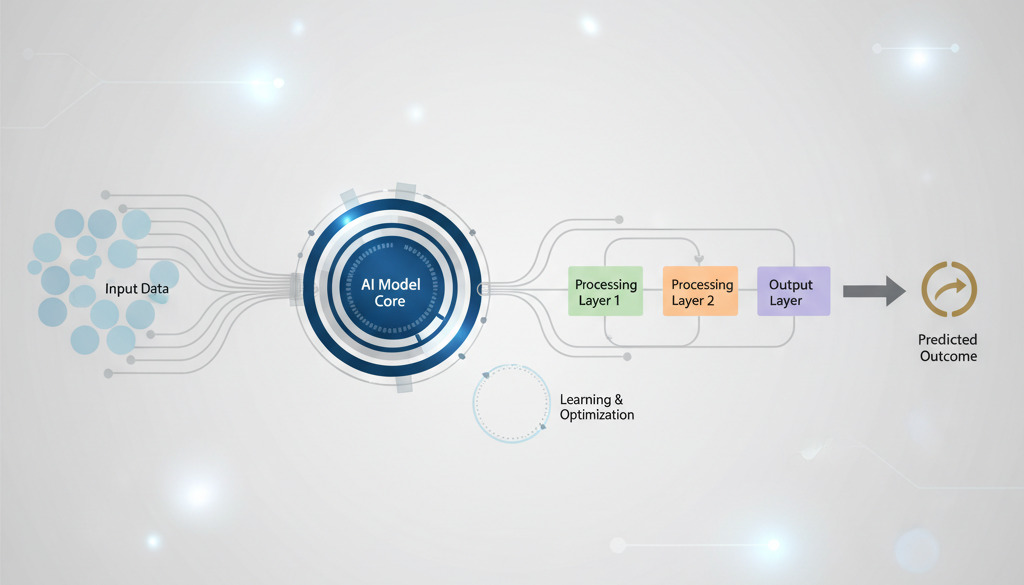
Visual aids are non-negotiable in AI content. A 500-word paragraph explaining a Convolutional Neural Network (CNN) architecture is far less effective than a single, well-designed infographic showing the layers of feature extraction. Visuals enhance retention and make your content more "shareable" on platforms like LinkedIn and Twitter. Ensure that all diagrams are branded and maintain a professional aesthetic; grainy screenshots of code snippets can detract from your perceived expertise.
Finally, every piece of content must have a purpose. What should the reader do next? In an expert AI blog, generic CTAs like "Contact Us" are often too aggressive for the early stages of a relationship. Instead, offer "Lead Magnets" that extend the learning: "Download our Technical Whitepaper on AI Governance" or "Join our Monthly AI Briefing for CTOs." This moves the reader from a casual browser to a warm lead in your CRM system.
Measuring the Impact of Your AI Expert Content
In a business-like environment, "gut feeling" is not enough to justify content expenditure. You must track sophisticated Key Performance Indicators (KPIs). Beyond simple page views, look at Average Time on Page and Scroll Depth. If your 3,000-word deep-dive has an average read time of 45 seconds, your content is likely either too dense or not meeting the reader's intent. High engagement rates on complex sections indicate that you are reaching the right audience.
Analyze the Quality of Backlinks. Are other AI firms, academic institutions, or industry journals linking to your work? This is a primary indicator of authority. Furthermore, monitor brand mentions across social media. Are people discussing your "unique take" on AI ethics? This qualitative feedback is often more valuable than raw traffic numbers because it indicates that you are actually shifting the narrative in your space.
Connect your content metrics to your bottom line. Use attribution modeling to see how many leads visited the blog before requesting a sales demo. By demonstrating a direct correlation between "expert blog content" and "qualified pipeline," you can secure the necessary budget to scale your content operations and bring on more specialized contributors.

Future-Proofing Your AI Content Strategy
The AI field moves at an exponential rate. To future-proof your strategy, you must be a student as much as a teacher. Dedicate time for your content team to stay updated with the latest research from NeurIPS, ICML, and CVPR. Content that was innovative six months ago may be obsolete today. A "living document" approach—where you periodically update your most successful evergreen posts with the latest data—can help maintain your rankings and relevance.
Audience expectations are also evolving. As AI literacy increases, readers will demand even more transparency and technical rigor. The "fluff" that worked in 2023 will not work in 2026. Prepare for this by raising your editorial standards today. Invest in fact-checking specialized for AI, ensuring that every technical claim is verifiable and that every code snippet provided is functional and optimized.
Finally, consider scalability. As your brand grows, you may need to move from a single expert blogger to a "Content Center of Excellence." This involves training your internal engineers and developers to become effective writers or hiring technical writers who can "ghostwrite" for your SMEs. Building a scalable engine for high-quality AI content ensures that your brand’s voice remains dominant even as the market becomes increasingly crowded.
In summary, crafting AI expert blog content is a sophisticated endeavor that requires a blend of technical mastery, strategic planning, and ethical clarity. By focusing on the specific needs of your audience, maintaining high technical standards, and staying ahead of industry trends, you can transform your blog into a powerful engine for brand authority and business growth. The future of AI is being written now; ensure it is your voice that is leading the conversation.
Leveraging AI for Content Strategy and Distribution
Beyond the creation of the content itself, artificial intelligence offers transformative opportunities in how we strategize and distribute AI expert blog content. AI-powered analytics tools can delve deep into audience engagement metrics, identifying precisely which topics resonate most, what content formats perform best, and even the optimal times for publication. This data-driven approach allows for a highly iterative and efficient content strategy, ensuring that resources are focused on content that demonstrably drives value and engagement.[2] Instead of relying on intuition, you can leverage AI to pinpoint emerging trends and audience pain points before they become mainstream, allowing your brand to be a thought leader rather than a follower.
Furthermore, AI can revolutionize content distribution. Tools exist that can help automate the process of tailoring content summaries and promotional snippets for different social media platforms, optimizing headlines for search engines, and even identifying key influencers or communities likely to engage with your material. Imagine an AI that not only suggests blog post topics but also drafts personalized outreach messages to relevant journalists and bloggers, or identifies opportunities for repurposing a technical whitepaper into a series of engaging social media threads. This level of intelligent automation frees up your team to focus on higher-level strategic initiatives, ensuring your expert AI content reaches the widest and most relevant audience possible.
FAQ
What makes AI blog content "authoritative"?
Authoritative AI blog content is characterized by its accuracy, depth of knowledge, and insightful analysis. It leverages credible data, expert opinions, and demonstrates a clear understanding of complex AI concepts.
How can I establish myself as an AI expert through my blog content?
Showcase your expertise by consistently publishing well-researched, original content that addresses niche AI topics. Engage with your audience through comments and social media, and consider citing original research or expert interviews.
What are the benefits of creating authoritative AI expert blog content for my brand?
Creating authoritative AI blog content builds trust and credibility with your target audience, positioning your brand as a thought leader in the AI space. This can lead to increased brand recognition, customer loyalty, and ultimately, business growth.
Keep reading
Hand-picked guides that go deeper — open the one you need next:
- Scale Your Business with AI: Content Marketing for Growth
- AI Keyword Research: Beyond Basic Keywords
- From Zero to Hero: Launch Your Business Blog with AI in Days
- Try Before You Buy: Evaluate One AI Article with Volteruno’s Free Plan
→ Read the full AI Content guide