
AI for Consistent Content: A Guide to Brand Cohesion

Consistency is the bedrock of modern brand equity. In a marketplace saturated with noise, a brand's ability to maintain a steady, recognizable voice across every digital touchpoint is what transforms casual browsers into loyal advocates. However, for most organizations, achieving this level of uniformity is an uphill battle. The "content paradox" suggests that as a brand scales, its consistency often diminishes due to fragmented teams, varying levels of expertise, and the sheer volume of assets required for 24/7 engagement.
Traditional barriers—human error, subjective interpretations of style guides, and the time-consuming nature of manual editorial reviews—often lead to a "drifting" brand identity. A blog post might sound professional and clinical, while a social media update feels jarringly informal. For businesses, this lack of cohesion does more than just look messy; it erodes customer trust and weakens marketing ROI. Enter Artificial Intelligence (AI). Moving beyond simple automation, modern AI serves as a transformative framework for content governance, allowing businesses to scale their output without diluting their unique identity.
Understanding AI's Core Capabilities for Content Consistency
To leverage AI for consistency, it is crucial to understand the technology under the hood. Most modern content tools are powered by Natural Language Processing (NLP) and Machine Learning (ML). Unlike legacy software that relies on rigid, "if-then" logic, NLP allows AI to understand context, nuance, and intent. It treats language as a mathematical pattern, identifying the specific linguistic markers that make a brand's voice unique—such as average sentence length, frequency of certain adjectives, or the use of active versus passive voice.
Machine Learning enables these systems to improve over time. By feeding an AI model your existing "gold standard" content—highly successful blog posts, white papers, and historical ad copy—the system learns the "DNA" of your brand. These models can then be fine-tuned to enforce predefined rules. For example, if your brand guidelines forbid the use of industry jargon in customer-facing emails, an NLP-driven system doesn't just look for specific words; it understands when a sentence structure is becoming overly complex or inaccessible, flagging it for correction in real-time.
AI-Powered Content Creation: Generating Branded Assets at Scale
One of the most immediate impacts of AI is its ability to generate high-quality drafts that already sound like your brand. In 2026, the industry has shifted away from generic prompts toward "brand-aware" generative AI. Instead of asking a tool to "write a blog post about sustainable fashion," enterprises use custom-trained models that automatically apply the brand’s specific tone, whether that is "sophisticated yet approachable" or "bold and disruptive."
This capability is particularly vital for handling localized content. Global brands often struggle when translating content, as direct translations rarely capture the brand's original "flavor." AI can act as a bridge, generating localized assets that maintain stylistic consistency across different languages and cultural contexts, ensuring that a campaign in Tokyo feels like the same brand as one in New York, despite the linguistic differences. Recent data suggests that marketers using these integrated AI workflows save an average of 2.5 hours per day on drafting tasks, allowing them to focus more on strategy and less on "blank page syndrome."
AI for Editorial Review: Ensuring Brand Alignment and Quality
Even the best human writers have "off" days where their personal style might seep into the corporate voice. AI-powered editorial tools act as an automated safety net, moving far beyond basic spellcheck. These systems conduct deep-tissue analysis of a draft, checking for brand voice adherence, sentiment alignment, and the inclusion of mandatory key messaging. If a brand emphasizes "empowerment," the AI can flag sections where the sentiment feels too passive or discouraging.
Furthermore, AI is exceptionally skilled at detecting factual inconsistencies. By cross-referencing a new draft against a company's internal knowledge base, the AI can alert an editor if a product description contradicts previously published technical specifications or price points. This "algorithmic oversight" reduces the burden on human editors, who often spend hours on repetitive style checks, and allows them to focus on the creative "soul" of the content while the AI handles the rigid enforcement of the style guide.
The Role of AI in Brand Guideline Enforcement and Management
Traditionally, brand guidelines are static PDF documents that sit in a shared drive, rarely consulted until a mistake is made. AI transforms these guidelines into a living, intelligent repository. Modern Digital Asset Management (DAM) systems integrated with AI can proactively scan every piece of content—both text and visual—to ensure compliance before it ever reaches a human reviewer.[2]
If your brand guidelines dictate that "User Experience" should never be abbreviated to "UX" in long-form content, the AI can automatically suggest the correction. This proactive enforcement also extends to visual elements. Visual AI can analyze images to ensure they align with the brand’s color palette, saturation levels, and subject matter themes. When guidelines need to change—for instance, during a rebrand—updates can be pushed through the AI system instantly, ensuring every piece of content generated from that moment forward reflects the new standards without the need for an organization-wide training seminar.
Optimizing Content Across Channels with AI Consistency
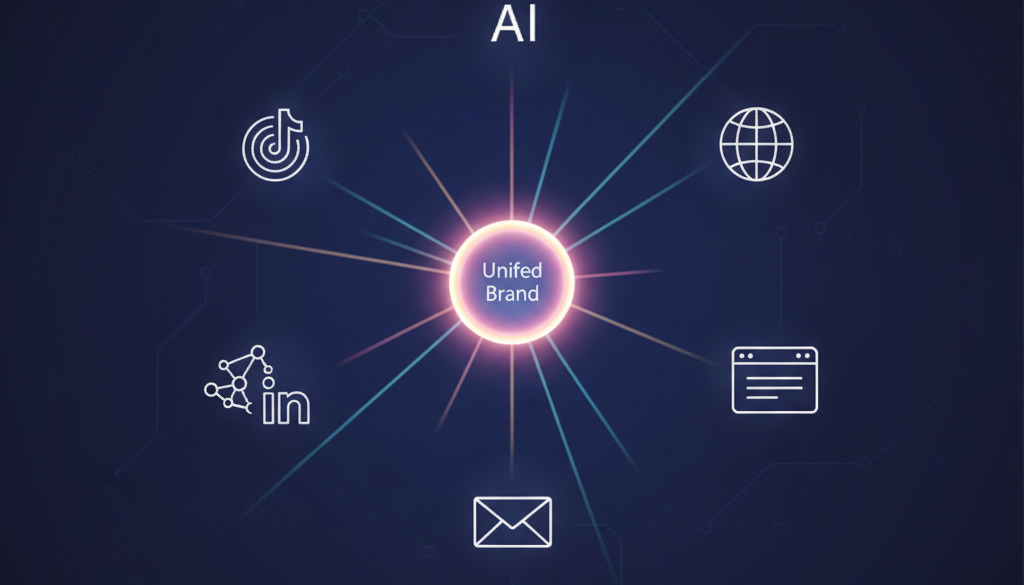
Each marketing channel requires a different "vibe," yet the core brand story must remain the same. A LinkedIn post, a TikTok script, and a technical white paper serve different purposes but should all feel like they originate from the same source. AI excels at this type of "dynamic adaptation." For example, an AI tool can take a 2,000-word research paper and instantly atomize it into five 280-character tweets, a 15-second video script, and a three-paragraph email newsletter—each perfectly formatted for its platform while retaining the original’s core message and authoritative tone.
Moreover, AI ensures the consistent use of Calls to Action (CTAs). Many brands suffer from "CTA fatigue" where different teams use "Buy Now," "Get Started," and "Shop the Range" interchangeably, confusing the customer journey. AI can enforce a standardized library of CTAs across all digital touchpoints, ensuring a unified path to conversion that feels familiar to the user regardless of where they interact with the brand.
AI-Driven Content Optimization for Engagement and Cohesion
Consistency is not just about how the content looks—it’s also about how it performs. AI can analyze vast amounts of user engagement data to determine which specific stylistic elements correlate with high conversion rates. If the data shows that your audience responds better to "problem-solution" metaphors rather than "data-driven" explanations, the AI can prioritize those metaphors in future content suggestions, creating a consistent experience that is also consistently effective.
This optimization extends to SEO. Aligning meta descriptions, headers, and internal linking strategies with brand messaging is often a manual chore prone to oversight. AI ensures that your keyword usage doesn't just satisfy search engines but also reflects your brand’s unique positioning. Instead of using generic keywords, the AI identifies phrases that hit the "sweet spot" between high search volume and brand-specific terminology, ensuring your SEO strategy contributes to, rather than detracts from, your brand identity.
Implementing AI for Content Consistency: Practical Considerations
Transitioning to an AI-enhanced content workflow requires more than just buying a subscription. The first critical step is data hygiene. AI is only as good as the data it is trained on. Organizations must provide clean training data, including up-to-date style guides, a glossary of approved (and forbidden) terms, and examples of "perfect" content. If you feed the AI inconsistent data, it will produce inconsistent results.
Tool Selection and Integration is the next hurdle. Organizations should look for AI solutions that allow for custom API integrations with their existing Content Management Systems (CMS) or Project Management tools (like Asana or Monday.com). The goal is to make AI a seamless part of the workflow, not an extra step. Finally, Human Oversight remains non-negotiable. AI should be viewed as a "co-pilot." While it handles the heavy lifting of drafting and rule enforcement, human strategists must provide the final creative spark and ethical oversight, ensuring the content remains empathetic and genuinely useful to the end reader.
Measuring the Impact of AI on Content Consistency
Moving from manual to AI-assisted content requires a clear way to measure ROI. Quantitative metrics include the reduction in "editorial rework time"—the amount of time spent fixing basic brand errors. Many companies find that AI reduces this time by upwards of 40%, allowing for faster publishing cycles. Another key metric is the "Brand Consistency Score," often determined by AI sentiment analysis tools that compare all published output against a baseline profile.
Qualitatively, the impact is seen in customer perception surveys and brand recall studies. When content is consistent, customers find it easier to recognize the brand without seeing a logo. AI can also facilitate this measurement by tracking how often "off-brand" keywords or tones appear in drafted content versus published content, providing a clear audit trail of improvement over time. According to Adobe's research, nearly 80% of marketing teams are shifting their focus from simple output volume to measurable brand impact, and consistency is the primary lever for that change.

Future Trends: AI's Evolving Role in Seamless Content Orchestration
We are entering an era of "Predictive Content Orchestration." Future AI models won't just react to prompts; they will predict content needs based on market shifts and historical trends while maintaining brand guardrails. Imagine an AI system that notices a competitor’s shift in messaging and automatically generates three defensive content pieces that stay strictly within your brand’s established voice, ready for approval within minutes.
Furthermore, the integration between AI and Digital Asset Management (DAM) will become deeper. We are moving toward a reality where the AI "knows" every piece of content the company has ever produced, preventing the accidental duplication of ideas and ensuring that every new asset builds upon the existing narrative thread rather than repeating it. This end-to-end management will allow even smaller teams to behave like global media houses, maintaining a level of polish and consistency that was previously impossible without massive editorial departments.
Conclusion: The Strategic Imperative of AI-Powered Content Consistency
In the digital economy, consistency is a competitive advantage. It is the invisible force that builds brand recognition, fosters consumer trust, and streamlines the path to purchase. As the volume of content continues to explode, the manual methods of the past are no longer sufficient to maintain quality at scale. AI is not merely a shortcut; it is a strategic necessity for any business that takes its brand identity seriously.
By leveraging AI for generation, editorial review, and channel optimization, organizations can achieve a level of cohesion that was once a pipe dream. The efficiency gains are significant, but the long-term benefit of enhanced brand equity is priceless. Now is the time for businesses to move beyond the experimental phase of AI and integrate these tools into the heart of their content operations. The brands that win in 2026 and beyond will be those that use AI to speak with a single, clear, and powerful voice across the entire digital landscape.
Implementing AI for Consistent Content: A Practical Roadmap
Transitioning to an AI-powered content strategy for brand cohesion might seem daunting, but a structured approach can demystify the process. The first crucial step involves a thorough audit of your existing content ecosystem. This audit should go beyond a simple inventory; it needs to identify recurring themes, brand voice deviations, stylistic inconsistencies, and outdated information. Understanding the current state is foundational to pinpointing where AI can have the most immediate and impactful effect. For instance, an audit might reveal that product descriptions across different platforms have vastly different tones, or that blog posts on similar topics present conflicting messages. These identified gaps become the primary targets for AI-driven remediation and future content generation guidelines.
Once the audit is complete, the next phase is selecting the right AI tools. The market offers a diverse range of solutions, from sophisticated natural language generation (NLG) platforms that can create entirely new content based on predefined parameters, to AI-powered editing and proofreading software that flags inconsistencies and suggests corrections. For content generation, consider tools that allow for extensive customization of brand voice, tone, and style. These often involve training the AI on your existing high-quality content to learn the nuances of your brand’s communication. For editorial oversight, look for AI that can analyze content for adherence to style guides, factual accuracy (by cross-referencing with a knowledge base), and sentiment, ensuring it aligns with the desired brand perception. It's not about finding a single “magic bullet” tool but rather assembling a suite of AI capabilities that address the specific needs identified during the audit.
The implementation of these tools requires a phased rollout and continuous refinement. Start with a pilot project, perhaps focusing on a specific content vertical or a single channel. This allows your team to gain experience with the AI, identify any unforeseen challenges, and gather feedback before a full-scale deployment. Crucially, the human element remains indispensable. AI should be viewed as a collaborative partner, not a replacement for human creativity and strategic oversight. Content strategists, editors, and marketers will need to adapt their roles, focusing on defining overarching strategies, refining AI outputs, ensuring ethical considerations are met, and handling complex creative tasks that AI cannot yet replicate. Regular training and upskilling of your content team will be essential to maximize the benefits of AI integration. Furthermore, establishing clear metrics for success – such as improved brand sentiment scores, reduced content production time, and increased audience engagement on consistently branded content – will be key to demonstrating the ROI of your AI investment and guiding future optimization efforts.
Establishing a Centralized Knowledge Base and Style Guide
A cornerstone of effective AI-driven content consistency is the creation and maintenance of a robust, centralized knowledge base and style guide. This serves as the single source of truth for the AI and human creators alike. The knowledge base should encompass all essential brand information, including product details, company history, mission and values, target audience personas, and approved terminology. This prevents the AI from generating factually incorrect or outdated information. Simultaneously, a comprehensive style guide, digitized and accessible to the AI, dictates everything from preferred grammar and punctuation to acceptable tone and voice nuances. This guide should be living document, regularly updated to reflect evolving brand strategies and market language. By providing the AI with clear, structured, and consistently updated guidelines, you empower it to generate content that not only adheres to brand standards but also reflects the latest brand messaging with precision.
FAQ
What is AI for consistent content?
AI for consistent content refers to the use of artificial intelligence tools and platforms to ensure that all brand communications, from marketing copy to customer service interactions, maintain a unified voice, tone, and messaging.[1] This helps build a stronger and more recognizable brand identity.
How can AI help maintain brand cohesion?
AI can analyze vast amounts of existing brand content to identify key stylistic elements, terminology, and messaging themes. It can then generate new content that aligns with these established patterns or flag deviations in human-created content, acting as a guardian of brand consistency.
What are the benefits of using AI for consistent content?
Using AI for consistent content can lead to improved brand recognition, increased customer trust, and more efficient content creation processes. By reducing inconsistencies, AI helps streamline marketing efforts and ensures a professional and reliable brand image across all touchpoints.
Keep reading
Hand-picked guides that go deeper — open the one you need next:
- Automated Content Publishing for Business Growth
- AI Marketing: Volteruno Delivers ROI
- Local Businesses Rejoice: Geo-Targeted Content With AI
- The Future of Content Marketing: AI is Your New Edge
→ Read the full AI Content guide