
The Ultimate Guide to AI-Powered Content Generation (2026)
The digital ecosystem is currently navigating its most significant pivot since the dawn of the public internet. While the previous decade was defined by the transition to mobile-first interfaces, the present era is being reshaped by AI-powered content generation. Businesses no longer view artificial intelligence as a futuristic curiosity; it has become a fundamental pillar of modern operational strategy. As of 2026, data suggests that over 85% of marketers have integrated AI into their content workflows, reflecting a matured market where the focus has shifted from "can we use AI?" to "how can we use AI to gain a competitive edge?"
AI-powered content generation is rapidly transforming businesses by enhancing efficiency, scalability, and creativity, while also presenting new strategic considerations and ethical challenges. This transformation is not merely about churning out text more quickly; it is about redefining the relationship between human intent and machine execution. This article provides a comprehensive exploration of the AI content landscape, offering business leaders and creative professionals a deeper understanding of the technologies, strategic implementations, and future trends that are defining the industry.
1. Understanding the Core Technologies Behind AI Content Generation
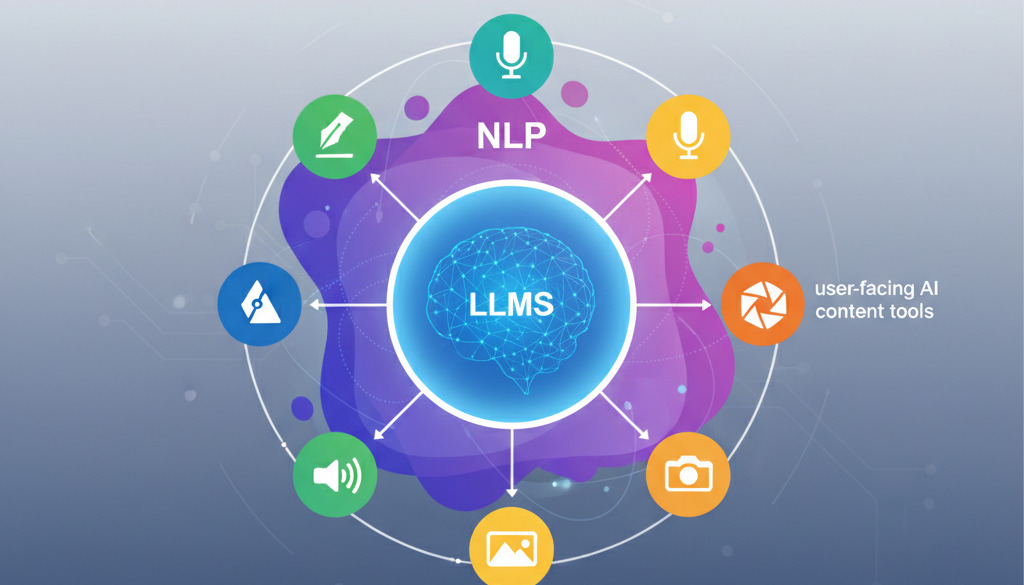
To leverage AI effectively, one must understand the mechanics driving the engine. At the heart of most modern content tools are Large Language Models (LLMs), such as OpenAI’s GPT-4, Google’s Gemini, and Meta’s Llama. These models are built upon "transformer" architectures—a type of neural network that processes data by paying "attention" to different parts of a sequence to understand context. Unlike earlier, simpler algorithms, transformers don't just predict the next word; they grasp nuances in intent, tone, and complex relationships within vast datasets.
Two critical disciplines work in tandem here: Natural Language Processing (NLP) and Natural Language Generation (NLG). NLP is the machine's ability to "read" and interpret the user's prompt, deciphering whether the request is for a technical whitepaper or a witty social media caption. NLG is the inverse—the technology that constructs coherent, human-like responses. Recent advancements have moved beyond simple text-matching into deep learning, where models refine their understanding through millions of parameters that simulate human cognitive patterns.
It is vital to distinguish between the model and the tool. A model is the raw intelligence (like GPT-4), while a tool is the software wrapper (like Jasper, Copy.ai, or Averi) that provides a user interface, specialized templates, and integrations. Understanding this distinction allows businesses to choose between "off-the-shelf" applications for speed or API-driven custom solutions for proprietary needs.
2. The Spectrum of AI-Powered Content: From Augmentation to Automation
AI's role in content creation is not binary; it exists on a continuum that ranges from assisting a writer to operating autonomously. On one end of the spectrum is Content Augmentation. Here, AI acts as a "co-pilot," assisting human creators with tasks that are often tedious or prone to bottlenecking. Features such as real-time grammar correction, keyword suggestions for SEO, and semantic paraphrasing fall into this category. The human remains the primary architect, using AI to polish and refine the output.
On the other end is Content Automation. This is common in high-volume, data-heavy environments. For example, financial institutions use AI to generate thousands of quarterly earning summaries instantly, and e-commerce giants use it to create unique product descriptions for millions of SKUs. In these cases, the AI operates with minimal human intervention, governed by pre-set templates and data triggers.
The middle ground represents the "Human-in-the-Loop" (HITL) model. This is currently the gold standard for high-quality content. The AI might generate a 2,000-word first draft based on a detailed outline, which a human editor then fact-checks, infuses with brand voice, and optimizes for sentiment. This blended approach offers the best of both worlds: the speed of automation with the critical thinking of a human.
3. Strategic Applications of AI-Generated Content Across Business Functions
Modern enterprises are deploying AI well beyond the marketing department. While it certainly excels at generating SEO-optimized blog posts and landing pages—averaging a 55% improvement in SEO rankings for early adopters—its utility spans the entire corporate structure. In Customer Support, AI-driven knowledge bases and chatbots are moving beyond simple "if-then" logic to provide sophisticated, nuanced responses that feel increasingly human, significantly reducing the burden on live agents.
In Internal Communications and HR, AI-powered content generation streamlines the creation of onboarding manuals, policy updates, and internal newsletters. Instead of a manager spending hours drafting a memo, AI can synthesize meeting notes into a structured announcement in seconds. Furthermore, in Product Development, AI is being used to draft technical documentation and even generate "user personas" for focus group simulations, allowing teams to test marketing copy and product features against simulated demographic profiles.
E-commerce represents perhaps the most aggressive application of this technology. AI models can now analyze user behavior in real-time to generate "dynamic product highlights." If a user is price-conscious, the AI highlights the item’s value; if the user is quality-focused, it emphasizes premium materials and craftsmanship. This level of real-time content pivots was impossible before the advent of generative AI.
4. Enhancing Operational Efficiency and Scalability with AI Content
The most immediate business case for AI content generation is the sheer acceleration of production. Traditional content pipelines are often slow, involving weeks of research, drafting, and multiple rounds of revisions. AI compresses this timeline. A task that once took ten hours can now be completed in thirty minutes of prompting and ten minutes of editing. This allows organizations to maintain a higher "content velocity"—the rate at which new, relevant assets are pushed to market.
From a cost-management perspective, the implications are profound. Reducing the reliance on external agencies for high-volume, repetitive tasks can save mid-sized enterprises upwards of $100,000 annually. Recent industry reports by Averi indicate that using integrated "content engines" (which handle everything from strategy to publishing) can allow a lean team of two to produce the output traditionally expected from a six-person department.
Critically, this doesn't necessarily mean downsizing teams. Instead, it enables Resource Optimization. By offloading the "grunt work" of drafting basic drafts or metadata to AI, senior creatives are freed to focus on high-level strategy, thought leadership, and original research—tasks where human intuition and lived experience remain irreplaceable.

5. Leveraging AI for Content Personalization and Targeted Messaging
In the age of information saturation, generic content is often ignored. AI facilitates "hyper-personalization" at a scale previously unthinkable. By integrating AI generation with Customer Relationship Management (CRM) data, businesses can create personalized email campaigns where the subject line, the body text, and even the call-to-action are unique to each recipient. This is not just "insert name here" tagging; it is semantic personalization based on purchase history and browsing intent.
Dynamic Content Creation also extends to web experiences. Modern CMS platforms are using AI to alter hero images and headlines on-the-fly to match the specific interests of the visiting user. For example, a travel website might show a "Family Fun" landing page to one user and a "Solo Adventure" page to another, with the copy dynamically generated to appeal to those specific motivations. This data-driven strategy ensures that every piece of content resonates with the specific demographics and behaviors of the target audience, leading to higher conversion rates and lower bounce rates.
6. The Creative Potential: AI as a Catalyst for Innovation
Contrary to the fear that AI stiles creativity, many top-tier firms find it acts as a powerful catalyst for innovation. One of the most significant barriers to high-level work is the "blank page" problem. AI serves as a universal brainstorming partner, capable of suggesting dozens of headlines, content angles, or unconventional metaphors in seconds. This allows creative teams to explore diverse directions before committing resources to any single path.
Furthermore, AI is pushing the boundaries of content formats. With tools like Adobe Firefly now integrating video generation and sophisticated color grading, marketers are experimenting with multimodal content—blending text, AI-generated imagery, and short-form video in ways that were once cost-prohibitive. For example, Kling 3.0 models allow for the generation of hyper-realistic video sequences from text prompts, enabling small brands to produce high-quality video ads without a full production crew. This democratizes high-production-value storytelling, allowing smaller players to innovate with the same visual language as multinational corporations.
7. Implementing AI-Powered Content Generation: A Strategic Framework
Adopting AI requires more than a subscription to a chatbot; it requires a structured framework. The first step is Defining Objectives. A company should identify whether its goal is lead generation, customer education, or internal efficiency. This dictates the choice of tools. For instance, if the goal is SEO dominance, a tool like Surfer or Averi (which integrates SEO scoring) is preferable to a general-purpose model like ChatGPT.
When Selecting Tools, businesses must evaluate the "stack problem." Using six disconnected tools—one for research, one for writing, one for SEO, and another for publishing—creates an integration headache.[1] The market is shifting toward "all-in-one" systems that handle the strategy-to-publishing lifecycle. Companies must also consider the Workflow Integration. Who owns the prompt engineering? How many rounds of human review are required? Establishing a clear workflow ensures that AI outputs are vetted for quality, brand alignment, and technical accuracy before reaching the public.
8. Quality Control, Ethical Considerations, and Brand Integrity
While AI is powerful, it is not infallible. "Hallucinations"—scenarios where an AI confidently presents false information as fact—remain a persistent challenge. Fact-checking by human experts is non-negotiable, particularly for medical, legal, or financial content (often referred to as YMYL: Your Money Your Life). Maintaining a consistent brand voice is another challenge; without specific tuning, AI can sound generic or overly formal. Brands must develop "Style Prompt Libraries" to ensure the AI adheres to a specific tone, whether it’s professional and authoritative or playful and colloquial.
Ethical considerations are equally paramount. LLMs are trained on massive datasets that often contain inherent biases. Without careful monitoring, AI can inadvertently generate content that reflects these prejudices or perpetuates misinformation. Transparency is also becoming a legal and consumer expectation. In 2026, many regions have implemented disclosure requirements, necessitating that businesses label AI-assisted content. Disclosure builds trust; failing to do so can lead to reputational damage if a customer feels deceived by a machine-generated interaction.

9. The Future of AI in Content Generation: Trends and Predictions
The next three years will see the move toward total Multimodal Integration. We are leaving the era where "content generation" meant only text. Future AI models will generate cohesive campaigns that include synchronized text, images, voiceovers, and video, all maintaining a single brand identity. We can also expect Hyper-Personalization to evolve into "Predictive Content," where AI generates answers and resources before a user even explicitly asks for them, based on their real-time digital journey.
The role of the content professional is undergoing its most radical shift. The "writer" of the future is more of a "Content Architect" or "AI Orchestrator." Success will depend less on the ability to draft manually and more on the ability to manage complex AI systems, refine prompts, and provide high-level creative oversight. Human empathy, strategic intuition, and the ability to tell stories with deep emotional resonance will become the most valuable skills in a sea of machine-generated data.
10. Conclusion: Navigating the AI Content Revolution
AI-powered content generation is no longer an optional luxury; it is a strategic imperative for any business looking to remain relevant in a global, fast-paced digital economy. By significantly lowering the barriers to entry for high-volume content and hyper-personalized experiences, AI offers a path to growth that human effort alone cannot achieve. However, this power must be balanced with rigorous quality control, ethical oversight, and a deep commitment to brand integrity.
For businesses ready to start this journey, the recommendation is clear: start small but think systematically. Identify a high-impact use case—perhaps a blog series or a personalized email workflow—and pilot an integrated AI content engine. As your team becomes proficient in orchestrating these tools, the focus can shift toward more complex, multimodal applications. The AI content revolution is underway; the businesses that succeed will be those that view AI not as a replacement for human creativity, but as the ultimate extension of it.
The Evolving Landscape of AI in Content Creation
The integration of AI into content creation workflows is rapidly transforming the industry, moving beyond simple text generation to encompass a wide range of sophisticated applications. As AI models become more advanced, they are increasingly capable of assisting with tasks that were once the sole domain of human creatives. This includes not only drafting initial content but also aiding in research, summarizing complex information, translating languages, and even generating visual and audio assets. The key to leveraging these advancements lies in understanding how to effectively collaborate with AI tools, treating them as partners rather than just automatons.
This collaborative approach necessitates a shift in skillsets. Content professionals will need to develop a nuanced understanding of AI capabilities and limitations. This involves learning how to craft precise and effective prompts, how to critically evaluate AI-generated outputs, and how to integrate these outputs seamlessly into a larger content strategy. The ability to 'edit' and 'guide' AI, rather than solely 'create' from scratch, will become paramount. Furthermore, the ethical considerations surrounding AI-generated content—such as issues of bias, authenticity, and intellectual property—will require careful navigation and the establishment of clear guidelines.
The future of content creation is likely to be a hybrid model, where human insight, creativity, and strategic thinking are amplified by the efficiency and scale of AI. This synergy allows for the creation of more personalized, engaging, and data-driven content at a speed and volume previously unimaginable. Businesses that embrace this evolution, by investing in the training of their teams and the strategic implementation of AI tools, will be best positioned to thrive in the dynamic digital landscape of the coming years.
FAQ
What is AI-powered content generation?
AI-powered content generation refers to the use of artificial intelligence and machine learning technologies to create written or visual content. These tools analyze vast amounts of data to produce human-like text, images, or other media based on user prompts.
How can AI content generation benefit businesses in 2026?
In 2026, businesses can leverage AI-powered content generation for increased efficiency in creating marketing copy, blog posts, social media updates, and product descriptions. It can also assist in brainstorming ideas, personalizing content at scale, and improving SEO efforts by generating relevant keywords and meta descriptions.
Are there ethical considerations with AI-generated content?
Yes, ethical considerations include ensuring transparency about AI-generated content, avoiding plagiarism, maintaining accuracy and fact-checking, and addressing potential biases present in the AI models. Responsible use involves human oversight to ensure quality and ethical standards are met.