
Content Marketing ROI: Maximize Your Returns

In the high-stakes arena of modern business, content marketing has evolved from a "nice-to-have" creative endeavor into a fundamental driver of corporate growth.[1] However, as budgets tighten and executive scrutiny intensifies, the ability to demonstrate a tangible return on investment (ROI) has become the defining challenge for marketing leaders. It is no longer enough to report on high traffic volumes or social media engagement; stakeholders demand a direct line of sight from content consumption to revenue generation.
The core problem lies in the inherent complexity of content attribution. Unlike a direct-response ad, a single blog post or white paper rarely triggers an immediate purchase. Instead, content works synergistically across multiple touchpoints, often over months, making it difficult to pinpoint exactly which asset sealed the deal. This guide provides a rigorous framework for navigating these complexities. We will move beyond the superficial "vanity metrics" to establish a data-driven methodology for measuring, attributing, and optimizing content marketing ROI, ensuring your department transforms from a cost center into a predictable revenue engine.
Understanding the Foundational Metrics of Content Marketing Success
Before any ROI calculation can begin, an organization must establish a standardized set of Key Performance Indicators (KPIs) that align with its broader business objectives. Relying on "vanity metrics"—such as page views or social likes—can be misleading, as these figures often fail to correlate with actual financial outcomes. To build a robust ROI model, marketers must categorize metrics into four specific pillars: traffic, engagement, lead generation, and conversion.
Traffic and Visibility: While basic, unique visitors and sessions provide the baseline for reach. However, high-quality traffic is more important than volume. Analyzing the source of traffic (organic search vs. paid social) helps determine the cost-efficiency of different distribution channels. Engagement: Metrics like average time on page and scroll depth indicate whether the content is actually being consumed. A high bounce rate on a long-form guide might suggest a misalignment between the headline and the content, or poor user experience, both of which erode ROI.
Lead Generation and Conversion: This is the "output" stage. Direct metrics include form submissions for gated assets, demo requests from a product-led blog post, or newsletter sign-ups. The most critical metric for ROI calculation is the Conversion Rate—moving a user from a reader to a lead, and eventually, from a lead to a closed-won customer. According to recent 2026 industry benchmarks, B2B SaaS organizations are increasingly focusing on "Pipeline Coverage," ensuring that content touchpoints account for at least 85% of the tracking path to justify continued investment.
The integrity of this entire framework rests on data accuracy. Without a properly configured analytics stack—integrating your Content Management System (CMS), Customer Relationship Management (CRM), and marketing automation tools—the resulting ROI figures will be speculative rather than actionable.
Calculating the Costs: A Comprehensive View of Content Marketing Investment
A frequent error in ROI reporting is the underestimation of the "Investment" side of the equation. To achieve an honest ROI figure, you must account for both direct and indirect expenses. Content is never "free," even if it is produced in-house. A comprehensive view of cost involves several layers of expenditure.
Direct Costs: These are the line items specifically tied to production and distribution. This includes fees for freelance writers, graphic designers, and video production houses. It also encompasses the "distribution tax"—the budget allocated to paid social promotion, PPC for content hubs, and SEO tools like Ahrefs or Semrush that facilitate content discovery. In 2026, many firms are also including the cost of AI-assisted content tools, which, while reducing the cost-per-article, require high-tier subscription fees for enterprise-grade security and accuracy.
Indirect and Operational Costs: These are often overlooked but can be significant. The most prominent is the fully loaded cost of labor. This includes the salaries, benefits, and overhead of the internal marketing team, as well as the time spent by subject matter experts (SMEs) outside the marketing department who contribute to technical white papers. If an engineer spends four hours a week reviewing content, their hourly rate is a functional cost of that content.
Technology and Infrastructure: The tech stack required to host, manage, and measure content—hosting fees, CMS licenses, and marketing automation software like HubSpot or Marketo—must be factored in. For accurate ROI, these costs should be amortized across the entire content output. By quantifying the "Time as a Cost," businesses can move toward a more sophisticated metric: Efficiency-Adjusted Output, which measures the volume of high-quality assets produced per dollar of total expenditure.
Quantifying Content's Revenue Impact: Attributing Sales and Business Value
Connecting a specific piece of content to a dollar of revenue is the "holy grail" of marketing analytics. This requires moving beyond simplistic attribution to models that reflect the reality of the buyer's journey. There are three primary ways to quantify revenue impact: direct attribution, indirect influence, and sales enablement.
Direct Revenue Attribution: Traditional models include First-Touch (giving credit to the asset that first brought the user to the site) and Last-Touch (crediting the asset consumed right before a conversion). However, modern B2B cycles are complex. Most sophisticated organizations now utilize Multi-Touch Attribution (MTA). By integrating CRM data, you can see all content touchpoints associated with a specific deal. If a customer reads three blog posts, watches a webinar, and downloads a case study before signing a $50,000 contract, each of those assets can be assigned a proportional "weighted" value of the revenue.
Indirect Revenue Impact: Content often provides value that doesn't show up in a linear funnel. For example, educational content can increase Customer Lifetime Value (CLV) by teaching existing users how to get more value from a product, thereby reducing churn. Similarly, powerful thought leadership can shorten the Sales Cycle Length. If a prospect enters a sales call already convinced of your expertise because of your white papers, the salesperson spends less time on education and more on closing, effectively increasing the efficiency of the sales team.
To implement this, marketers should use unique tracking URLs (UTMs) and dedicated landing pages for high-value campaigns. When a deal closes, the CRM should reflect the "content path" taken by the customer, allowing the marketing team to say with confidence: "Content-sourced leads accounted for 30% of our Annual Recurring Revenue (ARR) this quarter."
The Multi-faceted Benefits of Content: Beyond Immediate Financial Gains
While revenue is the ultimate metric, a narrow focus on immediate sales ignores the foundational value content provides to a brand's long-term health. These qualitative benefits eventually manifest as quantitative returns, making them essential components of the broader ROI narrative.
- Brand Building and Trust: High-quality content establishes your company as a "Thought Leader." When you consistently solve problems for your audience through your writing, you build brand equity. This manifests in higher "Brand Recall" and lower price sensitivity, as customers are willing to pay a premium for a brand they trust.
- Audience Engagement and Community: Content creates a reason for customers to return to your site without a sales prompt. By fostering a community through valuable insights, you increase repeat engagement metrics and decrease customer churn. Transitioning customers from "users" to "advocates" is a high-ROI activity that is fueled entirely by content.
- The Compound Interest of SEO: Unlike paid advertising, which stops generating leads the moment you stop paying, organic content is a long-term asset. A well-optimized blog post from three years ago can still drive thousands of visitors today at no additional cost. This cumulative organic visibility increases Domain Authority, lowering the "effective cost" of every future piece of content you publish.
These benefits contribute to a "halo effect" that makes all other marketing channels—from PR to outbound sales—more effective. In 2026, the brands with the highest ROI are those that treat content as an asset that appreciates in value, rather than a one-time expense.
Advanced Metrics and Methodologies for Deeper ROI Insights
For organizations looking to move past basic calculations, advanced metrics offer a more granular view of how content impacts the bottom line. Two of the most critical metrics in this category are Customer Acquisition Cost (CAC) reduction and the actual ROI Formula itself.
CAC Reduction: One of the strongest arguments for content is its ability to lower the total cost of acquiring a customer compared to traditional outbound methods or heavy PPC spending. By analyzing the "Content-Influenced CAC," companies frequently find that while content takes longer to convert, the leads are "warmer" and close at higher rates, resulting in a lower per-customer investment over time.
The Definitive Content Marketing ROI Formula: To provide stakeholders with a clear financial percentage, use the standard ROI calculation adapted for content:
ROI = [(Total Revenue from Content - Total Cost of Content) / Total Cost of Content] x 100%
For example, if your annual content program costs $200,000 (including staff, freelance, and tools) and it can be attributed to $1,000,000 in new and retained business revenue, your ROI is 400%. Applying this formula requires the "Revenue Impact" data discussed earlier. Furthermore, organizations should calculate "Return on Content Spend" (ROCS) to isolate the efficiency of production costs vs. distribution costs. According to 2026 data, top-performing B2B firms aim for a 30% increase in Marketing Qualified Leads (MQLs) directly attributable to content within the first four months of a new strategic cycle.
Strategies for Optimizing Content Marketing ROI
Measurement is only valuable if it leads to optimization. To improve ROI, you must either increase the "Gain" (results) or decrease the "Cost" (investment). This is achieved through a mixture of strategic targeting and operational efficiency.
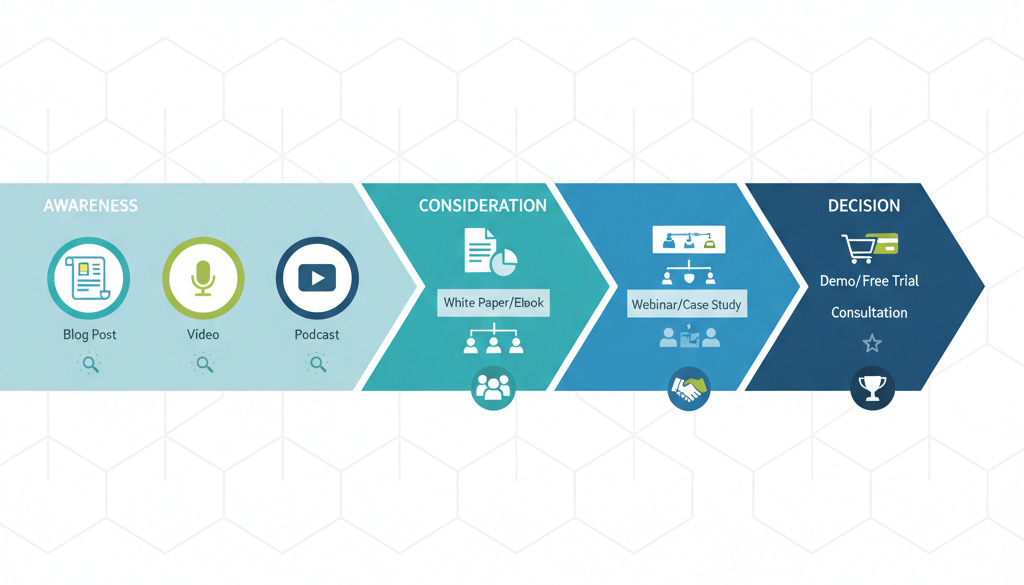
Segmentation and Personalization: Generic content often has a low ROI because it attempts to speak to everyone and resonates with no one. By developing highly specific Buyer Personas and mapping content to specific stages of the user journey (Awareness, Consideration, Decision), you increase conversion rates. Personalization—using data to recommend the right article to the right visitor at the right time—can significantly boost engagement and deal velocity.
The Art of the Content Audit and Repurposing: Many companies are sitting on a goldmine of underutilized assets. Instead of always creating new content, the highest ROI often comes from a Content Audit: identifying high-traffic but low-conversion posts and updating them with better CTAs or more current data. Repurposing is another efficiency multiplier. A single high-performing webinar can be turned into three blog posts, ten social snippets, and an infographic. This allows you to fill and dominate multiple channels with a fraction of the initial production investment.
Data-Driven Refinement: Use A/B testing for headlines, metadata, and Call-to-Action (CTA) placement. If changing a button from "Download Now" to "Get the Guide" increases conversions by 10%, you have effectively boosted your ROI with five minutes of work, proving that optimization is often about incremental gains rather than massive overhaul.

Overcoming Common Challenges in Measuring Content Marketing ROI
Despite the best frameworks, measuring content ROI remains difficult. Acknowledging these challenges is the first step toward mitigating their impact on your reporting.
- Attribution Complexity and "Dark Social": A significant portion of content sharing and consumption happens in places you can't track—private Slack groups, emails, or offline conversations. This is known as "Dark Social." While software like GA4 and CRM integrations help, marketers must accept that their data will always be a directional proxy for reality, rather than a perfect mirror of it.
- The Long Game: Content marketing is a marathon. A white paper published today might not influence a deal for six months. In cultures of "instant gratification," this can lead to premature budget cuts. Marketers must educate stakeholders on Leading Indicators (ranking improvements, newsletter growth) to show progress while waiting for the lagging indicators (revenue) to materialize.
- Lack of SMART Goals: Many content programs fail because they lack clear objectives. If the goal is "brand awareness," the metrics look very different than if the goal is "direct leads." Without Specific, Measurable, Achievable, Relevant, and Time-bound goals, your ROI calculation will lack context and purpose.
To overcome these, shift the conversation from "How much did this post make?" to "How does our content ecosystem contribute to the health of our sales pipeline over a 12-month period?"
The Evolving Landscape: Future-Proofing Your Content Marketing ROI Strategy
As we look toward the remainder of the decade, the tools and formats of content marketing are shifting rapidly. Staying ahead of these trends is vital for maintaining a competitive ROI.
AI and Machine Learning: By 2026, AI has moved beyond simple text generation to Predictive Analytics. Advanced platforms can now predict which topics are likely to yield the highest ROI based on historical performance and current market trends. This "AI-assisted strategy" allows teams to focus their resources only on content that has a high probability of conversion, dramatically increasing efficiency. However, the benchmark for success is no longer "production volume" but "citation rates" and "information gain"—metrics that prove your content offers something new that an AI can't simply replicate.
The Rise of Video and Interactive Content: Standard text-based blogs are facing stiffer competition. Video, webinars, and interactive tools (like calculators or assessments) often see much higher engagement rates. While these formats are more expensive to produce, their ability to capture attention in a noisy digital environment often leads to a superior ROI when measured against long-term conversion goals.
Integration with ABM: Content is increasingly becoming the "fuel" for Account-Based Marketing (ABM). By creating "bespoke" content for high-value accounts, marketing can support sales in winning multi-million dollar contracts. In this context, the ROI of a single, highly-targeted technical guide can be massive, as it directly influences a high-value enterprise deal.
Building a Culture of Measurement and Accountability
Ultimately, successful ROI measurement is as much about people and processes as it is about software and formulas. It requires a cultural shift within the organization to value data-driven decision-making.
Cross-Departmental Collaboration: Marketing cannot measure ROI in a vacuum. There must be a tight feedback loop between Marketing, Sales, and Product. If the sales team finds that a certain case study is their most effective closing tool, marketing needs to know so they can double down on similar content. If the product team releases a new feature, marketing must align content to drive adoption. Sharing data across these silos ensures that everyone is working toward the same revenue objectives.
Regular Reporting Cadence: ROI data should not be relegated to an annual report. Monthly performance reviews and live dashboards help the team stay agile. Seeing a real-time correlation between content updates and lead spikes keeps the team motivated and focused on high-impact tasks. Finally, Empowering the Team: Invest in training your content creators to understand the basics of analytics. When a writer understands how their work affects the bottom line, they cease to be just a "writer" and become a strategic business contributor. This accountability is the final piece of the puzzle in creating a self-optimizing content marketing engine.
Conclusion
Measuring content marketing ROI is a rigorous undertaking, but it is the only way for modern marketing leaders to secure their place as strategic partners in business growth. By establishing sound metrics, accounting for every dollar of investment, and utilizing sophisticated attribution models, you can prove the undeniable value of your content efforts.
Remember that the goal of tracking ROI is not just to justify previous spend, but to inform future strategy. Use the data you gather to eliminate waste, double down on high-performing formats, and continuously refine your message. As you implement these frameworks, you will find that content becomes more than just "brand voice"—it becomes a fundamental, predictable, and highly profitable engine for sustainable business success. Start today by auditing your current tracking capabilities and setting one SMART goal for your next campaign. The road to measurable growth begins with the first data point.
FAQ
What is content marketing ROI?
Content marketing ROI (Return on Investment) measures the profitability of your content marketing efforts. It helps you understand if the revenue generated from your content significantly outweighs the costs associated with its creation and distribution.
How can I calculate content marketing ROI?
A common way to calculate content marketing ROI is using the formula: (Revenue Generated from Content - Cost of Content) / Cost of Content * 100%. You'll need to track metrics like leads generated, customer acquisition cost, and sales influenced by your content.
What are some key metrics to track for content marketing ROI?
Key metrics include website traffic, lead generation, conversion rates, customer acquisition cost (CAC), customer lifetime value (CLTV), social engagement, and ultimately, revenue directly attributed to content marketing activities.
Keep reading
Hand-picked guides that go deeper — open the one you need next:
- AI Scalable Content Strategy for Rapid Growth
- Scale Your Business with AI: Content Marketing for Growth
- AI Keyword Research: Beyond Basic Keywords
- From Zero to Hero: Launch Your Business Blog with AI in Days
→ Read the full AI Content guide