
Conquer Google: Advanced AI SEO Article Writing Strategies

Key Takeaways
- Efficiency and Scale: AI drastically reduces the time and cost of content creation, allowing businesses to publish SEO-optimized articles consistently and at scale.
- Overcoming Hurdles: For business owners short on time or SEO expertise, AI offers a practical way to maintain a competitive online presence without a dedicated writing team.
- Human Oversight is Crucial: AI is a powerful assistant, not a replacement for human strategy. The best results come from combining AI-generated drafts with human editing for brand voice, accuracy, and unique insights.
- Strategic Implementation: Successful AI content strategy involves more than just generation. It requires solid keyword research, clear content structure, and performance measurement (ROI) to ensure articles meet business goals.
- Future of SEO: Optimizing for AI-driven search (Generative Engine Optimization or GEO) is the next frontier. Creating high-quality, well-structured content is key to being featured in both traditional search and AI-powered answers.
Understanding the SEO Content Conundrum for SMBs
In today's digital marketplace, having an online presence is not enough. To truly grow, your business needs to be visible, and the primary driver of organic visibility is high-quality, consistent content.[2] For small and medium-sized businesses (SMBs), this presents a significant challenge. SEO is no longer an optional marketing activity; it's a fundamental requirement for attracting customers who are actively searching for your products or services.
However, most business owners, particularly those over 40 who are experts in their trade but not necessarily in digital marketing, face a conundrum. You understand the importance of a blog filled with helpful, SEO-optimized articles, but you face real-world constraints:
- Time Constraints: Running a business is more than a full-time job. Finding the hours to research, write, edit, and optimize a single blog post—let alone multiple per month—is often impossible.
- Lack of In-House SEO Expertise: SEO is a complex and ever-evolving field. Understanding keyword intent, on-page optimization, and Google's algorithms is a specialized skill that most SMBs don't have in-house.
- Budget Limitations: Hiring a dedicated content team or an expensive marketing agency is not always financially feasible for a small or medium-sized enterprise.
This leads to a gap between knowing what needs to be done and having the resources to do it. The result is often an inactive blog or content that is generic and fails to attract the right audience. It doesn't just need to exist; it needs to be so good that it answers a potential customer's question completely, builds trust, and guides them toward a solution—yours. This is the critical difference between simply having content and having SEO content that converts.
The Evolution of Content Creation: From Manual to AI-Assisted
The journey of content creation for businesses has undergone a dramatic transformation. For decades, the process was entirely manual. It involved brainstorming sessions, laborious research, painstaking writing and editing, and finally, a slow publishing schedule. To scale, businesses turned to outsourcing, hiring freelance writers or agencies to shoulder the load.
While outsourcing helped with volume, it came with its own set of limitations:
- Cost: Quality writers come at a premium, and costs can quickly escalate.
- Inconsistency: Managing multiple writers can lead to a disjointed brand voice and fluctuating quality.
- Slow Turnaround Times: The back-and-forth process of assigning, drafting, reviewing, and revising can stretch for weeks.
Early attempts at automated content, known as "article spinning," produced low-quality, often unreadable text that was rightfully penalized by search engines. But today, we are in a new paradigm. The arrival of sophisticated Artificial Intelligence (AI), powered by advanced language models, has completely changed the game. AI is not just a minor improvement; it represents a fundamental shift in how we can approach content creation, offering a solution that addresses the core challenges of speed, cost, and consistency.
How AI Writes SEO Articles: The Underlying Technology
The term "Artificial Intelligence" can sound intimidating, but its application in writing is surprisingly straightforward to understand. At its core, AI-powered writing tools use a combination of Natural Language Processing (NLP) and Machine Learning (ML).[1] Think of it like a student who has studied a library larger than any that has ever existed.
Here’s a simplified breakdown of the process:
- Training on Massive Datasets: AI models are "trained" on billions of pages of text from the internet, including books, websites, articles, and research papers. This allows them to learn the nuances of grammar, style, context, and factual information.
- Understanding SEO Factors: Beyond just language, these models have also analyzed countless high-ranking web pages. They learn to recognize the patterns of successful SEO content, such as the use of headings, keyword density, internal linking, and content structure.
- Generating Human-like Text: When you provide a prompt—like "write an article about the benefits of drip irrigation for home gardens"—the AI uses its vast knowledge to generate new, original text. It predicts the most logical sequence of words to form coherent sentences and paragraphs that are relevant, readable, and optimized for your target topic. It doesn't copy-paste; it constructs content based on the patterns it has learned, allowing it to weave in target keywords naturally.
The goal of modern AI is not to create robotic text. It's to create content that is indistinguishable from, and in some cases more structured and comprehensive than, what a human writer could produce on a tight deadline.
The Core Benefits of AI for SEO Article Writing
For a busy business owner, the theoretical advantages of AI only matter if they translate into tangible business benefits. And they do. Integrating AI into your content workflow offers a powerful trifecta of advantages: speed, cost-effectiveness, and scalability.
Speed & Efficiency
Perhaps the most immediate benefit is the incredible acceleration of the content creation process. An experienced human writer might take 4-8 hours to research and write a thorough, 2000-word article. An AI can generate a well-structured first draft in minutes. This isn't about replacing the writer; it's about empowering your process. The time saved can be reinvested into strategy, editing, and promoting the content, dramatically increasing your overall marketing efficiency.
Cost-Effectiveness
Content is an investment, but AI significantly lowers the financial barrier to entry. Instead of paying per word or per article for freelance writers, investing in an AI tool or an AI-powered service provides a much more predictable and lower-cost model for generating a high volume of content. Let's compare the scenarios:
| Factor | Manual Content Creation (Freelancer) | AI-Assisted Content Creation |
|---|---|---|
| Cost per Article (2000 words) | $150 - $500+ | $5 - $30 (Tool subscription cost factored) |
| Turnaround Time | 3-7 days | Under 1 hour (including editing) |
| Volume per Month | Limited by budget (e.g., 4 articles) | High (e.g., 20+ articles for same budget) |
| Consistency | Varies by writer | Highly consistent tone and structure |
Scalability
SEO success often hinges on momentum. Publishing one article every three months is unlikely to move the needle. Search engines reward websites that consistently produce fresh, relevant content. AI makes this level of scalability achievable for any business. You can go from publishing sporadically to executing a robust content calendar with multiple posts per week, building your site's authority and expanding your digital footprint at a pace that was previously only possible for large corporations.
Keyword Research and Integration with AI Tools
Even the best-written article will fail if no one is searching for its topic. This is why keyword research remains the bedrock of any successful SEO strategy. It’s the process of finding the specific words and phrases your potential customers are typing into Google. Traditionally, this involves using complex tools and spreadsheets to analyze search volume, competition, and user intent.
AI is revolutionizing this foundational step. Modern AI platforms can:
- Augment Research: You can provide a core topic, and AI tools can generate hundreds of related long-tail keywords, questions, and subtopics that your target audience is interested in. This uncovers opportunities you might have missed.
- Analyze Competitors: Some tools can analyze the top-ranking articles for a given keyword and tell you what headings, topics, and questions they cover, providing a clear roadmap for your own content.
- Ensure Natural Integration: The most significant advantage is the AI's ability to integrate these keywords into the text. Early SEO was plagued by "keyword stuffing"—jamming a keyword into a page as many times as possible, resulting in awkward, unreadable content. Advanced AI understands context and semantics. It weaves keywords, synonyms, and related terms into the article naturally, satisfying both search engine algorithms and human readers.
Crafting Compelling Headlines and Meta Descriptions with AI
Your article could be a masterpiece, but it won't get read if no one clicks on it in the search results. Your headline and meta description are your first and only chance to earn that click. They are the sales pitch for your content, and they need to be compelling.
This is another area where AI excels. By analyzing millions of high-performing titles, AI can:
- Generate High-CTR Headlines: Give an AI a topic or a finished article, and it can suggest a dozen different headlines optimized for emotional appeal, clarity, and keyword relevance. It can craft listicle-style titles, question-based titles, and benefit-driven titles, allowing you to choose the one that best fits your audience.
- Write Persuasive Meta Descriptions: A good meta description is a concise summary (under 160 characters) that explains what the article is about and why the user should read it. AI can read your entire article and distill its essence into a perfect meta description that includes the target keyword and a clear call-to-action (e.g., "Learn more," "Discover how"), maximizing your click-through rate (CTR) from Google.
AI's Role in Structure and Readability Optimization
A giant wall of text will send visitors running. Great SEO content is easy to scan, logically structured, and provides answers quickly. AI is uniquely suited to creating content that is optimized for modern reading habits and search engine crawlers.
On-Page SEO Elements
Proper structure is a powerful signal to Google about what your content is about. AI can automatically format an article with the key on-page SEO elements in mind. This includes:
- Logical Headings: AI can organize content into a clear hierarchy with H2 and H3 subheadings. This not only helps search engines understand the main topics of your article but also allows human readers to easily scan the page and find the information they need.
- Short Paragraphs and Lists: AI models tend to generate short, digestible paragraphs and use bulleted or numbered lists. This breaks up the text, improves white space, and makes the information much easier to absorb, which increases dwell time—a key user engagement signal for SEO.
Content Depth and Relevance
Modern SEO is about satisfying user intent. When someone searches for a term, they have a question or a problem. Your content needs to provide a comprehensive answer. Because AI learns from the entire internet, it can cover a topic with impressive depth. It can identify and include all the necessary subtopics to ensure your article is a "one-stop shop" for a user's query, making it more likely that Google will see your page as the most authoritative result.
Enhancing Topical Authority with AI-Generated Content
Search engines like Google want to rank content from experts. One of the strongest signals of expertise is topical authority. This means your website has a deep and comprehensive collection of content on a specific subject. If you're a plumber, having one article about leaky faucets is good. Having 20 articles covering everything from faucet repair and water pressure to specific brands and DIY tips establishes you as an authority.
Building this authority manually is a slow, arduous process. AI makes building topical authority a core, achievable strategy. By leveraging AI's speed and scalability, you can systematically create a content plan around a central "pillar page" (e.g., "The Ultimate Guide to Home Plumbing") and support it with dozens of "cluster content" articles (the specific subtopics). This linked network of content sends a powerful message to Google that your website is a definitive source of information for your niche, boosting the rankings of all related pages.
Overcoming the "AI Sounding" Stereotype: Achieving Human-like Quality
Let's address the elephant in the room. Early AI-generated content was often clunky, repetitive, and devoid of personality. It was easy to spot because it "sounded like a robot." While some basic tools still produce this kind of content, the leading edge of AI has made quantum leaps in quality.
Modern AI models can:
- Adopt different tones (professional, witty, empathetic).
- Explain complex topics in simple terms.
- Maintain a consistent narrative flow.
However, the key to truly exceptional quality is not to rely on the AI blindly. The best practice is to treat the AI-generated text as a highly advanced first draft. Human oversight is still essential to fact-check, inject unique brand stories, add personal opinions, and refine the prose to perfectly match your brand voice. The fear of "robotic" content is only a reality if you skip this crucial final step.

AI as a Content Augmentation Tool, Not a Replacement
The rise of AI doesn't mean the end of content marketers or SEO experts. It means their roles are evolving. Viewing AI as a replacement for human expertise is a mistake. The most successful businesses are viewing it as a powerful augmentation tool—a co-pilot that handles the grunt work, freeing up human strategists to focus on higher-value tasks.
Think of the workflow this way:
- AI handles the heavy lifting: Initial research, drafting based on keyword targets, structuring the article, and optimizing for readability.
- Humans provide the strategic genius: Setting the overall content strategy, identifying unique angles, performing final fact-checking, weaving in personal anecdotes or case studies, and ensuring the content aligns perfectly with the customer journey and business goals.
This symbiotic relationship allows you to produce strategically sound, well-written, and perfectly optimized content at a scale and speed that was previously unimaginable.
Implementing AI Article Writing into Your Business Strategy
Integrating AI into your content marketing is a practical process that any business owner can undertake. It’s about being deliberate and strategic, not just flipping a switch. Here are the essential steps to get started.
- Choose the Right AI Solution: Not all AI is created equal. You can choose a hands-on AI writing tool (like Jasper or Copy.ai) that functions as a creative assistant, or you can opt for a more managed service that handles the process for you. The right choice depends on how much time you want to invest.
- Develop a Content Calendar: Don't just generate articles randomly. Start with your business goals. What do you want to be known for? What questions do your customers ask most often? Use this to build a content calendar of topics that you can then feed to your AI process.
- Create a Clear Prompting & Editing Protocol: Define how you will use the AI. Create a template for your prompts to ensure consistency. More importantly, establish a clear review and editing process. The final published piece should always have human approval.
- Set and Measure KPIs: Define what success looks like. Are you aiming for more organic traffic, higher rankings for specific keywords, or more leads from your blog? Set clear Key Performance Indicators (KPIs) and use tools like Google Analytics and Google Search Console to track your progress.
Tackling Content Creation Head-On: Expertly Crafted SEO Articles
For many overwhelmed business owners, even managing an AI tool can feel like one task too many. You know you need high-quality blog content to attract visitors from Google, but you truly have no time to dedicate to it. This is where a "done-for-you" approach becomes invaluable.
Imagine a service designed specifically for this problem. A service like 'More Customers From Your Blog' operates on a simple premise: We write the professional SEO articles for you. Instead of you having to learn to use AI, prompts, and editing workflows, you can rely on a system that combines the power of AI with expert human oversight to deliver publish-ready content. This approach is built for business owners who want the results of a powerful SEO content strategy without the steep learning curve or time investment, focusing purely on what matters most: acquiring more customers through your blog.
The Role of Human Editors and Strategists in the AI Workflow
We cannot overstate this: the final 10% of the work, done by a human, provides 90% of the unique value. An AI can write a factually correct and well-structured article about "choosing a water heater," but it can't add a paragraph about the time you helped a local family in an emergency or a specific tip you've learned from 20 years of experience in your town.
The role of the human editor and strategist is indispensable. Their tasks include:
- Fact-Checking and Accuracy: While AI is increasingly accurate, it can still make mistakes or pull outdated information. A human expert must verify every claim.
- Brand Voice and Tone Alignment: Your brand has a personality. A human editor ensures the content sounds like it comes from *you*.
- Adding Unique Insights (E-E-A-T): Google's quality guidelines emphasize Experience, Expertise, Authoritativeness, and Trustworthiness (E-E-A-T). Human experts add this by injecting real-world experience, unique opinions, and brand-specific stories that AI cannot invent.
- Strategic Goal Alignment: Does the article include a relevant call-to-action? Does it link to the right service pages? A human strategist ensures every piece of content serves a specific business purpose.
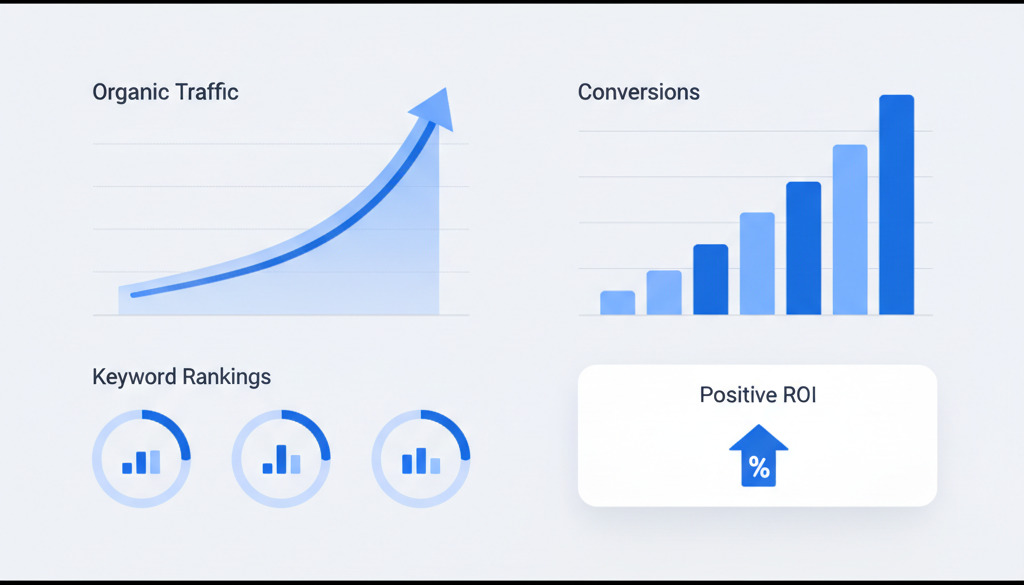
Measuring the ROI of AI-Driven SEO Content
Investing in any marketing effort requires a clear understanding of the return on investment (ROI). The impact of your AI-assisted content strategy is highly measurable. You need to look beyond vanity metrics and focus on data that ties directly to business growth.
Key metrics to track include:
- Organic Traffic Growth: Is your website getting more visitors from search engines month-over-month? Use Google Analytics to monitor this trend.
- Keyword Ranking Improvements: Are you ranking higher for your target keywords? Use a tool like Google Search Console to see which queries are driving traffic to your new articles.
- Lead Generation: How many visitors from your blog posts fill out a contact form, make a phone call, or sign up for your newsletter? This is where content turns into potential revenue.
- Conversion Rate: Of the leads generated, how many become paying customers? This is the ultimate measure of ROI.
By consistently producing high-quality, optimized content with AI, you create a long-term asset. An article you publish today can continue to attract customers for years to come, steadily reducing your average customer acquisition cost and building a sustainable pipeline of organic leads.
Your Shortcut to Google Visibility: AI-Written Blog Posts in Minutes
The true power of AI lies in its ability to provide a shortcut to visibility. What once required weeks of effort can now be accomplished in a remarkably short time. For businesses that feel left behind in the digital race, this is a chance to catch up and compete.
Imagine a system where professional SEO blog articles appear on your website in minutes—almost like magic. That’s the promise of a dedicated AI content service. By leveraging proprietary artificial intelligence, it’s possible to create a steady stream of content so that customers find you naturally through Google search, without you having to become an SEO expert yourself.
This isn't just about creating content; it's about creating a presence. It’s about showing up when and where your customers are looking, establishing your authority, and building the trust that turns a searcher into a customer.
Common Pitfalls to Avoid with AI Content Creation
While AI is a powerful tool, it's not a magic wand. There are common mistakes that can undermine your efforts and lead to poor results. Being aware of these pitfalls is the first step to avoiding them.
- Publishing Without Editing: Never copy, paste, and publish. The raw output from an AI lacks brand voice, may contain inaccuracies, and is missing the human touch that builds trust.
- Ignoring Keyword Strategy: Generating content without targeting specific, relevant keywords is like shouting into the void. Your strategy must be anchored in what your customers are actually searching for.
- Creating Generic, Soulless Content: Your content should reflect your unique business. If it could be published on any competitor's site, it's not good enough. Use AI for the foundation, but build upon it with your own expertise and personality.
- Failing to Update and Refresh: SEO is not a "set it and forget it" activity. Use AI to help you update old posts with new information to keep them relevant and maintain their rankings.
The Future of AI in SEO and Content Marketing
The integration of AI into search is only just beginning. We are moving beyond traditional SEO into what some experts call *Generative Engine Optimization (GEO)* or *Answer Engine Optimization (AEO)*. This means optimizing your content to be the source for AI-powered search results, like Google's AI Overviews.
What does this mean for you? It means that high-quality, well-structured, and authoritative content is more important than ever. AI-powered search engines will look for the clearest, most comprehensive, and most trustworthy sources to answer user queries. By using AI to build a deep library of expert content now, you are future-proofing your business and positioning it to be a primary source in the next generation of search.
We can also expect AI to enable hyper-personalization, where content on your site could adapt to individual visitors. The one constant is that the relationship between human creativity and AI efficiency will continue to deepen, creating incredible opportunities for businesses willing to adapt.
Starting Your AI Content Journey: A Practical First Step
Reading about these strategies is one thing; implementing them is another. The best way to understand the power of AI-assisted content is to see it in action. For many business owners, the fear of the unknown or the cost of a new tool can be a barrier. That’s why trying a solution with a low-risk entry point is the perfect first step.
Many services recognize this, offering a direct and tangible way to experience the benefits. Consider that more than 500 companies are already using systems that leverage AI to create SEO content. You can join them and see the impact on your own business. Look for offers where you can get started for free, such as services that provide your first few posts at no charge. For instance, with some platforms, your first 5 blog posts are free. This is your opportunity to gain a foothold online and start attracting the customers you've been missing, without any upfront investment.
Conclusion
For the modern small and medium-sized business owner, the demand for consistent, high-quality content can feel like an insurmountable obstacle. You have a business to run, and becoming a part-time SEO expert and content writer is simply not a viable option. Artificial intelligence provides a powerful, practical, and transformative solution.
By leveraging AI, you can drastically reduce the time and cost associated with content creation, scale your publishing efforts to build topical authority, and compete for visibility on Google. It’s a tool that levels the playing field, allowing you to overcome the barriers of time, expertise, and budget.
Remember, the most effective approach is a partnership between AI and human intelligence. Use AI to handle the scale and speed, and apply your human expertise to add the strategy, personality, and trust that will ultimately win over your audience. It's time to stop letting content be a roadblock and start using it as your most powerful engine for growth. Explore an AI solution today and take the first step toward conquering Google's first page.
Frequently Asked Questions
- 1. Will Google penalize my website for using AI-generated content?
- No. Google has been clear that its focus is on the quality of the content, not how it is produced. As long as the content is original, helpful, accurate, and created for people (not just for search engines), it is perfectly acceptable. The key is to use AI to create high-quality content and always have human oversight to edit and add value.
- 2. Do I still need an SEO expert if I use AI for writing?
- Yes, for the best results. While AI can handle content generation and basic optimization, an SEO expert or strategist is crucial for higher-level tasks. This includes in-depth keyword research, competitive analysis, technical SEO, backlink building, and measuring performance to ensure the content strategy is meeting business goals.
- 3. How much does AI article writing cost?
- The cost varies. Subscribing to a do-it-yourself AI writing tool can range from $30 to $100+ per month, depending on the features and volume. A "done-for-you" service, where a company manages the entire AI and editing process for you, will have a different pricing structure, often based on the number of articles per month, but saves you significant time.
- 4. Can AI really match the expertise of a human writer in my industry?
- AI can write with a high degree of factual accuracy based on the data it was trained on. However, it cannot replicate true, first-hand experience. It can explain how a furnace works, but it can't share a story about a unique repair job you did last winter. That's why the best workflow involves using the AI-generated text as a foundation and having a human expert (you or an editor) add that invaluable layer of real-world experience and E-E-A-T (Experience, Expertise, Authoritativeness, Trustworthiness).
- 5. How quickly can I expect to see results from AI-generated SEO articles?
- SEO is a long-term strategy. While AI can help you produce content much faster, it still takes time for Google to crawl, index, and rank your new pages. You might see some initial movement in a few weeks, but significant results—like consistent first-page rankings and a steady flow of organic traffic—typically take 6-12 months of consistent effort.
Keep reading
Hand-picked guides that go deeper — open the one you need next:
- Volteruno vs. Freelance Writers: The Cost-Effective Path to SEO Success
- Dominate Local Search: AI & Google My Business SEO
- Multilingual Content SEO AI: A Guide to Global Search Success
- Truth About AI SEO Ranking Guarantees: Experts Guide