
Mastering On-Page SEO: AI for Headlines, Meta Descriptions
Key Takeaways
- AI is a powerful ally for on-page SEO, automating and enhancing tasks like keyword research, content creation, and technical optimization.
- For busy business owners, AI tools can save dozens of hours per month while producing high-quality, search-engine-optimized content.
- Effective AI use involves more than just content generation; it includes optimizing for user experience, internal linking, and readability.
- The future of SEO, influenced by AI-driven search, is about becoming a citable, authoritative answer, a practice known as Answer Engine Optimization (AEO).
- While AI is a transformative tool, human oversight is crucial to maintain brand voice, ensure factual accuracy, and make strategic decisions.
- Solutions like "More Customers From Your Blog" are designed specifically to help businesses harness AI, offering a way to generate professional SEO articles in minutes.
As a business owner, you wear many hats. You're the CEO, the head of sales, the customer service manager, and often, the chief marketer. The challenge is that while you know having a strong online presence is critical, finding the time to consistently write, optimize, and publish blog articles can feel impossible. What if you could reclaim those hours and still climb the Google rankings? The solution is no longer a distant sci-fi concept; it's here today, and it’s called Artificial Intelligence.
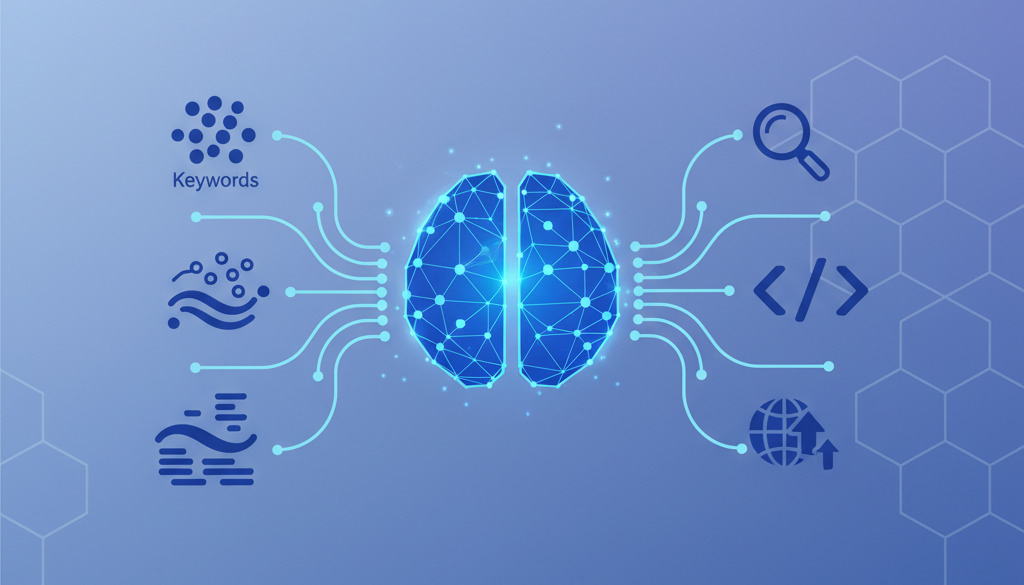
This article will demystify AI for on-page Search Engine Optimization (SEO).[1] We will explore, step-by-step, how you can leverage this incredible technology to create better content, optimize your website more effectively, and ultimately attract more customers through search engines—all without needing a technical background or a huge time commitment.
1. Understanding On-Page SEO in Today's Digital Landscape
Before we dive into the role of AI, it’s essential to have a clear understanding of on-page SEO. Simply put, on-page SEO involves all the actions you take directly on your website to improve its position in search engine rankings. This is different from off-page SEO, which involves external signals like backlinks from other sites.
Core Components of On-Page SEO
The main pillars of on-page SEO include:
- Content Quality: The information on your page and whether it thoroughly answers the searcher's query.
- Keyword Optimization: Using the right keywords in your titles, headings, and body text so Google understands what your page is about.
- Website Structure: Elements like titles, meta descriptions, headings (H1, H2, etc.), and internal links that create a logical and crawlable hierarchy.
- User Experience (UX): Factors like page speed, mobile-friendliness, and readability, which keep visitors engaged.
Why It Still Matters
Even as Google's algorithm becomes more complex with AI, on-page SEO remains the foundation of visibility. As recent studies from 2026 show, the goal is shifting from just ranking in a list of links to being included in AI-generated answers, or "AI Overviews." To be chosen for these prominent spots, your content must be clear, well-structured, and authoritative—all hallmarks of excellent on-page SEO.
The traditional challenge has always been the immense effort required. It demands research, writing skill, technical know-how, and, most importantly, time. For many business owners, this is the biggest barrier to success.
2. The Rise of Artificial Intelligence in Content Creation and Optimization
Artificial Intelligence is no longer just a buzzword; it’s a practical business tool. At its core, AI for content involves using sophisticated programs that can understand and process language, analyze massive datasets, and generate human-like text. It's like having a brilliant, tireless assistant who can research and write at superhuman speed.
For business owners, this technology directly addresses the most significant pain points of content marketing:
- It overcomes writer's block: AI can generate outlines, drafts, and ideas in seconds.
- It saves time: It automates the most time-consuming parts of research and writing.
- It improves quality: AI can analyze top-ranking content and help you create something even more comprehensive.
When applied to on-page SEO, AI becomes a surgical tool. It moves beyond just writing to actively optimizing every element of a page for maximum search engine visibility and reader engagement.
3. How AI Revolutionizes Keyword Research for On-Page Success
Keyword research is the bedrock of any successful SEO strategy. Traditionally, this involved using tools to find popular search terms. AI takes this process to a much more sophisticated level, giving you a significant competitive advantage.
Beyond Basic Keywords
AI doesn't just find keywords; it helps you understand the intent behind them. It can identify long-tail keywords—longer, more specific phrases that users type when they are closer to making a purchase—which often have lower competition and higher conversion rates.
Uncovering Semantic Keywords
Search engines now prioritize topic authority. To rank well, you need to cover a topic comprehensively. AI tools are brilliant at finding semantic keywords and related concepts. For example, if your main keyword is "home water filter," AI might suggest also including terms like:
- "under sink water filtration systems"
- "benefits of filtered tap water"
- "how to replace water filter cartridge"
- "hard water vs. soft water"
By including these related terms, you signal to Google that your article is a thorough resource, deserving of a top spot.
Analyzing the Competition
AI can instantly analyze the top-ranking pages for your target keywords and show you exactly which terms they are using, how their content is structured, and where there are gaps you can fill. This allows you to create content that is not just as good as the competition, but objectively better.
4. AI-Powered Content Generation: Crafting SEO-Optimized Articles Effortlessly
Here is where AI truly becomes a game-changer for the time-strapped business owner. While many tools can generate text, some platforms are built specifically to handle the entire SEO article creation process from start to finish. This is where a fully integrated solution can make all the difference.
For instance, services like More Customers From Your Blog are designed for this exact purpose. Their proprietary AI is engineered to produce professional, SEO-ready blog posts in a matter of minutes, taking the heavy lifting completely off your plate.
From Idea to Published Post in Minutes
The process is designed for simplicity, perfect for those who aren't tech-savvy. Typically, you would:
- Provide a topic or keyword: Tell the AI what you want to write about.
- Set some basic parameters: You might specify the tone of voice or target audience.
- Generate the article: The AI researches the topic, identifies relevant keywords, structures the article with headings and lists, and writes the full text.
The result is a comprehensive, optimized article that is ready to be published on your blog. For busy owners, this means you can go from having zero content ideas to a fully written post in less time than it takes to drink your morning coffee. This overcomes writer's block, ensures consistent quality, and, most importantly, frees you to focus on running your business.
5. Optimizing Existing Content with AI Assistance
SEO isn't just about creating new content; it's also about making your existing pages work harder for you. Your website might have dozens of older blog posts that are underperforming. AI provides an efficient way to breathe new life into them.
Conducting an SEO Content Audit
AI tools can crawl your entire website and analyze each page for SEO weaknesses. They can identify articles that:
- Are missing important keywords.
- Have poor readability scores.
- Lack sufficient topic depth compared to current top-ranking pages.
- Are outdated and contain information that is no longer accurate.
Getting Actionable Suggestions
Once the analysis is complete, the AI can provide specific, actionable recommendations. For example, it might suggest adding a section on a particular sub-topic, incorporating a list of statistics to add authority, or rewriting a complex paragraph to be more easily understood. This allows you to make high-impact improvements without having to guess what needs fixing.
6. The Role of AI in Crafting Compelling Meta Titles and Descriptions
Your meta title and meta description are your website’s "storefront" in search results. They are the first things a potential customer sees, and their quality directly impacts whether someone clicks on your link or a competitor's. A high click-through rate (CTR) signals to Google that your page is a good match for the query, which can boost your rankings.
Generating High-CTR Variations
Writing compelling meta tags is an art, but AI turns it into a science. An AI tool can generate dozens of different titles and descriptions for a single page in seconds. It can A/B test different approaches:
- Benefit-Oriented: "Save 20% on Your Energy Bill with a Smart Thermostat"
- Question-Based: "Tired of High Energy Bills? A Smart Thermostat Could Help"
- Direct and Keyword-Focused: "The Best Smart Thermostats of 2026: A Complete Review"
By analyzing data on which formats get the most clicks for similar topics, AI can predict which variations are most likely to succeed, removing the guesswork and improving your CTR.
7. Enhancing User Experience (UX) with AI-Driven On-Page Strategies
Google has made it clear: it wants to rank websites that provide a great experience for users. Factors like how long visitors stay on your page (dwell time) and whether they leave immediately (bounce rate) are critical ranking signals. AI can help you optimize for the human user, not just the search engine algorithm.
Analyzing User Behavior
By integrating with your website analytics, AI can identify patterns in user behavior. It might discover that users who land on a specific page tend to leave without visiting any other pages. This could indicate a problem with the content or a lack of clear next steps. The AI could then suggest adding a compelling call-to-action or creating internal links to related, helpful articles to keep the user engaged.
Ensuring Accessibility
A good user experience is an accessible one. AI can help identify UX issues that affect users with disabilities, such as missing image alt text or color contrast problems, helping you create a website that is welcoming to everyone while also scoring technical SEO points.
8. AI for Internal Linking: Building a Stronger Website Architecture
Internal links are links that point from one page on your website to another. They are incredibly important for SEO for two main reasons: they help Google understand the relationship between your pages and establish topic authority, and they guide users to more relevant content, keeping them on your site longer.
Identifying Strategic Linking Opportunities
For a site with hundreds of pages, manually finding the best internal linking opportunities is a monumental task. AI automates this process. It can scan a new blog post you’ve written and instantly suggest a list of older, relevant articles on your site that you should link to. It can also do the reverse, finding older articles where you can add a link to your new post.
Optimizing Anchor Text
The clickable text of a link, known as anchor text, is a small but important ranking signal. AI can suggest anchor text that is both descriptive for the user and rich with relevant keywords for search engines. For example, instead of generic text like "click here," an AI might suggest "learn more about our under-sink water filtration systems," providing much better context.

9. Image Optimization: Leveraging AI for Faster Load Times and Better Visibility
Images are essential for making your content engaging, but large, unoptimized image files are one of the biggest causes of slow page load speeds. A slow website frustrates users and hurts your rankings. AI offers a simple solution.
Automated Image Compression
Modern AI tools can automatically compress every image you upload to your website, significantly reducing its file size without any noticeable loss in visual quality. This process happens in the background, ensuring your site stays fast and responsive, which is a key factor for both desktop and mobile SEO.
Generating Descriptive Alt Text
Alt text (alternative text) is the description of an image that is used by screen readers and search engines. It’s crucial for accessibility and helps Google understand the context of your images. Writing unique alt text for every image can be tedious, but AI can now do it for you. By analyzing the image, AI can generate a descriptive, keyword-rich alt tag, such as "a residential kitchen with a newly installed under-sink water filter."
10. AI and Readability: Making Your Content Accessible to Everyone
If your audience can't easily understand your content, they won't stay to read it. Readability is a measure of how easy your text is to comprehend. For most business blogs, aiming for a 7th-9th grade reading level is a good practice to ensure you reach the widest possible audience. This is especially true for busy readers who are skimming for information.
Analyzing for Clarity and Simplicity
AI can instantly analyze your writing and flag common readability issues, such as:
- Overly long or complex sentences: It can suggest splitting them into shorter, more digestible ones.
- Use of passive voice: It will recommend changing "The ball was hit by John" to the more direct "John hit the ball."
- Excessive jargon: It can highlight industry-specific terms that may confuse a general audience and suggest simpler alternatives.
By using AI as an editing assistant, you can ensure your message is clear, direct, and engaging, which keeps people on your page longer and sends positive signals to search engines.
11. Structuring Content for SEO and Reader Engagement with AI
A giant wall of text is intimidating. Proper structure, using headings and subheadings, makes your content scannable and helps both users and search engines quickly grasp the main points of your article. Your main title should be an H1 tag, with main sections using H2 tags and subsections using H3 tags.
Creating a Logical Hierarchy
When you give an AI a topic, it doesn't just write paragraphs; it can generate a complete, logical outline. It understands how to break a broad topic down into a series of H2 and H3 headings that flow naturally from one to the next. This creates a well-organized article that’s easy for readers to follow and simple for Google to index.
Crafting Keyword-Rich Headings
Your headings are prime real estate for keywords. AI can help you write headings that are not only clear and engaging for a human reader but also contain the primary and secondary keywords you are targeting. This is a fundamental aspect of on-page SEO that AI excels at automating.
12. AI-Powered Content Updates and Repurposing Made Simple
The "publish and forget" approach to blogging is no longer effective. SEO requires that your content remains fresh, accurate, and relevant. This is often referred to as content refreshing.
Identifying Outdated Content
AI can monitor your website’s content and flag articles that are becoming stale. It might identify content with declining traffic or articles that contain information that is now several years old. For example, it could flag a "Best of 2024" article in the year 2026, prompting you to update it.
Assisting with Rewrites and Expansion
Once an article is identified for an update, AI can assist in the rewriting process. It can help you expand sections, add new, relevant information that has emerged since the original publication, and check for any outdated statistics or broken links. It can also help you repurpose a successful blog post into other formats, such as a script for a video, social media posts, or a downloadable checklist.
13. Potential Pitfalls and Ethical Considerations When Using AI for On-Page SEO
While AI is a powerful tool, it's not a magic bullet. Using it effectively requires awareness of its limitations. Blindly publishing AI-generated content without review can lead to problems.
The Need for a Human Touch
AI-generated content can sometimes be generic or lack the unique brand voice and perspective that sets your business apart. It’s crucial to treat the AI's output as a first draft. Always read through it, edit it to match your company's tone, inject your own experiences and anecdotes, and verify any facts or statistics it presents.
Think of AI as your co-pilot, not the pilot. You are still in command of the strategy and the final product.
Avoiding Over-Optimization
Because AI is so good at identifying keywords, there can be a temptation to stuff them unnaturally into the text. This practice, known as keyword stuffing, creates a poor reading experience and can get your site penalized by Google. Always prioritize writing for humans first; the SEO benefits will follow naturally when the content is helpful and well-written.
14. Measuring the Impact: How to Track Your AI-Optimized On-Page SEO Performance
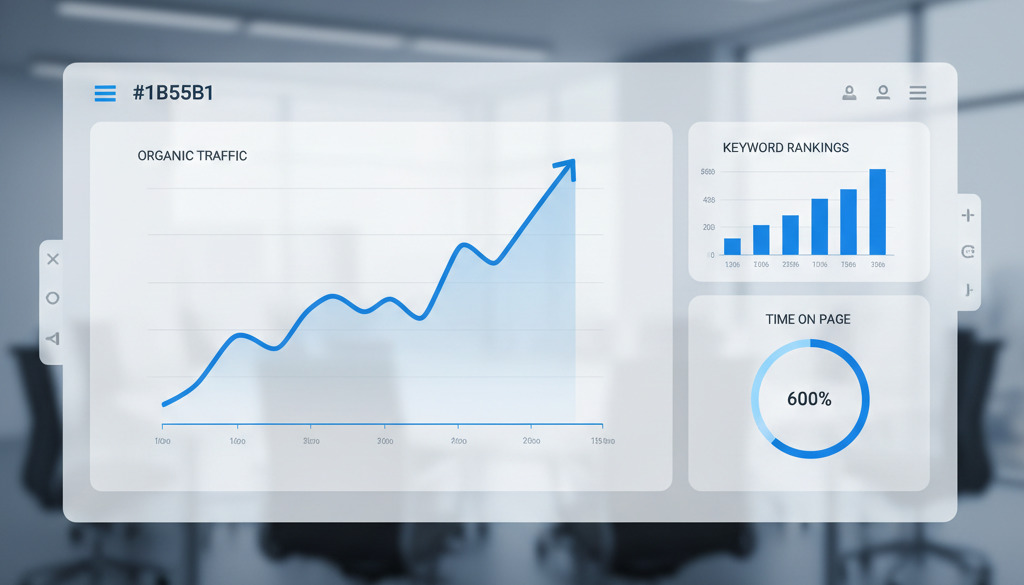
Implementing AI-driven strategies is only half the battle. You need to measure the results to understand what’s working and where you can improve. Focusing on a few key performance indicators (KPIs) will tell you if your efforts are paying off.
Key Metrics to Monitor
Using a free tool like Google Analytics, you should track the following metrics for the pages you optimize:
- Organic Traffic: An increase in visitors coming from search engines is the clearest sign of success.
- Keyword Rankings: Use a tool (or Google Search Console) to track your position for your target keywords. Are you moving up from page 3 to page 1?
- Click-Through Rate (CTR): A higher CTR indicates that your AI-optimized titles and descriptions are effectively attracting clicks.
- Time on Page: If this number is increasing, it means your content is engaging and readable.
To illustrate the potential impact, consider this sample data for a blog post before and after an AI-powered refresh:
| Metric | Before AI Optimization | After AI Optimization | Change |
|---|---|---|---|
| Monthly Organic Visitors | 150 | 950 | +533% |
| Average Keyword Ranking | #28 | #6 | +22 positions |
| Average Time on Page | 0:45 | 2:30 | +233% |
By regularly reviewing this data, you can refine your AI prompts and optimization strategies to continuously improve your results.
15. Future Trends: What's Next for AI in On-Page SEO?
The world of AI and search is evolving rapidly. While today’s tools are already impressive, the future holds even more exciting possibilities. The conversation is shifting towards new concepts like Generative Engine Optimization (GEO) and Answer Engine Optimization (AEO).
As industry experts noted in early 2026, the future of SEO isn't just about ranking higher; it's about becoming the answer. Visibility will depend less on your page's position and more on whether your brand is cited within AI-generated responses.
This means the on-page SEO work you do today—creating clear, authoritative, well-structured content—is the perfect foundation for this new reality. In the near future, AI will likely become even more proactive, capable of personalizing content for individual website visitors in real-time and automatically fixing SEO issues before they can negatively impact your traffic.
16. Getting Started with AI on-Page SEO: A Practical Approach for Business Owners
You don’t need to be a tech expert to get started. The key is to choose tools and services that are built for users like you. The goal is to save time and get better results, and the right solution makes this incredibly straightforward.
For many small and medium-sized business owners, the most effective first step is to automate the most time-consuming task: writing blog posts. This is where a dedicated service can provide an immediate return on investment. For example, a platform like More Customers From Your Blog is designed to be as simple as possible. Their proprietary artificial intelligence writes professional SEO blog articles for your website in minutes—it can feel like magic when customers start finding you on their own in Google.
With a user base of over 500 companies, these specialized tools are proving their value. Many even offer a way to get started without any risk. For example, the offer to receive your first few posts for free provides a perfect opportunity to see the quality for yourself and experience the time-saving benefits firsthand.
Conclusion
AI for on-page SEO is more than just a trend; it's a fundamental shift in how we approach digital marketing. It levels the playing field, allowing busy business owners to compete with larger companies by producing high-quality, optimized content efficiently and at scale.
By embracing AI as your assistant, you can take control of your content strategy, save invaluable time, and turn your website into a powerful engine for attracting new customers. The technology is here, it’s accessible, and it’s ready to go to work for your business.
Frequently Asked Questions
1. Will Google penalize my website for using AI-generated content?
No. Google's official stance is that they reward high-quality content, regardless of how it is produced. Their focus is on content that is helpful, reliable, and people-first. As long as you are using AI to create original, valuable content and not to manipulate rankings with spam, it is perfectly acceptable. The key is to use AI as a tool and always edit and review for quality and accuracy.
2. Do I need technical skills to use AI for SEO?
Absolutely not. The best AI tools and services, especially those designed for business owners, feature user-friendly interfaces that are very intuitive. If you can write an email, you can use these platforms. The goal of these services is to simplify SEO and content creation, not to add another layer of technical complexity.
3. How is this different from just using a tool like ChatGPT?
General AI chatbots like ChatGPT are powerful but require significant skill in "prompt engineering" to produce good SEO content. You have to tell it exactly how to do keyword research, structure the article, and what tone to use. Specialized SEO-AI services, like the "More Customers From Your Blog" platform, have this expertise built-in. Their AI is pre-trained on SEO best practices, so it handles the complex parts automatically, delivering a much more polished and optimized final product with less effort.
4. Can AI really capture my business's unique voice?
On its own, AI will produce a generic-sounding voice. This is why human oversight is critical. The best practice is to take the 80-90% completed draft from the AI and spend a few minutes editing it. Add your own stories, customer examples, and specific brand terminology. This combination of AI efficiency and human touch gives you the best of both worlds: fast content creation that still sounds authentically like you.
5. How much time can I realistically save?
The time savings are substantial. Manually writing a well-researched, 2000-word blog post can take anywhere from 6 to 10 hours. Using an AI-powered content service, you can generate a high-quality first draft in about 5-10 minutes. Even with another 30-60 minutes for editing and personalization, you are reducing the total time commitment by over 90%. For a business publishing just one article a week, this can free up more than 30 hours per month.
Keep reading
Hand-picked guides that go deeper — open the one you need next:
- Beyond Keywords: Advanced AI SEO Strategies
- AI Keyword Research: Unlock Hidden Opportunities
- Boost Your Google Rankings: AI for SEO Optimization Explained
- Volteruno vs. Freelance Writers: The Cost-Effective Path to SEO Success