
AI Content Keyword Research: The 2026 Strategy Guide

The traditional pillars of SEO are undergoing a seismic shift. For decades, keyword research was a grueling manual process: exporting massive CSV files, painstakingly filtering through "near-match" phrases, and guessing the intent behind vague search terms. In today’s digital ecosystem—where Google’s AI Overviews take up significant "pixel rank" and zero-click searches are the norm—the old methods are no longer sufficient.
AI content keyword research represents the next evolution of search strategy.[1] By leveraging Large Language Models (LLMs) and advanced data processing, marketers can now move beyond simple volume metrics to uncover the "why" behind a search. This approach doesn't just find words; it identifies the topical authority required to rank in a world where AI-generated summaries often push traditional organic results below the fold. For business owners and SEO professionals, mastering this new paradigm is the difference between visibility and digital obsolescence.
The Fundamental Principles of AI-Powered Keyword Discovery
At its core, AI-powered keyword discovery is built on the foundation of Natural Language Processing (NLP) and machine learning. Unlike legacy tools that rely on exact-string matching, AI algorithms can interpret the relationship between words. They process vast datasets to identify patterns that escape human analysis, such as the correlation between a specific long-tail query and a high-intent commercial action.
The shift is primarily from keywords to entities. In the AI era, search engines and research tools look at a primary topic and all the surrounding concepts that give it context. For example, if you are researching "cloud security," an AI tool won't just suggest "cloud security software." It will analyze search result pages (SERPs) and user behavior to suggest related entities like "zero-trust architecture," "SASE," and "identity access management." This scale of analysis—evaluating thousands of SERPs simultaneously—allows marketers to build a comprehensive data-backed map of a niche in minutes rather than weeks.
Harnessing AI for Advanced Search Intent Analysis
Understanding search intent is no longer about categorizing keywords as "informational" or "transactional." AI tools now provide a granular look at the user’s psychological state. By analyzing the content types that Google prefers for specific queries, AI can determine if a user is looking for a deep-dive whitepaper, a quick comparison table, or a video tutorial.
This nuance is critical because Google has moved toward "satisfying" the searcher within the interface. AI-driven intent analysis helps creators understand the missing pieces in the current SERP. If the top results for a query all ignore a specific pain point, AI identifies that gap, allowing you to create content that serves a "hidden" intent that competitors have overlooked.
Differentiating Subtleties: AI’s Role in Decoding Long-Tail and Question-Based Queries
Long-tail keywords often contain the highest conversion potential, yet they are notoriously difficult to track due to low individual volume. AI excels at grouping thousands of these low-volume, high-intent questions into manageable themes. By using NLP to decode the "semantic core" of questions starting with "how," "why," and "can I," AI allows brands to own the conversational space that powers voice search and AI chat interfaces like ChatGPT and Perplexity.
AI-Driven Competitive Keyword Intelligence
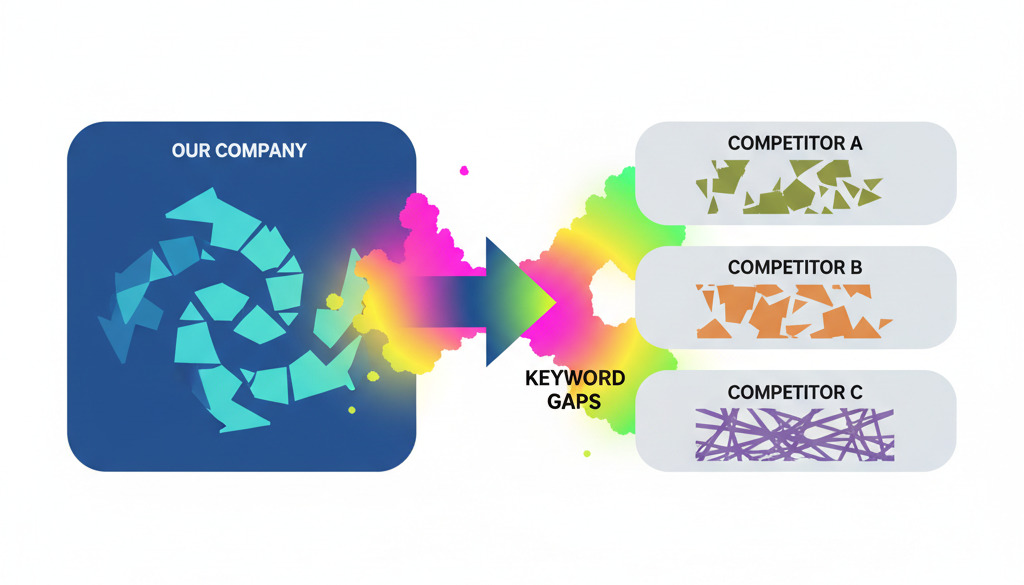
In 2026, competitive intelligence is about more than just seeing what keywords a rival ranks for.[2] AI tools now perform "gap analysis" at the topical level. By scraping and analyzing the entire content library of a competitor, AI can predict their content roadmap and identify areas of "authority decay"—topics where their content is outdated or no longer aligns with the latest search signals.
Furthermore, AI allows for real-time tracking of competitor SERP volatility. Instead of waiting for a monthly report, AI-driven suites can alert you the moment a competitor gains traction with a new topic cluster. This enables a proactive "fast-follower" strategy or a "pre-emptive" content strike to maintain market share. This level of intelligence effectively turns SEO from a reactive game into a strategic chess match.
Leveraging AI for Topic Clustering and Content Siloing
Content siloing is a powerful SEO technique, but manually organizing 500 keywords into logical hierarchies is prone to human error. AI simplifies this by using clustering algorithms. It identifies semantic proximity—how closely related two terms are in the eyes of an LLM—and automatically suggests a "Pillar and Cluster" framework.
Using AI for clustering ensures that your internal linking structure is mathematically optimized for crawlability and authority distribution. When you group content into these AI-verified silos, you signal to search engines that your site is a comprehensive resource on a subject, which is a key factor in surviving updates that prioritize "Helpful Content" and E-E-A-T (Experience, Expertise, Authoritativeness, and Trustworthiness).
The Synergy: AI for Keyword Grouping and Pillar/Cluster Content Strategy
The real power of AI lies in its ability to predict which "cluster" will provide the most significant lift to a "pillar" page. By analyzing internal link equity and external backlink patterns, AI can recommend exactly which sub-topics need more coverage to "break through" into the top 3 results for a high-competition keyword. This turns content production into an engineering problem rather than a creative guessing game.
Uncovering Emerging Trends and Predictive Keyword Analysis with AI
Traditional keyword tools are historical; they show you what happened last month. AI-powered research is predictive. By monitoring social media trends, news cycles, and patent filings, modern AI tools can forecast "breakout" keywords before they reach peak search volume.
For businesses in fast-moving sectors like technology or finance, this "first-mover advantage" is invaluable. AI can detect a 5% increase in interest for a specific niche term across specialized forums and predict its mainstream adoption. By the time the keyword shows up in standard tools with high volume, your content is already indexed and ranking, effectively capturing the traffic at its lowest acquisition cost.
The Role of AI in Optimizing Keyword Difficulty and Search Volume Accuracy
The standard "Keyword Difficulty" (KD) score is often a blunt instrument, usually based solely on backlink counts. AI provides a "Real-World Difficulty" assessment by factoring in content quality, brand authority of current rankers, and the presence of SERP features like AI Overviews. If a keyword is dominated by "zero-click" answers, an AI tool will warn you that even a #1 ranking won't yield significant traffic.
Additionally, AI refines search volume. Since Google often hides true volume behind ranges (0-10, 10-100), AI utilizes clickstream data and historical performance across similar niches to provide a more accurate "Expected Traffic" metric. This allows for a much more precise ROI calculation before a single word of content is written.
Beyond Basic Metrics: AI’s Contribution to Real-World Keyword Performance Prediction
Modern keyword research is no longer a isolated task; it’s an integrated performance projection. AI models can now run simulations: "If we rank in the top 5 for this cluster, what is the impact on lead generation based on historical conversion rates for similar intent?" This level of business intelligence elevates the SEO professional from a "web worker" to a strategic business advisor.
Practical Implementation: Integrating AI Tools into Your Keyword Research Workflow
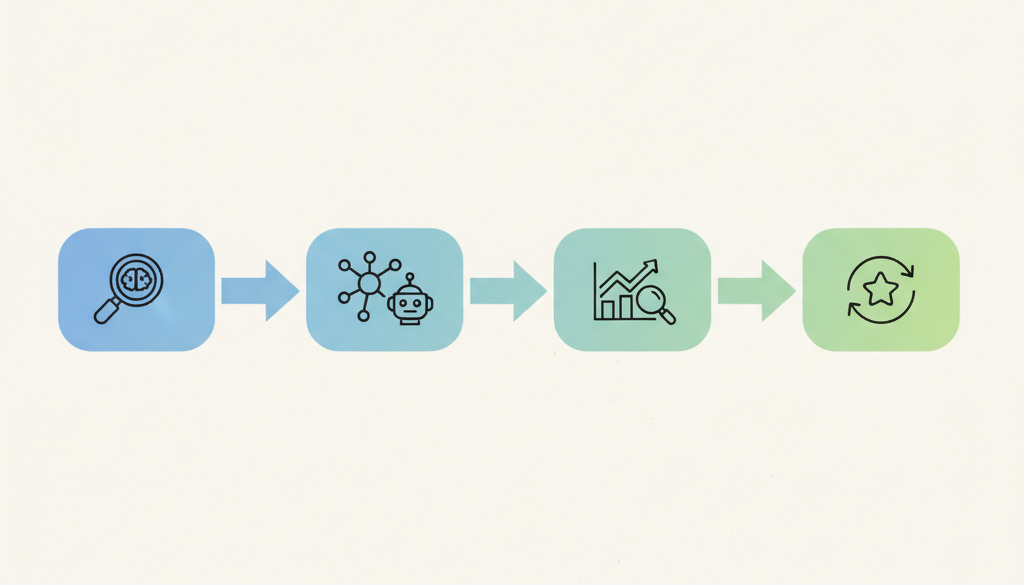
To successfully integrate AI into your workflow, you must move away from the "one-shot" prompt. Effective AI keyword research is an iterative process. Start by using an LLM to brainstorm a "seed" list based on customer pain points. Then, feed this list into a specialized SEO tool that uses AI for SERP analysis to validate the volume and difficulty.
- Discovery: Use an NLP-based tool to identify the "unspoken" questions your audience is asking.
- Validation: Cross-reference AI suggestions with hard search volume data from primary sources like Google Keyword Planner.
- Clustering: Use a clustering tool to group your list into 5-7 core themes.
- Mapping: Assign each cluster to a stage in the buyer’s journey (ToFU, MoFU, BoFU).
Tools like SE Ranking or Semrush’s AI features are excellent for tracking "AI visibility"—measuring how often your brand is cited in AI-generated answers. This is a critical new KPI for any modern content strategy.
Ethical Considerations and Limitations of AI in Keyword Research
While AI is transformative, it is not infallible. AI models are trained on historical data, which can perpetuate existing biases. If the current search results for a topic are of low quality or biased toward a specific viewpoint, the AI may suggest keywords and topics that reinforce that narrow perspective. Human oversight is mandatory to ensure that the content strategy remains original and adds "Information Gain"—a factor Google explicitly looks for.
Furthermore, there is a risk of "content homogenization." If every marketer uses the same AI tools to find the same keywords and generate the same clusters, the digital landscape becomes a sea of sameness. The most successful brands will be those that use AI for the data "heavy lifting" but apply human creativity to find the unique "hook" that makes their content stand out from the algorithmic average.
Maintaining a Human Touch: The Indispensable Role of Human Expertise
The human's role in keyword research has shifted from data gatherer to strategic curator. AI can tell you that "AI content keyword research" is a growing trend, but it cannot understand your specific brand voice or the nuances of your unique product offering. Human expertise is required to filter out irrelevant data and to inject "Experience" (the first 'E' in E-E-A-T) into the final strategy.
The Future of Content Keyword Research: AI and Beyond
Looking ahead, we are moving toward "Hyper-Personalized Keyword Research." In the future, keyword strategy may not be demographic-wide but session-specific, with AI adjusting content recommendations based on an individual user's real-time interaction history. We will also see a deeper integration between keyword research and real-time content generation, where the "keyword" effectively becomes a living prompt that updates the content as search trends shift.
The ultimate goal of AI in this field is to reach a state of "Predictive Visibility," where brands can anticipate a customer's need before the customer even knows how to phrase the query. For those who embrace these tools today, the reward is a significant competitive moat; for those who wait, the cost of catch-up may be insurmountable. The AI era of SEO isn't coming; it’s already here.
Keep reading
Hand-picked guides that go deeper — open the one you need next:
- Boost SEO: How AI Blog Writing Drives Organic Traffic
- Free AI Article Trial: Unlock SEO Growth with Volteruno
- DIY SEO Articles: Generate High-Quality Content with AI Writer
- Expand Your Reach: SEO Content in 25 Languages with AI