
Track AI SEO content ROI metrics

Are you pouring money into content? Do you actually know if it is making you money? Most business owners guess. They hope. They never truly measure, and this costs them significantly in the long run. Ignorance is not bliss when it comes to marketing; it is financial pain.[1]
But what if you could see clear dollar signs attached to your blog? What if you could prove your content works with surgical precision?
This guide shows you exactly how to navigate the complex world of content ROI metrics so you can stop wasting money and start boosting your bottom line.
- Move Beyond Vanity: Likes and shares are fine, but conversion rates and revenue per visitor are the metrics that pay bills.
- Calculate Total Investment: Include writer fees, tool subscriptions, and your own hourly value to get an accurate ROI denominator.
- Monitor the Full Funnel: Track how content influences everything from initial organic discovery to final customer acquisition (CAC).
- Leverage Automation: Using platforms like Volteruno streamlines both content creation and performance tracking for faster results.
The Pain of Unknown Content Costs: Are You Burning Cash?
Measuring content success is impossible without first identifying the hidden costs of production, which often include freelancer fees, internal staff time, and software subscriptions. When these expenses are not tracked against specific revenue outcomes, businesses risk "burning cash" on high-volume content that fails to attract qualified leads or generate measurable organic sales growth.
You feel the pressure to maintain an online presence. To keep up with the competition, you hire writers, buy expensive SEO tools, and spend hours every week managing your editorial calendar. You publish articles regularly on your Shopify or WordPress site, hoping for a breakthrough. But then... silence. No flood of new customers, no jump in sales. You just spent time and money, and it feels like throwing coins into a dark well where you get no echo back.
This uncertainty is more than just annoying; it is stressful. It robs you of your comfort and makes you fear falling behind competitors who seem to have cracked the code. Are your efforts actually working, or are you just staying busy? This is the pain of unknown content costs. To find relief, you must move toward a model of absolute clarity where every piece of content has a financial purpose.
Next Action: Think about your last three content projects. How much did they really cost? Add up the freelancer fees, the cost of tools, and the value of your own time spent editing.
Your Deepest Desire: Content That Fuels Growth, Not Drains Pockets
The ultimate goal of a content strategy is to transform a cost center into a profit engine by creating high-value assets that consistently convert visitors into paying customers. By focusing on growth-oriented metrics, you ensure that your website traffic isn't just a number, but a predictable pipeline for lead generation and brand authority development.
Imagine a scenario where every piece of content you publish brings in new leads and turns visitors into buyers. Your website traffic doesn't just increase; it soars with the right kind of people. This isn't a pipe dream; it is what happens when content works for you rather than against you. It is about seeing actual money return on your investment. You want your marketing to provide freedom—freedom from low sales and freedom from the anxiety of uncertainty.
Content ROI metrics show you the path. They reveal which topics are magnets for high-value customers and which ones are simply fluff. When you align your content with a Shopify AI strategy, you can automate the growth process, allowing your blog to generate sales while you focus on other aspects of your business. This level of success provides the tangible proof you need to scale your operations confidently.
Next Action: What is the ONE main goal you want your content to achieve? Is it more direct sales, more email sign-ups, or better brand authority? Define it clearly.
Forget Vanity Metrics: Focus on These 7 Profit-Driven Content KPIs
To truly understand content performance, you must prioritize profit-driven Key Performance Indicators (KPIs) such as Conversion Rate, Cost Per Lead (CPL), and Customer Acquisition Cost (CAC) over "vanity metrics" like social shares or raw pageviews. Profit-driven KPIs provide a direct link between your content efforts and the financial health of your business, enabling better budget allocation.
Many marketing reports focus on likes and shares because they look good in a presentation. However, these figures don't pay the bills. To build a sustainable business, you need metrics tied directly to revenue. These KPIs guide your decisions and show you the real return on your efforts. If you are looking to automate e-commerce for more sales, you must track the following seven metrics religiously:
| Metric Name | Data Source | Business Purpose | Ideal Trend |
|---|---|---|---|
| Conversion Rate | Google Analytics | Measures sales effectiveness | Increasing % |
| Cost Per Lead (CPL) | CRM / Ads Manager | Measures lead gen efficiency | Decreasing $ |
| Revenue Per Visitor | E-commerce Dashboard | Measures traffic quality | Increasing $ |
| Organic Traffic | Search Console | Measures SEO health | Increasing Vol |
Tracking these helps you understand if you are reaching the right audience. For instance, high traffic with zero conversions suggests a mismatch between your content and your product offering. Conversely, low traffic with high conversions tells you that you need to scale your reach using AI post optimization to get your high-performing content in front of more eyes.
Calculating Your Content Investment: Every Penny Counts
Calculating content investment requires an exhaustive audit of all expenses, including direct costs like writer fees and indirect costs like the "opportunity cost" of your internal team's time. In 2024, the average small business spends roughly $2,000 to $5,000 monthly on content, yet many fail to account for the software licenses and editing hours that inflate the true denominator of the ROI equation.
You need to be brutally honest with yourself about what you are spending. If you don't know your costs, you can't know your profit. A comprehensive investment list should include:
- Writer and Agency Fees: The direct payment for draft creation.
- Tool Subscriptions: SEO suites, keyword research platforms, and CMS themes.
- Internal Labor: The hours you or your manager spend planning and proofreading.
- Graphic Design: Custom images, infographics, or stock photo licenses.
- Distribution: Paid social or search ads used to "kickstart" an article's reach.
For example, if you use Volteruno to automate your blog, the monthly subscription for the AI engine is a fixed cost that replaces the variable, often higher, cost of manual freelance writers. By knowing exactly what you spend on the automated content publishing of your articles, you create a stable foundation for calculating your ROI. Don't guess—use the exact numbers from your bank statements.

Decoding Traffic & Engagement: Are People Actually Reading?
Analyzing traffic and engagement metrics like bounce rate and average time on page is essential to determine if your content is meeting user intent or simply driving "bounce" traffic. High-quality organic search traffic, which saw a 15% increase in value for e-commerce sites in 2023, remains the most important indicator of long-term content viability and authority.
High traffic volumes can be a deceptive metric if the visitors don't stay. To understand the "health" of your traffic, you must look at engagement.
If someone finds your article but leaves within three seconds (a "bounce"), your content didn't solve their problem. Bounce Rate should ideally be low, while Time on Page should be high, especially for long-form guides.
These metrics are the leading indicators that your content is authoritative and trustworthy in the eyes of both users and Google.
"Engagement is the bridge between a stranger clicking a link and a customer trusting a brand. Without it, traffic is just a vanity number."
Using Volteruno ensures that your articles are not just keyword-stuffed but are contextually relevant and engaging. This natural flow keeps visitors on your site longer, increasing the "Pages Per Session" and boosting your overall domain authority. If people are staying and reading, you are halfway to a conversion.
The Money Metric: Conversion Rate and Revenue Per Visitor
Conversion Rate and Revenue Per Visitor (RPV) are the definitive "money metrics" because they measure the direct impact of content on the corporate bottom line. By tracking how many users move from an informational blog post to a product page or checkout, businesses can assign a specific dollar value to every piece of content in their library.
This is where content truly proves its worth. A conversion doesn't always have to be a direct sale; it could be an email signup or a lead form submission. However, for e-commerce stores on Shopify, the ultimate conversion is the transaction. Revenue Per Visitor (RPV) is calculated by dividing total revenue by total sessions. If a specific blog post has a significantly higher RPV than others, you have found a "hero" piece of content that deserves more promotion.
To improve these metrics, your content must guide the user. It shouldn't just provide information; it should offer a solution that naturally leads to your product. For example, a guide on "How to fix a leaky faucet" should naturally link to the specific wrench you sell. This transition is what turns a reader into a buyer.
Lead Generation Power: Tracking Cost Per Lead (CPL)
Tracking Cost Per Lead (CPL) allows businesses to evaluate the efficiency of their content as a customer acquisition tool compared to expensive paid advertising. On average, content marketing costs 62% less than traditional marketing and generates about three times as many leads, making it a critical metric for small businesses with limited budgets.
Not every visitor is ready to buy the moment they land on your site. For high-ticket items or services, content serves as a lead magnet. Whether it’s a downloadable PDF, a webinar, or a newsletter signup, these leads are valuable assets. Your Cost Per Lead is calculated by taking your total content spend and dividing it by the number of new leads generated. If it costs $500 to produce an article that generates 50 leads, your CPL is $10.
Lowering your CPL makes your entire business more profitable. Automation tools for content-driven growth help reduce the production cost (the numerator), which automatically brings down your CPL even if your lead volume stays the same. This efficiency is what allows small businesses to compete with giants.
The Ultimate Goal: Customer Acquisition Cost (CAC) and ROI
The final calculation for content success is the Content Marketing ROI formula: (Revenue - Investment) / Investment x 100. This percentage, combined with the Customer Acquisition Cost (CAC), provides a clear, undeniable picture of whether your content strategy is a sustainable growth engine or a financial liability that needs reconfiguration.
Everything leads to this. Your Customer Acquisition Cost (CAC) is the total cost of your marketing and sales efforts divided by the number of new customers. Content's job is to lower this number over time. Unlike paid ads, which stop working the moment you stop paying, search-optimized content continues to bring in customers for months or even years. This "compounding" effect is what makes the ROI of content so high in the long run.
Consider a scenario where you invest $1,000 in content today. If that content generates $5,000 in sales over the next six months, your ROI is 400%. This is the proof you need to show stakeholders or to satisfy your own business instincts that your strategy is working. When your ROI is high and positive, you have achieved marketing freedom.
Addressing Your Doubts: "Is This Too Complicated?"
Many business owners avoid tracking content ROI metrics because they fear the perceived technical complexity of data analysis and attribution modeling. However, with modern analytics tools and a "start small" approach, measuring profit-driven KPIs is well within the reach of any entrepreneur, regardless of their mathematical background or technical skill level.
You might think you need a degree in data science to understand this, but that’s a myth. Google Analytics and Shopify’s built-in reports do the heavy lifting for you. If your data feels messy, start by tracking just one thing: which blog posts are leading directly to sales? You don't have to be perfect from day one; you just have to be better than you were yesterday.
The truth is that not tracking is far more dangerous. If you don't know your numbers, you can't fix them. Ignorance leads to wasted budgets and missed opportunities. You deserve the clarity that data provides. By using an AI-driven guide for Shopify blogs, you can simplify the entire production and tracking process simultaneously.
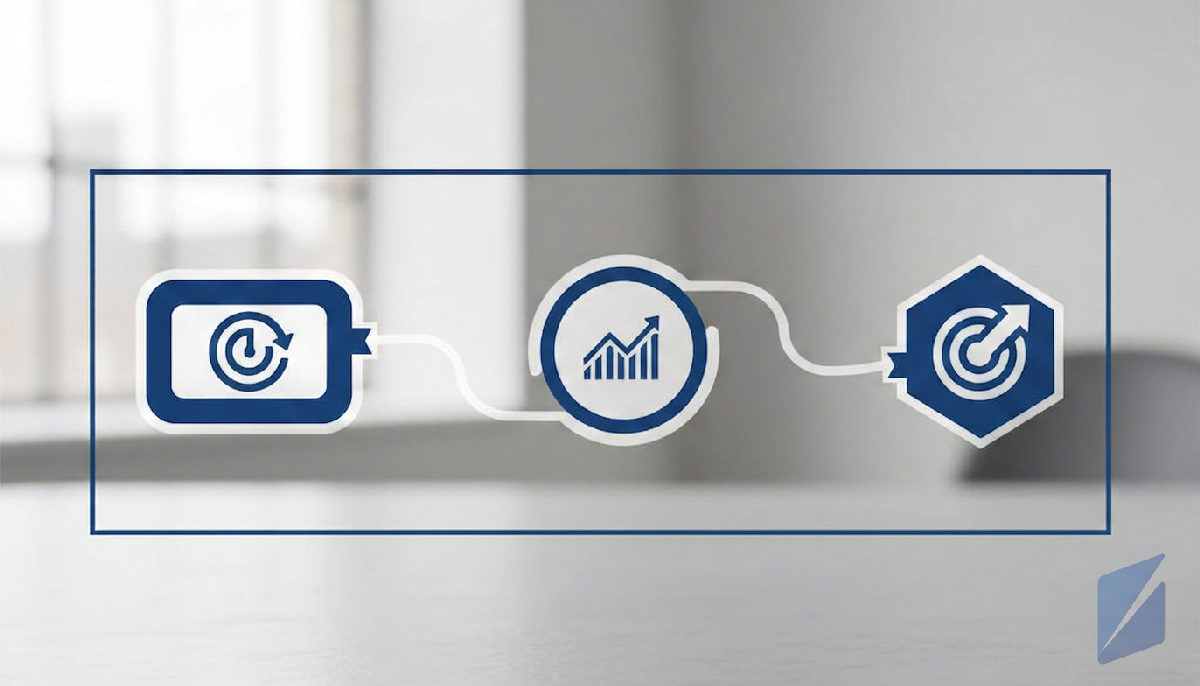
Automate Your Metrics: Let Technology Do the Heavy Lifting
Automation software dramatically increases the accuracy and frequency of content reporting by eliminating manual data entry and providing real-time performance dashboards. By integrating content creation with analytics, these tools allow business owners to pivot their strategies instantly based on what the data shows is currently working on the search engine results pages (SERPs).
Tracking should not be a chore that takes up your weekends. Modern technology allows you to automate both the creation and the tracking of your content. When you use Volteruno, you aren't just getting an AI writer; you are getting a system designed for performance. These platforms help you identify high-performing keywords and generate content that naturally ranks well, making the measurement of that performance much more rewarding.
Automation provides:
- Time Savings: Less manual checking of keywords.
- Accuracy: No more human error in spreadsheets.
- Real-Time Data: See exactly how your newest post is performing within days, not months.
Your Next Step to Content Profitability: Take Control Now!
Achieving a high return on your content strategy requires a shift from viewing blog posts as creative exercises to treating them as financial investments that must be measured and optimized. By implementing the seven key KPIs discussed today, you can eliminate wasteful spending and build a predictable, scalable revenue stream for your WordPress or Shopify business.
You now have the knowledge. You know why measuring matters, which metrics to track, and how to calculate your ROI. You understand that automation is your secret weapon in this process. Stop guessing and start measuring. Your business deserves clear results, and you deserve the success that comes with a high-performing content marketing strategy. The journey to profitable content starts with one step: choose your most important metric and check it today.
Frequently Asked Questions
What is a good ROI for content marketing?
While "good" varies by industry, a standard benchmark is a 3:1 ratio, meaning for every $1 spent, you generate $3 in revenue. High-performing content strategies often see a 5:1 or even 10:1 ratio once the content matures and ranks organically on search engines. Using automation tools like Volteruno can help push these ratios higher by lowering the initial investment cost per article.
How long does it take to see a positive ROI from blog content?
Content is a long-term play. Typically, it takes 3 to 6 months for SEO-driven content to begin ranking significantly and driving traffic. However, the ROI often compounds over time because a single well-written post can continue to generate leads for years without further investment. Faster results can be seen by using AI optimization to ensure articles are perfectly tuned for search engines from the moment they are published.
Can I track content ROI without expensive software?
Yes. You can track the most critical metrics using free tools like Google Analytics 4 (GA4) and Google Search Console. By setting up "Conversions" or "Events" in GA4, you can see exactly which blog articles were part of the customer's journey before they made a purchase. While premium tools offer more automation, the logic of ROI remains accessible to everyone with a standard analytics setup.
Why is Customer Acquisition Cost (CAC) important for content?
CAC tells you if your marketing is sustainable. If it costs you more to acquire a customer through content than that customer spends at your store, you are losing money. Content efforts should aim to lower your CAC over time compared to paid advertising, as organic traffic has no "cost-per-click" associated with it once the article is live and ranking.
How does Volteruno help with content ROI?
Volteruno improves ROI by automating the most expensive and time-consuming part of the process: writing and optimizing content. By using advanced AI to generate SEO-ready articles for Shopify and WordPress, it significantly reduces the "Investment" side of the ROI equation while increasing the "Revenue" side through better search engine rankings and higher engagement rates.
Is traffic volume the same as ROI?
No. Traffic is a "vanity metric" if it doesn't lead to a business goal. You can have 100,000 visitors, but if none of them buy anything or sign up for your list, your ROI is 0% (or negative). ROI only counts when you compare the money spent to produce that traffic against the actual revenue or lead value those visitors generated.