
Boost Your Local Business with AI-Powered SEO Content

Key Takeaways
- Local SEO is Critical: A huge portion of customer searches are for local businesses. If you're not visible locally, you're losing customers. Statistics show 46% of all Google searches have local intent.
- AI is a Game-Changer: Artificial intelligence can create high-quality, locally-optimized content in minutes, solving the biggest challenges for business owners: lack of time, budget, and SEO expertise.
- Hyper-Local Content Wins: AI tools can generate content that mentions specific neighborhoods, local events, and landmarks, directly appealing to customers in your service area.
- Human Oversight is Key: AI is a powerful tool, not a complete replacement for your expertise. The best results come from using AI for generation and human intelligence for refinement and adding a personal touch.
- Cost-Effective Growth: Leveraging AI for content is significantly more affordable and faster than hiring a traditional agency or writer, offering a clear return on investment through increased organic traffic and leads.
I. Introduction: The Evolving Landscape of Local Business Online Presence
The way customers find your local business has fundamentally and permanently changed. Gone are the days of relying solely on word-of-mouth or a listing in the yellow pages. Today, your storefront is Google. With nearly half of all Google searches having local intent, your online visibility is not just an advantage; it's a prerequisite for survival and growth. Customers are searching for "best pizza near me," "emergency plumber in [Your City]," and "boutique clothing stores downtown." If your business doesn’t appear in those search results, you are effectively invisible to a massive pool of ready-to-buy customers.
For many established small and medium-sized business (SMB) owners, particularly those over 40 who didn't grow up as "digital natives," this reality can be daunting. You are an expert in your trade—be it roofing, baking, or financial consulting—not in search engine algorithms. You know that having online content is important, but the idea of writing blog posts, optimizing for keywords, and keeping up with Google's constant changes feels like a full-time job you simply don't have time for.
This is where a transformative technology steps in: Artificial Intelligence (AI). AI is no longer a futuristic concept from science fiction; it is a practical, accessible tool that is revolutionizing content creation. For local businesses, AI offers a powerful solution to bridge the chasm between knowing you need SEO content and having the resources to create it. It is poised to level the playing field, empowering you to compete with larger companies without needing a massive marketing budget or a team of writers.
II. Understanding Local SEO: The Foundation of Customer Discovery
Before we dive into the role of AI, it's crucial to understand the foundation upon which it builds: Local Search Engine Optimization (Local SEO). While it shares principles with general SEO, local SEO is a specialized discipline focused on increasing your visibility to customers in a specific geographic area.
Core Principles of Local SEO
The goal of local SEO is to appear in the "Local Pack" (the map and three business listings at the top of a search results page) and in the localized organic results for queries that have local intent. It’s the difference between someone searching for "how to fix a leaky faucet" (general SEO) and "plumber in Minneapolis" (local SEO).
Key ranking factors include:
- Google Business Profile (GBP): This is the cornerstone of local SEO. A complete, accurate, and active GBP profile with photos, correct hours, and positive reviews sends powerful trust signals to Google. Research shows customers are 70% more likely to visit businesses with a complete profile.
- Local Citations (NAP): These are mentions of your business's Name, Address, and Phone number (NAP) across the web on directories like Yelp, Angie's List, and industry-specific sites. Consistency is paramount.
- Online Reviews: The quantity, quality, and velocity of customer reviews on Google and other platforms heavily influence rankings. A staggering 97% of consumers read reviews for local businesses.
- On-Page SEO Signals: This involves optimizing your website's content with location-specific keywords (e.g., "serving the greater Boston area"), creating location-specific service pages, and embedding a map.
A strong presence in these areas confirms to search engines that you are a legitimate, trusted entity serving a particular community, making you the right answer for a local customer's search.
III. The Content Chasm: Why Local Businesses Struggle with SEO Content
If the formula for local SEO seems straightforward, why do so many businesses fail to execute it effectively? The answer lies in the "content chasm"—the gap between knowing content is necessary and having the ability to produce it consistently.
Common Pain Points for Business Owners
For the typical SMB owner, the hurdles are significant and deeply felt:
- Time Constraints: You are busy running your actual business—managing employees, serving customers, and handling logistics. Dedicating 5-10 hours a week to researching, writing, and editing blog posts is often an impossible luxury.
- Lack of SEO Knowledge: Understanding keyword research, search intent, and on-page optimization is a technical skill. Writing an article is one thing; writing an article that ranks on Google is another entirely.
- Writing is Not Their Forte: Many brilliant business owners are not natural writers. The pressure to sound professional and create engaging content can lead to procrastination and frustration.
- The Cost Barrier: Hiring a freelance writer or a marketing agency can be expensive, with a single high-quality blog post often costing hundreds of dollars—an investment that can feel risky without guaranteed returns.
The consequence of this struggle is a stagnant online presence. Your website exists, but it doesn't attract new customers. Competitors who are publishing regular, helpful content slowly climb the search rankings, capturing the market share that could have been yours.[1] This inaction leads to missed opportunities and a growing sense of being left behind in the digital marketplace.
IV. Introducing AI for Content Creation: A Paradigm Shift
Imagine being able to generate a well-researched, professionally written, and SEO-optimized article about a topic relevant to your local customers in a matter of minutes. This is no longer a fantasy; it's the reality made possible by AI-powered content generation.
In the context of content, Artificial Intelligence refers to sophisticated algorithms, specifically Large Language Models (LLMs), that have been trained on vast amounts of text from the internet. These models learn the patterns, structures, and nuances of human language. By giving them a simple instruction, or "prompt," you can direct them to write articles, emails, social media posts, and more.
This technology represents a paradigm shift for content creation. It democratizes the ability to produce high-quality written material. Previously, this capability was locked behind the barriers of time, skill, and budget. Now, AI provides a tool that allows any business owner to become a prolific content publisher, focusing their energy on their core business expertise while the AI handles the heavy lifting of writing.
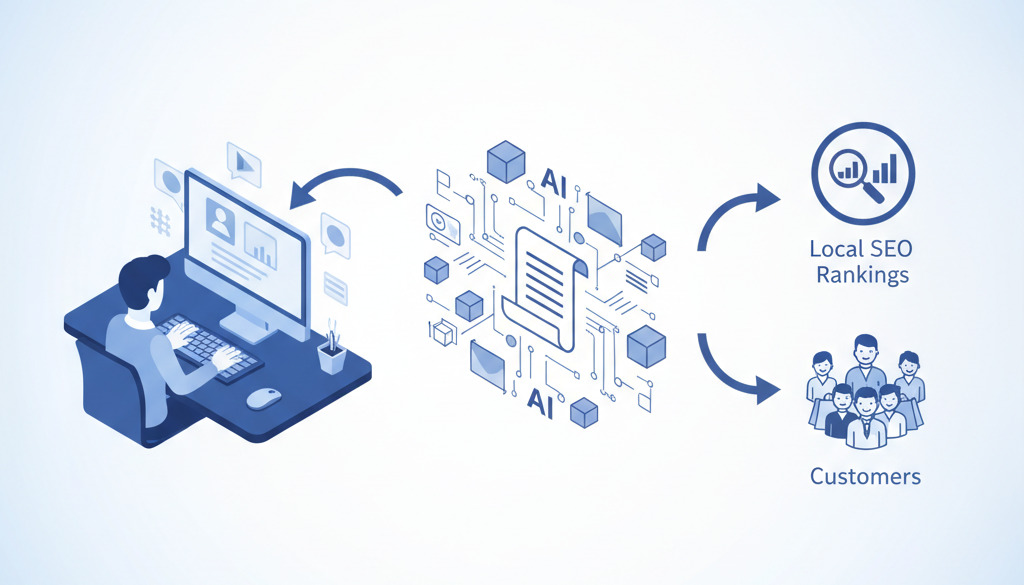
V. How AI Supercharges Local SEO: Targeted Content Generation
The true power of AI for local businesses lies in its ability to create P, highly relevant content at scale. It’s not just about producing more content; it’s about producing the *right* content that speaks directly to your local audience.
Analyzing Local Trends and Keywords
Modern AI tools can be directed to analyze local search trends. They can identify the specific long-tail keywords your potential customers are using. For example, instead of targeting the broad keyword "roof repair," an AI can help you create content for "hail damage roof repair in Dallas" or "signs of a leaky roof in Atlanta suburbs." This precision targeting is what drives high-intent local traffic.
Addressing Local Customer Needs
AI can rapidly generate articles that answer common local questions. Think about the queries your customers have every day. A local HVAC company could use AI to generate articles on:
- "What's the Average Cost to Replace an AC Unit in Phoenix?"
- "Preparing Your Furnace for a Harsh Minnesota Winter."
- "Choosing the Right Air Purifier for Texas Allergy Season."
Each of these topics directly addresses a specific, location-based customer need, positioning your business as a helpful expert and building trust before they even pick up the phone.
VI. The Mechanics of AI-Driven SEO Content: From Prompt to Publication
Using AI for content creation is not a mystical process. It’s a straightforward workflow that puts you, the business expert, in the driver’s seat. Understanding this process demystifies the technology and highlights the importance of human oversight.

The Power of the Prompt
The process begins with prompt engineering. A prompt is the instruction you give the AI. The quality of your output is directly related to the quality of your input. A weak prompt like "write a blog about plumbing" will yield a generic, useless article. A strong prompt, however, will generate Gold-tier content:
"Act as an expert local plumber with 20 years of experience in Chicago. Write a 1,500-word blog post for homeowners titled 'The Ultimate Guide to Preventing Frozen Pipes in Chicago Winters.' Include a section on what to do if pipes have already burst, mention the specific challenges of older brick homes in neighborhoods like Lincoln Park and Wicker Park, and end with a call to action to book a winterization inspection."
The Human-in-the-Loop Process
Once the AI generates the draft—which often takes only a few minutes—the crucial step of human review begins. This "human-in-the-loop" approach is essential for ensuring excellence.
- Review for Accuracy: AI is not infallible. You must review the content to ensure all technical details, statistics, and facts are correct.
- Inject Your Brand Voice: The AI provides a polished draft. It’s your job to tweak the language to match your company’s personality. Is your brand formal and authoritative, or friendly and conversational?
- Add Personal Stories and Expertise: This is where you shine. Add a short anecdote about a specific job you did or a unique tip that only comes from years of experience. This transforms a good article into a great one and makes it uniquely yours.
This partnership—AI for speed and scale, human for accuracy and authenticity—is the winning formula for local SEO content.
VII. Crafting Geo-Specific Content with AI: Reaching Your Neighborhood Customers
One of the most effective local SEO strategies is creating content that is unabashedly and specifically local. This is where AI’s ability to weave in geo-specific details becomes a superpower for your business.
Going Beyond City-Level Targeting
With AI, you can drill down past just your city name. You can create content that resonates with people in specific neighborhoods, referencing local landmarks, streets, or community quirks that only a local would know.
- For a Miami real estate agent: AI can help write a "Neighborhood Spotlight: A Guide to Living in Coral Gables," discussing the pros and cons, mentioning local parks like the Venetian Pool, and talking about school districts.
- For a Denver-based brewery: AI can generate a blog post titled "The Best Post-Hike Beers: Pairing Our Brews with Local Trails Near Golden," connecting a popular local activity directly to their product.
- For a New York City pest control company: AI can create content about "Managing Pests in Pre-War Brooklyn Brownstones," addressing the unique structural challenges of the local housing stock.
This level of specificity shows customers that you’re not just *in* their community; you *are a part* of their community. It builds an immediate connection that a generic, placeless competitor can never match.
VIII. Optimizing Existing Content with AI: Enhancing Your Digital Footprint
AI isn’t just for creating new content from scratch. It’s also an incredibly powerful tool for breathing new life into your existing digital assets. Many businesses have a handful of blog posts or service pages they created years ago that are now gathering digital dust.
Conducting an AI-Powered Content Audit
You can use AI tools to analyze your existing pages. By providing the text of an old article and asking for an SEO audit, the AI can:
- Identify Keyword Gaps: It can suggest valuable local keywords you missed, like adding "24/7 emergency service" or a specific suburb name.
- Improve Readability: AI can restructure dense paragraphs, add bullet points, and simplify complex sentences to make the content more engaging for readers.
- Suggest Structural Enhancements: It might recommend adding an FAQ section, a data table, or a "Key Takeaways" summary to improve user experience and SEO.
Repurposing Content for Maximum Reach
AI can help you take a single piece of content and multiply its impact. You can feed a long blog post into an AI and ask it to:
- Generate 5 social media posts based on the article.
- Write a script for a short YouTube video summarizing the key points.
- Create an email newsletter to send to your customer list.
- Draft a condensed version for your Google Business Profile "Updates" section.
This approach maximizes the return on your content investment, ensuring your expert knowledge reaches customers across multiple platforms without requiring hours of extra work.
IX. Building Authority and Trust Through AI-Assisted Content
In local business, trust is everything. Customers are inviting you into their homes or relying on your services for critical needs. A robust content strategy, powered by AI, is one of the most effective ways to build that trust and establish your business as the leading authority in your local market.
When a potential customer searches for a solution to a problem and finds a helpful, well-written article from your website, a subtle but powerful psychological connection is made. By consistently publishing content that educates, informs, and solves problems—without asking for anything in return—you build a bank of goodwill.
Imagine a homeowner worried about their flickering lights. They search "reasons why my lights are flickering" and find a detailed article from your local electrical company explaining potential causes, from simple issues to more serious ones. They are now aware of your brand and view you as a knowledgeable expert. When they decide they need a professional, who will they be more likely to call? The company that helped them understand their problem, or a random name from a directory? By becoming a reliable resource, you become the first choice.
X. Overcoming AI Hesitation: Addressing Concerns of the Business Owner
It's natural for a seasoned business owner to be skeptical of new technology, especially one as hyped as AI. You might worry that the content will sound robotic, be inaccurate, or even get you penalized by Google. These are valid concerns that deserve to be addressed.
Concern #1: "It Will Sound Robotic and Inhuman."
Early AI writing tools often produced clunky, awkward prose. However, today's technology is vastly more sophisticated. More importantly, as we’ve discussed, AI is not meant to be a one-click-and-publish solution. It’s a writing assistant. The AI does the heavy lifting of structure and research, but you provide the final polish, the personal stories, and the authentic brand voice. It’s your expertise, amplified by technology.
Concern #2: "The Information Might Be Wrong."
This is a legitimate risk, which is why the "human-in-the-loop" approach is non-negotiable. You are the expert in your field. The AI-generated draft is a starting point that you must fact-check and verify. This process is still infinitely faster than starting with a blank page. The AI provides the clay; you are the sculptor who shapes it into a masterpiece.
Concern #3: "Will Google Penalize AI Content?"
Google has been very clear on this topic: they reward high-quality, helpful content, regardless of how it is produced. They penalize spammy, low-value content. An AI-generated article that is generic, unedited, and unhelpful may perform poorly. But a well-crafted, human-edited, and genuinely useful article that was started with AI is seen by Google as just what it is: great content.
Think of AI as a tool, like a calculator for an accountant or a power saw for a carpenter. It doesn't replace the expert; it makes the expert more efficient and capable.
Leveraging AI for Hyperlocal SEO Content Creation
The power of AI in content creation extends significantly when focused on the nuances of local SEO. Unlike broad-stroke content strategies, hyperlocal SEO demands an understanding of specific geographic areas, local search intent, and the unique needs of a local customer base. AI tools can analyze vast amounts of local search data, identifying trending keywords, popular local service providers, and the specific questions potential customers in a particular neighborhood or city are asking. For instance, an AI can process search queries related to "best plumber in [specific neighborhood]" or "emergency dentist near [local landmark]," uncovering valuable long-tail keywords that are highly specific and less competitive.
Furthermore, AI can assist in generating content that directly addresses local concerns and events. Imagine a local restaurant using AI to brainstorm blog post ideas about upcoming community festivals or analyzing popular local dishes. The AI can suggest content angles like "Top 5 Family-Friendly Activities in [City] This Weekend" or "Seasonal Ingredients You'll Find at [Restaurant Name] This Spring." This type of content resonates deeply with local audiences because it speaks directly to their daily lives and interests. By analyzing competitor content performance within a specific geographic radius, AI can also pinpoint content gaps that your business can fill, offering unique perspectives or more comprehensive information that local users are searching for.
The efficiency gains are substantial. Instead of manually sifting through local directories, community forums, and social media groups to understand local search trends, AI can automate much of this discovery process. This allows local businesses, often operating with limited marketing resources, to focus their energy on higher-value tasks like customer engagement and service delivery, while still benefiting from a robust and locally relevant SEO content strategy. AI can also help in optimizing existing local landing pages by suggesting keyword inclusions, improving meta descriptions with local modifiers, and even proposing schema markup tailored for local businesses, such as opening hours, addresses, and customer reviews, all of which are critical for local search visibility.
AI-Driven Keyword Research for Local Dominance
The foundation of any successful SEO strategy, especially at the local level, lies in precise keyword research. For local businesses, generic keywords are often too broad and fail to attract the most relevant clientele. This is where AI truly shines, offering a granular approach to identifying the search terms that potential customers in your immediate vicinity are using. AI algorithms can process enormous datasets, including Google Maps searches, local business reviews, and even geotagged social media posts, to uncover highly specific, location-based keywords. For example, if you run a bakery in Charleston, AI can identify phrases like "artisan sourdough baked goods downtown Charleston," "vegan pastries King Street Charleston," or "custom birthday cakes Mount Pleasant SC." These long-tail keywords are not only less competitive but also indicate a higher intent to purchase, meaning users searching for them are more likely to convert.
Moreover, AI tools can go beyond simple keyword identification to understand search intent. They can differentiate between someone looking for "pizza delivery near me" and "best pizza restaurants Mount Pleasant SC experience." This understanding allows businesses to create content that directly answers the user's underlying need, whether it’s a quick meal solution or an in-depth review of dining options. AI can also analyze the semantics and sentiment of local reviews and forum discussions, providing invaluable insights into what customers love and what they are complaining about. This qualitative data can then be used to inform content creation, ensuring that the material produced is not only relevant but also addresses pain points and highlights unique selling propositions that resonate with the local community. By leveraging AI for this sophisticated local keyword research, businesses can ensure their content speaks directly to their target audience, leading to increased local traffic, improved click-through rates, and ultimately, more in-store visits or local service bookings.
FAQ
What is local SEO content AI?
Local SEO content AI refers to artificial intelligence tools and techniques used to create and optimize content specifically for local search engine optimization. This technology helps businesses tailor their website copy, blog posts, and other digital assets to attract customers in their geographic area.
How can AI help create local SEO content?
AI can assist by generating location-specific keywords, identifying trending local topics, writing geographically relevant descriptions for products and services, and even suggesting content formats likely to engage a local audience.
Will AI fully automate local SEO content creation?
While AI is a powerful assistant, it's unlikely to fully automate local SEO content creation. Human oversight is still crucial for ensuring brand voice consistency, factual accuracy, and genuine local relevance that resonates with your target community.
→ Read the full Small Business guide
Keep reading
Hand-picked guides that go deeper — open the one you need next:
- Tell Us About Your Business
- More Customers Through Your Blog
- The Ultimate Guide to AI-Powered SEO for Small Businesses
- Volteruno AI for SMB Content Marketing
→ Read the full Small Business guide