
AI for Small Business Content Marketing: Boost Reach and ROI

Key Takeaways
- AI scales production: Small businesses can now compete with larger firms by using AI to generate high-quality drafts and visual assets in minutes.
- Human-AI collaboration is essential: The most successful brands use a "human-in-the-loop" strategy to ensure authenticity and brand voice.
- Personalization is the new standard: AI allows for hyper-personalized content delivery that was previously too expensive for small budgets.
- Efficiency over replacement: Use AI to handle repetitive tasks like keyword research and social media scheduling, freeing humans for creative strategy.
The digital landscape for small businesses is undergoing a seismic shift. In an era where attention is the most valuable currency, content marketing small business AI strategies have evolved from a "nice-to-have" luxury into a fundamental requirement for survival. By 2026, the gap between businesses that leverage artificial intelligence and those that rely solely on manual processes has widened significantly.[1] For the modern small business owner, AI is not a replacement for talent; it is the ultimate force multiplier.
Content marketing has historically been a labor-intensive endeavor, often requiring a dedicated team of writers, designers, and SEO specialists. For small firms, these resources are often out of reach. However, AI levels the playing field, providing tools that automate time-consuming research and drafting while offering predictive insights that take the guesswork out of ROI. This article explores how small businesses can strategically integrate AI to dominate their niche without losing the human touch that defines their brand.
Understanding the AI Landscape for Content Marketers
Before diving into specific tools, it is crucial to understand that AI in content marketing is not a single monolith. It is a suite of technologies, including machine learning (ML) and natural language processing (NLP), designed to interpret data and generate human-like output. For a small business, this means having a virtual department that works 24/7 to analyze what your customers want and how to deliver it to them.
Defining AI in Content Marketing
Practical AI application involves using algorithms to solve specific creative and analytical problems. In 2026, this transcends simple chatbots. It involves generative AI that creates text and images, and predictive AI that analyzes historical data to suggest future content topics. These systems learn from every interaction, becoming more aligned with your brand’s specific goals over time.
Key AI Applications Relevant to Small Businesses
Small businesses typically benefit most from AI in four key areas: automated research, content generation, distribution optimization, and personalized customer messaging. By automating the technical heavy lifting, such as metadata generation and keyword clustering, business owners can focus on the high-level strategy and relationship building that drives sales.
Demystifying AI Terminology
Terms like "large language models" (LLMs) and "neural networks" can be intimidating. Simply put, LLMs are the engines behind tools like ChatGPT or Gemini that understand the nuances of human language. Predictive analytics uses these engines to spot patterns in buyer behavior, telling you which blog posts are likely to lead to a conversion before you even hit publish.
AI-Powered Content Ideation and Research
The greatest challenge in content marketing is often knowing what to talk about. AI eliminates the "blank page" syndrome by processing vast amounts of web data to identify precisely what your target audience is searching for at any given moment.
Topic Clustering and Keyword Research with AI
Traditional keyword research was a manual process of guessing and checking. Today, AI tools analyze search intent—the "why" behind a query. Instead of just targeting "plubming services," AI can identify a cluster of related topics like "emergency pipe repair costs" or "how to prevent winter pipe bursts," allowing you to build topical authority across an entire subject area.
Competitor Content Analysis for Gap Identification
Small businesses often struggle to identify where their competitors are failing. AI can scan thousands of competitor pages in seconds to find "content gaps"—topics that are high in demand but low in quality competition. This allows small brands to swoop in and capture traffic by providing superior answers to these neglected questions.
Revolutionizing Content Creation with Generative AI Tools
Content creation is no longer the bottleneck it once was. With generative AI, the time required to move from an idea to a polished draft has decreased by up to 80%. However, the secret to success in 2026 is maintaining a human-in-the-loop approach to ensure quality.
Improving Writing Speed and Overcoming Writer's Block
AI assistants are exceptional at creating outlines, drafting email subject lines, and summarizing long-form reports. For a small business owner, this means you can provide a few bullet points about a new product and receive a first draft of a blog post in seconds. Your role shifts from "primary author" to "chief editor," adding personal anecdotes and brand-specific values that the AI cannot replicate.
Generating Content Variations and Repurposing
One of the most efficient uses of AI is content repurposing. A single long-form video or blog post can be transformed by AI into ten social media snippets, a newsletter summary, and three different LinkedIn posts. This ensures your message reaches different segments of your audience on their preferred platforms without requiring hours of manual rewriting.
Visual Content Generation
Visuals are no longer a barrier for those without a graphic design budget. AI image generators can create branded social media graphics, header images, and even short video clips from text prompts. This allows small businesses to maintain a high-end visual aesthetic that builds trust and authority.
Personalizing Content at Scale with AI
Generic marketing is increasingly ignored. In 2026, consumers expect content that feels tailor-made for their specific needs. AI makes this possible for small businesses by automating the segmentation and delivery process.
Understanding Individual Customer Journeys
AI maps the path a customer takes from the first click to the final purchase. By analyzing which content pieces a user interacts with, the AI can predict their stage in the buying cycle. A user who reads your "beginner guides" will receive different content than someone who has visited your pricing page three times.
Dynamic Content Delivery
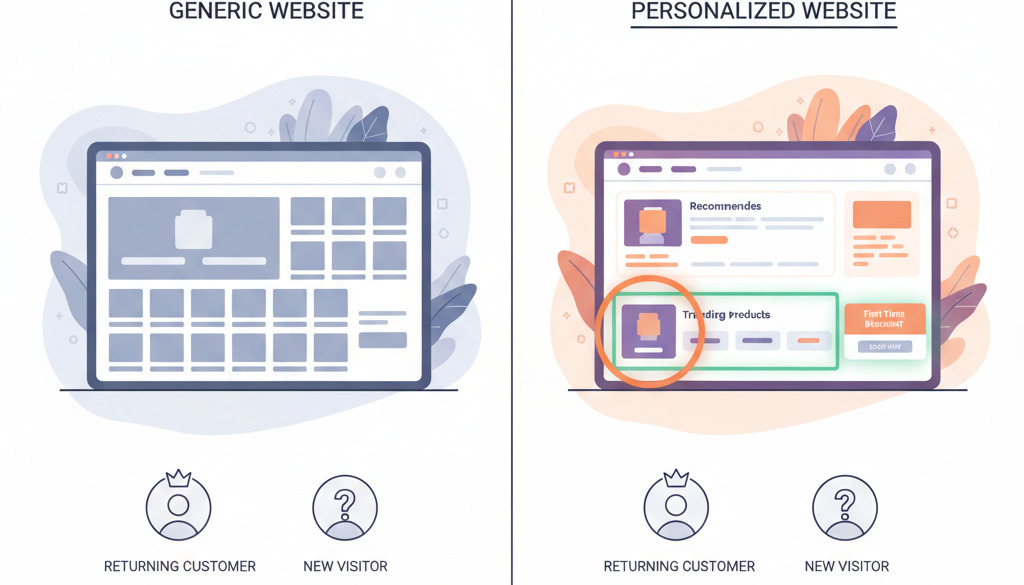
Small business websites can now use dynamic content blocks that change based on who is visiting. If a return customer visits your site, the AI can automatically highlight "loyalty rewards" content, while a first-time visitor might see an "educational intro" video. This level of personalization drastically increases conversion rates.
Optimizing Content Performance Through AI Analytics
Small businesses cannot afford to waste budget on content that doesn't perform. AI provides actionable intelligence, moving beyond vanity metrics like "likes" to focus on real business outcomes.
Understanding Audience Engagement Metrics with AI
While traditional analytics tell you how many people clicked a link, AI analytics tell you *how* they engaged. AI can detect "scroll depth" and "hover intent," helping you understand if readers are actually consuming your content or just skimming the headlines. This feedback loop allows you to refine your content style to keep audiences reading longer.
Identifying High-Impact Content for Amplification
Not all content is created equal. AI identifies "outliers"—posts that are getting unusually high engagement or conversion rates. It then suggests that you put a small advertising budget behind these specific posts, ensuring your ad spend is only directed toward proven winners.
Automated A/B Testing and Optimization
AI can run hundreds of A/B tests simultaneously. It can test different headlines, call-to-action buttons, and even image colors in real-time, automatically funneling traffic to the version that performs best. For a small business, this means your marketing funnel is constantly self-optimizing without manual intervention.
AI in SEO and Content Distribution Strategies
Search engine optimization has moved beyond simple keywords to a concept known as **Topical Authority**. AI helps small businesses build this authority by ensuring every piece of content fits into a larger, SEO-friendly ecosystem.
AI-Driven Keyword Optimization
In 2026, SEO is about semantic search. AI tools help you include "Latent Semantic Indexing" (LSI) keywords—terms related to your main topic that prove to search engines you have comprehensive knowledge. This helps small sites outrank larger, more generic competitors for specialized local queries.
Smart Content Distribution
Timing is everything. AI analyzes when your specific audience is most active on platforms like LinkedIn, Instagram, or X. It can then schedule your content to go live at those peak moments, maximizing initial engagement and boosting the post's visibility in social algorithms.
AI for Link Building Insights
Link building remains a cornerstone of SEO. AI can scan the web to find high-authority sites in your niche that are linking to your competitors but not to you. It then identifies the best "hook" for your outreach, increasing the chances of securing a backlink that boosts your search rankings.
Selecting the Right AI Tools for Your Small Business
The marketplace is flooded with AI solutions, making selection difficult. Small businesses must focus on tools that provide the highest ROI for their specific industry and budget.
Assessing Your Needs and Budget
Before buying a subscription, identify your biggest bottleneck. Is it writing? Research? Social media management? Avoid "all-in-one" platforms that charge for features you won't use. Many powerful AI tools offer freemium models that are perfectly sufficient for solo entrepreneurs or small teams.
Key AI Tool Categories
Focus on three primary pillars: LLMs for writing (like Claude or GPT-4), SEO platforms with AI features (like Semrush or SurferSEO), and Social Media Managers that use AI for scheduling and listening (like Sprout Social or Hootsuite). These three categories cover 90% of a typical content marketing workflow.
Implementing AI in Your Small Business Content Workflow
Implementation should be a gradual evolution, not an overnight overhaul. Start by integrating AI into a single process, such as your weekly newsletter, before expanding to other areas.
Training and Upskilling Your Team
The most important skill in 2026 is **prompt engineering**—learning how to talk to AI to get the best results. Small business owners should invest time in learning how to provide context, constraints, and "persona" instructions to AI tools. A well-prompted AI can produce professional-grade work, while a poorly prompted one produces generic fluff.
Defining Roles and Responsibilities
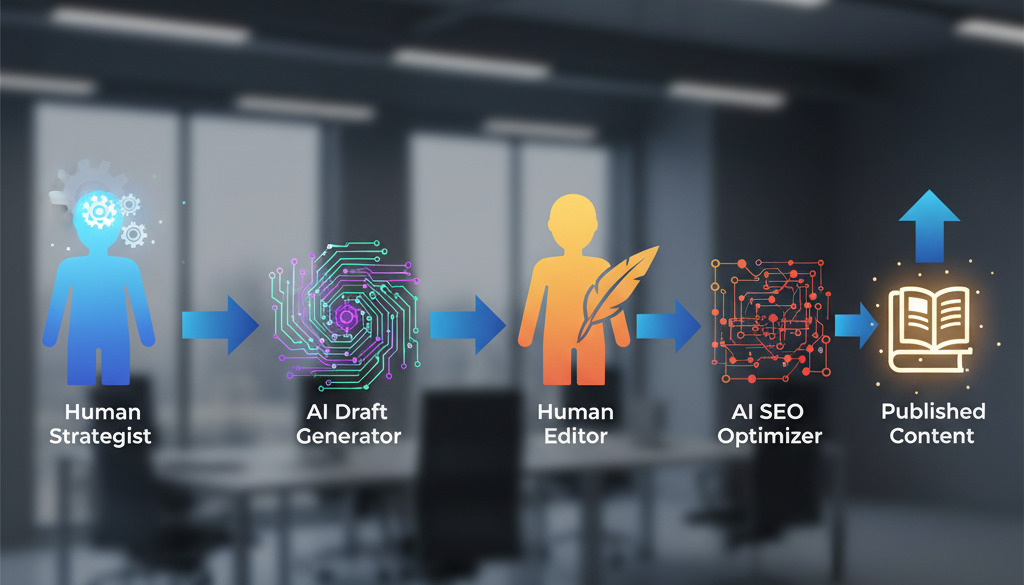
Even with AI, someone must be the "Final Editor." Establish a workflow where AI does the drafting, a human does the fact-checking and brand-polishing, and the AI does the final SEO optimization. This clear division of labor prevents errors and maintains the unique "voice" of your business.
Ethical Considerations and Responsible AI Use in Content Marketing
Trust is the foundation of any small business. If customers feel they are being "tricked" by robots, that trust is shattered. Ethical AI use is not just a moral choice; it is a business imperative.
Transparency and Disclosure
While you don't necessarily need a disclaimer on every social post, being transparent about using AI for data analysis or visual generation can actually build trust as a "forward-thinking" brand. For long-form educational content, ensure a human expert has verified all facts to prevent the spread of AI "hallucinations" (incorrect information generated by the model).
Bias Mitigation
AI models are trained on the internet, which contains biases. Always review AI-generated content to ensure it reflects the inclusive and professional values of your brand. Never publish AI content "blindly," as it may inadvertently use culturally insensitive language or outdated stereotypes.
Data Privacy and Security
Small businesses must be careful not to feed sensitive customer data into public AI models. Ensure the tools you use are compliant with regulations like GDPR or CCPA. Use "enterprise" versions of AI tools when possible, as these usually offer better data protection and do not use your inputs to train their future models.
The Future of AI in Small Business Content Marketing
As we look toward the late 2020s, AI will become even more integrated. We are moving toward autonomous content ecosystems where AI monitors your sales inventory and automatically creates content to promote items that need an extra push.
The future belongs to the "hybrid" small business. These are the brands that use AI to handle the volume and humans to handle the emotional connection. As AI makes content "free" to produce, the value of unique, lived-experience human perspective will only increase. By staying proactive and adaptable, small businesses can use AI to build a brand that is both efficient and deeply personal.
Conclusion
The integration of content marketing small business AI strategies is the most significant competitive advantage available today. By using AI for ideation, creation, and optimization, small businesses can finally break free from the "content hamster wheel" and focus on growth. The goal is not to sound like a machine, but to use the machine to amplify your human voice.
Embracing AI is no longer about technology; it is about empowerment. It allows a one-person shop to have the marketing output of a global agency. Start today by choosing one AI tool and one workflow, and begin the journey toward an efficient, data-driven, and highly profitable future. The field is level—it is time to start playing.
Frequently Asked Questions
Will using AI for content marketing hurt my search engine rankings?
As of 2026, search engines emphasize Helpful Content regardless of how it was created. If your AI-generated content is accurate, provides value, and includes human oversight for quality, it will rank well. Google and other engines penalize low-quality, "spammy" AI content, not the use of AI itself. Always edit and fact-check AI drafts to ensure they meet high editorial standards.
Do I need to be a tech expert to use AI in my small business?
Not at all. Most modern AI tools for content marketing are designed with user-friendly "no-code" interfaces. If you can use an email client or a social media app, you can use generative AI. The key skill is learning how to write clear instructions (prompts) to get the best output from the software.
Is AI content creation expensive for a small business budget?
AI is actually a major cost-saving tool. While some enterprise platforms are expensive, many robust tools offer monthly subscriptions that cost less than a single freelance article. By automating research and drafting, you save on the "opportunity cost" of your own time or the high fees of traditional marketing agencies.
How can I ensure AI-generated content still sounds like my brand?
The best way is to use a Brand Voice Guide. You can feed your existing high-performing content into an AI tool and ask it to "analyze the tone, style, and vocabulary." Then, instruct the AI to use that specific style for all future drafts. Crucially, a human editor should always perform the final pass to add nuances and personal stories that make the brand feel authentic.
Can AI help me with video and image marketing as well?
Yes. AI has revolutionized visual content. Small businesses can now use AI to generate realistic stock photos (saving on licensing fees), create short social media reels from text, and even "upscale" old, low-resolution images. Video AI tools can also help with automatic subtitling and editing, making video marketing much more accessible.
Keep reading
Hand-picked guides that go deeper — open the one you need next:
- AI Blog Writing: A Small Business Guide to Google Rank
- From Zero to Hero: How AI Content Transformed My Small Business Blog
- Local SEO AI Content: Strategies for 2026 Dominance
- From Zero to Hero: How AI Content Automation Levels the Playing Field for Small Businesses
→ Read the full Small Business guide
→ Read the full Small Business guide