
From Zero to Hero: Build Your Online Presence With AI

Key Takeaways
- Your online presence is non-negotiable: In today's market, your website, social media, and search engine visibility are as crucial as a physical storefront. Success requires a strong, consistent digital footprint.
- AI is your new business partner: Artificial Intelligence is no longer sci-fi; it's a practical tool that can write blog posts, manage social media, and optimize your site for search engines, saving you immense time and effort.
- Content is king, and AI is the kingmaker: High-quality content attracts customers. AI helps you identify what your audience wants to read and creates that content for you, establishing your authority and driving sales.
- SEO doesn't have to be a mystery: AI demystifies Search Engine Optimization by identifying the right keywords and optimizing your content, making it easier for customers to find you on Google.
- Start small, scale smart: You don't need to be a tech expert. Start with one area, like AI-powered blog writing, to see tangible results before expanding. The goal is progress, not perfection.
Introduction: The New Digital Main Street
In the not-so-distant past, a prime location on a busy street was the key to business visibility. Today, that busy street is the internet. The line between your physical and online presence has all but vanished. For many of your customers, if your business doesn’t exist on Google, it doesn’t exist at all. This digital-first reality presents a massive opportunity, but for busy small and medium-sized business (SMB) owners, it also brings a significant challenge: how do you build and maintain a powerful online presence when you're already juggling every other aspect of your company?[1]
If you're a business owner over 40, you’ve built your company on solid principles of quality, service, and relationships. You know an online presence is critical, but the thought of blogging, social media updates, and something called "SEO" feels like a second full-time job you neither have the time nor the passion for. You're not alone in this sentiment. The demands of digital marketing are relentless. But what if there was a way to bridge this gap? What if you could leverage a powerful new technology to do the heavy lifting for you?
This is where Artificial Intelligence (AI) enters the picture. It’s not about robots or futuristic fantasies; it’s a practical, accessible tool that's revolutionizing how businesses like yours build their online presence. This guide will show you exactly how AI can become your most efficient employee, working 24/7 to build your brand, attract customers, and drive growth, moving your business from digital invisibility to online hero status.
Understanding Your Digital Footprint: The Foundation of Online Presence
Before you can build, you need a blueprint. Your digital footprint is the sum of all your business’s activities and assets online. It’s much more than just a website. Think of it as your company's digital reputation, portfolio, and communication hub all rolled into one. For the modern business owner, understanding its components is the first step toward mastering it.

Key Components of Your Digital Footprint
- Your Website: This is your digital headquarters. It should be professional, easy to navigate, and clearly explain what you do and who you do it for. It includes your homepage, service pages, 'About Us' page, and, crucially, your blog.
- Search Engine Visibility: This is how easily customers find you when they search for your services or products on Google. If you’re a plumber in Dallas, you want to appear when someone searches "emergency plumber Dallas." This is a cornerstone of your online presence.
- Social Media Profiles: Platforms like Facebook, LinkedIn, Instagram, or even TikTok are your outposts for community engagement. They allow you to connect with customers on a more personal level and share timely updates.
- Online Reviews and Listings: Your profiles on Google Business Profile, Yelp, Angie's List, and other industry-specific directories are critical. Positive reviews build trust and social proof, directly influencing purchasing decisions.
- Content: This is the currency of the internet. It includes your blog posts, videos, case studies, and social media updates. Valuable content is what attracts visitors and establishes you as an expert in your field.
A strong and consistent online presence across these areas is no longer a "nice-to-have." It is a business imperative. It builds credibility, expands your reach beyond your local neighborhood, and creates a direct channel to potential customers who are actively looking for a solution you provide.
The AI Revolution in Content Creation: A Paradigm Shift
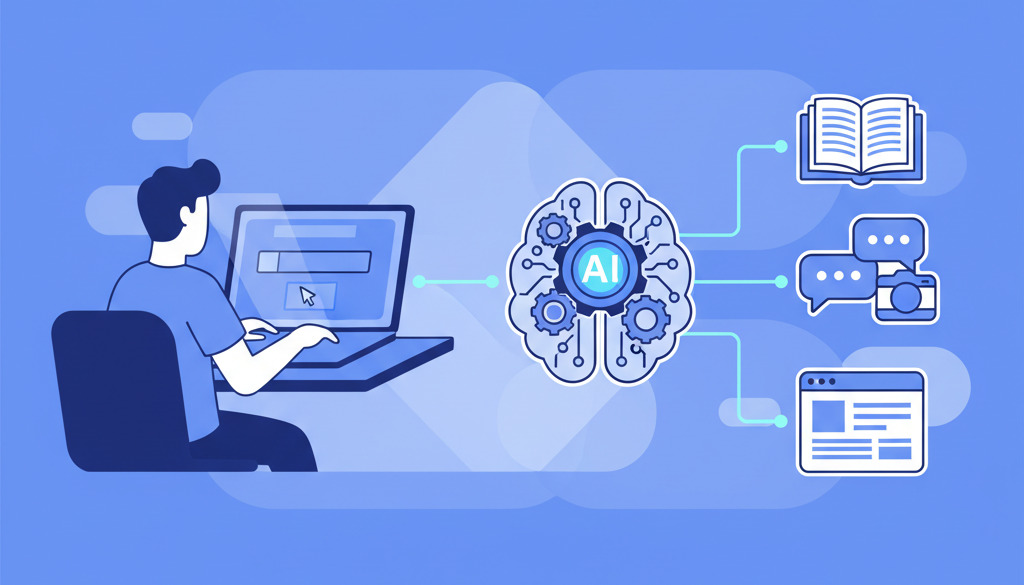
For decades, creating content was a purely human endeavor, requiring time, skill, and a creative spark. This is the single biggest hurdle for most SMB owners. The AI revolution changes this dynamic entirely. In simple terms, AI content generation tools are sophisticated software programs that have been trained on vast amounts of text and data. They can understand language, context, and tone to produce original content based on a prompt you provide.
Think of it like giving instructions to a highly skilled, incredibly fast writer. You provide the topic, the target audience, and the goal, and the AI drafts the article, social media post, or website copy for you in minutes, not hours or days.
The core benefit of this technology is the dramatic reduction in time and effort required to produce high-quality content. The creative block that comes from staring at a blank page disappears. The hours spent researching, writing, and editing are compressed into a few simple clicks. This isn’t about creating robotic, soulless text. Modern AI can be guided to write in a specific brand voice—be it professional, friendly, witty, or technical. It’s a paradigm shift that turns content creation from a daunting chore into a manageable, strategic task.
Strategic Content Creation for SMB Growth: AI as Your Ally
Why is content so important? Because content is what answers your customers’ questions, solves their problems, and builds the trust required for them to make a purchase. A plumbing company that regularly posts blog articles about "How to prevent frozen pipes in winter" or "5 signs you have a hidden water leak" isn't just sharing information; it's demonstrating expertise and building a relationship with homeowners before they even have a crisis.
This is where most business owners get stuck. What should you write about? What are people searching for? AI serves as your strategic partner in answering these critical questions.
How AI Fuels Your Content Strategy
- Topic & Keyword Identification: AI tools can analyze search data and online conversations to discover the exact phrases and questions your potential customers are typing into Google. It takes the guesswork out of choosing blog topics, ensuring you’re writing about things people actually want to know.
- Generating Audience-Relevant Drafts: Once a topic is chosen, AI can generate a comprehensive, well-structured article. This isn’t just a random collection of words; it’s a coherent piece designed to be informative and engaging for your target reader.
- Scaling Your Efforts: Consistency is key in content marketing. AI allows you to produce a steady stream of blog posts, keeping your website fresh and giving Google more reasons to rank you highly. Instead of one article a month, you can easily publish one a week, exponentially increasing your chances of being found.
The goal is to move from sporadic, reactive marketing to a strategic, proactive content plan. For business owners who want to bypass the learning curve of using general AI tools, specialized platforms have emerged to streamline this process even further. Solutions like Volteruno, for example, use a proprietary AI designed specifically to write professional, SEO-optimized articles for your website in minutes.
Beyond Blog Posts: Amplifying Your Brand with AI-Driven Content
While the power of AI in generating blog content is undeniable, its capabilities extend far beyond single articles. To truly build a robust online presence, businesses must leverage AI across a diverse range of content formats and platforms. This holistic approach ensures your brand resonates with a wider audience and solidifies your authority in your niche. AI can be your tireless assistant in crafting compelling social media updates, engaging video scripts, informative email newsletters, and even persuasive website copy that converts visitors into loyal customers. The key is to think of AI not just as a writer, but as a versatile content strategist capable of adapting to the unique demands of each digital channel.The Social Media Symphony: AI for Engagement and Reach
Social media platforms are dynamic hubs for customer interaction and brand visibility. AI can revolutionize your social media strategy by not only generating fresh content ideas but also optimizing them for maximum impact. Imagine an AI that analyzes trending topics, understands the sentiment around your industry, and suggests relevant hashtags that will increase your posts' reach. Furthermore, AI can help you tailor your message to each platform, recognizing that what works on LinkedIn might not be ideal for Instagram. For instance, AI can generate short, visually appealing captions for Instagram posts that include relevant emojis and calls to action, while simultaneously drafting more professional, thought-provoking updates for LinkedIn that encourage discussion. Beyond simple text generation, AI can also assist in identifying optimal posting times based on your audience's activity patterns, ensuring your content reaches them when they are most likely to engage. Tools can even analyze the performance of past posts, highlighting which types of content, tones, and visual elements garnered the most likes, shares, and comments, allowing for continuous refinement of your strategy. This predictive and analytical power of AI transforms social media management from a time-consuming chore into a strategic growth engine, helping you build a vibrant online community and foster genuine connections with your audience. The ongoing conversation is crucial; AI can help you listen to it and respond effectively, turning followers into advocates.Video Voyages: AI Scripting and Storyboarding for Visual Impact
Video content continues to dominate online engagement, and AI can be a powerful ally in this space. The process of conceptualizing, scripting, and producing videos can be incredibly time-consuming. AI can significantly accelerate this by assisting in scriptwriting. You can feed an AI a topic, a target audience, and desired key messages, and it can generate a draft script complete with dialogue, scene descriptions, and even suggestions for visual elements. This dramatically reduces the initial creative bottleneck. For example, if you're launching a new product, AI can help brainstorm different video angles – an explainer video, a customer testimonial format, or a behind-the-scenes look – and then draft compelling narratives for each. Furthermore, AI can analyze successful video content in your industry to identify common storytelling structures, pacing, and visual cues that resonate with viewers. This insight can inform your own video production, ensuring your content is not only informative but also captivating. Beyond scripting, AI is also beginning to play a role in video editing and even content summarization, allowing you to repurpose longer videos into shorter, social-media-friendly clips. The ability to consistently produce high-quality video content, tailored to your brand voice and audience preferences, is a significant advantage in building a memorable online presence. By using AI to streamline the creative and production processes, you can dedicate more resources to perfecting the visual storytelling and message delivery, ensuring your video content truly stands out.Email Ensembles: AI for Personalized Outreach and Nurturing Leads
Email marketing remains one of the most effective channels for direct customer communication and lead nurturing. AI can elevate your email campaigns from generic blasts to highly personalized and impactful messages. AI algorithms can analyze customer data, purchase history, and browsing behavior to segment your audience with incredible precision. This allows you to send targeted emails that speak directly to the individual needs and interests of each recipient. For instance, an AI can identify customers who have repeatedly viewed a specific product category and then automatically generate an email showcasing new arrivals or special offers within that category. Moreover, AI can help craft compelling subject lines and email body content that are optimized for open and click-through rates. By testing different variations of copy and analyzing the results, AI can continuously improve the effectiveness of your email messaging. Beyond direct sales, AI can also be invaluable for creating automated email sequences designed to onboard new subscribers, nurture potential leads through the sales funnel, or re-engage inactive customers. This level of automation and personalization frees up valuable time for marketers to focus on strategic planning and relationship building, rather than the repetitive task of writing individual emails. The cumulative effect of consistent, relevant, and personalized email communication, powered by AI, significantly contributes to building a strong, loyal customer base and solidifying your brand's presence in their inboxes and minds.Website Wonders: AI for Conversion-Focused Copy and User Experience
Your website is often the first point of contact a potential customer has with your brand online. AI can play a crucial role in optimizing every aspect of your website for conversions and a seamless user experience. This extends beyond blog posts to critical elements like landing pages, product descriptions, and calls to action. AI tools can analyze user behavior on your site, identifying pages with high bounce rates or areas where visitors tend to drop off. Armed with this data, AI can suggest improvements to website copy, making it clearer, more persuasive, and benefit-oriented. For example, if a product page isn't converting well, AI can help rewrite the description to highlight unique selling propositions more effectively or address potential customer objections. Furthermore, AI can assist in crafting compelling headlines and calls to action that encourage visitors to take the desired next step, whether it's signing up for a newsletter, requesting a quote, or making a purchase. The personalization capabilities of AI can also be applied to website content, dynamically adjusting headlines or product recommendations based on a visitor's past interactions or demographic information. This creates a more engaging and relevant experience, increasing the likelihood of conversion. In essence, AI acts as a continuous optimization engine for your website, ensuring that it not only looks professional but also functions effectively as a powerful tool for attracting, engaging, and converting your target audience, thereby significantly strengthening your overall online presence.Leveraging AI for Comprehensive Brand Storytelling and Content Amplification
Beyond optimizing existing website elements for conversion, AI offers powerful avenues for proactively building and amplifying your online presence through sophisticated content creation and strategic distribution. Think of AI not just as an efficiency tool, but as a creative partner capable of generating compelling narratives that resonate with your target audience across various platforms. The "From Zero to Hero: Build Your Online Presence With AI" movement is fundamentally about establishing a strong, recognizable, and engaging brand identity, and AI can be the engine driving this ambition. It can assist in developing a consistent brand voice, ensuring that all your communications, from social media posts to email marketing campaigns, align with your core values and messaging. For instance, AI-powered natural language generation (NLG) tools can help brainstorm and draft a wide range of content formats, including blog post outlines, social media captions, video scripts, and even podcast episode ideas. This dramatically reduces the initial creative friction and allows marketing teams to focus on refining and personalizing the AI-generated output, rather than starting from scratch.
Furthermore, AI's analytical capabilities extend to understanding content performance at a granular level, offering insights that inform a more effective content strategy. By analyzing vast datasets of user engagement, AI can identify trending topics, popular content formats, and the optimal times to publish for maximum reach within specific demographics. This predictive power allows businesses to move from reactive content creation to a proactive approach, anticipating audience needs and preferences before they even articulate them. For example, an AI might detect an emerging sub-niche within your industry on a social media platform and suggest creating a series of informative articles or engaging infographics addressing those specific interests. This not only positions your brand as a thought leader but also ensures that your content is consistently relevant and valuable. The ability to understand sentiment analysis, through AI, can also be crucial in gauging audience reception to your existing content and adapting future strategies accordingly. By monitoring comments, reviews, and social media mentions, AI can provide a clear picture of what resonates, what falls flat, and what prompts discussion, allowing for rapid iteration and improvement of your content marketing efforts.
The true power of AI in building an online presence lies in its capacity for personalized content amplification. Gone are the days of one-size-fits-all marketing. AI can segment your audience with incredible precision based on their online behavior, interests, and past interactions. This allows for the dynamic tailoring of content delivery, ensuring that each individual receives messages most relevant to them. Imagine an AI system identifying a user who has repeatedly shown interest in a particular product category. Instead of bombarding them with generic ads, the AI can trigger the delivery of highly targeted content, such as in-depth reviews of specific products in that category, customer testimonials, or even personalized discount offers. This level of personalization fosters a deeper connection with the audience, making them feel understood and valued, which is paramount in converting passive browsers into loyal customers and brand advocates. The AI can orchestrate these personalized campaigns across multiple channels – email, social media, website recommendations – creating a cohesive and highly effective customer journey. This sophisticated approach to content creation and distribution, powered by AI, transforms a basic online presence into a thriving digital ecosystem that actively engages and converts.
Leveraging AI for Strategic Audience Engagement and Conversion Optimization
While the previous discussion highlighted AI's prowess in personalized content amplification and dynamic tailoring of messages, a deeper dive reveals its multifaceted role in cultivating a truly robust online presence. This extends beyond simply showing the right content to the right person; it encompasses understanding the nuances of audience interaction, predicting future trends, and automating complex engagement strategies that were once the sole domain of human expertise. AI acts as an intelligent co-pilot, not just delivering messages but also analyzing the effectiveness of those messages in real-time and suggesting or implementing adjustments to maximize impact. This iterative process, fueled by data-driven insights, is what truly sets AI-powered online presences apart. One of the most significant contributions of AI to building an online presence is its ability to move beyond reactive analysis to proactive engagement. Traditional analytics tools can tell you what happened. AI, however, can predict what *will* happen. By analyzing vast datasets of user behavior, including click-through rates, time spent on page, conversion paths, and even sentiment analysis from social media comments, AI algorithms can identify patterns that forecast user interests and potential churn. This predictive capability allows businesses to intercept potential issues before they arise, or to capitalize on emerging opportunities. For instance, an AI might flag a segment of users whose engagement is gradually declining. Instead of waiting for them to disengage completely, the AI can trigger a targeted re-engagement campaign, perhaps offering a special incentive or a personalized piece of content designed to reignite their interest. Similarly, AI can identify nascent trends within your target audience even before they become mainstream, allowing your brand to be an early adopter and thought leader in emerging conversations. This proactive stance fundamentally shifts the paradigm of online presence management from a passive reflection of current performance to an active, future-oriented strategy. Furthermore, AI's capacity for granular analysis extends to the optimization of the entire customer journey. It's not just about the initial touchpoint; it's about every interaction leading to a desired outcome. AI can map and analyze complex customer journeys across various platforms and touchpoints, identifying bottlenecks and friction points that might be hindering conversions. For example, an AI might notice that a significant number of users are abandoning their shopping carts at the checkout stage. By analyzing the user flow leading up to that point, it could identify that the shipping information request is too cumbersome, or that the payment options are insufficient. Based on this insight, the AI can recommend or even automatically implement changes to the website's design or functionality to streamline the checkout process, thereby reducing cart abandonment and increasing sales. This level of diagnostic and prescriptive power, driven by AI, is invaluable for refining the user experience and ensuring that every interaction contributes positively to the brand's objectives. The constant feedback loop, where AI analyzes the impact of its own recommendations and continues to learn and adapt, ensures a continuously optimized and effective online presence. This dynamic evolution is crucial in today's fast-paced digital landscape, where user expectations are constantly shifting and the competition for attention is fierce. ### AI-Powered Content Ideation and Performance Forecasting Beyond the direct engagement and optimization strategies, AI also revolutionizes the foundational elements of online presence: content creation and strategy. The challenge of consistently generating fresh, relevant, and engaging content can be a significant hurdle. AI-powered tools can assist by analyzing trending topics, keyword opportunities, and competitor content performance to suggest new content ideas that are likely to resonate with the target audience. Tools utilizing natural language processing (NLP) can even generate initial drafts of articles, social media posts, or email copy, which can then be refined by human content creators. This accelerates the content production pipeline, allowing businesses to maintain a more consistent and robust content schedule. Moreover, AI can move beyond simply suggesting ideas to forecasting the potential performance of that content. By analyzing historical data and the characteristics of proposed content (e.g., topic, format, keywords, target audience), AI models can provide an estimated range of engagement metrics, such as reach, click-through rates, and conversion potential. This predictive analytics allows marketing teams to prioritize content creation efforts on the topics and formats most likely to yield positive results, allocating resources more effectively and reducing the risk of investing time and effort into content that ultimately underperforms. This data-driven approach to content strategy, informed by AI, ensures that every piece of content published is a calculated step towards building a stronger and more impactful online presence. The ability to foresee trends and predict content success allows brands to be agile, adapting their content strategy in near real-time to capitalize on emerging opportunities and mitigate potential risks in the ever-evolving digital landscape.AI-Powered Content Optimization and Personalization
Beyond idea generation and performance prediction, AI offers sophisticated tools for optimizing existing content and delivering personalized experiences at scale. AI algorithms can analyze vast datasets of user behavior, engagement patterns, and conversion funnels to identify specific points of friction or opportunities for improvement within your content. For instance, AI can pinpoint which sections of a blog post are most frequently skipped, which call-to-action buttons have the lowest click-through rates, or which landing page elements are hindering conversions. Armed with this insight, content creators can strategically revise and refine their assets to enhance user experience and drive desired outcomes. This iterative optimization process, powered by AI's analytical capabilities, ensures that your content isn't just produced; it's continuously honed for maximum effectiveness. This means your website copy, landing pages, and marketing materials become more persuasive and resonate more deeply with your audience over time, directly contributing to a stronger online presence.
Furthermore, AI excels in its ability to personalize content delivery, a critical factor in building a strong online presence in today's crowded digital space. Instead of adopting a one-size-fits-all approach, AI can dynamically tailor content recommendations, website layouts, and even email messaging based on individual user profiles, browsing history, and past interactions. Imagine a user returning to your website; AI can instantly present them with articles, products, or services that align precisely with their known interests or previous searches, creating a highly relevant and engaging experience. This level of personalization fosters a deeper connection with your audience, making them feel understood and valued, which in turn encourages loyalty and repeat engagement. By moving beyond generic broadcasts to highly targeted, individual conversations, AI empowers businesses to build more meaningful relationships and solidify their online presence through customer-centric communication.
Enhancing User Engagement Through AI-Driven Personalization
The ultimate goal of building an online presence is to attract, engage, and convert an audience. AI-driven personalization directly addresses these objectives by creating pathways for deeper user interaction. When users are presented with content that feels curated specifically for them, their time spent on site naturally increases, reducing bounce rates and signaling to search engines that your platform is a valuable resource. This also extends to email marketing, where AI can segment audiences with incredible granularity and craft personalized subject lines and body content, leading to higher open and click-through rates. Even on social media, AI can help identify optimal posting times and tailor ad creative to specific audience segments, ensuring that your message cuts through the noise and lands with maximum impact. This multi-faceted approach to personalization transforms passive website visitors into active, engaged community members, forming the bedrock of a thriving online presence.
FAQ
How can AI help me build an online presence?
AI tools can automate content creation, optimize your website for search engines, and personalize marketing messages. These capabilities help you reach a wider audience more efficiently and effectively.
What are some key AI tools for building an online presence?
Examples include AI-powered writing assistants for blog posts and social media updates, AI image generators for visual content, and AI chatbots for customer engagement.
Is AI a replacement for human creativity when building an online presence?
No, AI is best used as a powerful assistant to augment human creativity. It can handle repetitive tasks and provide data-driven insights, allowing you to focus on strategy, unique branding, and genuine audience connection.
Keep reading
Hand-picked guides that go deeper — open the one you need next:
- Getting Started with AI Content: A Business Guide
- Why Manual Content Creation is Obsolete: The AI Advantage
- AI Blog Workflow Automation: Idea to Published
- AI Content for Customer Acquisition: Your Blog's New Engine
→ Read the full AI Content guide