
From Zero to Hero: How AI Content Transformed My Small

Key Takeaways
- Overcoming Content Hurdles: Small business owners often lack the time, budget, and expertise for consistent content creation. AI offers a powerful solution to bridge this gap, automating the heavy lifting of writing and research.
- Tangible Business Growth: Real-world case studies show that strategic AI content implementation can lead to significant increases in website traffic (up to 75%), content output (5x), and conversion rates (a 20% boost).
- Strategic SEO Advantage: AI tools are not just for writing; they are essential for modern SEO. They can perform keyword research, analyze competitors, and generate fully optimized articles that rank higher in search engines.
- Human Oversight is Crucial: The most successful AI content strategies involve a human touch. Reviewing, editing, and infusing AI-generated drafts with your unique brand voice and expertise is key to maintaining quality and authenticity.
- Accessible and Cost-Effective: AI content generation provides a remarkable return on investment by drastically reducing the cost and time associated with traditional content methods, freeing you to focus on core business activities.
The Content Conundrum: Why Small Businesses Struggle and AI Offers a Solution
For any small business in 2026, a strong online presence is not just an advantage; it is a necessity.[1] At the heart of that presence lies content. Consistent, high-quality blog posts, articles, and social media updates are the engines that drive customer acquisition, build brand trust, and establish you as an authority in your field. Yet, for most small business owners I speak to, this is a major source of stress. The common refrain is a mix of frustration and resignation: "I don't have time for this," "I have no idea what to write about," or "Hiring a good writer is just too expensive."
These are not just excuses; they are the legitimate struggles of running a business with a small team and a tight budget. As an entrepreneur over 40 myself, I understand that your focus is on serving your customers and managing daily operations, not staring at a blank screen trying to become a professional blogger overnight. Traditional methods of content creation are often inefficient and unsustainable for lean teams. This is the content conundrum: you know you need it, but you lack the resources to do it well.
This is precisely where Artificial Intelligence steps in as a game-changing solution. AI content generation tools are no longer a futuristic concept; they are practical, efficient, and cost-effective partners for growth. They can handle the heavy lifting of research, drafting, and even optimization, turning a daunting task into a manageable one. As we'll explore, AI provides a direct answer to the pain points that hold so many small businesses back from achieving their online potential.
Identifying the Right AI Content Tools for Your Business Needs
Once you recognize the potential of AI, the next logical step is navigating the vast landscape of available tools. The market is filled with options, each with different strengths and features, which can feel overwhelming. Generally, these tools fall into a few broad categories relevant to content creation: text generators for creating articles and posts, SEO tools for optimization, and social media content creators. For the purpose of building a successful business blog, the focus remains on powerful text generation and SEO capabilities.
Key Factors for Evaluation
When selecting a tool, small business owners should prioritize several key factors:
- Ease of Use: The platform should be intuitive. As a business owner who isn't a tech native, you need a tool that doesn't require a steep learning curve or advanced technical knowledge. The process from login to content creation should be straightforward.
- Output Quality: The AI should produce content that is well-written, coherent, and factually sound. While human editing is always recommended, the initial draft should be of high quality to minimize your editing time.
- Customization and Control: A good tool allows you to guide the AI by providing specific keywords, defining the tone of voice, and structuring the output. This ensures the content aligns with your brand and strategic goals.
- Cost: The pricing model should be transparent and offer a clear return on investment. Look for plans that align with a small business budget, avoiding exorbitant enterprise-level fees.
For many, the challenge lies in juggling multiple tools for different tasks. This is why integrated solutions are becoming so popular. For instance, my own journey in this space led me to build "More Customers From Your Blog," a service designed specifically to remove this complexity. It combines SEO intelligence with powerful AI to generate complete, professional blog articles in minutes, providing an all-in-one solution for business owners who want results without the hassle of managing multiple platforms.
Case Study 1: A Local Bakery Boosts Website Traffic by 75% with AI-Generated Blog Posts
Background: "Sweet Delights," a beloved local bakery with a strong community presence, faced a classic small business challenge. While their walk-in traffic was steady, their online visibility was practically non-existent. Their website was a simple digital brochure with no active blog, causing them to lose out on valuable search traffic and online orders.
The Challenge
The owner, a passionate baker in her late 50s, had zero time for marketing. The idea of writing regular blog posts was overwhelming. She knew she needed to attract customers looking for "best birthday cakes in [city]" or "sourdough bread bakery near me," but she didn't know how to capture that audience online. Her website sat dormant, failing to bring in new business.
The Solution
We helped Sweet Delights implement a simple yet powerful AI content strategy. Using an AI article writer, they began generating two blog posts per week. The topics were strategically chosen to match customer search intent, focusing on subjects like "5 Tips for Keeping Your Pastries Fresh," "The Secret to Our Famous Chocolate Chip Cookies," and "Holiday Baking Ideas for the Whole Family." The AI handled the initial drafting, allowing the owner to simply review, add her personal touch, and hit publish in under 30 minutes per post.
The Results
The impact was staggering and swift. Within three months, the bakery's website saw a 75% increase in organic traffic. They started ranking on the first page of Google for several key local search terms. More importantly, this new traffic converted into tangible business. Online pre-orders for custom cakes increased by 40%, and they saw a noticeable rise in new customers who mentioned they "found the bakery on Google." This case perfectly illustrates how AI can empower even the most traditional businesses to achieve remarkable digital growth.
Case Study 2: A Boutique Consultancy Scales Content Output 5x Without Increasing Headcount
Background: "Growth Partners" is a small, specialized consulting firm with a team of three industry experts. Their knowledge is their greatest asset, but their ability to showcase it through content was severely limited by their schedules.
The Challenge
The firm needed to establish thought leadership to attract high-value B2B clients. This required publishing in-depth articles, market analyses, and white papers. However, each piece of content took a consultant 10-15 hours to research, write, and edit. At this rate, they could only manage to publish one or two articles per month, which wasn't enough to build momentum or dominate their niche.
The Solution
Growth Partners adopted AI not as a writer, but as a research assistant and co-creator. They used AI to generate detailed outlines for their articles based on specific prompts and target keywords. The AI would then produce a comprehensive first draft, complete with foundational research and data points. The human expert would then take this draft, fact-check it, and, most importantly, layer their unique insights, analysis, and proprietary knowledge on top. This collaborative approach cut the content creation time for each article from over ten hours to just two or three.
The Results
The firm was able to increase its content output by 500%—going from two articles per month to ten—without hiring additional staff or burning out their existing team. This consistent stream of high-quality, expert-driven content dramatically boosted their LinkedIn presence, increased newsletter sign-ups by 300%, and positioned them as the go-to experts in their field. They started receiving inbound leads from ideal clients who cited their blog posts as the reason for reaching out. The AI handled the structure, while the consultants provided the soul.

Streamlining SEO with AI: From Keyword Research to Optimized Content
Search Engine Optimization (SEO) can feel like a dark art to many small business owners. It’s a world of keywords, backlinks, and algorithms that seems complex and ever-changing. The good news is that AI has demystified much of this process, making powerful SEO strategies accessible to everyone, not just large corporations with dedicated marketing teams.
AI-Powered Keyword and Topic Discovery
One of the first steps in any successful content strategy is knowing what your potential customers are searching for. AI excels at this. Modern tools can analyze vast amounts of search data to identify high-impact keywords for your specific niche—terms that have significant search volume but manageable competition. Beyond just keywords, AI can suggest entire topic clusters, helping you build a comprehensive content plan that covers all angles of a subject and establishes your website as an authoritative resource. For those new to this, learning about effective AI-powered keyword research can be a great starting point.
Competitive Analysis and Content Gaps
AI can also act as your digital scout, analyzing the content of your top competitors. It can tell you what keywords they are ranking for, what topics they cover, and, most importantly, where the gaps are. By identifying what they’ve missed, you can create content that fills a void in the market, giving you a strategic advantage in search rankings. This moves your content strategy from reactive to proactive.
Ultimately, the goal is to seamlessly integrate these SEO insights into your articles. This is where purpose-built platforms shine. Many business owners I’ve worked with have found success with services like "More Customers From Your Blog" because they are designed from the ground up to generate SEO-optimized articles. The AI doesn't just write text; it strategically weaves in target keywords, structures the content with proper headings for search engine crawlers, and aligns the article with proven user intent, ensuring every piece of content has the best possible chance to rank from the moment it's published.
Enhancing Customer Engagement Through AI-Powered Content Personalization
In a crowded digital marketplace, generic content gets ignored. The key to capturing and retaining customer attention is personalization. You need to deliver the right message to the right person at the right time. While this once required sophisticated data analysis teams, AI now puts this capability within reach of small businesses.
AI can help you understand your audience on a deeper level by analyzing customer data from various touchpoints—such as website behavior, purchase history, and email engagement. This allows you to segment your audience and tailor content specifically to their interests and needs. For example, an e-commerce store can use AI to generate personalized email newsletters featuring products similar to what a customer has previously viewed or purchased. This simple act of showing you understand their preferences can dramatically increase click-through rates and sales.
This extends beyond email. AI can help create different versions of website landing pages or social media posts for different audience segments. A new visitor might see a welcome message with a general overview of your services, while a returning customer might see content related to a product they recently showed interest in. This level of personalization makes customers feel seen and understood, fostering a much stronger connection to your brand and leading to higher engagement rates across all your marketing channels.
Overcoming Writer's Block: AI as a Creative Catalyst for Business Owners
Every person tasked with creating content has experienced it: the dreaded blank page. For a busy business owner, this "writer's block" isn't just frustrating; it's a barrier to growth. When you finally carve out an hour to write that blog post, staring at a blinking cursor with no ideas is a recipe for giving up entirely.
Here, AI serves as an incredible creative catalyst. It’s the ultimate brainstorming partner, available 24/7. When you feel stuck, you can turn to an AI tool with a simple prompt and receive a wealth of ideas in seconds. For example, you can ask for:
- 10 blog post titles about a specific topic.
- A list of questions your customers might have about a product.
- An outline for an article comparing two different industry methods.
- An introductory paragraph to get you started.
This simple act of generating initial ideas and structure is often enough to break the creative logjam. It gives you a starting point to build upon, a framework to fill in with your own knowledge and voice. Think of AI not as a replacement for your creativity, but as a tool to unlock it. It removes the initial friction and inertia, fostering a collaborative workflow where the AI handles the grunt work of getting started, and you provide the strategy, expertise, and final polish. This partnership transforms content creation from a chore into a more dynamic and less intimidating process.
Cost-Effectiveness and ROI: The Financial Benefits of AI Content
For any small business, every dollar counts. The decision to invest in a new tool or service always comes down to the return on investment (ROI). When it comes to content creation, AI presents one of the most compelling financial cases in modern business technology. Let's break down the costs of traditional methods: hiring a freelance writer can cost anywhere from $100 to over $1,000 per article, depending on the quality and length. Engaging a marketing agency for content can run into thousands of dollars per month.[2] For many small businesses, these costs are simply prohibitive.
In contrast, AI content generation tools are incredibly cost-effective. Most operate on a subscription model, often costing less for an entire month than a single article from a freelancer. When you consider the sheer volume of content you can produce—blog posts, social media updates, email newsletters, product descriptions—the value proposition becomes undeniable. The efficiency gains alone provide a massive ROI. A task that once took 8 hours of a person's time can now be accomplished in under an hour.
This frees up an incredible amount of resources. It’s not just about saving money; it’s about reallocating your most valuable asset: your time. Instead of spending hours writing, you can now focus on core business operations—serving customers, developing new products, and strategic planning. The ability to produce more high-quality content, faster and for less money, drives more traffic and leads, making the ROI on AI content tools both immediate and long-lasting.
Case Study 3: A Shopify Store Increases Conversion Rates by 20% with Product Descriptions and Blog Content
Background: "Artisan Crafts" was a passion project turned full-time business, selling unique handmade goods on Shopify. The products were beautiful, but the online store wasn't performing as expected. The owner was a talented artisan but not a copywriter or marketer.
The Challenge
The store faced two major issues. First, the product descriptions were brief and generic, failing to convey the value, craftsmanship, and story behind each item. This led to a high cart abandonment rate. Second, with no active blog, the store had almost no organic search presence, relying entirely on paid social media ads for traffic, which was expensive and unsustainable.
The Solution
The owner turned to AI to tackle both problems. First, she used an AI product description generator to rewrite all of her listings. She fed the AI key details about each product—the materials used, the creation process, the ideal customer—and it produced compelling, keyword-rich, and persuasive descriptions that highlighted the unique selling points of each craft. Next, she implemented a content strategy using an AI writer to create two blog posts a week. The topics were focused on her customers' interests, such as "How to Decorate Your Home with Handcrafted Goods" and "The Story Behind Our Sustainable Materials."
The Results
The impact was twofold and powerful. The new, professionally written product descriptions led to a 20% increase in the conversion rate on product pages. Customers were more confident in their purchases because they better understood the value of the items. Simultaneously, the consistent blog content started attracting organic traffic. Within four months, organic search became the store's number one source of new customers, reducing their reliance on paid ads. The blog not only drove traffic but also built a community around the brand, leading to increased sales and customer loyalty.
Ensuring Quality and Authenticity: The Human Touch in AI Content
A common and valid concern among business owners is that AI-generated content might sound robotic, generic, or lack the unique soul of their brand. The fear is that it will be easily identifiable as machine-written and fail to connect with a human audience. However, the most successful adopters of AI view it as a collaborative tool, not a full replacement for human oversight.
The key to maintaining quality and authenticity lies in what is often called the "human-in-the-loop" approach. AI is brilliant at generating a structured, well-researched, and SEO-friendly first draft. But the final, published piece should always pass through your hands. This crucial review stage is where you:
- Fact-Check for Accuracy: While modern AI is increasingly reliable, it can still make mistakes. A quick review to verify statistics, names, and key facts is essential to protect your credibility.
- Infuse Your Brand Voice: Your business has a unique personality. Whether it’s professional and authoritative, friendly and casual, or quirky and fun, you must edit the AI draft to reflect that voice. Add your own anecdotes, opinions, and industry-specific terminology.
- Add Personal Stories and Expertise: AI does not have your years of experience. Weave in personal stories, client examples, and unique insights that only you can provide. This is what transforms a good article into a great one and builds a genuine connection with your readers.
Thinking that you must choose between pure AI content and purely human-written content is a false dichotomy. In fact, many are finding that over-reliance on traditional methods is becoming less effective, a trend explored in discussions about AI-powered content automation. The winning formula is a hybrid: let AI handle 80% of the work (the research, structure, and drafting), and you provide the critical 20% of polish, personality, and expertise that makes the content uniquely yours.
AI for Social Media: Amplifying Your Brand Voice Across Platforms
A successful blog is the cornerstone of a content strategy, but its reach is magnified exponentially when amplified through social media. However, managing multiple social platforms is another time-consuming task that often falls by the wayside for busy entrepreneurs. AI offers a powerful solution for maintaining a consistent and engaging social media presence with minimal effort.
AI tools can repurpose your blog content for different platforms. For example, you can feed a finished blog post into an AI tool and ask it to generate:
- Five engaging tweets summarizing the key points.
- A captivating Instagram caption to go with a relevant image.
- A more detailed post for LinkedIn, tailored to a professional audience.
- A script for a short-form video (like a TikTok or Reel) based on the article's main tips.
Beyond repurposing, AI can help you brainstorm new social media content ideas from scratch, suggest relevant hashtags to increase visibility, and even analyze the best times to post for maximum engagement based on your audience's activity patterns. This level of automation ensures that your brand remains active and top-of-mind across all channels, driving traffic back to your website and creating a cohesive brand narrative without requiring hours of daily management.
Building Authority and Trust: AI-Assisted Content for Thought Leadership
In today's market, customers don't just buy products or services; they buy from businesses they trust. Building that trust requires demonstrating your expertise and establishing your brand as a credible authority in your field. This is achieved through consistent, high-value "thought leadership" content.
This is an area where AI, guided by human expertise, truly excels. You can use AI to identify trending topics, complex customer questions, and emerging industry debates. Armed with these insights, you can direct the AI to generate comprehensive first drafts of in-depth content formats, such as:
- Ultimate Guides: Create a definitive resource on a core topic in your industry.
- How-To Tutorials: Break down a complex process into easy-to-follow steps for your audience.
- In-Depth Analyses: Offer a detailed perspective on a recent trend or industry report.
The AI can quickly gather the foundational information and structure the article, saving you dozens of hours of research. Your role is to then overlay your unique analysis, experience-based insights, and strategic perspective. The result is a substantial piece of content that showcases your deep knowledge and provides immense value to your audience. Consistently publishing this type of content positions you as a go-to expert, attracting not only customers but also potential partners and media opportunities, thereby building a moat of credibility around your business.
The Future of Small Business Content: AI as an Indispensable Partner
The rapid evolution and adoption of AI are not a passing trend. As we move forward, artificial intelligence will become even more deeply integrated into the core workflows of successful small businesses. The capabilities of these tools are expanding at an exponential rate, moving beyond simple text generation to encompass sophisticated video creation, hyper-personalization, and predictive analytics.
According to Gartner, it is predicted that by the end of 2026, approximately 40% of all enterprise applications will have task-specific AI agents built into them. While this statistic focuses on larger enterprises, the technology inevitably trickles down and becomes more accessible for small businesses. We are already seeing this with tools that act as a "Digital Chief of Staff," automating tasks from prospect research to content strategy. The businesses that embrace these tools now will be the ones who build a significant and lasting competitive advantage.
Ignoring this shift is no longer an option. Just as businesses that ignored the internet 20 years ago were left behind, businesses that ignore AI today risk becoming obsolete. The future is one where AI is not just a tool, but an indispensable partner in growth. Learning how to transform your blog strategy with AI isn't just about efficiency; it's about future-proofing your business.
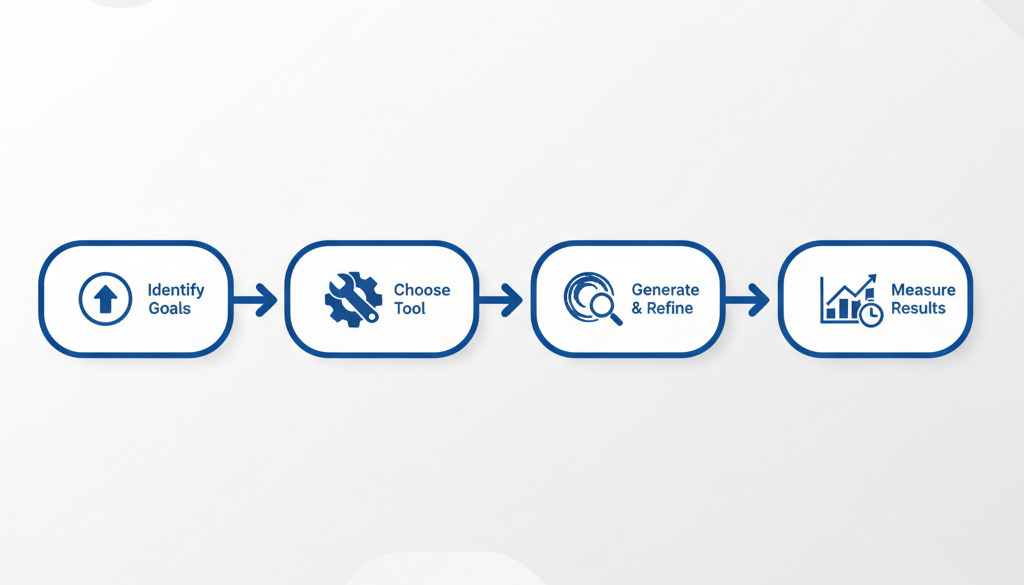
Getting Started with AI Content: A Practical Roadmap for Small Businesses
Embarking on your AI content journey doesn't have to be intimidating. The key is to start small, build confidence, and scale your efforts as you see results. Here is a practical, step-by-step roadmap for any small business owner looking to get started:
- Define a Single, Clear Goal: Don't try to do everything at once. Start with one specific objective. Is it to improve your product descriptions? To publish one blog post per week? To create more social media content? A clear goal will guide your focus.
- Start with Low-Risk Applications: Begin with content that is easy to create and review. Generating ideas for social media posts, writing first drafts of product descriptions, or creating outlines for future blog posts are excellent starting points. This allows you to get comfortable with the technology without the pressure of publishing a flagship article immediately.
- Choose a User-Friendly Tool: Select a platform designed for business owners, not tech experts. Look for an intuitive interface, clear instructions, and helpful support. This is where exploring a specialized service can be a huge advantage.
- Embrace the "Generate and Refine" Workflow: Use the AI to create the first 80% of the content. Then, dedicate a small amount of time to reviewing, editing, and adding your unique human touch. This is the most efficient and effective way to use AI.
- Measure Your Results: Track the impact of your efforts. Did website traffic increase? Are your new product descriptions converting better? Use simple metrics to validate your investment of time and resources.
For many business owners, the biggest hurdle is the initial hesitation and fear of the unknown. This is why I built the "More Customers From Your Blog" service with a simple, risk-free entry point. The mission is to get professional SEO articles on your website in minutes, attracting customers through Google as if by magic. To make this accessible, your first five blog posts are completely free. This allows you to experience the power of AI-driven content for your own business, see the quality of the output, and measure the initial results without any commitment. It’s the perfect way to take that first step.
Debunking AI Content Myths: Addressing Common Misconceptions
As with any transformative technology, AI is surrounded by myths and misconceptions. For business owners who are not tech-savvy, these fears can be a significant barrier to adoption. Let's address some of the most common myths directly.
Myth 1: AI Content is Unoriginal and Repetitive
This was a valid concern with early-generation AI, but modern language models are incredibly sophisticated. They do not "copy and paste" from the internet. Instead, they analyze patterns from vast datasets to generate entirely new sentences and ideas. When guided with specific prompts and your unique brand context, AI can produce highly original content. The key is providing quality input to get quality output.
Myth 2: AI Tools Require Advanced Technical Skills
While the technology behind AI is complex, the user-facing tools are not. The best AI content platforms are designed for simplicity. If you can write an email or a social media post, you have all the technical skills needed to use most AI writers. The goal of these companies is to make their technology accessible, not to create a barrier to entry.
Myth 3: AI Content Will Make Human Writers Obsolete
This is perhaps the biggest fear, but it misunderstands the role of AI. AI is a tool to augment human capabilities, not replace them entirely. It excels at tasks that are time-consuming for humans, like research, data compilation, and first-drafting. This frees up human writers and business owners to focus on higher-value tasks: strategy, creativity, editing, and building a genuine brand voice. The future is collaborative, with AI as the assistant and a human as the creative director.
Measuring Success: Key Metrics to Track Your AI Content Performance
Creating content is only half the battle; to ensure your strategy is working, you must measure its impact. Tracking key performance indicators (KPIs) allows you to understand what
Keep reading
Hand-picked guides that go deeper — open the one you need next:
- Small Business AI Content: A Guide to Scalable Growth
- Small Business, Big Impact: Leveraging AI for Professional Content Marketing
- Boost Your SEO in 2026: The AI Edge for Small Businesses
- AI Blog Writing: A Small Business Guide to Google Rank
→ Read the full Small Business guide