
Local SEO AI Content: Strategies for 2026 Dominance

The digital storefront has undergone a seismic shift. For over a decade, local search was a relatively predictable game of keywords, citations, and proximity. However, as we move through 2026, the landscape is being redefined by Artificial Intelligence.[1] Platforms like ChatGPT, Google Gemini, and Search Generative Experience (SGE) are changing how users find local services. According to recent industry forecasts from Gartner, traditional search volume is expected to decline significantly as users shift toward AI-powered answers.
For local businesses, this transition represents both a risk and a massive opportunity. It is no longer sufficient to simply rank in the "local pack" of blue links; you must become the entity that AI models trust and recommend. This article explores how to strategically leverage AI content generation to dominate local search, focusing on high-quality orchestration that balances machine efficiency with human authenticity.
Understanding Local SEO: Foundations for AI Integration
Local search engine optimization (SEO) is the practice of improving the online visibility of businesses that serve their communities face-to-face.[2] Its core objective is to ensure that when a customer searches for "emergency plumber near me" or "best coffee shop in Boston," your business appears at the top. The primary drivers of local rankings remain proximity, relevance, and prominence. However, the way these factors are interpreted by search engines has become increasingly sophisticated.
Key pillars of local SEO include Google Business Profile (GBP) optimization, managing local citations across directories, collecting authentic online reviews, and establishing strong on-page local signals. The inherent challenge for small to mid-sized businesses is the sheer volume of content required to keep these signals fresh. Geographically specific intent requires constant updates and hyperlocal relevance. This is where AI integration becomes a necessity rather than a luxury, providing the scale needed to compete in crowded urban markets without inflating marketing budgets beyond reach.
The Rise of AI in Content Creation: Capabilities and Applications
AI content generation has evolved from simple text prediction to complex Large Language Models (LLMs) capable of producing human-like reasoning and narrative structures. In the context of SEO, these tools allow marketers to generate drafts, brainstorm topic ideas, and summarize vast amounts of competitor data in seconds. The capability of AI to understand "context" rather than just "keywords" is what makes it revolutionary for local businesses.
Beyond traditional blog posts, AI is now used for more granular applications: rephrasing technical jargon into localized slang, generating video scripts for local Facebook ads, and even analyzing customer sentiment in reviews to identify service gaps. By automating the foundational heavy lifting of content drafting, local businesses can maintain a prolific online presence that was previously only available to national brands with dedicated content teams. The goal is to move past "digital clutter" and into a phase of direct, helpful results that AI search engines can easily parse and recommend.
Strategic AI Content Generation for Local SEO: Core Principles
The most common mistake businesses make is treating AI as an "autopilot" solution. True strategic advantage comes from using AI to augment human expertise, not replace it. The first principle of effective local AI content is the "AI-as-Assistant" model. A human must define the strategy, the tone, and the factual accuracy, while the AI executes the technical drafting.
Central to this is prompt engineering. For local SEO, a generic prompt like "Write a blog about plumbing" is useless. A strategic prompt would be: "Act as a local expert plumber in Austin, Texas. Write an informative update about how the recent flash flooding in the Zilker neighborhood affects residential drainage systems, focusing on three preventative steps homeowners can take." This degree of specificity ensures the output is geographically relevant and satisfies the "E-E-A-T" (Experience, Expertise, Authoritativeness, and Trustworthiness) criteria that search engines prioritize.
Optimizing Google Business Profile (GBP) with AI-Assisted Content
Your Google Business Profile is the digital equivalent of your front door. AI can drastically improve the maintenance of this asset. Descriptions that were once static and boring can be refreshed using AI to include current mission statements and localized service modifiers. For example, rather than a generic "We sell furniture," AI can help craft: "Serving the Manhattan area for 20 years, our showroom near Union Square features ergonomic office solutions tailored for New York apartments."
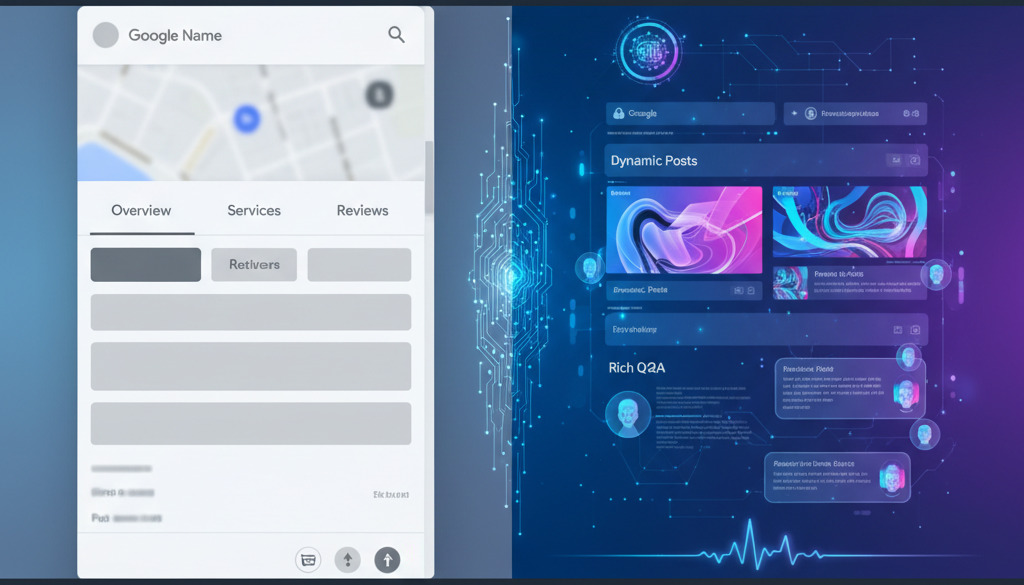
Furthermore, AI-driven consistency in GBP Posts is vital. These "mini-blogs" signal to Google that your business is active. AI can generate a month's worth of post ideas—ranging from "Weekend specials in [City]" to "How we're participating in the [Local Festival]"—in minutes. Even the Q&A section can be enhanced; AI can analyze your existing service catalogs to draft comprehensive, helpful responses to common user questions, ensuring that potential customers get instant, accurate information when they land on your profile.
Hyperlocal Content Creation: Leveraging AI for Geographic Relevance
Hyperlocal content goes beyond the city level to the neighborhood, street, or landmark level. It is the gold standard for capturing highly targeted search intent. AI excels at this when provided with the right data. For instance, a real estate agency can use AI to generate "Neighborhood Guides" that mention specific parks, schools, and even local legends or historical facts about a four-block radius.
For service-based businesses, AI can create distinct Service Area Pages. If you are a contractor in Chicago, your "Lincoln Park" page should feel fundamentally different from your "Naperville" page. AI can help synthesize neighborhood-specific data—such as typical housing styles or local building codes—into the copy. This creates an immediate bond of trust with the user, who sees that you understand their specific environment. However, human oversight remains mandatory here to ensure that a local landmark mentioned by the AI hasn't been closed for five years, an error that would immediately destroy local credibility.
Enhancing On-Page Local SEO with AI-Generated Content
On-page SEO remains the "source of truth" according to recent studies. When AI engines like Gemini or ChatGPT look for answers, they often crawl your website to verify the data found on third-party platforms. AI can be used to optimize your Location Landing Pages by naturally weaving in "entity-based" keywords. Instead of "Plumber in Dallas," AI helps you rank for semantic variations like "Residential pipe repair near the American Airlines Center."
Crucially, AI can generate optimized Meta Titles and Descriptions at scale. If you have 50 different location pages, writing unique, compelling meta-data for each is a grueling task. AI can do this in seconds, ensuring each tag includes the specific city/neighborhood and a compelling local call-to-action (CTA). Furthermore, AI can assist in checking that your Schema Markup (code that tells search engines what your content means) aligns perfectly with the text on the page, creating a cohesive signal for search crawlers.
AI-Powered Content for Local Link Building and Citations
Link building is often the most difficult part of local SEO, but AI simplifies the "content" side of the outreach. AI can analyze local news trends to suggest Guest Post Ideation for local news sites or community blogs. If the local news is discussing a new water restriction, an AI can help a landscaping business quickly draft a "Water-Saving Garden Guide" to offer as a guest resource, earning a high-quality local backlink.
Additionally, AI can help identify niche-specific citation opportunities. By scraping lists of local business directories and comparing them to your competitors, AI can generate a priority list of where your business is missing. It can even help draft personalized outreach emails to local chamber of commerce members or nearby businesses for potential cross-promotional partnerships, making the "human" part of networking much more efficient.
Measuring the Impact: Tracking AI Content Performance in Local SEO
Data without analysis is just noise. To succeed with local SEO AI content, you must track metrics that go beyond simple ranking positions. Key performance indicators (KPIs) should include GBP Insights (how many people called or requested directions after viewing an AI-generated post?) and Local Organic Traffic (are the neighborhood-specific pages actually landing visitors?).
Modern SEO platforms now provide "AI Visibility" scores, showing how often your business is mentioned in AI-generated overviews. If your AI-assisted content is working, you should see an increase in "zero-click" engagement—where users find your hours or phone number directly in the search result. Businesses should use A/B testing: compare the performance of a human-only page versus an AI-assisted, human-edited page to see which resonates better with both search engines and local users.

Ethical Considerations and Best Practices for AI in Local SEO Content
As AI becomes ubiquitous, "responsible AI" is the new benchmark for quality. The biggest risk is factual hallucination. If an AI generates a blog post for a local medical clinic and includes incorrect health advice or an outdated address, the consequences are severe. Human review is non-negotiable. Every piece of AI-generated content must be checked for accuracy, brand voice, and originality.
Moreover, businesses must avoid the "uncanny valley" of content—text that feels almost human but is clearly robotic. AI content should serve as a base that a human editor then seasons with local anecdotes, personal experiences, and specific client success stories. Google’s algorithms are increasingly adept at identifying "low-effort" content. To stay safe, ensure your AI-assisted pages offer genuine value and aren't just a collection of keywords designed to trick an algorithm that no longer exists in its 2010 form.
The Future of AI in Local SEO: Predictions and Opportunities
Looking ahead, we're entering the era of Generative Engine Optimization (GEO) and Answer Engine Optimization (AEO). In the near future, local search will move toward predictive analytics. AI will not just show you the closest pizza place; it will predict which one you are most likely to enjoy based on your past behavior and current local events. For businesses, this means content will need to become more dynamic—changing based on real-time factors like weather, local traffic, or stock levels.
We may also see AI agents navigating the web on behalf of users. Your website must be structured as a "Source of Truth" that these agents can easily read. This means moving beyond "marketing speak" and toward structured data and clear, authoritative statements. The future belongs to businesses that use AI to be more human, using the time saved on drafting to focus on actual customer service and community engagement.
Conclusion: Human-AI Synergy for Local Search Dominance
The integration of AI into local SEO is not a trend to be ignored, but a paradigm shift to be embraced. By leveraging AI to handle the scale and technicalities of content creation—from Google Business Profile updates to hyperlocal neighborhood guides—businesses can achieve a level of visibility that was previously impossible. However, the technology is merely a multiplier of your existing expertise.
The winners in the 2026 local search landscape will be those who master the synergy between machine efficiency and human intuition. Use AI to research, draft, and optimize, but use your human team to verify, empathize, and lead. Start small: optimize your GBP descriptions with AI today, audit your location pages, and ensure that every piece of content you publish serves your local community first. In the world of AI search, authenticity is the highest-ranking signal of all.
Keep reading
Hand-picked guides that go deeper — open the one you need next:
- The Future of Content Marketing: AI for Small Business
- Local SEO for Small Business: Dominate with AI Content
- Local SEO for Plumbers: Attract More Customers with AI Content
- Boost Local Rankings with Volteruno's AI Content
→ Read the full Small Business guide
→ Read the full Small Business guide