
Reach Global Audiences: Multilingual AI Blog Articles

Key Takeaways
- Unlock Global Markets: Multilingual AI content allows businesses to access untapped, non-English-speaking customer bases, significantly expanding revenue opportunities.
- Boost Efficiency: AI drastically reduces the time and cost associated with traditional content translation and localization, allowing for rapid scaling across multiple languages.
- Enhance SEO: By creating content optimized for local search terms in various languages, you can improve global search engine rankings, drive targeted traffic, and increase engagement.
- Human Oversight is Crucial: AI is a powerful tool for generating first drafts, but human review by native speakers is essential to ensure cultural nuance, accuracy, and brand consistency.
- Accessible for All Businesses: Modern AI platforms are designed for ease of use, making it possible for business owners who are not digital natives to implement a sophisticated global content strategy without a steep learning curve.
In today's deeply interconnected world, the digital frontier is no longer confined to a single country or language. For ambitious businesses, growth means thinking globally. However, reaching international audiences has traditionally been a major hurdle. The process of translating and localizing content for diverse markets is often slow, expensive, and complex. Many small and medium-sized business owners know they need to be online and visible, but simply lack the time and resources to tackle this challenge. Fortunately, a revolutionary solution has emerged: multilingual AI content. This technology levels the playing field, making a global reach more accessible and affordable than ever before.
Understanding the Core: What is Multilingual AI Content?
At its heart, multilingual AI content is text that has been generated or adapted by artificial intelligence for use in multiple languages.[2] It’s not just about swapping words from English to Spanish; it’s about creating relevant, readable, and effective communication for different linguistic audiences. This technology represents a major leap forward for any business looking to expand its digital footprint.
The Technology Driving the Change
The engine behind this innovation involves sophisticated branches of AI known as Natural Language Processing (NLP) and Machine Learning (ML).[1] NLP gives computers the ability to understand, interpret, and generate human language. ML allows these systems to learn from vast amounts of data—in this case, billions of texts from across the internet in various languages. This training enables them to understand not just vocabulary but also grammar, syntax, and even some elements of style.
Beyond Simple Translation
It’s crucial to distinguish multilingual AI content from basic online translation tools like Google Translate. While those services are useful for getting the gist of a sentence, they perform literal, word-for-word translations. Multilingual AI aims for a higher standard. It attempts to understand the context and produce more natural-sounding phrasing, taking into account common idioms and sentence structures in the target language. While still an evolving field, the goal is to create content that feels written for a native speaker, not just translated for one.
The Business Imperative: Why Go Multilingual Now?
For business owners who are focused on day-to-day operations, the idea of expanding into 25 languages might seem daunting. However, the strategic reasons for doing so have never been more compelling. The question is shifting from "why should we?" to "can we afford not to?" As recent data shows, a staggering 76% of online shoppers prefer to buy from websites that provide information in their own language.
Accessing Untapped Markets
The majority of the world's internet users do not speak English as their first language. These represent vast, underserved markets waiting for businesses to communicate with them effectively. By offering content in languages like Spanish, French, German, Japanese, or Portuguese, you can connect with millions of potential customers who would otherwise never find or engage with your brand. This translates directly into new revenue streams and business growth.
Enhancing the Customer Experience
Speaking to customers in their native language is a powerful way to build trust. When a user lands on your website and finds blog posts, product information, and support articles in a language they understand fluently, it creates an immediate sense of comfort and credibility. This positive experience fosters brand loyalty, improves engagement, and makes customers feel valued, which is key to long-term success.
Gaining a Competitive Edge
In a crowded marketplace, a multilingual content strategy can be a significant differentiator. While your monolingual competitors are limited to English-speaking audiences, you can establish a strong presence in international markets. This first-mover advantage allows you to build brand authority and capture market share before others even get started.
Overcoming Barriers: The Traditional Cost and Time Drain of Localization
For years, the path to a global audience was paved with significant obstacles, especially for small and medium-sized businesses. The traditional approach to localization is resource-intensive, creating bottlenecks that make true scalability nearly impossible.
The Manual Translation Burden
The most significant barrier has always been cost. Professional human translation is a specialized skill, and it comes at a premium. A typical workflow involves:
- Hiring a professional translator (often charged per word).
- Engaging a separate editor or proofreader to check for errors.
- Employing a localization specialist to ensure cultural appropriateness.
When this process is repeated for five, ten, or twenty languages, the costs can quickly spiral into tens of thousands of dollars for even a moderate amount of content.
The Pace of Production
Time is another critical factor. Manual translation is inherently slow. A single blog post can take days or even weeks to be translated, proofread, and formatted for multiple languages. This slow pace makes it difficult to react to market trends, launch global campaigns simultaneously, or maintain a consistent publishing schedule across all your target regions. It creates a significant lag that can put you steps behind more agile competitors.
Maintaining Consistency Across Languages
Ensuring your brand's voice, tone, and core messaging remain consistent across different languages is a monumental challenge with traditional methods. When you have different translators and agencies handling different languages, subtle variations can creep in, diluting your brand identity. It requires a tremendous amount of oversight and project management to keep everyone aligned, adding another layer of complexity and expense.
AI as Your Global Content Engine: The Mechanics of Multilingual AI Content Creation
Artificial intelligence transforms the daunting task of multilingual content creation into a streamlined and manageable process. Instead of a slow, manual assembly line, AI acts as a powerful, on-demand content engine. For business owners who need efficiency, understanding its mechanics reveals a path to effortless global expansion.
Core AI Generation Capabilities
Modern AI tools, particularly those built on advanced Large Language Models (LLMs), can generate original content in numerous languages from scratch. You provide a prompt—a set of instructions, keywords, and a desired topic—and the AI writes a complete article, product description, or social media post in the specified language. This means you don't always need a source English text; you can create unique content directly for your target markets.
The "Adapt and Translate" Process
Beyond creating new content, AI excels at taking existing content and intelligently adapting it for other languages. This process is far more sophisticated than simple word-for-word translation. The AI analyzes the structure and intent of the source text and reconstructs it in the target language, using more natural syntax and phrasing. This "transcreation" capability allows you to leverage your existing library of high-performing English content for global audiences efficiently.
Leveraging Large Language Models (LLMs)
The foundation of this technology is the Large Language Model. These are massive AI models trained on a diverse, multilingual dataset encompassing a significant portion of the public internet. This extensive training gives them a deep understanding of linguistic patterns, cultural references, and different styles of writing across dozens of languages. It is this foundational knowledge that allows them to generate coherent, contextually relevant, and stylistically appropriate content at scale.
Strategic Advantages of AI-Powered Multilingual Content
Adopting an AI-driven approach to multilingual content isn't just about modernizing a workflow; it's about unlocking strategic advantages that can fundamentally change your growth trajectory. For time-strapped business owners, these benefits translate directly to a stronger bottom line and a greater return on investment.
Scalability and Speed
This is perhaps the most significant advantage. With traditional methods, launching in a new language is a major project. With AI, you can generate content for a new market in a matter of hours, not months. You can take a single article and have it ready in 10, 15, or even 25 languages simultaneously. This ability to scale rapidly allows you to test new markets and expand your presence with unprecedented agility, drastically reducing your time-to-market.
Cost-Effectiveness
The cost savings are substantial. While AI platforms typically involve a subscription fee, this is often a fraction of the cost of hiring professional translators for a large volume of content. For the price of translating a few blog posts manually, an AI service could generate hundreds. This makes a robust multilingual strategy financially viable for small and medium-sized businesses, not just large multinational corporations.
Content Volume and Frequency
Search engines reward websites that publish fresh, relevant content regularly. AI enables you to maintain a high-frequency publishing schedule across all your target languages. Instead of one English blog post per week, you can publish one post per week in ten different languages. This massive increase in content volume signals to search engines that you are a relevant authority in these markets, helping to boost your international SEO efforts and drive organic traffic.
Choosing the Right Subjects: What Content Benefits Most from Multilingual AI?
While AI can handle a wide variety of content types, a strategic approach involves focusing its power where it will deliver the most impact. Certain types of content are perfectly suited for AI generation and localization, allowing you to maximize efficiency and ROI.
High-Volume, Evergreen Content
This is the sweet spot for multilingual AI. Content that remains relevant over a long period is an ideal candidate for translation and localization across multiple languages. Examples include:
- Blog Posts: Informational articles, how-to guides, and industry insights can attract traffic for years. Generating these in multiple languages is a highly effective SEO strategy.
- FAQs: A comprehensive FAQ page is invaluable for customer self-service. Translating it allows you to support a global customer base efficiently.
- Product Descriptions: For e-commerce businesses, having detailed product descriptions in the local language is essential for sales. AI can generate these at scale, as highlighted in guides on AI product description generators.
- Informational Pages: "About Us," "Our Mission," and other foundational website pages.
Content Requiring Regular Updates
If you have content that needs frequent updates—such as articles about changing regulations, software updates, or recurring events—AI can be an incredible time-saver. When new information becomes available, you can quickly update the source text and use AI to propagate those changes across all language versions instantly. This ensures consistency and accuracy without a tedious manual review process for each language.
Initial Market Entry Content
When you decide to enter a new country or linguistic market, you need to populate your regional website with a foundational layer of content quickly. AI is the perfect tool for this task. It can rapidly generate a starting set of blog articles, service pages, and company information to establish an immediate presence and begin attracting local search traffic while you develop more in-depth, culturally-specific campaigns.
Ensuring Quality and Accuracy: The Human Touch in AI Content
The power and speed of AI are undeniable, but it's critical to approach this technology with a realistic perspective. The most successful multilingual content strategies are not fully automated; they are a blend of artificial intelligence and human intelligence. Thinking of AI as a hyper-efficient assistant, rather than a complete replacement for human expertise, is the key to success.
AI as a First Draft Generator
The most effective way to use multilingual AI is as a powerful first-draft generator. It can handle the most time-consuming part of the process—the initial translation and adaptation—in minutes. This gives you a document that is approximately 80-95% of the way there, saving immense amounts of time and money. However, that final 5-20% is where human oversight becomes indispensable.
The Role of Human Reviewers
After the AI has created the content, a native speaker or a subject matter expert must review it. This human touch is crucial for several reasons:
- Nuance and Tone: AI can struggle with the subtle nuances of tone, humor, and brand voice. A human can refine the text to ensure it aligns perfectly with your brand identity.
- Cultural Sensitivity: A phrase that is perfectly innocent in one culture could be inappropriate or confusing in another. A human reviewer can catch these potential red flags.
- Factual Accuracy: While generally reliable, AI can occasionally make factual errors or "hallucinate" information. An expert must verify all claims, statistics, and technical details.
Iterative Improvement
Many advanced AI systems can learn from human feedback. When a reviewer makes a correction, that data can be used to fine-tune the AI model. Over time, this iterative process helps the AI produce even better, more accurate, and more stylistically appropriate outputs for your specific needs, making the workflow progressively more efficient.

SEO Beyond Borders: How Multilingual AI Content Boosts Global Search Visibility
A multilingual website is not just a customer service tool; it is a powerful engine for international Search Engine Optimization (SEO). By creating content in your customers' native languages, you can significantly improve your visibility in search engines like Google around the world. This is a core component of any serious global growth plan, and AI makes it achievable for any business.
Targeting Local Search Queries
People in different countries search for products and services using their native language and local slang. An English-only website will never rank for a search term like "mejores zapatillas para correr" (best running shoes) in Spain. AI can help you create content that is specifically optimized for these local keywords. By researching and incorporating these terms naturally, you can attract highly qualified organic traffic from search engines in your target markets. Thinking about this from a strategic level is key, a topic explored in discussions on AI-driven keyword research strategies.
Building Authority in New Markets
Search engines aim to provide users with the most relevant, authoritative content. A website with a deep library of high-quality articles, guides, and resources in Spanish tells Google that you are an authority on that topic for the Spanish-speaking market. Publishing content frequently across multiple languages signals your relevance and commitment, which is rewarded with higher search rankings over time.
Reducing Bounce Rates and Increasing Engagement
When a user from Germany clicks on a search result and lands on a page written in fluent German, they are far more likely to stay, read, and engage with the content. This behavior—longer time on page, lower bounce rates, and more clicks—sends strong positive signals to search engines. It tells them that you are providing a valuable experience for users in that region, which further boosts your rankings for future searches.
Implementing Multilingual AI Content for Your Business
Getting started with multilingual AI content is more straightforward than many business owners think. It involves a clear, strategic process: defining your goals, choosing the right tools, and establishing an efficient workflow. This systematic approach ensures you get the best results without wasting time or resources.
Defining Your Target Languages and Audiences
The first step is not to translate into every possible language, but to be selective. Use your existing business data or conduct market research to identify which countries or linguistic groups offer the most potential for your products or services. Where do you already have some customer traction? Which markets have a large, underserved population? Start with 2-3 high-potential languages before expanding further.
Selecting the Right AI Tools and Platforms
The market for AI content tools is vast. Some are general-purpose writers, while others are built specifically for business and SEO performance. For business owners who need a reliable, efficient solution, it pays to look for a specialized service. For example, some platforms are emerging with a clear promise for businesses, such as the service conceptually named "More Customers From Your Blog — We Write SEO Articles For You." This type of service uses its own proprietary AI to generate professional, SEO-optimized blog articles in minutes, removing the technical burden from the business owner.
Establishing a Workflow
A successful implementation relies on a repeatable process. A typical workflow looks like this:
- Prompt Creation: Clearly define the topic, target keywords, desired tone of voice, and any other key instructions for the AI.
- AI Generation: Use your chosen platform to generate the first draft of the content in your target languages.
- Human Review: Send the AI-generated text to a native-speaking freelancer or an internal team member for review. They should check for accuracy, cultural nuances, and brand voice.
- Formatting and Publication: Once approved, format the content in your CMS (like WordPress or Shopify) with proper headings, images, and internal links.
- Publish and Promote: Publish the article and promote it through your local social media channels or email lists.
Navigating Cultural Nuances with AI and Human Expertise
True localization goes deeper than language; it delves into culture. While AI is becoming more sophisticated, it cannot replicate the lived experience and deep cultural understanding of a human being. Therefore, successfully navigating cultural nuances requires a smart combination of AI’s efficiency and human expertise.
Beyond Literal Translation
Effective global marketing is not about direct translation. It’s about conveying a message in a way that resonates with the target audience. AI can be prompted to consider this—for example, you can instruct it to "avoid a humorous tone for a German audience" or "use an enthusiastic and friendly tone for a Brazilian audience." This helps guide the AI, but it is not foolproof. A human must make the final judgment on whether the tone is appropriate.
Identifying Cultural Red Flags
Human reviewers are your most important line of defense against cultural missteps. They can identify potentially sensitive topics, inappropriate idioms, or imagery that might be offensive in a specific culture. For example, a hand gesture that is positive in one country could be insulting in another. An AI, lacking real-world context, would likely miss this. This process of refinement is crucial for protecting your brand’s reputation.
Adapting Marketing Messaging
Calls-to-action (CTAs), slogans, and value propositions may need to be entirely rephrased to be effective in different cultures. A direct, assertive CTA like "Buy Now and Save 20%!" might work well in the US but could be perceived as overly aggressive in Japan, where a softer approach like "View Plan Options" might be more effective. AI can help generate alternatives, but a human with marketing experience in that region should make the final strategic choice.
Case Studies: Real-World Success with Multilingual AI Content
The theoretical benefits of multilingual AI become much clearer when viewed through the lens of real-world application. While specific company data is often proprietary, we can look at hypothetical but realistic examples that mirror the success businesses are finding.
Example 1: The E-commerce Retailer Entering Europe
An American online store selling specialized hiking gear identified a growing market in Germany and France but lacked the budget for a full-scale localization team.
- Action: They used an AI platform to translate their top 50 product descriptions and 10 of their most popular blog posts about hiking trails and gear reviews into German and French.
- Process: The AI-generated content was then reviewed by freelance native speakers for a few hundred dollars per language, a fraction of the cost of full translation.
- Result: Within three months, organic traffic from Germany and France increased by over 300%. They saw their first sales from these countries and were able to use the AI to create localized ads for social media, resulting in a 15% increase in online revenue.
Example 2: A B2B Software Company Tapping into Asia
A B2B software-as-a-service (SaaS) company wanted to expand into the Japanese and South Korean markets. The technical nature of their content made traditional translation slow and expensive.
- Action: They leveraged an AI tool to adapt their entire existing library of support documentation and 20 key "how-to" articles into Japanese and Korean. The focus was on providing immediate value through self-service help content.
- Process: The AI drafts were reviewed by their in-country sales partners, who could quickly verify the technical accuracy and make minor adjustments.
- Result: The company saw a 40% reduction in support tickets from these new markets because customers could find answers on their own. The localized content also generated high-quality leads, with inbound inquiries from Japan and Korea increasing by 25% in the first six months. Mastering a content strategy with a strategic SEO blueprint was key to this success.
Measuring Success: Key Metrics for Multilingual AI Content Performance
Implementing a multilingual AI content strategy is not a "set it and forget it" activity. To ensure you’re getting a positive return on your investment, you need to track the right performance metrics. For a busy business owner, these metrics provide a clear, data-driven picture of what’s working.
Website Traffic by Language and Region
This is the most fundamental metric. Using a tool like Google Analytics, you can filter your website traffic to see how many visitors are coming from specific countries or have their browser set to a particular language. A steady increase in traffic from Germany after launching German content is a clear indicator of success.
Engagement Metrics
Traffic alone isn't enough. You need to know if users are finding the content valuable. Key engagement metrics include:
- Time on Page: Are users spending time reading your localized content?
- Bounce Rate: Are users leaving your site immediately after arriving, or are they exploring further? A low bounce rate is a good sign.
- Pages per Session: Are visitors clicking through to other pages on your site?
Strong engagement metrics for your multilingual content tell search engines that you are providing a high-quality user experience.
Conversion Rates and Lead Generation
Ultimately, content should drive business results. Track how many visitors from your target regions are completing key actions, such as filling out a contact form, signing up for a newsletter, or making a purchase. Monitoring conversion rates by language and region is the most direct way to measure the ROI of your efforts.
SEO Rankings in Target Markets
Use an SEO tool to track your website’s search engine rankings for your main keywords in your target countries. For example, are you moving up the results page on Google.de (Germany) for your target German keywords? Improvement in search rankings is a leading indicator of future organic traffic growth.
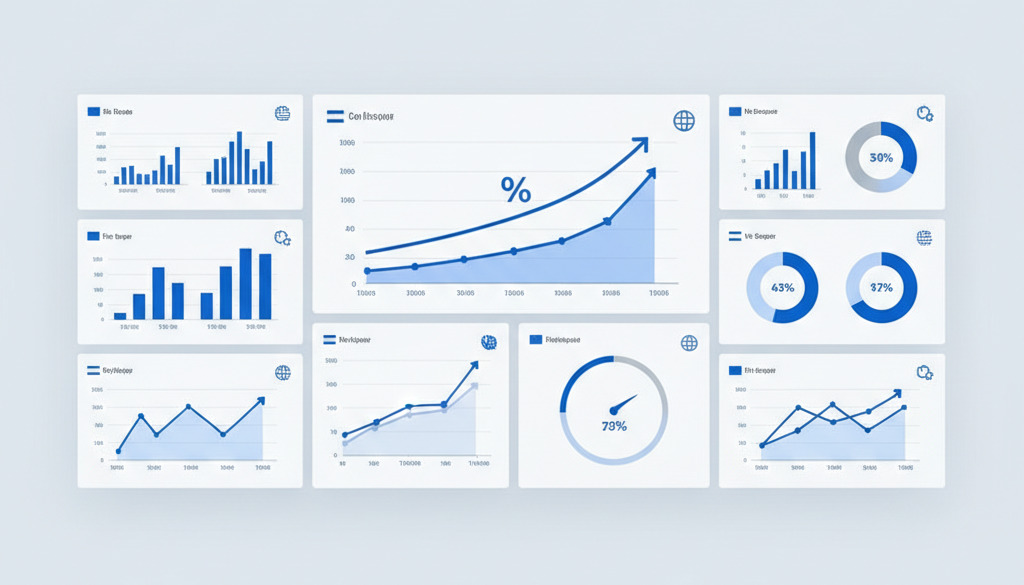
Dashboard displaying upward trends and ROI for multilingual content strategy. The Future of Multilingual Content: AI's Evolving Role
The field of artificial intelligence is advancing at an astonishing pace, and its capabilities in multilingual content creation are continuously improving. Looking ahead, several key trends will shape how businesses communicate globally, making these tools even more powerful and integrated into our workflows.
Increasing Sophistication of AI
The AI of today is already impressive, but the AI of tomorrow will have an even greater grasp of complex linguistic challenges. We can expect future models to be much better at:
- Understanding and replicating brand voice with minimal prompting.
- Detecting and applying cultural nuances, humor, and idiomatic expressions more accurately.
- Generating text that is virtually indistinguishable from that written by a top-tier human copywriter.
As one recent analysis of 2026 AI trends noted, the focus is shifting from model capability to reliable system design that works across languages from the ground up.
Personalized Multilingual Experiences
The next frontier is hyper-personalization. In the near future, AI may be able to tailor content not just for a language, but for an individual user. Imagine a website that can adjust its tone, examples, and even product recommendations in real-time based on a user's location, past behavior, and dialect. This will create a truly one-to-one customer experience on a global scale.
The Blended Approach Will Remain
Despite these advancements, the consensus is that the future is a blended model. AI will become an even more powerful and seamless partner, but strategic human oversight will remain critical. Humans will guide the strategy, validate cultural appropriateness, and make the final call on brand messaging. The synergy between human creativity and AI’s computational power will be the hallmark of successful global content strategies.
Getting Started: Your First Steps with Multilingual AI Content
For a business owner who is not a digital native, the idea of launching a global content strategy can feel overwhelming. The key is to start small and take pragmatic, manageable steps. You don't need to do everything at once.
Start Small, Test, and Learn
Don't try to launch in 20 languages on day one. Choose one or two languages that, based on your research, have the most potential. Run a small pilot project. Translate your five most popular blog posts or your top ten product pages. Measure the results over a few months. This test-and-learn approach allows you to build a business case and refine your workflow with minimal risk.
Define Clear Objectives
Before you begin, know what you want to achieve. Is your primary goal to increase website traffic, generate leads from a new country, or reduce support costs? Having a clear objective will help you focus your efforts and measure success effectively. For example, your goal could be: "Increase organic traffic from Mexico by 20% within six months."
Explore Accessible Solutions
You don't need a team of data scientists to get started. The best approach is to find a service that does the heavy lifting for you. Look for platforms designed specifically for business owners who need results without the complexity. For instance, some services offer a compelling proposition where their proprietary artificial intelligence writes professional SEO blog articles for your website in minutes—almost like magic. The immediate benefit is clear: customers will find you on their own in Google, reducing your reliance on paid advertising. To make the decision even easier, some of these platforms have proven their value and offer a risk-free way to begin. As they say, "More than 500 companies are already using it. Your first 5 posts are free." This kind of accessible, results-oriented solution is the perfect starting point.
Conclusion
The digital world is global, and language should no longer be a barrier to your business's growth. Multilingual AI content represents a transformative shift, moving global expansion from a costly, complex endeavor to an accessible, strategic opportunity. For small and medium-sized business owners, this technology is an empowering tool that levels the playing field, allowing you to connect with customers in their native tongue, build trust, and drive revenue in previously untapped markets.
By blending the incredible speed and scale of AI with essential human oversight, you can launch a sophisticated international content strategy efficiently and affordably. The time to think globally is now. By exploring AI-driven content solutions, you can take the first crucial step towards building a truly international brand and ensuring your business thrives on the world stage.
Frequently Asked Questions
1. Is AI-generated multilingual content accurate enough to use for my business?
AI-generated content has become remarkably accurate, often reaching over 90% quality for many language pairs. However, it is not perfect. The best practice is to always use AI to create the first draft and then have a native speaker review and refine it. This "human-in-the-loop" approach ensures 100% accuracy, proper tone, and cultural appropriateness, giving you the best of both worlds: AI's speed and human quality control.
2. How much does it cost to get started with multilingual AI content?
The cost is significantly lower than traditional methods. Many AI content platforms operate on a subscription model, with plans starting from as low as $50-$100 per month, depending on the volume of content you need. Compared to hiring professional translators, which can cost hundreds or thousands of dollars for just a few articles, AI offers a massive cost saving that makes global content accessible to small businesses.
3. Do I still need to hire human translators?
You may not need to hire traditional translation agencies for the entire process, but you do need humans. Instead of paying for full translation, you will pay for review and editing, which is a much faster and less expensive task. You can hire freelance native speakers on platforms like Upwork for a fraction of the cost of a full translation project to handle this final, crucial quality check.
4. What is the very first step I should take?
The best first step is to identify one or two target languages with the most potential for your business. Use your website analytics to see if you are already getting traffic from non-English speaking countries. This data is your best clue for where to start. Once you've chosen a language, run a small pilot project by translating 3-5 of your most popular blog posts and measure the results.
5. How long will it take to see results from my multilingual SEO efforts?
SEO is a long-term strategy. While you might see an initial traffic increase within the first 1-2 months, it typically takes 4-6 months to see significant, stable results. Consistency is key. By regularly publishing high-quality, localized content, you will gradually build authority and climb the search rankings in your target markets, leading to sustainable organic traffic growth.
6. Can I use AI to translate my existing WordPress or Shopify blog?
Absolutely. Many AI content tools are designed to integrate with popular platforms like WordPress and Shopify. You can often export your existing content, have the AI adapt it into different languages, and then easily import the new versions back into your website. This is one of the most efficient ways to leverage your existing content library for a global audience, a topic further explored in guides like the one on WordPress SEO automation.
Keep reading
Hand-picked guides that go deeper — open the one you need next:
- AI Scalable Content Strategy for Rapid Growth
- Scale Your Business with AI: Content Marketing for Growth
- AI Keyword Research: Beyond Basic Keywords
- From Zero to Hero: Launch Your Business Blog with AI in Days
→ Read the full AI Content guide