
SEO Article Writing Strategy: A Comprehensive Guide for 2026

Key Takeaways
- Intent-Centric Writing: Success in 2026 requires aligning content with the specific search intent (informational, transactional, etc.) of the user.
- AI and Search Synergy: Modern strategies must optimize for both traditional search results and AI-driven summary extractions.
- Quality Over Density: Moving beyond keyword stuffing to focus on topical authority and comprehensive answers.
- Technical Foundation: Page speed, mobile-friendliness, and structured data are essential for maintaining visibility.
- Dynamic Updates: Regularly refreshing content is the only way to safeguard rankings in an era of rapid algorithmic shifts.
1. Understanding the Foundation: Purpose and Audience in SEO Content
Before a single word is typed, a successful SEO article writing strategy must be rooted in a clear business objective. Writing for the sake of publishing often leads to vanity metrics—traffic that doesn't convert or readers who bounce immediately. A polished strategy begins by asking if the goal is direct lead generation, building brand lifestyle authority, or establishing thought leadership within a specific niche.
Profiling the target audience is the next critical step. This involves more than just demographics; you must understand their pain points and the specific language they use to describe their problems. For instance, a C-suite executive and a junior developer may search for the same solution using entirely different terminology. Mapping these nuances ensures your content resonates on a personal level while remaining discoverable.
Aligning Audience Needs with Search Intent
Understanding the audience directly informs keyword selection. If your audience is looking for a quick fix, they will use "how-to" phrases, signaling informational intent. If they are comparing solutions, they will use brand names and "best of" modifiers. By identifying these patterns early, you can structure the article to mirror the user’s mental journey, ensuring higher engagement and lower bounce rates.
2. Strategic Keyword Research: Fueling Your Content Engine
Keyword research has evolved from finding high-volume terms to uncovering topical clusters. To fuel a robust content engine, you must look beyond short-tail keywords (e.g., "SEO") and focus on long-tail phrases and question-based queries (e.g., "how to develop an SEO article writing strategy for B2B"). These longer phrases often have lower competition and much higher conversion rates because they capture users further along the buying cycle.
Utilizing tools like SEMrush, Ahrefs, or Google Search Console allows you to analyze keyword difficulty and search volume. However, the modern strategist also looks at semantic keywords—terms related to the primary topic that help search engines understand the context and depth of your coverage. This holistic approach ensures your article is seen as a comprehensive resource rather than a superficial overview.
Differentiating Search Intents
To rank effectively in 2026, you must categorize keywords into four primary buckets:
- Informational: The user wants to learn something (e.g., "what is SEO writing").
- Navigational: The user is looking for a specific site or page.
- Commercial Investigation: The user is researching products or services (e.g., "top SEO tools 2026").
- Transactional: The user is ready to buy (e.g., "buy SEO strategy consultation").
3. Crafting a Compelling Narrative: The Art of Engaging Content
Writing for SEO does not mean writing for robots. In fact, Google’s increasingly sophisticated algorithms, such as those powering AI Overviews, prioritize clarity, conciseness, and value. A polished, business-like tone establishes authority, but the prose must remain accessible. Every sentence should serve the purpose of guiding the reader toward a solution. Avoid fluff; every paragraph must introduce a new idea or provide a specific example that reinforces your expertise.
The structure of the article is as important as the words themselves. Large blocks of text are intimidating and lead to high bounce rates. Instead, use frequent headings, short paragraphs (3-4 lines maximum), and bulleted lists to make the content skimmable. This allows readers to find the specific information they need quickly, which improves the overall user experience and performance metrics.
Incorporating Storytelling and Emotional Resonance
Even in a business context, stories sell. By framing your advice within a real-world scenario—such as a company that doubled its organic traffic by shifting its content strategy—you build a stronger connection with the reader. Addressing reader emotions, such as the frustration of stagnant growth or the pressure to perform, makes your brand feel human and trustworthy. Originality is your greatest asset here; provide unique insights and data that cannot be found elsewhere.
4. On-Page Optimization Techniques: Guiding Search Engines
On-page optimization is the process of providing clear signals to search engines about what your page is about. The strategic placement of keywords remains vital. Your primary keyword should appear in the first 100 words, the H1 tag, and at least one H2 heading. Secondary and semantic keywords should be distributed naturally throughout the body text to reinforce the topic without triggering "keyword stuffing" penalties.
Meta descriptions and title tags are your first opportunity to win the click. They should be descriptive, include the primary keyword, and feature a clear call to value. For example, instead of "SEO Writing Guide," use "SEO Article Writing Strategy: A Guide to Ranking in 2026." This sets expectations and entices the user to click through from the search engine results page (SERP).

Maximizing Discoverability via Internal Linking and Media
On-page SEO extends to how you handle non-text elements. Every image must have descriptive alt text that includes relevant keywords, helping your content appear in image searches. Furthermore, a robust internal linking strategy is essential. By linking to other relevant articles on your site, you help search engine crawlers discover new pages and distribute "link juice" (authority) across your entire domain, creating a cohesive web of information.
5. Off-Page SEO Synergies: Amplifying Your Article's Reach
While high-quality writing happens on your site, its impact is often determined by what happens off your site. Backlinks remain one of the strongest signals of authority. When reputable websites link back to your article, it serves as a vote of confidence to search engines. Earning these links requires a proactive approach, such as original research or high-value infographics that others in your industry want to reference.
Content promotion is a crucial part of an off-page strategy. Once an article is published, it should be shared across professional networks like LinkedIn and industry-specific forums. This social media amplification drives initial traffic, which signals to search engines that the content is relevant and engaging. This "velocity" of engagement can lead to faster indexing and higher initial rankings.
Synergy between on-page and off-page efforts: A perfectly optimized article will struggle without authority, and a high-authority site will fail if its on-page content is poor. The two work in tandem to create a comprehensive SEO success story.
6. Technical SEO Considerations for Article Publishing
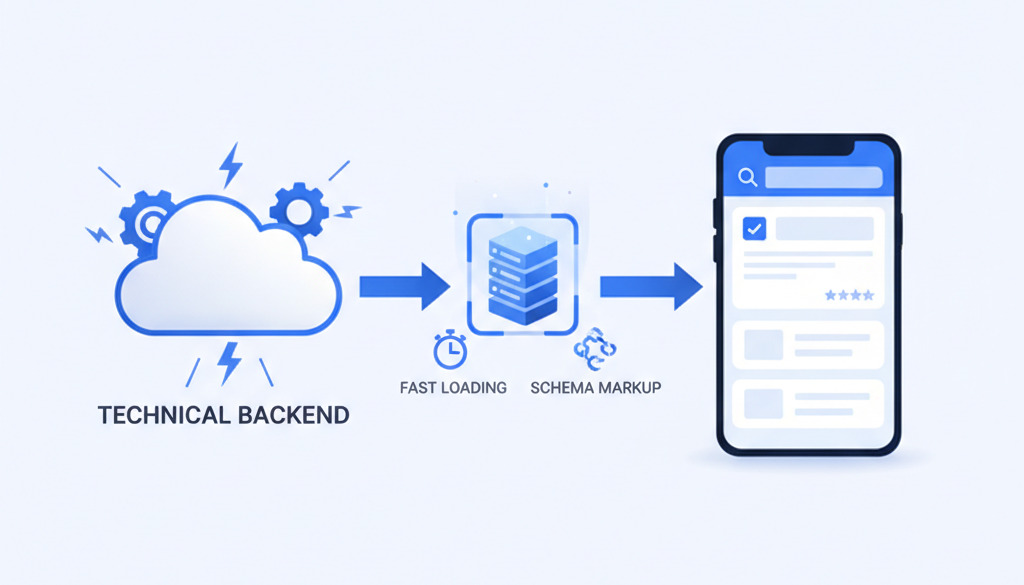
Technical SEO is the invisible architecture that supports your writing. Even the best SEO article writing strategy will fail if the website takes ten seconds to load. In the mobile-first indexing world of 2026, your content must be perfectly responsive. This means layouts that adjust seamlessly to different screen sizes and interactive elements that are easy to use on a touchscreen.
Structured data markup, or Schema, is another technical essential. By adding specific code to your article, you can help search engines understand that a particular piece of text is a "How-to," a "Review," or an "FAQ." This increases the likelihood of your content appearing as a rich snippet or being featured in an AI-generated answer box, significantly increasing your visibility on the SERP.
URL Structure and Site Health
Clean, descriptive URLs are more user-friendly and easier for search engines to parse. For example, yourdomain.com/seo-article-writing-strategy is far superior to yourdomain.com/p=12345. Additionally, regular technical audits to identify broken links, crawl errors, or duplicate content issues are necessary to ensure that your articles are being indexed correctly and that "dead weight" isn't dragging down your site's overall performance.
7. Measuring Success: Analytics and Iterative Improvement
You cannot manage what you do not measure. A professional SEO strategy relies on tracking Key Performance Indicators (KPIs) to determine the return on investment. Organic traffic growth is the most obvious metric, but it should be viewed alongside keyword rankings and conversion rates. Are readers taking the desired action—signing up for a newsletter or requesting a demo—after reading your article?
Tools like Google Analytics 4 (GA4) provide deep insights into user behavior. You can see exactly how long readers are spending on your page and where they are dropping off. High bounce rates or low "time on page" often indicate that the content didn't match the searcher's intent or that the opening hook wasn't strong enough. This data allows for precise, evidence-based refinements.
Interpreting Search Console Data for Growth
Google Search Console is particularly valuable for identifying "near-miss" opportunities. It shows you the keywords your article is appearing for, even if it isn't getting clicks yet. If you see your article is ranking on page two for a high-volume term you didn't specifically target, you can go back and optimize the content to capture that traffic, potentially jumping to the first page with minimal effort.
8. Content Updates and Evergreen Strategies: Sustaining Momentum
The digital landscape is not static. An article that ranks #1 today can easily drop to #10 in six months as competitors publish newer, more relevant information. Regularly updating content is vital for maintaining authority. This doesn't mean rewriting the entire piece every time; rather, refresh outdated statistics, add new links to recent industry developments, and ensure all internal links are still functioning correctly.
Developing an evergreen content strategy is the best way to ensure long-term visibility. Evergreen articles are those that remain relevant for years, addressing fundamental industry questions. By balancing seasonal or news-driven pieces with deeply researched evergreen guides, you create a stable foundation of organic traffic that continues to deliver value long after the initial publish date.
Longevity through expansion: If an article is performing well, consider expanding it into a multi-part series or adding new subheadings to cover emerging sub-topics. This signals to search engines that the page is a living resource that continues to provide the most up-to-date information available.
9. Ethical SEO Practices and Avoiding Penalties
Sustainability is the hallmark of a professional SEO strategy. While "black-hat" tactics like keyword stuffing, hidden text, or participating in link schemes might provide a temporary boost, they carry a high risk of permanent manual penalties from search engines. Google's guidelines are increasingly focused on E-E-A-T (Experience, Expertise, Authoritativeness, and Trustworthiness), and any attempt to shortcut this through manipulation will eventually backfire.
Focusing on user-centric content is the safest and most effective long-term strategy.[1] When you prioritize the reader's experience—providing fast, honest, and comprehensive answers—you naturally align with the goals of search engine algorithms. This alignment ensures that your site survives algorithm updates that often wipe out competitors who relied on manipulative tactics.
Transparency and authenticity: Clearly citing sources, properly attributing authors, and providing a clear way for readers to contact your business are all trust signals that search engines reward. In an era of AI-generated spam, human-verified and ethically produced content stands out more than ever.
10. Future-Proofing Your SEO Article Strategy
As we look toward the future of digital marketing, the integration of AI into search (such as Search Generative Experience) is the most significant shift. To future-proof your strategy, you must ensure your content is structured in a way that AI models can easily parse and cite. This means using direct answers to common questions early in the article and maintaining a high level of factual accuracy.
Adapting to changing user behaviors is equally important. Voice search and visual search are growing, which means optimizing for conversational language and high-quality imagery is no longer optional. A holistic content marketing approach—one that integrates SEO with email marketing, social media, and paid search—creates a resilient ecosystem where your content can thrive regardless of external shifts.
Holistic Integration: SEO should not exist in a vacuum. By using SEO insights to inform your social media posts and vice versa, you create a brand presence that is consistent and pervasive. The most successful businesses of the future will be those that view SEO as a core component of their overall brand identity, rather than just a technical checklist.
Conclusion
A sophisticated SEO article writing strategy is a blend of data-driven science and creative storytelling. By focusing on deep audience understanding, strategic keyword clusters, and a commitment to technical excellence, you can create content that not only ranks high on search engines but also earns the trust and loyalty of your readers. In a competitive digital marketplace, the winners are those who consistently deliver genuine value through high-quality, authoritative information. Start by auditing your current content, identifying the gaps in your strategy, and applying these principles to build a sustainable engine for organic growth.
Frequently Asked Questions
How long should an SEO article be to rank on page one?
There is no "magic" word count that guarantees a ranking. Instead, the length of your article should be determined by the search intent and the depth of the topic. While long-form content (1,500+ words) often ranks better for complex informational queries because it covers the topic comprehensively, a simple transactional query might only require 500 words. Focus on being the most helpful resource rather than hitting a specific word count.
How often should I update my old blog posts?
For most industries, a quarterly or bi-annual review of your top-performing content is recommended. You should prioritize updating articles that are seeing a decline in traffic or those that contain time-sensitive information, such as annual statistics. Keeping your "evergreen" content fresh signals to Google that your site is active and provides the most current and relevant answers to users.
Does using AI to write articles hurt my SEO rankings?
Google has clarified that its focus is on content quality, not how the content was produced. Using AI to assist with research or drafting is acceptable, but publishing raw, unedited AI text is risky. To rank well, content must demonstrate E-E-A-T (Expertise, Experience, Authoritativeness, and Trustworthiness). Human oversight is essential to ensure factual accuracy, unique insights, and a brand-consistent voice that AI cannot replicate on its own.
What is the most important on-page SEO factor in 2026?
While all factors contribute, matching search intent is the most critical element. Even with perfect keyword placement and fast page speeds, your article will not rank if it doesn't provide what the user was looking for. If the search results show "how-to" guides but you publish a product sales page, you are unlikely to reach the first page. Always analyze the current SERP to understand what format and information Google is rewarding for your target keyword.
Keep reading
Hand-picked guides that go deeper — open the one you need next:
- SEO & AI Blog Automation: The Set It & Forget It Guide
- SEO Article Writing: Page 1 Conversions for Volteruno
- SEO Simplified for Business Owners: A Practical Growth Guide
- AI Competitive SEO: Overtake Competitors