
Shopify Success: Automate Your Blog Content for More Sales
Key Takeaways
- Save Time, Sell More: Automating your Shopify blog frees up hundreds of hours, allowing you to focus on core business operations while your content works to attract new customers.
- Boost SEO Automatically: Consistent, high-quality blog posts are crucial for ranking on Google. Automation ensures a steady stream of SEO-optimized content that drives organic traffic to your store.
- AI is Your Partner, Not Your Replacement: AI tools generate content drafts, but human oversight is essential for ensuring factual accuracy, brand voice alignment, and adding unique insights that build trust.
- Strategy is Non-Negotiable: Effective automation starts with clear goals and a deep understanding of your target audience. Your content must answer their questions and solve their problems.
- Start Small, Scale Smart: You don't need to automate everything at once. Begin by experimenting with a few AI-generated posts, measure the results, and refine your process for long-term success.
Why Your Shopify Store Needs a Blog (Even If You're Busy)
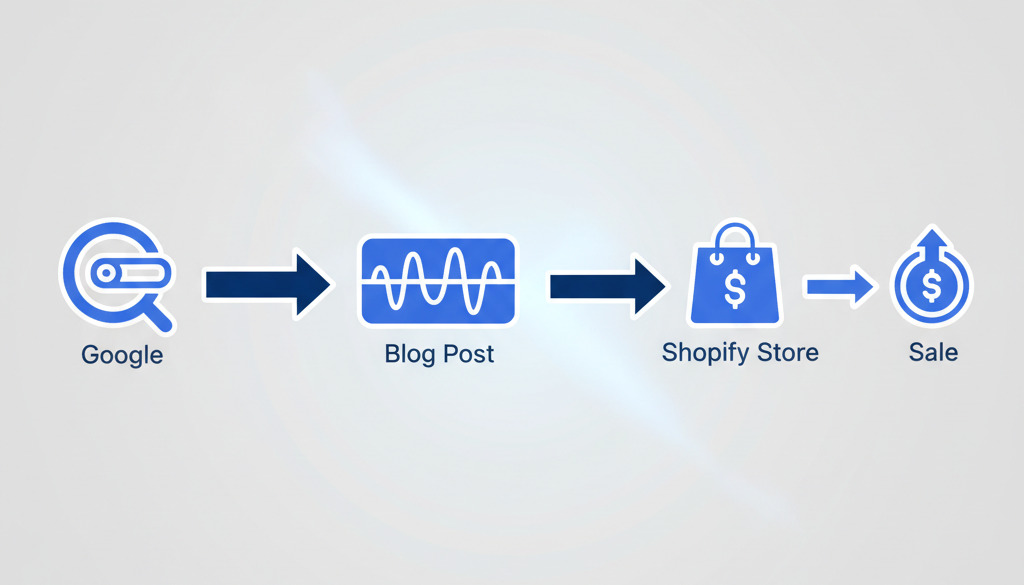
As a driven business owner, your to-do list is endless. Between managing inventory, fulfilling orders, and handling customer service, the idea of adding "write a blog post" to the mix can feel overwhelming. You know having an online presence is important, but who has the time? The truth is, a blog isn't just a "nice-to-have" for a Shopify store; it's a powerful engine for growth.[1] It's one of the most effective ways to attract customers who aren't just browsing—they're actively searching for solutions and products you provide.
Establishing Credibility and Trust
Imagine a customer lands on your store. They see your products, but they don't know you. A well-maintained blog changes that. By publishing articles that help, inform, and solve problems related to your niche, you are no longer just a retailer; you become an expert. This valuable content builds a foundation of trust. When you give away expertise for free, customers are far more likely to trust the quality of your products and make a purchase.
Boosting Organic Search Engine Rankings
How do new customers find you? For many, the journey starts with a Google search. A blog is your single best tool for improving your store's Search Engine Optimization (SEO). Every article you publish is a new opportunity for your store to rank for relevant keywords. If you sell high-end kitchen knives, an article on "How to Properly Sharpen a Chef's Knife" can attract organic traffic from searchers who are your ideal customers. Over time, this consistent stream of content signals to Google that your site is a relevant and authoritative source, boosting your rankings and visibility.
Attracting and Engaging Your Target Audience
Your blog allows you to speak directly to your target audience about their needs and interests. It's a space to answer their questions, address their pain points, and engage them beyond a simple transaction. This type of engagement keeps visitors on your site longer, encourages them to explore your products, and brings them back for more. A blog turns a one-time buyer into a loyal fan. The challenge, of course, isn't understanding these benefits—it's finding the time to execute. This is precisely where automation becomes a game-changer.
Understanding the Landscape: Manual vs. Automated Content Creation
For decades, content creation was a purely manual, labor-intensive process. For many small business owners, it remains that way. But technology has created a new path forward. Understanding the difference between the traditional approach and an automated one reveals why so many Shopify entrepreneurs are making the switch.
The Traditional Approach: The Time Sink
Let's be honest about what it takes to create a single, high-quality blog post manually:
- Ideation (1-2 hours): Brainstorming topics that are relevant to your audience and have SEO potential.
- Research (2-4 hours): Gathering information, statistics, and competitive analysis.
- Writing (4-8 hours): Crafting the actual content, ensuring it flows well and provides real value.
- Editing & Proofreading (1-2 hours): Polishing the draft, checking for grammar, and ensuring brand voice consistency.
- SEO Optimization (1 hour): Fine-tuning keywords, writing meta descriptions, adding internal links, and optimizing images.
- Publishing & Promotion (1 hour): Formatting in Shopify and sharing on social media or email newsletters.
Total Time per Post: 10-18 hours. For a busy entrepreneur, that's two full workdays dedicated to a single piece of content. This massive time commitment is the number one reason why most Shopify blogs are either never started or quickly abandoned.
Defining Content Automation for Shopify
Content automation refers to using software and technology to streamline, accelerate, or handle the tasks of content creation and publishing. This isn't about creating soulless, robotic articles. It's about leveraging powerful tools to do the heavy lifting, guided by your human strategy. Automation can range from using AI to generate a first draft to scheduling a month's worth of content in a single afternoon.
Key Differences and Advantages
A side-by-side comparison makes the advantages of automation crystal clear.
| Factor | Manual Creation | Automated Creation |
|---|---|---|
| Speed | Very slow (10-18 hours/post) | Extremely fast (1-2 hours/post, including review) |
| Scalability | Low (Difficult to produce more than 1 post/week) | High (Can produce multiple posts per day) |
| Consistency | Difficult to maintain a regular schedule | Easy to maintain a consistent publishing calendar |
| Cost | High (if outsourcing) or high opportunity cost of your time | Low (Affordable monthly subscriptions) |
| Time Investment | Significant; takes you away from other business tasks | Minimal; frees you up to focus on strategy and growth |
The primary advantage is the massive recovery of your most valuable asset: time. By automating the most time-consuming parts of the process, you can finally achieve the content consistency required to see real results from your blog.
Identifying Your Content Goals and Target Audience for Automation
Jumping into content automation without a clear plan is like driving without a destination. To be effective, your automated content strategy must be built on a solid foundation of well-defined goals and a deep understanding of your ideal customer. Technology is the vehicle, but your strategy is the GPS.
Defining Your "Why": What Do You Want Your Blog to Achieve?
Before you generate a single word, you need to define success. Vague goals like "get more traffic" are not enough. Your objectives should be specific, measurable, achievable, relevant, and time-bound (SMART). Here are some examples:
- Increase organic website traffic from search engines by 25% in the next 6 months.
- Generate 50 qualified leads per month through blog post CTAs within one year.
- Improve the conversion rate for blog readers by 15% over the next quarter.
- Become a top-3 ranked resource for 5 core industry keywords in 9 months.
These specific goals will dictate the topics you choose, the calls-to-action you include, and the metrics you track.
Deep Diving into Your Ideal Customer
You cannot create effective content if you don't know who you're talking to. As a business owner, you likely have a good sense of your customer, but it pays to formalize this. Think about the 40+ year-old entrepreneur who knows they need to be online but finds the technology intimidating. What are their specific challenges?
- What are their biggest pain points? (e.g., "I don't have time to write," "SEO is confusing," "I don't know what to write about.")
- What questions are they asking Google? (e.g., "how to get more visitors to my shopify store," "is a blog worth it for e-commerce," "best tools for small business marketing.")
- What are their interests and values? (e.g., They value efficiency, proven results, and straightforward solutions.)
Understanding this person's mindset is crucial for crafting AI prompts that generate content that truly resonates with them.
Translating Goals into Content Strategies
With your goals and audience defined, you can map them to a concrete content strategy. This involves creating "content pillars" or core themes that align with your business. For a store selling gardening supplies, pillars might be "Vegetable Gardening for Beginners," "Organic Pest Control," and "Container Gardening." Your automated content efforts can then focus on generating specific articles under these pillars, ensuring every piece you publish is purposeful and aligned with your overall objectives.
The Power of AI in Shopify Blog Content Generation
The biggest revolution in content automation is the rise of Artificial Intelligence. For business owners who aren't writers or tech experts, AI has leveled the playing field, making it possible to create high-quality content at a scale that was previously unimaginable.
What is AI-Powered Content Creation?
In simple terms, AI content generation uses large language models (LLMs)—complex algorithms trained on vast amounts of text and data from the internet—to understand and create human-like text. When you provide a prompt, the AI uses its training to predict the most logical sequence of words to form sentences and paragraphs that match your request. Think of it as a super-powered assistant that can research and write a first draft on any topic in seconds.
How AI Generates Blog Posts
The process is surprisingly straightforward:
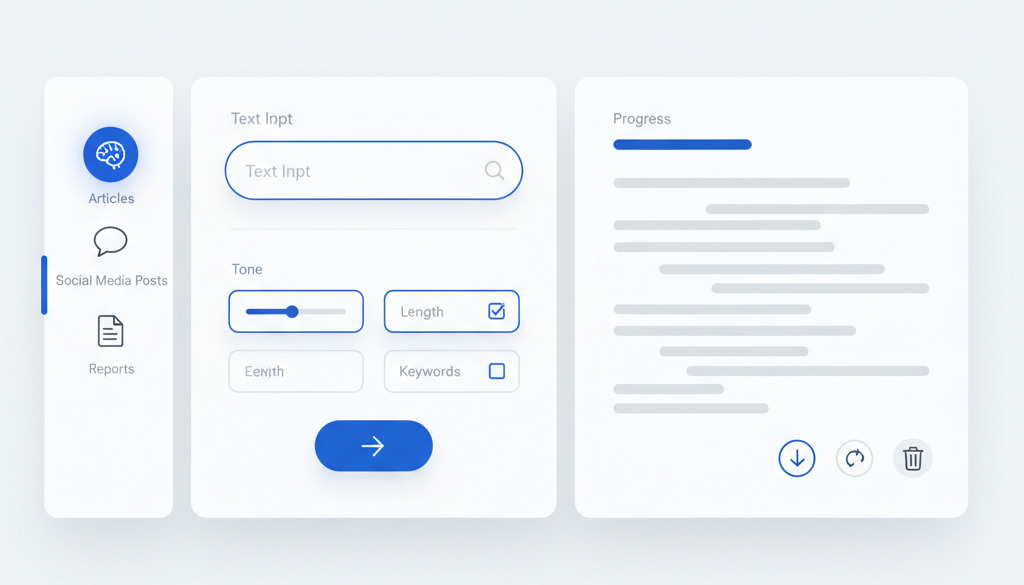
- You Provide an Input: This is an instruction, known as a prompt, where you tell the AI what you want. You might specify the topic, target audience, keywords to include, and desired tone.
- The AI Processes the Request: It analyzes your prompt and combs through its knowledge base to gather relevant information.
- The AI Generates the Output: It constructs the text, starting with an outline, then drafting sections, and even suggesting headlines or meta descriptions.
This allows you to bypass the most time-consuming parts of the writing process: the blank page and the initial research.
Benefits for Shopify Store Owners
- Speed and Scale: This is the most obvious benefit. An AI can produce a 2,000-word draft in minutes, not days. This allows you to scale your content production dramatically.
- Cost-Effectiveness: Compared to the high cost of hiring freelance writers or agencies, AI content tools are incredibly affordable, offering a high return on investment.
- Overcoming Writer's Block: Even for those who enjoy writing, staring at a blank screen can be paralyzing. AI provides a starting point, giving you a structured draft to refine and build upon.
Harnessing sophisticated AI, tools like Több vásárló a blogodról can generate professional SEO blog posts for your website in minutes. This allows you to attract customers organically from Google, almost like magic. Their proprietary AI is designed to write high-quality, SEO-optimized content quickly, enabling businesses to scale their content marketing without the usual time and resource investment.
Choosing the Right Automation Tools for Your Shopify Store
The market for automation tools is vast and growing. For a Shopify store owner, the key is to choose tools that are effective, easy to use, and integrate well with your existing workflow. Here’s a breakdown of what to look for.
Types of Content Automation Tools
Automation isn't just about writing. It spans the entire content lifecycle.
- AI Writing Assistants: These are the core of content generation. They produce text based on your prompts. Examples range from general-purpose models to specialized services.
- Content Scheduling Platforms: Tools like Buffer, Hootsuite, or even Shopify's own scheduling feature allow you to plan and automate the *publishing* of your content in advance.
- SEO Optimization Tools: Platforms like SurferSEO or MarketMuse analyze top-ranking content and provide guidelines to ensure your articles are optimized for search engines. Many AI writers are starting to integrate these features.
- Content Curation Tools: Tools like Curata or Feedly can help you find relevant third-party content to share, supplementing your original articles and establishing your brand as a helpful resource.
Key Features to Look For
When evaluating tools, especially for an audience that values simplicity and results, focus on these features:
- Ease of Use: The interface should be intuitive. You shouldn’t need a degree in computer science to generate a blog post. Look for clean layouts and clear instructions.
- Quality of AI Output: Test the language quality. Does it sound natural? Can you control the tone of voice to match your brand?
- SEO Integration: Does the tool help you with keyword research, on-page optimization, and meta tags? The goal is content that ranks, not just content that exists.
- Shopify Integration: While not always necessary, tools that can connect directly to your Shopify blog can save you a step in the publishing process.
- Customization: The ability to tailor prompts, define your brand voice, and refine output is crucial for creating content that doesn’t feel generic.
When considering AI-powered writing, platforms such as Több vásárló a blogodról stand out for their ability to deliver professional SEO articles rapidly. They are built specifically for business owners who want to put their content in front of customers searching on Google. With over 500 companies already benefiting, it offers a proven way to automate your blog content creation, and its promise of 'almost like magic' efficiency is backed by sophisticated AI designed for busy entrepreneurs.
Crafting Effective Prompts for AI Content Generation
The most common mistake business owners make when using AI is providing weak, generic prompts. The rule is simple: garbage in, garbage out. The quality of the content your AI generates is directly proportional to the quality of the instructions you provide. Mastering the art of the prompt is the key to unlocking AI's full potential.
The Art of the Prompt
A good prompt is clear, specific, and provides context. Don't make the AI guess what you want. Your goal is to give it a detailed blueprint for the article you envision. Think of yourself as a manager giving a clear assignment to a new employee.
Key Elements of a Powerful Prompt
A high-quality prompt should include several of these elements:
- Role: Tell the AI to act as an expert. "Act as an e-commerce SEO expert and content strategist."
- Task: Clearly state what you want it to do. "Write a comprehensive, 2000-word blog post."
- Topic: Be specific. "The topic is 'The Top 10 Benefits of Using Organic Cotton for Baby Clothes.'"
- Target Audience: Define who you're writing for. "The target audience is new parents in the US who are environmentally conscious and concerned about chemicals in fabrics."
- Keywords: Include your primary and secondary SEO keywords. "Include the keywords: 'organic baby clothes,' 'GOTS certified cotton,' 'sensitive skin baby,' and 'sustainable baby products.'"
- Tone and Style: Describe the voice you want. "The tone should be informative, reassuring, and professional, but also warm and relatable."
- Structure: Provide an outline or specify the sections you want. "Include an introduction, a section for each of the 10 benefits with a clear heading, and a concluding summary."
- Exclusions: Tell the AI what to avoid. "Do not use overly technical jargon. Do not mention specific competitor brands."
Examples of Good vs. Bad Prompts
The difference is stark:
Bad Prompt: "Write a blog post about organic baby clothes."
This prompt is lazy and will result in a generic, uninspired article that won't rank or resonate with anyone.
Good Prompt: "Act as a baby product expert. Write a 1500-word blog post titled 'Why Organic Cotton is a Must-Have for Your Baby's Wardrobe.' The target audience is new mothers researching the best materials for their baby's sensitive skin. The tone should be helpful, empathetic, and trustworthy. Please include a section on what GOTS certification means and a section on how to care for organic cotton garments. Naturally integrate the keywords 'organic cotton baby', 'sensitive skin clothing', and 'non-toxic baby clothes'."
This detailed prompt gives the AI all the information it needs to produce a targeted, valuable, and strategically sound piece of content.
The Human Touch: Editing and Refining AI-Generated Content
One of the biggest misconceptions about AI content automation is that it's a "one-and-done" process. This could not be further from the truth. AI is an incredibly powerful tool for creating a first draft, but human oversight is non-negotiable. The final 20% of the work, the human touch, is what elevates a good draft into a great article that builds your brand and drives sales.
Why Human Oversight is Crucial
AI is a machine that predicts text; it doesn't understand truth, nuance, or your brand's unique story. Human review is essential for several reasons:
- Factual Accuracy: AI models can occasionally "hallucinate" or present information that is outdated or incorrect. You are the expert in your field, and you must fact-check everything.
- Brand Voice Alignment: Your brand has a unique personality. The AI can mimic it, but only you can ensure the content truly reflects your values and speaks to your customers in a genuine way.
- Originality and Unique Insights: AI generates content based on existing data. It cannot add your personal experiences, customer success stories, or unique industry insights. These are the elements that make your content stand out and build a real connection with your audience.
Essential Editing Steps
Once the AI has delivered its draft, your work begins. Follow this checklist:
- Fact-Checking: Verify every statistic, claim, and piece of data. If the AI cites a study, find the source.
- Brand Voice Alignment: Read the article aloud. Does it sound like you? Adjust phrasing, word choice, and tone to match your brand. For example, if your brand is playful, inject some humor. If it's authoritative, make the language more formal.
- Readability and Flow: Break up long paragraphs. Improve transitions between sections. Ensure the article is easy to scan with clear headings and bullet points.
- Adding Unique Value: This is the most important step. Where can you add a personal anecdote? Can you insert a quote from a happy customer? Can you provide a specific example from your own business that illustrates a point?
SEO Refinements
Finally, do a last pass for SEO. Does the article flow naturally while still containing your keywords? Are there opportunities to add internal links to your product pages or other relevant blog posts? Is the meta description compelling? This final polish ensures your content is ready to be found by search engines.
Building a Content Calendar with Automation in Mind
Consistent publishing is a key factor in successful content marketing.[2] A sporadic approach—posting whenever you have a spare moment—will not deliver the SEO or engagement results you’re looking for. Automation makes consistency achievable, and a content calendar provides the strategic framework.
From Sporadic to Strategic
A content calendar is a schedule that dictates what content you will publish and when. It transforms your content efforts from a reactive afterthought into a planned, strategic activity. Knowing what you will post for the next month or quarter eliminates the daily stress of "What should I write about today?" and ensures a steady flow of valuable information for your audience and for search engines.
Integrating Automation into Your Calendar
Your calendar becomes even more powerful when you build your automation workflow into it. Instead of just "Publish Post A," your calendar can be more detailed:
- Week 1, Monday: Research topics & craft prompts for 4 blog posts for the month.
- Week 1, Tuesday: Generate AI drafts for all 4 posts.
- Week 1, Wednesday: Edit and refine Post 1. Add unique insights and brand voice.
- Week 1, Thursday: Edit and refine Post 2. Finalize SEO and add internal links.
- Week 1, Friday: Schedule Posts 1 & 2 for publishing in Shopify.
This "batching" approach is incredibly efficient. You can dedicate a few days to creating an entire month's worth of content, freeing you up for the rest of the month.
Leveraging Different Content Formats
Think beyond just blog posts. Automation can help you efficiently create content for all your marketing channels. Your calendar can include entries for:
- Product Descriptions: Use AI to write compelling, SEO-friendly descriptions for new products.
- Social Media Updates: Ask the AI to create 5 different social media posts based on a single blog article.
- Email Newsletters: Have the AI draft an email summarizing your latest blog post for your subscriber list.
By planning these activities in your calendar, you create an integrated content machine where every piece of content is working together to grow your business.
Automating Blog Post Publishing on Shopify
Creating the content is a huge part of the battle, but streamlining the publishing process is the final step to true "set it and forget it" efficiency. Your goal is to get your polished, human-approved content into your Shopify blog with as few clicks as possible.
Direct Shopify Integration
A growing number of AI and content marketing platforms are offering direct integration with Shopify. This is often the most seamless solution. The workflow typically looks like this:
- You generate and refine your article within the third-party tool.
- You click a "Publish" or "Send to Shopify" button.
- The tool sends the article, including its title, body content, images, and sometimes even SEO tags, directly to your Shopify blog as a draft.
- You log into Shopify, give it one final look, and hit publish or schedule it.
This eliminates the tedious process of copying and pasting, re-uploading images, and reformatting, which can be a source of errors and wasted time.
Using Scheduling Tools
Shopify has a built-in scheduling feature that is simple yet powerful. Once your blog post is finalized and created as a draft in your Shopify admin, you don't have to publish it immediately. In the "Visibility" section of the blog post editor, you can set a future publish date and time. This is perfect for the batching strategy discussed earlier. You can load up a month's worth of content and have it automatically go live on the dates you specified in your content calendar, ensuring a consistent presence even if you’re on vacation or focused on a new product launch.
Streamlining the Workflow
The key to efficiency is creating a repeatable system. Document your process from start to finish. For example:
- Step 1: Use AI Tool X to generate draft based on Prompt Y.
- Step 2: Edit for facts, voice, and flow in a Google Doc.
- Step 3: Add unique business examples and a call-to-action to a key product page.
- Step 4: Copy/paste into Shopify blog editor (or use direct integration).
- Step 5: Add SEO title, meta description, and featured image.
- Step 6: Schedule for publishing next Tuesday at 9:00 AM EST.
Having a documented process like this removes guesswork and makes it easy to delegate the task to a virtual assistant or team member in the future.
Measuring the Impact: Tracking Your Automated Blog's Performance
Automating your content creation saves you time, but how do you know if it’s actually working to grow your business? The answer lies in tracking the right data. Measuring your blog's performance is not a vanity exercise; it’s an essential feedback loop that tells you what’s resonating with your audience and what’s driving sales.
Key Performance Indicators (KPIs) for Blog Success
Don't get lost in a sea of data. Focus on the metrics that matter most for an e-commerce business:
- Traffic Metrics:
- Page Views: How many times your articles are being viewed.
- Unique Visitors: How many individual people are reading your blog.
- Traffic Sources: Where are readers coming from? The goal is to see a steady increase in "Organic Search."
- Engagement Metrics:
- Time on Page: How long people are spending reading your articles. Longer times suggest the content is valuable.
- Bounce Rate: The percentage of visitors who leave after viewing only one page. A high bounce rate might indicate the content didn't meet their expectations.
- Comments/Social Shares: A direct measure of how engaging your audience finds the content.
- Conversion Metrics:
- Leads Generated: If you have a newsletter sign-up, how many subscribers is the blog generating?
- Sales from Blog: This is the ultimate goal. Tools like Google Analytics can help you track how many readers go on to make a purchase.
- SEO Metrics:
- Keyword Rankings: Are your articles starting to rank on Google for your target keywords?
Utilizing Shopify Analytics and Other Tools
Your Shopify dashboard has built-in analytics that can show you which blog posts are getting the most traffic. For deeper insights, connecting your store to Google Analytics is a must. It’s a free, powerful tool that allows you to see the full customer journey—how they found your blog, which articles they read, and whether they ultimately made a purchase. This allows you to directly attribute revenue to your content marketing efforts.
Iterating Based on Data
Data is only useful if you act on it. Once a month, review your KPIs. Which articles drove the most traffic and sales? Which topics fell flat? Use this information to refine your future content strategy. If you see that "how-to" guides perform exceptionally well, create more of them. If listicles get a lot of social shares, add more of those to your calendar. This data-driven approach ensures your automated content strategy becomes more effective and profitable over time.
Addressing Common Concerns and Pitfalls of Content Automation
Embracing a new technology like AI can feel daunting, and it’s natural to have questions and concerns. Many business owners worry about quality, authenticity, and the impact on their brand. Let’s address these common fears head-on.
"Will My Content Sound Robotic?"
This is a valid concern, especially with early or less-advanced AI models. However, modern AI tools are capable of producing remarkably natural and nuanced text. The key to avoiding a robotic tone lies in two areas: crafting detailed prompts that specify a human-like tone, and, most importantly, thorough human editing. Your final review is where you inject personality, smooth out awkward phrasing, and ensure the content truly reflects your brand’s voice.
"Is AI Content Bad for SEO?"
This is a major point of confusion. Google’s official stance is clear: they reward high-quality, helpful content that is created for people, regardless of how it is produced. Google does not penalize content simply because it was made with AI. It penalizes *bad* content—thin, spammy, unhelpful articles created to manipulate search rankings. An AI-generated article that has been fact-checked, edited for clarity, and enriched with your unique expertise is not bad content. It’s just efficiently produced good content.
"Our focus is on the quality of content, rather than how content is produced... When it comes to automatically generated content, our guidance has been consistent for years. If you use automation — including AI — to generate content with the primary purpose of manipulating search rankings, that's a violation of our spam policies." - Google Search Central Blog
"What About Plagiarism?"
Reputable AI content generation tools do not plagiarize. They don't copy and paste from a single source. Instead, they generate new word combinations based on the patterns they learned during their training. The resulting text is statistically original. That said, it’s always a wise precaution to run the content through a plagiarism checker like Copyscape or Grammarly’s checker, especially when you first start using a new tool, for peace of mind.
Over-Reliance on Automation
The biggest pitfall is seeing automation as a magic button that removes the need for strategy. Don't fall into the trap of churning out dozens of unedited, unstrategic articles. This will only hurt your brand and your SEO. Remember, AI is your assistant, not your strategist. You are still the captain of the ship, directing the AI to create content that serves your specific business goals and your unique audience.
Advanced Strategies: Scaling Your Content with Automation
Once you’ve mastered the basics of generating and publishing blog posts, you can leverage automation for even greater efficiency and impact. These advanced strategies can help you dominate your niche and maximize the return on every piece of content you create.
Content Repurposing Made Easy
A single blog post is a treasure trove of content that can be repurposed across multiple channels. Manually, this is a time-consuming task. With AI, it’s effortless. Once you have a finalized blog post, you can use AI prompts to:
- "Summarize this article into a 500-word email newsletter."
- "Extract 5 key takeaways from this blog post and write a Twitter thread about them."
- "Turn the main sections of this article into a script for a 3-minute YouTube video."
- "Create a series of 10 engaging questions based on this text to post on Facebook and Instagram."
This allows you to reach different audience segments on their preferred platforms, all while starting from a single piece of core content.
Personalizing Content Experiences
The future of e-commerce is personalization. While still an emerging field, AI can be used to create content tailored to different user segments. For example, you could generate slightly different versions of a product guide—one for beginners and one for experts. In the future, this could even become dynamic, where the content on a page changes based on a customer's known purchase history or browsing behavior, creating a truly personal and highly effective experience.
Testing and Optimizing at Scale
Which headline will get more clicks? Which call-to-action will drive more sales? A/B testing provides the answers, but it requires creating multiple versions of your content. AI makes this incredibly easy. You can ask an AI tool to "Generate 10 alternative, compelling headlines for this article" or "Write three different versions of a concluding paragraph, each with a different call-to-action." This allows you to test and optimize your content continuously, using real data to improve its performance at a scale that would be impossible to manage manually.
The Future of Shopify Blog Content and Automation
The world of AI and e-commerce is evolving at a breakneck pace. For a Shopify store owner, staying aware of these trends is key to maintaining a competitive edge. What we’re seeing today is just the beginning.
Evolving AI Capabilities
The AI models of tomorrow will be even more powerful. We can expect advancements in:
- Hyper-Personalization: AI that can generate content in real-time based on an individual user's behavior on your site.
- Multimodality: AI that can seamlessly create not just text, but also relevant images, audio, and video to accompany your articles.
- Proactive Strategy: AI that can analyze your store’s data and market trends to proactively suggest high-impact blog topics you should cover.
As these technologies become more integrated into e-commerce platforms like Shopify, the barriers to creating a world-class content experience will continue to fall.
The Hybrid Approach: The Winning Formula
Despite these technological leaps, the future of content marketing is not one of full robotic replacement. The winning formula will always be a hybrid approach. The most successful brands will be those that masterfully combine the speed and scale of AI with the strategic thinking, creativity, and unique insights of human marketers. AI will handle the 80%—the research, the drafting, the repurposing—while humans focus on the critical 20%—the strategy, the brand voice, the personal stories, and the final polish.
Staying Ahead of the Curve
For a business owner who may not be a "native" of the online world, the key is not to become an AI expert, but to remain open and adaptable. By embracing these tools now, you position your business to take advantage of future advancements. Starting your content automation journey today builds the foundation and processes you need to stay competitive for years to come.

Getting Started: Your First Steps Towards Automated Content
You understand the benefits and you see the potential. It’s time to move from theory to action. Getting started with content automation is simpler than you might think. Here’s how to take your first steps.
Recap of Key Benefits
Let’s quickly remember why this is a priority for your business. By automating your blog content, you will:
- Reclaim your valuable time to focus on sales, a new product, or customer support.
- Dramatically improve your SEO and attract new customers from Google for free.
- Build trust and authority in your niche, turning visitors into loyal customers.
- Maintain a consistent, professional online presence without the weekly stress.
Actionable Steps for Implementation
- Define Your Goals & Audience (1 Hour): Before you touch any tools, spend one hour clearly writing down your goals for the blog and the profile of your ideal customer. This is the most important step.
- Explore Tools (2 Hours): Research 2-3 AI content tools. Look for ones with good reviews, user-friendly interfaces, and a focus on SEO. Many offer free trials.
- Start Small (3-4 Hours): Don't try to automate your entire content strategy overnight. Your first goal is to produce just one high-quality, AI-assisted blog post. Craft a detailed prompt, generate the draft, and then take your time editing and refining it.
- Focus on Quality: During this first attempt, focus on the human touch. Add your own stories, ensure the facts are correct, and polish it until it truly represents your brand.
- Publish and Monitor: Publish that first post and watch your analytics. This first-hand experience is the best way to learn and build confidence.
Ready to transform your Shopify blog? A service like Több vásárló a blogodról offers a powerful, user-friendly solution designed for exactly this purpose. With their AI writing your professional SEO articles, you can start attracting more customers from Google today. Take advantage of their offer for your first 5 posts free and experience the "magic" of effortless content creation. This provides a risk-free way to see the power of automation for yourself.
Conclusion
The challenge of creating consistent, high-quality blog content is one of the most common hurdles for Shopify store owners. The demands of running a business leave little time for the intensive work of writing, editing, and optimizing articles. For too long, this has meant that countless entrepreneurs have had to abandon their content marketing efforts, leaving a powerful channel for customer acquisition untapped.
Content automation, powered by artificial intelligence, fundamentally changes this equation. It is not about replacing the business owner's unique voice or strategic vision. Instead, it’s about empowering you with a tool that handles the most time-consuming aspects of the process. It’s a force multiplier for your efforts, allowing you to finally execute the content strategy you know your business needs.
By combining the efficiency of AI with your essential human oversight, you can build a thriving blog that works for you 24/7—attracting visitors, building trust, and driving sales. The long-term vision is one where your blog becomes a sustainable and predictable engine for growth, allowing you to take control of your online presence and build a more resilient, profitable business.
Frequently Asked Questions
1. Will Google penalize my store for using AI-generated content?
No.
→ Read the full Shopify & Ecommerce guide
Keep reading
Hand-picked guides that go deeper — open the one you need next:
- Shopify AI: Automate E-commerce for Organic Sales
- Shopify SEO: The AI Strategy That Drives 24% More Sales
- Shopify AI Strategy: E-commerce Automation Mastered
- Boost Your Shopify Store: AI-Driven Blog Content for Sales
→ Read the full Shopify & Ecommerce guide