
WordPress SEO: Auto-Publishing with AI Content

Key Takeaways
- Automate Content Creation: WordPress auto-publishing AI tools can generate and post SEO-optimized blog articles, saving business owners dozens of hours each month.
- Improve Google Rankings: Consistently publishing high-quality, relevant content is a key factor in SEO success. AI helps you maintain a regular schedule to attract more organic traffic.
- Cost-Effective Solution: Using AI for content is significantly more affordable than hiring a dedicated writer or marketing agency, making it ideal for small to medium-sized businesses.
- Human Oversight is Crucial: AI is a powerful assistant, not a replacement for human strategy. Always review, edit, and fact-check AI-generated content to ensure quality and brand alignment.
- Get Started Easily: Many solutions are designed for non-technical users, allowing you to connect your WordPress site and start generating content in minutes.
Understanding the Landscape: The Evolving Role of Content in Business Growth
In today's digital-first world, your company's online presence isn't just a line item in a marketing plan; it's the front door to your business. For most potential customers, their journey begins with a search engine. They have a problem, a question, or a need, and they turn to Google for answers. If your business doesn't show up in those search results, for all intents and purposes, you are invisible.
This is where the power of organic search, or Search Engine Optimization (SEO), comes into play. Unlike paid ads that disappear the moment you stop paying, organic search is a sustainable, long-term channel for attracting a steady stream of qualified customers. The currency of organic search is high-quality content. Search engines like Google aim to provide their users with the most relevant, helpful, and authoritative answers. The more consistently you provide that kind of content, the more you are rewarded with higher rankings and visibility.
There is a direct and undeniable correlation between the frequency and relevance of your content and your ability to climb the search engine rankings. A website with a regularly updated blog that addresses customer pain points, answers common questions, and provides industry insights will always outperform a static, unchanging site. This consistent output signals to Google that you are an active, authoritative voice in your field, building trust with both the algorithm and your future customers.
The Pain Points of Traditional Content Creation for Business Owners
If creating content is the key to online growth, why doesn't every business have a thriving blog? The answer is simple: traditional content creation is incredibly demanding. For a busy business owner, especially one who is over 40 and didn't grow up as a digital native, the process can feel overwhelming and unsustainable.
The first major hurdle is the sheer time investment required. Crafting a single, well-researched blog post involves a long chain of tasks: brainstorming relevant topics, performing keyword research, outlining the structure, writing the draft, finding or creating images, editing for clarity and grammar, optimizing for SEO, and finally, publishing and promoting it. This process can easily consume 8-10 hours for just one article. For a business owner already juggling sales, operations, and customer service, finding that time is a monumental challenge.
The second pain point is the skill gap. Being an expert in your industry doesn't automatically make you an expert writer, SEO specialist, or content strategist. Effective online content requires a unique blend of creative writing, technical optimization, and marketing savvy. Many business owners know they need content, but they either lack the skills or the confidence to produce it themselves, leading to paralysis.
Finally, there are the financial implications. The obvious solution is to outsource. However, hiring professional freelance writers or a marketing agency can be expensive, with quality articles often costing hundreds of dollars each. Furthermore, managing these external resources introduces its own set of challenges, from communication and revisions to ensuring they truly capture your brand's voice and expertise.
What Exactly is WordPress Auto-Publishing AI?
This is where a new wave of technology comes to the rescue. WordPress auto-publishing AI refers to a category of software tools that leverage artificial intelligence to automate the entire lifecycle of content creation, from ideation to publication, directly within your WordPress website.[1] It acts as a bridge, closing the gap between the need for consistent, high-quality content and the limited resources of many business owners.
At its core, this technology is powered by advanced Natural Language Processing (NLP) and machine learning models. These models have been trained on vast datasets of text from the internet, allowing them to understand context, grammar, style, and even nuanced topics. When you provide a prompt—such as a keyword or a topic—the AI synthesizes this knowledge to generate new, original text that reads as if it were written by a human.
It's important to clarify what "auto-publishing" means in this context. While some tools can be configured to post content completely autonomously, the best practice always involves a human-in-the-loop approach. The "auto" part refers to the automation of the heavy lifting—the research, drafting, and SEO structuring—which is then presented to you for a final, strategic review before publication. This ensures both efficiency and quality control.
Key Features and Capabilities of AI Content Generation Tools
These powerful platforms are more than just simple text generators. They are comprehensive content marketing assistants packed with features designed to streamline your workflow and improve your results. Understanding these capabilities is key to leveraging their full potential.

Topic Generation and Ideation
Staring at a blank page is often the hardest part of content creation. AI tools can eliminate this hurdle entirely. Based on your industry and a few seed keywords, they can generate hundreds of relevant and engaging blog post ideas, often categorized by user intent (e.g., "how-to," "what is," "best of"). This ensures you're always writing about topics your target audience is actively searching for.
Content Drafting and Writing
This is the main event. Once a topic is chosen, the AI can produce a full-length, structured article draft in minutes. This isn't just a block of text; it's a complete post with headings (H2s, H3s), paragraphs, and lists. Modern AI can adopt different tones of voice—from professional and business-like to casual and friendly—to match your brand identity.
SEO Optimization Integration
The best AI content tools are built with SEO as a primary focus. They don't just write an article; they optimize it. This includes naturally weaving in your target keywords, suggesting SEO-optimized titles, generating meta descriptions, and ensuring the content structure is easy for Google to crawl and understand.[2] Some advanced tools even optimize for what's known as Answer Engine Optimization (AEO), structuring content so AI search tools like ChatGPT and Gemini will cite it.
Customization and Editing Options
No AI is perfect, and your unique expertise is irreplaceable. AI content platforms provide user-friendly editors that allow you to easily review, revise, and enhance the generated draft. You can add personal anecdotes, insert specific data points from your business, and refine the tone to perfectly align with your brand. This collaborative approach combines the speed of AI with the authenticity of human experience.
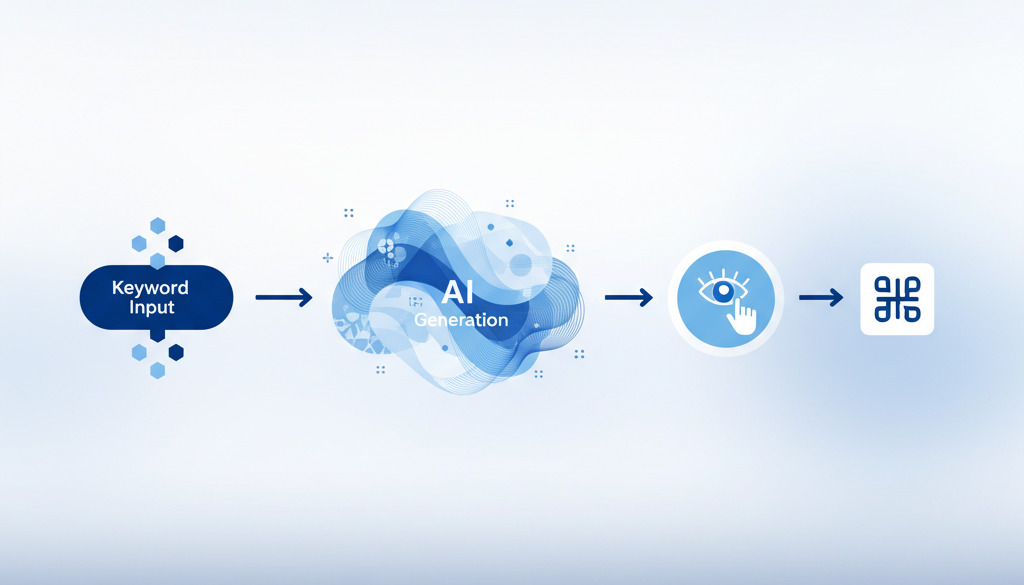
The "Magic" Behind the Scenes: How AI Crafts Your Blog Posts
How can a machine write a comprehensive article about a niche topic? The process, while complex, can be understood as a series of intelligent steps. It’s not "magic," but a sophisticated application of data analysis and pattern recognition that mimics human thought processes.
First, the AI performs a deep analysis of your chosen keyword or topic. It scours the internet to understand the search intent behind the query. Is the user looking for a definition, a step-by-step guide, a comparison, or an opinion? It analyzes the top-ranking articles for that keyword to identify common themes, subtopics, and questions that need to be answered to create a truly comprehensive piece.
Next, it synthesizes data from countless authoritative sources to gather facts, statistics, and different perspectives on the subject. This is the "research" phase, completed in seconds instead of hours. The AI then begins the writing process, structuring the information logically with an introduction, a body broken into sections with clear headings, and a conclusion. It focuses on creating a narrative that flows naturally, making complex information easy to digest.
Throughout this process, the AI constantly makes decisions to adapt its output. It can adjust the reading level to match your target audience and infuse the text with your specified tone of voice. This iterative learning process means that the more you use the tool and provide feedback (by editing the content), the better it gets at matching your specific style and preferences.
Benefits of Embracing AI for Your WordPress Content Strategy (Focus on SMB Owners)
For small and medium-sized business (SMB) owners, the advantages of integrating AI into their content workflow are transformative. It directly addresses the primary pain points of traditional content creation and opens up new avenues for growth that were previously out of reach.
Significant Time Savings
This is the most immediate and impactful benefit. The hours spent on research, writing, and formatting are reduced to mere minutes. An AI can generate a 4,000-word draft in less time than it takes to make a cup of coffee. This frees you, the business owner, to focus on what you do best: running your business, serving your customers, and strategic planning.
Cost-Effectiveness
The financial comparison is stark. AI content subscriptions often cost a fraction of what it would take to hire a single freelance writer for one or two articles per month. This makes consistent, high-volume content creation financially viable for even the smallest businesses. You can now compete with larger companies on the SEO front without needing a massive marketing budget.
Here's a simple comparison:
| Factor | Traditional Content Creation (per article) | AI-Powered Content Creation (per article) |
|---|---|---|
| Time Investment | 8-12 hours | 30-60 minutes (review & editing) |
| Average Cost | $250 - $1,000+ (outsourced) | $5 - $20 (subscription cost) |
| Turnaround Time | Days to Weeks | Minutes |
| Scalability | Limited by human resources | Virtually unlimited |
Consistency and Volume
SEO success is a marathon, not a sprint. Search engines reward consistency. AI enables you to establish and maintain a regular publishing schedule—whether it's one, three, or five posts a week—without fail. This steady stream of new content keeps your website fresh, grows your topical authority, and continuously provides new opportunities to rank for valuable keywords.
Overcoming Creative Blocks
Every writer, no matter how experienced, faces the dreaded writer's block. For a business owner with a million other things on their mind, this can be a constant struggle. AI serves as an inexhaustible well of ideas and a reliable partner that can produce a solid first draft on demand, completely eliminating the "blank page" problem.
Driving Organic Traffic: How AI-Generated Content Improves SEO
Ultimately, the goal of content is to drive business results, and in the online world, that means attracting organic traffic from search engines. AI-generated content, when done correctly, is a powerful engine for SEO growth. It directly contributes to the factors that Google values most.
First and foremost, AI tools excel at creating keyword-rich, topically relevant content. By analyzing search intent and top-ranking competitors, the AI ensures that your articles comprehensively cover a subject, naturally incorporating the terms and phrases that your potential customers are using. This topical depth signals to Google that your page is a high-quality result for that query.
Second, the ability to produce content at scale allows you to build a vast library of helpful resources on your site. This has a compounding effect on your SEO. Each new post is another asset that can rank in Google, another page that can earn backlinks, and another signal of your website's authority. A site with 200 well-written articles will have exponentially more organic visibility than a site with only 20.
Finally, consistent publishing with AI-driven efficiency helps build domain authority. When Google’s crawlers repeatedly visit your site and find fresh, valuable, and well-structured content, it reinforces your site's authority and trustworthiness in their eyes. This leads to better overall search rankings and more organic traffic over time.
Keep reading
Hand-picked guides that go deeper — open the one you need next:
- WordPress AI Plugin Benefits: The 2026 Comprehensive Guide
- WordPress Blog Content on Autopilot: A Non-Technical Guide to SEO Success
- Unlock Your WordPress Potential: Auto-Publish SEO-Optimized Blogs with AI
- Power Up Your WordPress Blog: Seamless AI Content Publishing with Volteruno
→ Read the full WordPress guide