
WordPress Traffic AI: The 2026 Growth Strategy Guide

The digital economy of 2026 is no longer a landscape defined by static pages and manual outreach. For years, WordPress site owners have relied on the traditional triad of search engine optimization (SEO), paid acquisition, and social media sharing.[1] However, we have entered an era where "WordPress traffic AI" is not just a buzzword but the foundational pillar of digital growth. As automated agents now account for over 51% of web activity, the challenge for modern businesses is twofold: they must remain visible to human users while becoming readable and authoritative for the AI models that now mediate how those users discover information.
This paradigm shift, punctuated by the release of WordPress 7.0 and its native AI connectors, signifies a move toward intelligent, collaborative ecosystems. Businesses that fail to adapt risk becoming invisible to "Answer Engines" like ChatGPT, Gemini, and Perplexity, which increasingly provide direct solutions rather than lists of blue links. This article explores how Artificial Intelligence is revolutionizing WordPress traffic generation, offering a roadmap for businesses to optimize their presence, enhance engagement, and drive measurable, sustainable growth in an AI-first world.
Understanding the AI-Powered Shift in Website Traffic Generation
In the context of WordPress, Artificial Intelligence refers to the implementation of technologies—specifically machine learning (ML), natural language processing (NLP), and deep learning—to automate and enhance how a site attracts and retains visitors. Unlike traditional methods that rely on "set and forget" rules, AI systems are dynamic; they learn from incoming data, adjusting strategies in real-time to optimize for conversion and reach.
The limitations of manual traffic generation are becoming increasingly apparent. Standard SEO requires hundreds of hours of manual keyword mapping and backlink prospecting, often with a delay of months before seeing results. AI changes this by processing vast datasets—such as global search trends, competitor price shifts, and user clickstream data—to identify patterns that a human analyst would miss. For instance, while a manual strategy might target a high-volume keyword, an AI model can identify "topic clusters" and semantic relationships that capture long-tail traffic with much higher intent.
The rise of the "machine-readable web" is perhaps the most significant shift. As Riley Cullen of WP Engine notes, modern websites must now serve machine-readable data for AI agents. This means that AI isn't just a tool for the site owner; it is the consumer of the site’s data. To drive traffic today, your WordPress site must be optimized so that large language models (LLMs) can easily crawl, understand, and cite your content as a primary source of truth.
Leveraging AI for Enhanced Search Engine Optimization (SEO)
AI in Keyword Research and Content Optimization
The era of simple keyword density is over. Modern WordPress SEO is governed by semantic search—understanding the intent behind a query. AI tools like SurferSEO or Frase analyze the top-performing content across the web to create comprehensive content briefs. They identify the "entities" and subtopics required to satisfy both Google’s algorithms and AI answer engines. By utilizing NLP, these tools suggest the exact terminology and question-and-answer formats that make a WordPress post more likely to be featured in an AI's direct response.
Intelligent Link Building and Authority Building
Backlinks remain a cornerstone of authority, but the "spray and pray" outreach method is dead. AI-powered platforms now allow WordPress administrators to identify high-context prospects for outreach. These systems analyze the "link equity" and topical relevance of millions of sites, ensuring that you only spend resources on links that will actually move the needle. Predictive algorithms can even forecast the potential traffic impact of a specific backlink, allowing for more strategic resource allocation.
Technical SEO Automation and Auditing
Technical SEO is often the most neglected aspect of WordPress management due to its complexity. However, AI can now automate the identification of crawl errors, broken schema markups, and site speed bottlenecks. Advanced auditing tools use machine learning to simulate how an AI crawler (like GPTBot) sees your site. This allows you to fix indexability issues before they result in a loss of visibility in AI search results.
AI-Driven Content Creation and Personalization for Engagement
AI-Assisted Content Generation and Ideation
Content is the fuel for traffic, and AI has drastically lowered the cost of production. With the integration of AI clients in WordPress 7.0, generating blog post outlines and drafting repetitive sections (like product descriptions or FAQs) has become a native feature. However, the expert approach requires human-in-the-loop (HITL) workflows. High-performing WordPress sites use AI to generate the first 60% of content—handling the data and structure—while human editors provide the "Information Gain," adding original insights and brand voice that AIs cannot replicate.
Dynamic Content Personalization
Once a visitor arrives via AI-optimized search, the goal is to keep them there. AI-driven personalization engines analyze a visitor's location, device, and previous browsing history within seconds. For a WordPress e-commerce site, this might mean dynamically changing the homepage hero image to match the user's inferred interests. Research shows that personalized content recommendations can increase dwell time by up to 40%, a critical metric that tells search engines your site is a high-quality destination, thereby boosting your organic rankings further.
Supercharging WordPress Site Speed and Performance with AI
Predictive Caching and Resource Optimization
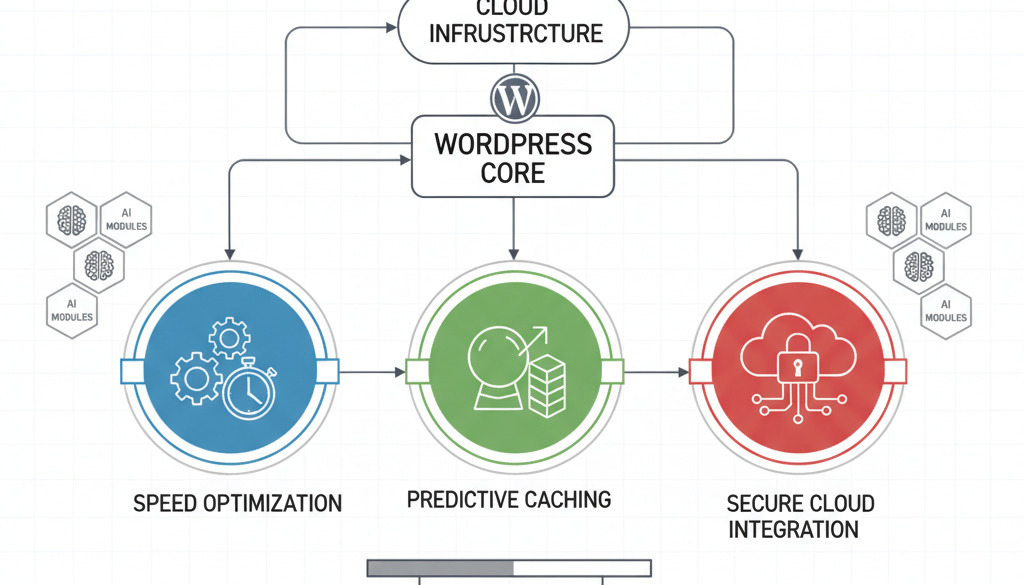
Site speed is a direct ranking factor for Google and a critical component of user retention. AI-powered performance plugins are moving beyond static caching. These tools use predictive algorithms to analyze traffic patterns; for example, if data shows that 80% of users who land on a blog post eventually click over to the "Pricing" page, the AI can pre-load those assets in the background. This "just-in-time" resource delivery makes a WordPress site feel instantaneous.
AI-Powered Security and Malware Detection
Traffic loss often occurs not due to bad SEO, but due to security breaches that lead to blacklisting. Traditional firewalls use signature-based detection, which only catches known threats. AI security layers for WordPress use behavioral analysis to distinguish between a legitimate human visitor and a malicious bot trying to scrape content or inject code. According to recent data from 610 Digital, proactive AI bot management is now essential, as bot-driven resource tax can slow down site performance by as much as 30% if left unmanaged.
AI for Advanced Audience Analysis and Segmentation
Deep Dive into User Behavior Analytics
Standard analytics tell you *what* happened; AI analytics tell you *why*. Tools integrated into the WordPress dashboard now use session recordings and heatmaps processed by AI to identify "friction points." If an AI notices that a significant percentage of mobile users are dropping off at a specific checkout step, it can flag this as a critical usability error. This deep understanding of user journeys allows businesses to refine their site architecture to maximize the value of the traffic they receive.
Predictive Analytics for Audience Needs
The most successful WordPress publishers in 2026 are those who stay ahead of the curve. Predictive AI tools analyze social media trends and global search data to suggest topics *before* they peak in popularity. By being the first to publish authoritative content on an emerging trend, a WordPress site can capture the "first-mover advantage," securing top spots in both traditional search results and AI-generated syntheses.
Optimizing WordPress Paid Advertising Campaigns with AI
AI in Bid Management and Budget Allocation
For WordPress sites relying on PPC (Pay-Per-Click) to drive traffic, AI has transformed the economics of advertising. Automated bidding systems use machine learning to adjust bids in real-time, millisecond by millisecond. These systems look at hundreds of variables—time of day, user intent, competitor activity—to ensure that every dollar spent on ads has the highest probability of resulting in a conversion. This prevents the "budget bleed" common in manually managed accounts.
Intelligent Ad Creative and Targeting
AI doesn't just manage the spend; it manages the message. Generative AI tools can create hundreds of variations of ad headlines and images, testing them against specific audience segments. For instance, a WordPress plugin developer might use AI to show a "developer-focused" ad to people on LinkedIn and a "business-focused" ad to users on Facebook, all while tracking which creative leads to the highest quality site traffic.
AI Chatbots and Virtual Assistants for Improved User Experience and Traffic Retention
Enhancing User Engagement and Support
Traffic retention is just as important as traffic acquisition. AI chatbots, integrated directly via WordPress plugins, provide 24/7 engagement that goes far beyond simple programmed responses. Utilizing NLP, these bots can handle complex queries, helping users find specific articles or products. This immediate gratification lowers bounce rates and encourages users to explore deeper into the site, which signals to search engines that the site is a high-value resource.
Proactive Engagement and Re-engagement Strategies
Modern chatbots are no longer reactive. If an AI detects that a user has been lingering on a high-intent page (like a "Services" page) for more than 60 seconds without taking action, it can proactively trigger a conversation. "Hi there, I noticed you're looking at our WordPress maintenance plans. Would you like a quick comparison chart sent to your email?" This type of AI-driven interaction converts lukewarm traffic into warm leads, ensuring that the traffic you work hard to acquire doesn't go to waste.

Implementing AI Tools within the WordPress Ecosystem
Popular AI Plugins and Platforms for WordPress
The current WordPress ecosystem offers a variety of specialized AI tools. For SEO, **Rank Math AI** and **Yoast SEO** provide content suggestions based on competitive data. For performance, **10Web** uses AI to automate site speed optimization and page building. For those looking to optimize for Answer Engine Optimization (AEO), tools like **Frizerly** auto-publish structured, entity-rich content designed to be cited by ChatGPT and Gemini. These plugins are bridging the gap between standard site management and the highly automated future of the web.
Strategic Integration and Workflow Design
Transitioning to an AI-enhanced workflow should be intentional. It is recommended to start with one area—such as SEO optimization—and master the toolset before expanding. The goal is to build a "Modular Data Architecture," as suggested by industry experts, where your WordPress database is structured to be easily interpreted by various AI tools. This ensures that as you add new plugins or switch AI models (leveraging the vendor-agnostic framework of WordPress 7.0), your data remains clean and useful.
Ethical Considerations and the Future of AI in WordPress Traffic
Data Privacy and Transparency
As AI relies heavily on user data to personalize experiences, ethical considerations are paramount. WordPress site owners must ensure they are compliant with global regulations like GDPR and CCPA. Transparency is the currency of the AI age; clearly stating how data is used to improve user experience can build trust. Furthermore, site owners must be wary of "algorithmic bias"—ensuring that the AI tools they use do not inadvertently exclude or disadvantage specific audience segments.
The Evolving Role of Human Expertise
Despite the "automation" of traffic generation, the human element has never been more critical. AI is a multiplier, not a replacement. A strategist is still required to set the overall business goals, define the brand's unique point of view, and audit the AI's output for accuracy and tone. The most successful WordPress professionals in the coming years will be those who develop "AI Literacy"—the ability to prompt, manage, and refine AI systems to do the heavy lifting while they focus on high-level strategy and creative vision.
Emerging AI Trends and Their Potential Impact
Looking forward, we can expect "Hyper-Personalization" to become the norm. This goes beyond changing a name in an email; it involves real-time generative UI, where a WordPress site’s layout literally morphs to suit the specific psychological profile and needs of a visitor. Additionally, as video search grows, generative AI for video will allow WordPress sites to automatically turn blog posts into high-quality video content, capturing traffic from YouTube and TikTok and funneling it back to the central business hub.
Conclusion
The marriage of WordPress and Artificial Intelligence represents the most significant change in website management since the advent of the CMS itself. By 2026, the success of a digital presence will be determined by how effectively a business bridges the gap between human needs and machine capabilities. AI offers the tools to not only find your audience with surgical precision but to engage them with unprecedented personalization and speed.
For WordPress site owners, the call to action is clear: begin the strategic integration of AI tools today. Whether it’s optimizing your content for Answer Engines, automating your technical SEO, or deploying intelligent chatbots, every step toward AI adoption is a step toward future-proofing your traffic. Embrace AI as a vital partner in your WordPress strategy, and transform your website from a static brochure into a dynamic, intelligent engine of business growth.
Harnessing WordPress Traffic AI for Unprecedented Engagement
The strategic integration of AI into a WordPress infrastructure is no longer an optional upgrade; it's the bedrock of a robust traffic acquisition and retention strategy for 2026 and beyond. Beyond the immediate benefits of content generation and SEO optimization, advanced AI applications within WordPress are poised to revolutionize how businesses interact with their audiences, creating truly dynamic and responsive online experiences. The focus shifts from simply attracting eyeballs to cultivating deep, meaningful engagement that translates directly into conversions and brand loyalty. This evolution is driven by AI's capacity to analyze vast datasets of user behavior, preferences, and even emotional cues, enabling a level of personalization previously unimaginable. One of the most impactful areas where WordPress traffic AI will shine is in predictive analytics and tailor-made user journeys. Imagine an AI that not only understands a visitor's browsing history on your site but also correlates it with external data to anticipate their needs *before* they even articulate them. This could manifest as AI dynamically altering navigation menus, proactively suggesting relevant products or services, or even modifying the tone and style of on-page content in real-time. For instance, a user showing signs of technical inquiry might be presented with detailed spec sheets and support documentation, while a user exhibiting purchasing intent could be guided towards testimonials, pricing pages, and checkout options, all orchestrated seamlessly by intelligent algorithms embedded within the WordPress ecosystem. This level of proactive, context-aware engagement fosters a sense of being understood, dramatically increasing the likelihood of conversion and significantly reducing bounce rates.Furthermore, the application of AI in community building and personalized support within WordPress sites will further solidify user retention. AI-powered chatbots, far more sophisticated than their predecessors, will be capable of handling complex customer service inquiries, offering personalized recommendations, and even facilitating community discussions. These intelligent agents can moderate forums, answer FAQs with nuanced understanding, and escalate issues to human support only when absolutely necessary, freeing up valuable human resources. The data gathered from these interactions provides invaluable insights into user sentiment and recurring problems, allowing businesses to iteratively improve their offerings and content strategy. By empowering WordPress sites with the tools to foster genuine connection and provide instant, intelligent support, businesses can cultivate a loyal user base that actively advocates for their brand, driving organic traffic and sustained growth.
FAQ
What is WordPress traffic AI?
WordPress traffic AI refers to the use of artificial intelligence tools and strategies to enhance and grow website traffic specifically for WordPress sites. This can include AI-powered content creation, SEO optimization, and audience targeting.
How can AI improve WordPress website traffic by 2026?
AI can automate repetitive tasks, personalize user experiences, provide data-driven insights for content strategy, and predict user behavior to optimize engagement and conversion rates, leading to significant traffic growth.
What are the key benefits of using WordPress traffic AI strategies?
Key benefits include increased organic reach, improved search engine rankings, enhanced user engagement, more efficient content creation, and a better understanding of audience needs, all contributing to sustainable traffic growth.
→ Read the full WordPress guide
Keep reading
Hand-picked guides that go deeper — open the one you need next:
- WordPress SEO Made Easy: Auto-Publish Expert Articles with Volteruno's AI
- WordPress SEO AI: The Future of Ranking in Search Engines
- Unlock Your WordPress Potential: Auto-Publish SEO-Optimized Blogs with AI
- Seamless WordPress AI Integration: Publish Content Directly
→ Read the full WordPress guide