
Beyond Content: How AI Drives Customer Acquisition
Key Takeaways
- Shift from Expense to Asset: Customer acquisition costs are rising, forcing a move from paid ads to owning content assets. AI makes creating these assets scalable.
- Inbound Marketing Engine: AI content fuels the inbound methodology, attracting customers naturally through valuable information rather than interrupting them with ads.
- Human-Augmented Strategy: The best results come from using AI as a powerful assistant to accelerate research and drafting, while human experts provide strategic oversight, editing, and brand voice.
- Data-Driven Content: AI analyzes search trends, competitor strategies, and customer pain points to create content that is precisely targeted to user intent, significantly improving its chances of ranking on Google.
- Measurable ROI: Unlike the fleeting nature of ad spend, AI-generated content builds a long-term, compounding return on investment by generating organic traffic and leads for years to come.
Understanding the Core of AI-Powered Customer Acquisition
For decades, customer acquisition has been a game of "push." Businesses pushed advertisements, pushed sales calls, and pushed their message onto a broad audience, hoping a small fraction would respond. The digital age promised change, yet for many, it simply shifted the "push" from print to screen. Today, that model is breaking down. Recent reports highlight that customer acquisition costs (CAC) are rising across nearly every major paid channel, while consumer attention is more fragmented than ever.
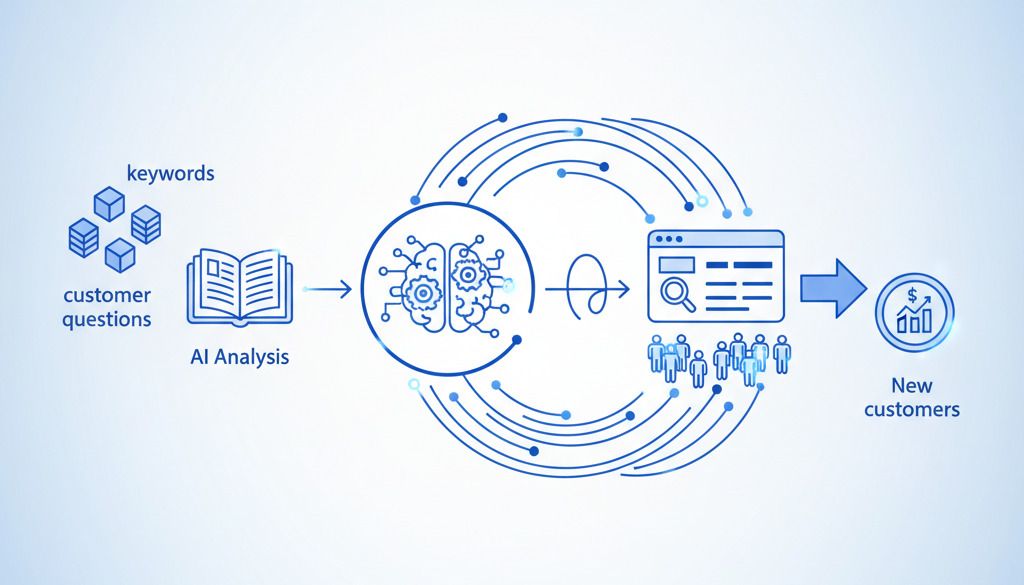
This is where AI-powered customer acquisition introduces a revolutionary new paradigm: pull. Instead of you chasing customers, they find you. This strategy hinges on a simple exchange: you provide valuable, helpful answers to your potential customers' questions, and in return, they give you their attention, trust, and eventually, their business.
AI-powered customer acquisition is not merely about writing blog posts faster. It’s about creating a strategic ecosystem of content assets—articles, guides, FAQs, and more—that are specifically engineered to:
- Answer the precise questions your ideal customers are typing into Google.
- Address their pain points and offer solutions.
- Build your brand’s authority and credibility within your niche.
- Attract and engage users organically, pulling them into your marketing funnel without the high cost of paid ads.
At its core, AI acts as an intelligence engine, analyzing vast amounts of data to inform a content strategy that consistently places your business in front of the right people at the exact moment they are looking for your solution.[2]
The Strategic Imperative of SEO Content for Small Businesses
If you are a business owner over 40, you’ve built your company on solid, time-tested principles. You might view the online world with a degree of skepticism, seeing it as a chaotic space of fleeting trends. However, one online principle has proven to be as enduring as any traditional business practice: when people need a solution, they search for it. Today, the primary place they search is Google.
This reality makes Search Engine Optimization (SEO) a non-negotiable part of modern business strategy. SEO is the process of making your website more visible and attractive to search engines for the keywords related to your products or services.
Finding Customers vs. Chasing Customers
Think about the difference. Chasing customers involves expensive ad campaigns, cold outreach, and interrupting people during their day. It’s a constant drain on your marketing budget. Finding customers, on the other hand, means positioning your business so that motivated buyers discover you when they are actively seeking help. This is the power of SEO content. A single, well-crafted blog post that ranks on the first page of Google can bring in a steady stream of qualified leads for years, creating a valuable, long-term asset for your business.
Debunking Myths: AI Content Isn't Just Automation, It's Intelligence
Early iterations of AI text generators rightfully earned a poor reputation for producing generic, unreadable, and often nonsensical content. This has led to a common myth: that AI content is inherently low-quality. For the business owner who has spent years building a reputation on expertise and quality, the idea of using AI can seem counterintuitive.
However, it's crucial to distinguish between basic AI novelties and sophisticated, professional-grade AI content platforms. Modern AI for business content is not about replacing human thought; it's about augmenting it. Think of it less as a robotic writer and more as an incredibly powerful research assistant and co-pilot.
This advanced AI operates on a different level:
- It doesn't just string words together; it analyzes the top-ranking content for a given keyword to understand what structure, topics, and information Google deems valuable.
- It can process user search intent to generate outlines and drafts that are directly relevant to what the reader wants to know.
- It helps identify gaps in existing content that your business can fill, establishing your authority.
"The signal-to-noise ratio has collapsed," notes one industry analysis of the modern content landscape. The goal is no longer to just "publish more content," but to publish the *right* content. This is where AI intelligence, guided by human strategy, creates a winning combination.
How AI Content Fuels the Inbound Marketing Engine
Inbound marketing is a methodology that attracts customers by creating valuable content and experiences tailored to them. It forms a stark contrast to outbound marketing, which interrupts your audience with content they don’t always want. AI-generated content is the high-octane fuel for this inbound engine.
The process works in a virtuous cycle:
- Attract: You use AI to create high-quality blog posts and articles optimized around keywords your target audience is searching for. These articles act as "digital storefronts" across the search engine landscape, attracting visitors who have a genuine interest in your area of expertise.
- Engage: Once visitors arrive on your site, the content works to engage them further. It answers their questions, addresses their problems, and demonstrates your company's a deep understanding of their needs. This builds initial trust and encourages them to explore more of what you have to offer.
- Convert: The content seamlessly guides visitors toward a next step. This could be signing up for a newsletter, downloading a more detailed guide, or requesting a consultation. The content itself becomes the primary lead generation tool.
By consistently producing relevant content with the help of AI, you create a powerful, self-sustaining system that brings a steady stream of qualified leads directly to your doorstep.
Identifying Your Ideal Customer with AI-Assisted Research
You may have a good sense of who your customer is, but AI can transform that gut feeling into a data-backed, highly detailed customer persona. To acquire customers effectively, you must first understand them deeply—their challenges, their goals, their questions, and the language they use to describe them. AI is exceptionally good at this research phase.
Uncovering Customer Pain Points
AI tools can analyze online forums like Reddit, Quora, review sites, and competitor social media comments to identify recurring themes and pain points. What problems are people constantly complaining about? What solutions are they desperately seeking? This analysis provides a treasure trove of content ideas that are guaranteed to resonate because they address a real, expressed need.
This process moves beyond simple demographics (e.g., "male, age 45-55") to psychographics (e.g., "frustrated with the complexity of inventory management software, values simplicity and clear reporting"). Content written for the second customer profile will always be more effective.
Strategic Keyword Research: The Foundation of AI Content Success
Content without a keyword strategy is like a ship without a rudder. It might be beautiful, but it will drift aimlessly without ever reaching its destination. Keywords are the bridge between your customer's problem and your content's solution. The entire AI content acquisition model rests on this foundation.
AI has transformed keyword research from a manual, time-consuming task into a strategic, data-driven process:
- Identifying High-Intent Keywords: AI tools can sift through millions of search queries to pinpoint the ones that signal a user is close to making a purchase or taking an action. These are far more valuable than broad, informational keywords.
- Long-Tail Keyword Discovery: Many business owners focus on highly competitive, one or two-word keywords (e.g., "plumber"). AI excels at uncovering *long-tail keywords*—longer, more specific phrases (e.g., "emergency plumber for leaking pipe in Austin"). These searches have lower volume but much higher conversion intent, making them perfect for acquiring specific customers.
- Competitor Analysis: AI can analyze your competitors' websites and tell you exactly which keywords they are ranking for. This allows you to either challenge them directly or find underserved keywords they have missed.
By building your content plan on a foundation of strategic keywords, you ensure that every article you create has a clear purpose and a direct path to attracting your ideal customer.
Crafting High-Quality, SEO-Optimized Blog Content with AI
Here is where strategy turns into execution. Once you have your keywords and a deep understanding of your customer, AI can dramatically accelerate the content creation process. For a busy business owner, this is perhaps the most significant benefit—getting professional-grade content without spending dozens of hours writing.
From Draft to Polished Post
The ideal workflow involves using AI to create a comprehensive, well-structured first draft. An advanced AI will not just write; it will incorporate your target keywords naturally, structure the article with logical headings, and base the information on successful, existing content. This 80% solution is then handed off for the crucial final 20% of human refinement.
A human editor or strategist will then:
- Inject your unique brand voice and perspective.
- Add personal anecdotes or company-specific case studies.
- Verify all facts and statistics for accuracy.
- Ensure the content flows naturally and connects with the reader on an emotional level.
This human-AI collaboration offers the best of both worlds: the speed and data-processing power of a machine, combined with the wisdom and authenticity of a human expert. For many small and medium-sized businesses without a dedicated writing team, specialized services are emerging to fill this gap. Solutions that promise to "Get More Customers From Your Blog" by handling the entire process—using their own proprietary AI to write professional SEO articles in minutes—are becoming invaluable. They turn content creation from a chore into a seamless background process, allowing you to focus on running your business.
Beyond Blog Posts: Diversifying AI Content for Broader Reach
While long-form blog articles are the cornerstone of SEO-driven customer acquisition, your content strategy shouldn't end there. AI can be a versatile partner in creating a wide array of content assets to engage customers at different stages of their journey.
Consider using AI to help you generate:
- Landing Page Copy: Create compelling, conversion-focused text for pages that promote a specific service or product.
- Email Marketing Sequences: Draft a series of emails to nurture new leads, welcome new customers, or re-engage past clients.
- Social Media Posts: Repurpose key ideas from your blog posts into bite-sized content for platforms like LinkedIn or Facebook to drive traffic back to your website.
- Product Descriptions: Write clear, benefit-oriented descriptions for your e-commerce products or service offerings.
- Video Scripts: Generate a structured script for a short informational video based on a successful blog post.
By diversifying your content, you create a consistent brand presence across all potential customer touchpoints, reinforcing your message and maximizing your opportunities for acquisition.
Optimizing Your Website for AI-Generated Content
Producing excellent content is only half the battle. Your website itself must be technically sound and user-friendly for that content to perform. A clunky, slow, or confusing website can cause both users and search engines to give up before they even have a chance to read your article. This is known as *technical SEO*.
Key areas to focus on include:
- Page Speed: In an age of instant gratification, a slow-loading page is a death sentence. Your content must load quickly, especially on mobile devices.
- Mobile-Friendliness: The majority of web traffic now comes from smartphones. Your website and all its content must be easy to read and navigate on a small screen.
- Clear Site Structure: Your website should be organized logically, with clear menus and navigation. This helps users and search engines understand the hierarchy of your content.
- Internal Linking: Within your AI-generated articles, you should link to other relevant pages and posts on your own site. This helps keep users engaged longer and spreads "SEO authority" throughout your website.
Think of your website as the library and your content as the books. The library must be well-lit, organized, and easy to navigate for anyone to find and enjoy the books within it.
Measuring Success: Key Metrics for AI Content Customer Acquisition
One of the most significant advantages of digital marketing is its measurability. Unlike a billboard or newspaper ad, you can track the performance of your AI content with incredible precision. However, it's important to focus on the metrics that truly matter for customer acquisition. Recent data shows that while 67% of marketers use AI tools daily, only 19% have frameworks to measure whether AI is genuinely improving outcomes.
To avoid this trap, focus on these Key Performance Indicators (KPIs):
Primary Customer Acquisition KPIs
| Metric | What It Measures | Why It Matters |
|---|---|---|
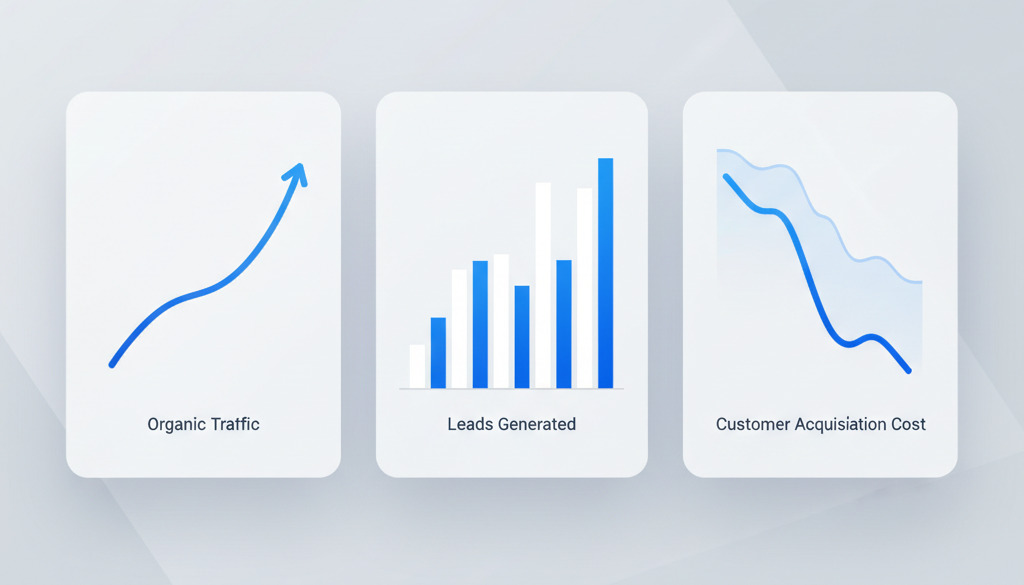
| Organic Traffic | The number of visitors who arrive at your site from a search engine result (e.g., Google), not from a paid ad. | This is the most direct indicator that your content is being found and attracting an audience. Growth here is the primary goal. |
| Keyword Rankings | Your website's position in the search results for your target keywords. | A higher ranking means more visibility and more traffic. Tracking this shows if your SEO efforts are working. |
| Leads Generated | The number of visitors who take a desired action (e.g., fill out a contact form, subscribe to a newsletter). | This metric connects content directly to potential business. It's the bridge between traffic and revenue. |
| Customer Acquisition Cost (CAC) | The total cost of your content efforts divided by the number of new customers acquired through those efforts. | The ultimate measure of efficiency. The goal is to drive this number down over time as your content assets mature. |
By regularly tracking these metrics, you can make data-informed decisions, doubling down on what works and refining what doesn’t, ensuring your AI content strategy is delivering a tangible return on investment.
Integrating AI Content into Your Existing Marketing Strategy
AI content is not a standalone solution that replaces all other marketing. It is a powerful catalyst that should be integrated with and amplify your existing efforts. The goal is to create a cohesive marketing system where the whole is greater than the sum of its parts.
For example:
- Paid Ads + Content: Instead of running an ad that points to a generic homepage, run it to a highly relevant, deeply informative AI-generated blog post. This educates the customer and builds trust, leading to a much higher conversion rate than a direct sales pitch.
- Social Media + Content: Your social media channels should not be a constant stream of promotions. Use them to share your valuable AI-generated articles, positioning your brand as a helpful expert. This builds a following that is engaged and receptive to your message.
- Sales Team + Content: Equip your sales team with a library of AI-generated articles that answer common customer questions and objections. When a prospect raises an issue, a salesperson can follow up with a helpful, detailed blog post, demonstrating expertise and building credibility.
Developing a content calendar and a clear workflow for review and distribution is key to making this integration seamless and effective.
Addressing Potential Challenges and Ethical Considerations
Embracing AI content for customer acquisition requires a clear-eyed approach that acknowledges potential pitfalls. While the benefits are immense, navigating the landscape with awareness is crucial for long-term success.
Maintaining Authenticity
The biggest risk is losing your brand's unique voice. AI can produce content that is technically perfect but soulless. It is absolutely essential that all AI-generated content passes through a human review process. This is where you add your unique insights, company-specific examples, and the personality that makes your business yours. Never simply copy and paste from an AI tool directly to your website.
Accuracy and Fact-Checking
AI models are trained on vast datasets from the internet, but they are not infallible. They can occasionally "hallucinate" facts or present outdated information. Your reputation is built on trust, so it is your responsibility to fact-check every claim, statistic, and piece of data in the content before it is published. The human-in-the-loop is not just a recommendation; it is a requirement for professional quality.
The Future of Customer Acquisition: AI as a Strategic Partner
The trends are clear and the momentum is unstoppable. AI is rapidly evolving from a simple tool for automation into a genuine strategic partner for business growth. The shift away from expensive, interruptive advertising toward value-driven, ecosystem-based growth is accelerating, and AI is at the center of this transformation.
Looking ahead, we can expect AI to become even more sophisticated, enabling:
- Hyper-Personalization at Scale: AI will allow for the creation of content experiences that are dynamically tailored to individual users based on their behavior and interests.
- Predictive Content Generation: AI will be able to predict emerging trends and suggest content topics before they become highly competitive.
- Conversational AI and Agents: As seen in recent retail trends where chat interactions have surged, customers are becoming more comfortable with AI. Soon, AI agents will not just provide links but have helpful, nuanced conversations based on your site's content, guiding users to the right solution.
Businesses that embrace AI now are not just improving efficiency; they are building the foundational skills and data assets required to compete in the next decade of digital marketing. Those who wait will find themselves at a significant and potentially insurmountable disadvantage.
Real-World Impact: Success Stories and Case Studies
For a business owner who is rightfully focused on tangible results, an abstract discussion of strategy is not enough. The real question is: *does this actually work?* The answer is a definitive yes.
Across the country, small and medium-sized businesses are quietly transforming their growth trajectories with AI-assisted content. Consider a local HVAC company that was spending thousands per month on Google Ads with mediocre results. By shifting their focus to an AI-powered content strategy, they began publishing articles like "5 Signs Your Air Conditioner Needs Repair" and "How to Choose the Right Furnace Size for Your Home." Within six months, they ranked on the first page for dozens of local search terms, generating more inbound service calls from their blog than from their paid ads, and at a fraction of the cost.
These stories share a common theme. Business owners are tired of the complexity and cost of digital advertising. The appeal of a solution that works for you is immense. Imagine having a proprietary AI that writes professional SEO articles for your website in minutes, making your business discoverable on Google almost like magic. Customers find you on their own. This is the promise that services built for business owners are delivering on, with hundreds of companies already seeing the benefits.
Getting Started: Your First Steps with AI Content for Acquisition
For a business owner who lacks the time or desire to become an SEO expert, the idea of launching a full-scale AI content strategy can feel daunting. The key is to start small and leverage services that make it easy.
- Define One Goal: Don't try to do everything at once. What is the #1 service or product you want to get more customers for? This will be the focus of your initial content efforts.
- Identify 5-10 Core Customer Questions: What are the most common questions you hear from prospects about this service? Write them down. This is the seed for your first content topics.
- Explore a Done-For-You Service: The most efficient path for a busy owner is to use a specialized service. Look for platforms designed specifically for SEO blog content. They handle the technical aspects of keyword research and AI drafting, letting you focus on providing the strategic input.
- Take Advantage of No-Risk Trials: The best services are confident in their product. Many offer free trials to prove their value. For example, some AI content platforms for businesses offer your first 5 posts for free. This is a perfect, zero-risk way to experience the quality and efficiency of the process firsthand.
Adopting AI doesn't have to be a massive, expensive overhaul. It can be a simple, incremental process that starts delivering value from day one.

Building Trust and Credibility with AI-Assisted Content
It may seem paradoxical, but using AI correctly can actually *increase* the trust and credibility of your brand. When done right, AI doesn't replace your expertise; it gives it a bigger microphone.
Think of it this way: a business that consistently publishes helpful, well-researched, and insightful content appears more professional, authoritative, and trustworthy than a business with a static, outdated website. By using AI to handle the heavy lifting of content production, you free up your valuable time—the time of the business owner and true expert—to focus on higher-level activities that build trust, such as engaging with customers, developing new strategies, and leading your industry. AI manages the *output*, while you provide the *oversight and authority*.
Maximizing ROI: Long-Term Value of AI Content Customer Acquisition
Perhaps the most compelling argument for embracing AI content is the long-term financial model. It fundamentally changes the economics of customer acquisition.
Paid advertising is like renting a house. The moment you stop paying rent, you have nothing to show for it. Your visibility disappears instantly. Content marketing, especially AI-accelerated content marketing, is like buying a house. Each article you publish is an asset you own. It may take some time to appreciate, but a well-ranked article can generate traffic and leads for *years*, delivering a compounding return on your initial investment.
Recent industry data shows that content marketing generates three times more leads than outbound marketing at a 62% lower cost. AI significantly widens this gap by drastically reducing the production cost of the content itself. Over time, this strategy allows you to build a sustainable pipeline of qualified inbound leads, reducing your reliance on expensive and volatile ad platforms.
The Human Element: Refining AI Output for Authentic Connection
Let us be unequivocally clear: AI is not a "set it and forget it" solution for customer acquisition. The most successful and sustainable strategies will always be those that masterfully blend the power of automation with the irreplaceable value of the human touch.
AI is your researcher, your draftsman, and your analyst. It can tell you *what* to write about and provide a solid structure. But it cannot replicate your years of experience, your passion for your work, or your genuine empathy for your customers. Your role, as the business leader, is to be the final, crucial filter. You are the editor-in-chief, the brand steward, and the voice of authenticity.
Use AI to get to the 10-yard line, but always be the one to carry the ball into the end zone. It is in this final, human-driven refinement that you inject the personality, stories, and unique perspective that transform a good piece of content into a great one—one that doesn't just rank on Google, but also resonates with the human being on the other side of the screen.
Conclusion: The Smartest Way to Grow
The landscape of customer acquisition has fundamentally changed. The old methods of "push" marketing are becoming less effective and more expensive by the day. For established business owners who value efficiency, sustainability, and tangible results, the path forward is clear. AI-powered content is not a future trend; it is the most strategic, cost-effective method for organic customer acquisition available today.[1]
By transforming your expertise into a library of digital assets, you create a powerful "pull" mechanism that brings motivated customers directly to you. This is not about sacrificing quality for automation. It is about using intelligent automation to amplify your quality and reach a wider audience than ever before.
For business owners who know that online content is critical but lack the time or inclination to do it themselves, solutions that write SEO articles for you are the key. They bridge the gap between knowing what you need to do and actually getting it done. The journey to effortless, organic growth begins with your first piece of strategically crafted content.
Frequently Asked Questions
1. Is AI-generated content penalized by Google?
No. Google's official stance is that they reward high-quality, helpful content, regardless of how it is produced. They are against using automation primarily to generate spammy, low-value content. As long as your process includes human review to ensure the content is accurate, original, and provides real value to the reader, it is perfectly acceptable and can rank very well.
2. How much human oversight does AI content still need?
A significant amount. AI should be treated as a powerful first-draft tool, not a final publisher. A human expert should always review, edit, and refine the content to add a unique brand voice, verify facts, include personal insights or anecdotes, and ensure it fully meets the user's needs. We recommend an 80/20 split: 80% of the initial drafting by AI, 20% of crucial refinement and strategy by humans.
3. Can AI really understand my specific, niche business?
On its own, AI provides a broad understanding. The key is how you "prompt" and guide it. By feeding it specific information about your services, target audience, and customer pain points, you can guide the AI to generate much more relevant content. Specialized AI content services are particularly good at this, as their systems are often designed to incorporate this business-specific context from the start.
4. What's the difference between using a simple AI writer and a specialized AI content service?
Simple AI writers (like ChatGPT) are general-purpose tools. They are powerful but require a lot of skill in prompt engineering and SEO knowledge to produce effective content. A specialized AI content service is a complete workflow solution. It often includes built-in keyword research, competitor analysis, SEO-optimized structuring, and a process designed specifically to create high-ranking blog content, making it much more efficient for business owners focused on customer acquisition.
5. How long does it take to see results from an AI content strategy?
SEO and content marketing are a long-term strategy, not an overnight fix. While AI speeds up production, it still takes time for Google to discover, index, and rank your content. Generally, you can expect to start seeing initial traffic and ranking improvements within 3-6 months, with an established and consistent strategy delivering significant, compounding results after 9-12 months.
6. Is it expensive to get started with AI for content creation?
It is far less expensive than traditional marketing or hiring a full-time writer. Many AI writing tools have affordable monthly subscriptions. Furthermore, specialized services designed for small businesses often have pricing tiers based on the volume of content needed. When you consider the long-term ROI and the cost savings compared to paid advertising, an AI content strategy is one of the most cost-effective marketing investments you can make.
Keep reading
Hand-picked guides that go deeper — open the one you need next:
- The 'Autopilot' Advantage: Consistent SEO Content
- The Future of Business: Becoming an AI Content Entrepreneur
- The ROI of AI Content: Why Volteruno is Your Smartest Marketing Investment
- From Idea to Publish: The Seamless AI Content Generation Workflow
→ Read the full AI Content guide