
Mastering the AI Content Generation Workflow: A Full Guide
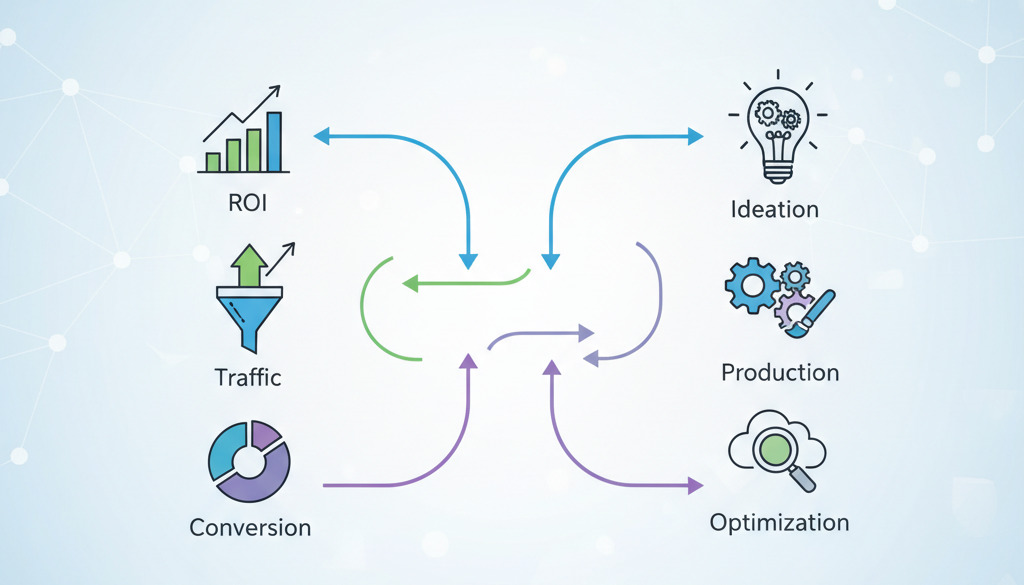
The dawn of the "generative era" hasn't just changed how we write; it has fundamentally altered the economics of information.[1] In 2024 and looking toward 2026, the challenge for businesses is no longer about whether to use AI, but how to construct a robust AI content generation workflow that yields measurable business impact. According to recent industry reports, while over 80% of marketing teams have adopted some form of AI, many struggle with "uneven maturity"—where output volume increases, but strategic value remains stagnant.
Establishing a professional workflow is the antidote to this plateau. It moves an organization from experimental, one-off prompts to a scalable engine capable of producing high-quality, brand-aligned content at a fraction of traditional costs. This guide provides a blueprint for mastering that transition, ensuring your AI integration is both ethical and high-performing.
Section 1: Understanding the Core Components of AI Content Generation
To build a workflow, one must first understand the machinery. At the heart of most modern AI content tools are Large Language Models (LLMs) such as GPT-4, Claude 3.5, or Gemini. These models use Natural Language Processing (NLP) to predict and generate text based on massive datasets. However, the technology has evolved into a multi-modal ecosystem. Beyond simple text, we now see the rise of AI agents—autonomous programs that can perceive their environment and take actions to achieve goals, rather than just waiting for a prompt.
The scope of AI content is vast. It ranges from "short-form" tactical copy like Google Ads and meta descriptions to "long-form" strategic assets like white papers, technical documentation, and even functional code. The strength of current AI lies in its ability to synthesize information, restructure data, and brainstorm ideas at superhuman speeds. Conversely, its limitations include a tendency for "hallucinations" (confident but false statements), a lack of original lived experience, and an inherent bias derived from its training data. Recognizing these components allows a business to treat AI as a powerful co-processor rather than a replacement for human intellect.
Section 2: Defining Your Content Strategy and Objectives with AI
A workflow without an objective is merely an expensive novelty. To succeed, AI content generation must be tethered to specific business outcomes. For example, if a SaaS company aims to increase organic traffic by 40% in Q3, the AI workflow should focus on scaling its keyword-driven blog production and FAQ libraries. If a retail brand wants to improve social media engagement, the AI should be tuned for creative storytelling and trend adaptation.
Identifying the "AI sweet spot" involves finding the intersection of high-volume needs and low-risk domains. Common objectives include:
- Speed-to-Market: Reducing the time from content ideation to publication by 70%.
- Multilingual Expansion: Localizing content for global markets without a linear increase in headcount.
- Personalization at Scale: Generating thousands of unique email variants for specific customer segments.
Success is measured through KPIs like search engine rankings, conversion rates from AI-assisted landing pages, and the "Human-Effort-per-Asset" ratio, which tracks how much manual intervention is required to get an AI draft to a publishable state.
Section 3: Selecting the Right AI Content Generation Tools
The automation market is currently bifurcating. On one side, we have "traditional" automation tools (iPaaS) like Zapier or Make, which excel at deterministic, if-this-then-that triggers. On the other, we are seeing the rise of AI-native platforms like Taskade or Jasper that combine autonomous agents with workflow triggers. In 2025, the "right" tool is often one that offers an API-first approach, allowing it to integrate seamlessly with your existing Content Management System (CMS) and CRM.
When evaluating tools, consider the distinction between open-source models (like Llama 3) and proprietary ones (like OpenAI’s models). Open-source models offer greater privacy and customization for companies handling sensitive data, while proprietary models often provide superior reasoning capabilities out of the box. Key criteria should include the platform's ability to "learn" your brand voice, its support for multi-step workflows, and its transparency regarding data usage and security—especially critical for enterprise-level operations.
Section 4: Crafting Effective Prompts for Optimal AI Output
Prompt engineering is the bridge between intent and execution. A vague prompt yields generic content; a structured prompt yields a professional asset. To master this, your workflow must standardize "Mega-Prompts" that include context, role, task, and constraints. For example, instead of saying "Write a blog about SEO," a professional prompt would be: "Act as a Senior SEO Strategist. Analyze the attached keyword list and draft a 1,200-word educational guide for B2B marketers. Tone: authoritative and technical. Constraint: Do not use jargon without defining it. Format: Use H2 and H3 headings."
The science of prompting now includes "Few-Shot Prompting," where you provide the AI with 3-5 examples of your best previous work to emulate. Iterative refinement is also essential. By A/B testing different prompt structures and auditing the outputs, teams can develop a "Prompt Library"—a centralized repository of vetted scripts that ensure consistency across the entire organization, regardless of who is operating the AI.
Section 5: Integrating AI into Your Existing Content Creation Process
AI should not sit in a silo. True efficiency comes from mapping your current content lifecycle and identifying specific "insertion points." For most organizations, the lifecycle follows this path: Research → Ideation → Outlining → Drafting → Editing → Distribution. AI is most effective in the Research, Ideation, and Drafting phases, while humans remain central to Editing and Strategy.
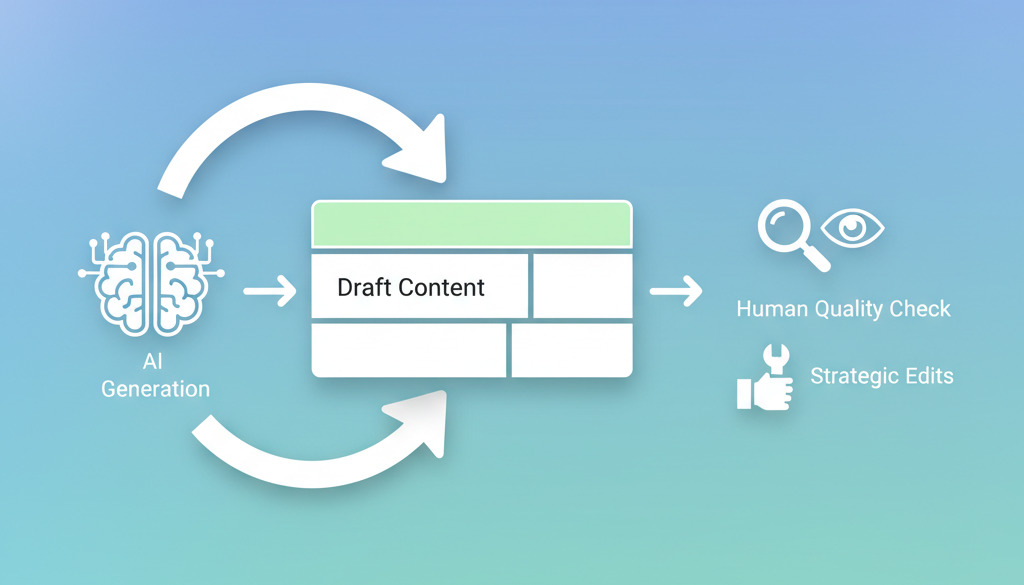
A "Human-in-the-Loop" (HITL) model is the gold standard for integration. In this setup, an AI agent might perform the initial data pull and draft a preliminary outline. A human strategist then reviews and adjusts that outline to ensure it hits psychological triggers that AI might miss. Once the AI generates the full draft, human editors refine the prose for nuance and brand authenticity. This collaborative handoff ensures that the final product feels human-led while benefiting from machine-generated speed.
Section 6: Quality Assurance and Human Oversight of AI Content
The greatest risk to a brand using AI is "drift"—the gradual erosion of quality and accuracy that occurs when machines are left unchecked. A robust Quality Assurance (QA) protocol is non-negotiable. Every piece of AI-generated content must undergoes a three-point check: Factual Accuracy, Brand Alignment, and Technical Integrity.
Because LLMs are probabilistic, they can confidently state incorrect facts. Organizations should employ specialized fact-checkers or use AI tools specifically designed for grounded verification. Furthermore, "AI detectors" and plagiarism scanners (like Copyleaks or Originality.ai) should be part of the tech stack to ensure the content doesn't inadvertently mirror existing copyrighted material. Human oversight is the "brand shield" that prevents embarrassing hallucinations from reaching the public, maintaining the trust that is foundational to any customer relationship.
Section 7: Optimizing AI-Generated Content for SEO and Distribution
AI content is not inherently SEO-friendly; it is word-frequency-friendly. To rank in a post-AI world, content must demonstrate E-E-A-T (Experience, Expertise, Authoritativeness, and Trustworthiness). Use AI to analyze SERP (Search Engine Results Page) gaps and suggest semantic keywords, but rely on human experts to add unique insights or original data that a model cannot replicate. Tools like SurferSEO or Clearscope can be integrated into the workflow to score AI drafts against real-time search data.
Distribution is the next frontier. A single AI-generated white paper can be atomized into twenty LinkedIn posts, five email newsletters, and a video script using specialized AI agents. This cross-channel optimization ensures that the investment in a single piece of "pillar content" is maximized through automated formatting and scheduling across your digital ecosystem.
Section 8: Scaling Your AI Content Generation Workflow
Scaling requires moving from manual prompting to automated pipelines. This is where AI agents become transformative. Instead of a marketer manually pasting text into a ChatGPT window, a scalable infrastructure uses "agentic workflows." Here, several AI agents work in sequence: one finds trending topics, another researches sources, a third writes the copy, and a fourth creates the CMS metadata.
To overcome bottlenecks, businesses must automate the "connective tissue" of the workflow. This might involve using Python scripts or low-code platforms to automatically move AI outputs from the generation tool to a staging environment in WordPress or Contentful. Scalability isn't just about more content; it’s about reducing the "cost per unit of content" by minimizing the manual labor required for formatting, tagging, and uploading.

Section 9: Measuring Performance and Iterating Your AI Workflow
Data is the fuel for workflow improvement. By tracking the performance of AI-assisted content vs. purely human-made content, you can identify which niches or formats AI handles best. For example, you may find that AI excels at technical "How-To" guides but underperforms in "Opinion/Thought Leadership" pieces. Use these insights to rebalance your resource allocation.
Establishing a continuous feedback loop is vital. Marketers should "tag" content in their analytics platforms based on the level of AI involvement. If AI-heavy content sees a higher bounce rate, it may indicate a need for more rigorous human editing or more sophisticated prompting. Regular "Workflow Audits" allow teams to swap out underperforming tools or update their prompt libraries to reflect the latest model capabilities, ensuring the workflow never becomes obsolete.
Section 10: Ethical Considerations and Responsible AI Content Creation
As AI becomes ubiquitous, transparency becomes a competitive advantage. Corporate responsibility in AI content creation involves two main pillars: bias mitigation and disclosure. AI models are trained on internet data, which often contains systemic biases. Workflows must include an "Ethical Review" stage to ensure content doesn't perpetuate stereotypes or provide harmful advice, particularly in sensitive sectors like finance or healthcare.
Furthermore, the legal landscape regarding AI and copyright is still evolving. Recent US copyright rulings suggest that purely AI-generated works may not receive the same protections as human-authored ones. This reinforces the need for "Human-in-the-Loop" processes—by adding significant human creative input, businesses can better secure their intellectual property. Transparency with your audience—disclosing when AI was used to assist in research or drafting—can also build brand trust in an era of digital skepticism.
Section 11: Future Trends in AI Content Generation Workflows
Looking ahead to 2026, the trend is moving away from generic generation toward "Hyper-Personalization." We will see workflows that generate dynamic content in real-time based on a user’s specific browsing history and intent. AI will not just write the article; it will customize it for the specific reader viewing it at that moment.
Another major shift will be the integration of "Personalized LLMs"—models trained specifically on a company’s internal private data, style guides, and past successful campaigns. This will virtually eliminate the "generic" feel of current AI outputs. The collaboration between humans and AI will move from a linear relationship to a "Mesh" relationship, where AI agents act as proactive team members, suggesting content ideas before a human even asks for them, based on real-time market shifts.
Conclusion
Mastering the AI content generation workflow is the definitive skill for the modern marketing organization. It is a journey from "content as a craft" to "content as a strategic engine." By defining clear objectives, selecting the right hybrid tools, and maintaining a rigorous human-centric quality assurance process, businesses can unlock unprecedented levels of creativity and efficiency. AI is not here to replace the storyteller; it is here to be the world’s most powerful pen. The businesses that build the most robust workflows today will be the ones that define the narrative of tomorrow.
The Ethical Imperative of AI Content Generation Workflows
As AI content generation workflows become increasingly sophisticated and integrated into business operations, a critical parallel development must encompass the ethical considerations that guide their implementation. The power to generate content at scale, personalize it to an unprecedented degree, and automate much of the creative process carries significant responsibilities. Neglecting the ethical dimension not only risks reputational damage but can also lead to tangible harms, including the spread of misinformation, the exacerbation of societal biases, and the erosion of trust between brands and their audiences. Therefore, a robust AI content generation workflow must include built-in mechanisms for ethical oversight and accountability. One of the primary ethical challenges revolves around transparency and disclosure. When content is generated or significantly augmented by AI, there is a growing expectation, and in some jurisdictions, a legal requirement, for this to be clearly communicated to the end-user. Failure to disclose can be perceived as deceptive, particularly in contexts where authenticity and human authorship are valued, such as journalism, creative writing, or personal testimonials. Implementing an AI content generation workflow necessitates establishing clear guidelines on when and how AI involvement will be disclosed. This might involve watermarking AI-generated images, including disclaimers on AI-written articles, or ensuring that AI-assisted human editors maintain final editorial control and are credited appropriately. The goal is to foster an environment of trust where consumers understand the provenance of the content they interact with, enabling them to critically evaluate its source and potential biases. Further ethical considerations arise from the data used to train AI models. If the training data contains inherent biases related to race, gender, socioeconomic status, or any other protected characteristic, the AI's outputs will likely reflect and perpetuate these biases. This can manifest in various ways, from generating stereotypical portrayals of certain groups to offering discriminatory recommendations or content. A responsible AI content generation workflow must therefore incorporate rigorous data curation and bias detection processes. This involves actively seeking out and mitigating biases in training datasets, and continuously monitoring the AI’s outputs for unintended discriminatory patterns. Regular audits and feedback loops involving diverse human reviewers are essential to identify and correct these issues before they cause harm. Moreover, the evolving capabilities of AI in content generation raise questions about intellectual property, plagiarism, and the potential for malicious use, such as the creation of deepfakes or sophisticated phishing campaigns. Workflows need to be designed to prevent the outright regurgitation of copyrighted material without attribution, which AI models could inadvertently do if not properly constrained. Equally important is safeguarding against the weaponization of AI-generated content. This means building in safeguards to prevent the generation of hate speech, propaganda, or other harmful material, and establishing clear protocols for responding to instances where the AI is misused. The ethical imperative extends beyond simply creating content; it involves ensuring that the tools used for its creation are not contributing to a more fractured or deceptive information ecosystem. Ultimately, a holistic approach to AI content generation workflows must prioritize fairness, accountability, and the well-being of both creators and consumers, embedding ethical principles at every stage from data input to final output dissemination.FAQ
What are the key stages of an AI content generation workflow?
A typical AI content generation workflow includes ideation and research, prompt engineering, content generation, editing and refinement, and final review and publishing. Each stage plays a crucial role in ensuring the quality and relevance of the AI-generated content.
How important is prompt engineering in AI content generation?
Prompt engineering is critical as it directly influences the quality, accuracy, and style of the output. Well-crafted prompts provide clear instructions and context to the AI, leading to more relevant and useful content.
Can AI content generation fully replace human writers?
While AI excels at rapidly generating draft content and assisting with ideation, it cannot fully replace human writers. Human oversight is essential for critical thinking, nuanced understanding, creativity, fact-checking, and ensuring brand voice and ethical considerations.
Keep reading
Hand-picked guides that go deeper — open the one you need next:
- Your Blog, Your Rules: AI Content Customization
- Automated Content Publishing for Business Growth
- AI Marketing: Volteruno Delivers ROI
- Local Businesses Rejoice: Geo-Targeted Content With AI
→ Read the full AI Content guide