
AI Content Topic Generation: Beat Writer's Block

Key Takeaways
- Overcome Writer's Block: AI topic generation provides a virtually endless stream of relevant, data-driven ideas, eliminating the challenge of staring at a blank page.
- Enhance SEO Performance: AI tools uncover high-value keywords, analyze competitor strategies, and identify content gaps, helping your blog rank higher in Google search results and attract organic traffic.
- Understand Your Audience Deeper: AI analyzes customer data, online discussions, and search trends to reveal the precise questions and pain points your target audience has, enabling you to create content that truly resonates.
- Save Time and Resources: For busy business owners, AI automates the time-consuming process of brainstorming and research, allowing you to maintain a consistent publishing schedule without sacrificing time spent on your core operations.
- Strategic Business Growth: Integrating AI for topic generation isn't just about creating content; it's about creating a strategic asset that drives leads, builds authority, and generates a measurable return on investment.
The Evolving Landscape of Content Marketing for Businesses
In the last decade, the way businesses connect with customers has been completely transformed. The days of relying solely on traditional advertising are over. Today, your potential customers are online, actively searching for answers, solutions, and trustworthy brands. This is where content marketing, specifically a business blog, becomes not just an option, but a necessity for growth.
The Central Role of SEO and Organic Traffic
For a business owner, especially one who isn't a digital native, the term Search Engine Optimization (SEO) might sound complex. In simple terms, SEO is the process of making your website more attractive to search engines like Google. When someone searches for a product or service you offer, good SEO helps your business appear at the top of the results. This is called "organic traffic," and it's incredibly valuable because it consists of potential customers who are already looking for what you provide.
The Content Conundrum for Business Owners
While the benefits are clear, the reality of maintaining a successful blog presents significant hurdles for established business owners. The primary challenges are universal:
- Time Constraints: Running a business is more than a full-time job. Finding hours to brainstorm, write, and edit blog posts is a luxury most don't have.
- Lack of Expertise: Writing effective web content is a specific skill. It requires an understanding of SEO, audience engagement, and compelling storytelling.
- Idea Generation Burnout: The most daunting task of all can be consistently coming up with fresh, relevant topic ideas. What should you write about next week? Next month? How do you ensure it's something your customers actually want to read? This is where writer's block meets business strategy, and it can bring content plans to a screeching halt.
Understanding AI-Powered Content Topic Generation
Imagine having a strategic partner who can analyze the entire internet, understand your customers' deepest needs, and deliver a list of compelling blog topics to your desk every morning. That, in essence, is what AI-powered content topic generation does. It is a solution designed specifically to solve the content conundrum for busy professionals.
What Is It, in Simple Business Terms?
AI content topic generation uses artificial intelligence to automate the process of finding and validating ideas for your blog.[1] Instead of you manually guessing what to write about, the AI performs a comprehensive analysis of massive datasets. It acts as your tireless market researcher, identifying subjects that are not only relevant to your business but are also actively being searched for by your ideal customers. It’s the data-driven answer to the question, "What content will bring more customers to my website?"
How AI Delivers Speed and Scale
The fundamental difference between AI-driven ideation and traditional methods is the sheer speed and scale. A human might spend hours or even days using various tools to research a handful of good keywords and topic angles. An AI system can perform this work in minutes, analyzing millions of data points simultaneously. It can cross-reference search engine data, social media trends, competitor articles, and forum discussions to generate hundreds of potential ideas, categorized and prioritized for business impact.
Identifying Your Target Audience's Unmet Needs and Questions
The most successful content doesn't just promote a business; it solves a problem for the customer. Before a person is ready to buy, they are looking for information. They have questions, concerns, and pain points. Your blog is the perfect place to address these issues, building trust and positioning your business as a helpful expert. The challenge is knowing what those specific questions and needs are.
Moving Beyond Assumptions
Many businesses operate on assumptions about their customers. You might think you know what they struggle with, but are you certain? AI removes the guesswork. It provides a direct line into the mind of your target audience by analyzing the digital trails they leave across the web.
How AI Uncovers Customer Pain Points
AI tools can be programmed to scan and interpret a vast range of unstructured information. This includes:
- Customer Reviews: Analyzing reviews for your products (and your competitors') can reveal common complaints, feature requests, and points of confusion.
- Online Forums and Q&A Sites: Platforms like Reddit or Quora are goldmines of authentic conversations. AI can identify the most frequently asked questions related to your industry.
- Social Media Comments: Monitoring discussions on social media helps you understand public sentiment and identify the language your customers use to describe their problems.
By identifying these unmet needs, you can create foundational content that serves as a valuable resource, drawing in potential customers at the very beginning of their journey.
Leveraging Keyword Research with an AI Twist
Keyword research is a cornerstone of any successful SEO strategy. It’s the process of identifying the specific words and phrases people type into Google when they’re looking for products, services, or information. While traditional keyword research is effective, it can be manual, time-consuming, and often misses the bigger picture.
The Limitations of Traditional Keyword Tools
Standard keyword research tools are powerful, but they often present data in a linear fashion. You enter a "seed" keyword and get a list of related terms with their search volume. This is useful, but it doesn’t always help you understand the *intent* behind the search or how different keywords relate to each other to form a broader topic of interest.
How AI Enhances the Process
AI brings a new level of sophistication to this process. Instead of just looking at individual keywords, it analyzes patterns and relationships to identify strategic opportunities. For a deeper dive into this subject, an AI content keyword research guide can provide even more strategic insights.
Discovering Keyword Clusters and Long-Tail Gems
An AI-powered approach excels in two key areas:
- Long-Tail Keywords: These are longer, more specific search phrases (e.g., "best waterproof running shoes for flat feet" instead of just "running shoes"). They typically have lower search volume but much higher conversion intent. AI is exceptionally good at uncovering these valuable, specific queries.
- Keyword Clusters: AI can group related keywords into "clusters" or "hubs." This signals that there is a broad topic area with many sub-topics that you can cover. For example, it might identify a cluster around "home office setup," which could include topics like "ergonomic chairs," "desks for small spaces," and "best lighting for video calls." This allows you to plan a series of articles, establishing your website as a definitive authority on the subject.
Analyzing Competitor Content Strategies for Gaps and Opportunities
In business, you always keep an eye on the competition. The same principle applies to your content strategy. You don’t need to reinvent the wheel—you just need to build a better one. Understanding what content is already working for your competitors, and more importantly, what they are missing, is a direct path to gaining a competitive edge.
The Importance of Strategic Competitive Analysis
Analyzing your competitors isn't about copying them. It's about learning from their successes and failures to inform your own strategy. By seeing what topics drive traffic to their sites, you can target similar areas. By identifying topics they have failed to cover, you can swoop in and fill that void, capturing an audience they have ignored.
How AI Automates Competitor Intelligence
Manually sifting through a competitor's entire blog is an impossibly slow task. AI tools can do this in minutes. An AI can scan a competitor's domain and instantly provide a report on:
- Their most successful pages: Which articles are bringing them the most organic traffic from Google?
- The keywords they rank for: What search terms are their business drivers?
- Their content frequency: How often are they publishing new articles?
Identifying and Winning the Content Gaps
The most valuable output of this analysis is the identification of "content gaps." These are topics that are relevant to your shared audience and have significant search interest, but that your competitors have either overlooked or covered poorly. For example, an AI might find that several of your competitors have written about "small business accounting" but none have covered the specific topic of "quarterly tax preparation for freelance consultants." This creates a golden opportunity for you to become the go-to resource for that specific, underserved niche.

Utilizing AI for Trend Spotting and Predictive Content Ideas
In the fast-paced digital world, what is popular today can be forgotten tomorrow. Creating content that is timely and relevant is crucial for capturing audience interest. While it's important to build a foundation of "evergreen" content that remains valuable over time, capitalizing on current trends can give you a significant traffic boost and show that your brand is current and knowledgeable.
The Power of Predictive Analysis
AI excels at pattern recognition, making it a powerful tool for trend analysis. By monitoring news sites, industry publications, social media conversations, and search query data in real-time, AI can identify topics that are rapidly gaining popularity. This allows you to get ahead of the curve and publish content about an emerging trend just as public interest is beginning to peak.
From Reactive to Proactive Content Creation
Many businesses are reactive; they write about a trend only after it has become mainstream. By then, the digital space is already crowded, and it's difficult to stand out. AI enables a proactive approach. An AI model might detect a growing number of conversations around a new piece of legislation affecting small businesses or a new technology disrupting an industry. By alerting you to this early on, it gives you the chance to create one of the first comprehensive articles on the topic, establishing your authority and capturing valuable early traffic.
The Science Behind AI Topic Suggestion Algorithms
For a business owner, you don't need to understand how to build an engine to know that a car will get you where you need to go. The same is true for artificial intelligence. While the underlying technology is incredibly complex, the principles that make it work for topic generation are quite straightforward and focused on delivering one thing: data-backed suggestions, not random guesses.
A Glimpse Under the Hood
At a high level, these AI systems use a combination of several technologies:
- Natural Language Processing (NLP): This is the technology that allows computers to understand human language as it is written and spoken. NLP is how the AI can read an article, a customer review, or a forum post and understand its topic, sentiment, and key points.
- Machine Learning (ML): This is the "learning" part of AI. The system is trained on vast amounts of text and data from the internet. It learns what makes a good title, what topics are related to each other, and which keywords are associated with high user engagement.
- Data Mining: This is the process of sifting through enormous datasets to find patterns and valuable information. The AI mines data from search engines, social platforms, and analytics to spot trends and identify opportunities.
The End Result: Strategic Confidence
The purpose of this technology is to replace guesswork with data. When an AI suggests a topic like "The 5 Biggest Tax Mistakes New Restaurant Owners Make," it's not a creative whim. That suggestion is the result of an analysis that likely found a high volume of search queries from new restaurant owners about taxes, a lack of comprehensive articles on the subject from competitors, and a high level of engagement with similar content on social media. It provides you with the confidence to invest time and resources into creating content that is almost guaranteed to find an audience.
Crafting Compelling and SEO-Optimized Topic Titles
A blog post's title is arguably its most important element. It’s the first thing a potential reader sees in a Google search, on social media, or in their inbox. The title has to do a lot of work in just a few words: it must accurately reflect the content, include important keywords for SEO, and be compelling enough to make someone want to click.
The Art and Science of a Great Title
Crafting the perfect title is both an art and a science. It needs to be creative and engaging, but it also needs to be optimized for search algorithms. For busy business owners, spending time trying to come up with multiple title variations for every single blog post is not a practical use of their time. This is another area where AI assistance can be invaluable.
How AI Helps You Write Titles That Work
An AI topic generator doesn't just give you a subject; it often suggests several optimized titles to go with it. Here’s how it helps:
- Keyword Integration: AI ensures that your primary keyword is naturally included in the title, which is a critical signal for search engines.
- Proven Formats: The system learns from millions of articles which title formats get the most clicks. It might suggest titles formatted as "how-to" guides, numbered lists ("5 Ways to..."), or questions.
- A/B Testing Ideas: AI can generate several distinct variations of a title. This allows you to see different angles for the same topic. For example, for a topic on inventory management, it might suggest "A Step-by-Step Guide to Inventory Management" as well as "Stop Losing Money: 3 Inventory Mistakes to Avoid."
By using AI to help craft titles, you increase the likelihood that your well-written article actually gets seen and read by your target audience.
Generating Topic Ideas for Diverse Content Formats
While the blog post is the cornerstone of content marketing for many businesses, a truly effective strategy involves a mix of different content formats. Your audience consumes information in various ways. Some prefer to read in-depth articles, while others might prefer watching a short video or looking at a shareable graphic. Your AI topic generation strategy should be able to fuel all of these channels.
Thinking Beyond the Blog Post
A strong topic idea is not limited to a single format. A single core idea, identified by AI as being highly relevant to your audience, can be repurposed and adapted across multiple platforms. This creates a cohesive and far-reaching content strategy that maximizes the return on your initial research efforts.
How AI Fuels a Multi-Channel Strategy
An AI system can generate ideas that are inherently suited for different formats. For example:
- For Blog Posts: In-depth "how-to" guides, case studies, and comprehensive explorations of a complex topic.
- For Social Media Updates: The core idea can be distilled into a quick tip, a thought-provoking question, a statistic, or a quote.
- For Video Scripts: A topic like "Unboxing and Setting Up [Your Product]" or a "Top 5 Mistakes" list is perfectly suited for a short, engaging video.
- For Infographics: If AI identifies a topic rich with data, statistics, or a step-by-step process, it can suggest this as a prime candidate for a visually engaging infographic.
By thinking about your AI-generated topics in this holistic way, you can create a content ecosystem where each piece supports the others, reaching your customers wherever they are most active.
Bridging the Gap: From AI Topic Ideas to Engaging Content
A common and understandable concern among business owners is whether AI-generated topics lead to robotic or generic content. It’s a valid question. The topic is just the starting point. The real magic happens when you combine the data-driven direction of AI with genuine human expertise and personality.
AI Provides the Foundation, You Provide the Flair
Think of the AI-generated topic as a precise, architect-designed blueprint for a house. The blueprint guarantees that the structure will be sound, the rooms will be in the right places, and it will meet all the necessary codes. It provides the perfect foundation. However, it is the human touch—the choice of paint colors, furniture, and personal decor—that turns the house into a home. Similarly, the AI provides the topic that is guaranteed to be structurally sound from an SEO and audience-interest perspective. It is the business owner's unique insight, personal stories, and brand voice that turn it into a compelling and engaging piece of content.
The Role of Human Oversight
The best approach is to view AI as a powerful assistant, not a complete replacement. Use the AI to generate a list of 20 validated topic ideas. Then, use your human expertise to:
- Select the best fit: Choose the topics that you feel most passionate and knowledgeable about.
- Add personal experience: Inject your own stories, case studies, and real-world examples. This is something AI cannot replicate.
- Refine the angle: The AI might suggest "Tips for Better Customer Service." You can refine this to "The Customer Service Philosophy That Doubled Our Client Retention," making it unique to you.
For those looking to understand this synergy further, exploring a guide on mastering AI article writers can show how this partnership works in practice to create truly engaging content.
Practical Application: Implementing AI Topic Generation in Your Workflow
Adopting new technology can feel intimidating, especially when you are already managing a hundred other things in your business. The good news is that integrating AI topic generation into your workflow is more straightforward than you might think. The goal is to make your life easier, not to add another complex task to your to-do list.
Step-by-Step Integration
For the hands-on business owner, the process can be broken down into a few simple steps:
- Define Your Core Topics: Start by giving the AI some context. What are the main pillars of your business? Are you in construction, retail, consulting? Provide 3-5 broad themes.
- Enter Your Competitors: Provide the website addresses of 2-3 of your main competitors. This will allow the AI to perform the gap analysis we discussed earlier.
- Generate and Review: Run the tool. Within minutes, you should have a long list of potential topics, often sorted by keyword volume or some other priority score.
- Select and Schedule: Review the list and select the topics that best align with your business goals for the coming month or quarter. Add them to your content calendar.
The Simplified, Hands-Off Approach
For many business owners, even those few steps are more than they have time for. They understand the value but need a solution that runs itself. This is where fully managed services come in. For example, platforms like the one from More Customers From Your Blog are designed for this exact scenario. They simplify this entire process, handling the technical setup, the AI-driven topic generation, the professional writing, and the publishing. This allows you to reap all the benefits of a world-class content strategy while you remain focused on your core business operations.
Overcoming Common Objections and Misconceptions About AI Content
As with any transformative technology, there is a lot of misinformation and apprehension surrounding AI in content creation. It is important to separate the myths from the reality to make an informed business decision.
Myth 1: AI Content is Unoriginal and Plagiarized
This is one of the biggest fears. Early, less sophisticated AI models did have a tendency to re-arrange existing text. However, modern AI systems, particularly those built on large language models, generate text from scratch based on learned patterns. They don't "copy and paste" from sources. The content is statistically unique. Reputable services also always include plagiarism checks as a final layer of security.
Myth 2: AI Lacks the "Human Touch" and Creativity
It’s true that an AI doesn't have personal experiences or emotions. However, it can analyze millions of examples of creative, human-written text and learn what makes it engaging. It can replicate tones, from professional and business-like to witty and casual. The "human touch" comes from strategic guidance—providing the AI with the right prompts, adding your own specific brand stories, and ensuring the final output aligns with your company’s voice. The AI provides the 90% of high-quality draft; the human provides the final 10% of unique brand personality.
Myth 3: Using AI is Too Complicated for a Non-Technical Person
While the technology behind AI is complex, the user interfaces of modern AI tools and services are designed for simplicity. As we discussed, many platforms are as simple as typing your needs into a text box. Furthermore, full-service solutions exist specifically to remove any technical burden from the business owner entirely.
Ensuring Quality and Originality with AI-Assisted Content
The ultimate goal of using AI is not just to produce more content, but to produce better content that drives business results. Ensuring the quality, originality, and relevance of every article published on your site is paramount. This requires a process of smart collaboration between the AI tool and human expertise.
Best Practices for Quality Control
Whether you are using an AI tool yourself or working with a service, there are several best practices to ensure top quality:
- Start with a Detailed Brief: The more context you provide the AI, the better the output. Specify your target audience, the desired tone of voice, key points to include, and a clear call to action.
- Fact-Check Everything: While AI is incredibly knowledgeable, it can occasionally make mistakes, especially with very recent data or highly niche topics. Always have a human review the content for factual accuracy.
- Review and Refine: Treat the AI-generated text as a high-quality first draft. A human editor should always read through it to refine phrasing, add brand-specific terminology, and inject personality.
The Value of Hybrid Services
This is why the most effective and reputable AI content services operate on a hybrid model. For instance, a service whose mission is to get more customers from your blog will not rely solely on automation. They combine the efficiency and data-processing power of AI for topic generation and initial drafting with the critical eye of professional human writers and editors. This "AI-assisted, human-perfected" approach ensures that the final content is not only SEO-optimized and original but also polished, accurate, and perfectly aligned with your brand voice.
Measuring the ROI of AI-Driven Content Topic Generation
As a business owner, every investment you make needs to justify itself. You need to see a return. A content marketing strategy fueled by AI is no different. The good news is that the impact of this approach is highly measurable, tying directly to key business metrics that matter to your bottom line.
Key Metrics to Track
To measure the Return on Investment (ROI) of your content, you should focus on a few key performance indicators (KPIs):
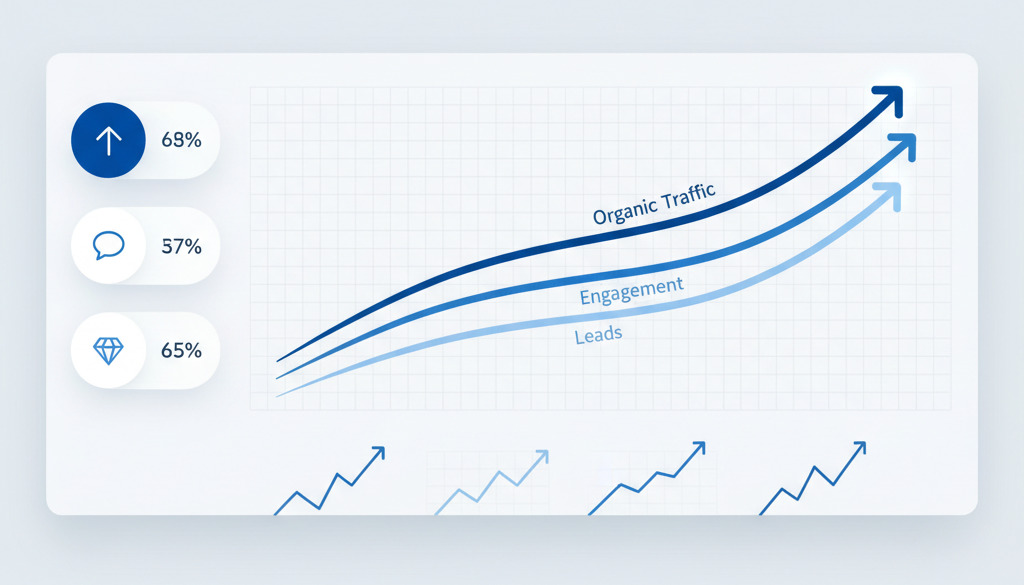
- Organic Traffic: Are more people finding your website through Google searches? This is the primary indicator that your SEO efforts are working. You can track this easily using free tools like Google Analytics.
- Keyword Rankings: Are you starting to appear on the first page of Google for your target keywords? An increase in rankings directly leads to more traffic.
- Engagement Rate: Are people staying on your pages to read your content? Metrics like "time on page" and "bounce rate" tell you if your content is engaging and valuable to your visitors.
- Lead Generation: How many readers are taking the next step? This could be signing up for your newsletter, downloading a guide, or filling out a contact form. This is where content starts turning into potential revenue.
- Conversion Rate: Ultimately, what percentage of readers become paying customers? This is the most important metric and the true measure of ROI.
The Business Case for AI
When you use AI for topic generation, you are creating content that is pre-validated to have audience interest and search demand. This dramatically increases the probability of seeing positive movement in these KPIs. You are no longer "throwing content at the wall to see what sticks." You are making a calculated, data-driven investment in topics that are strategically chosen to attract and convert your ideal customers.
The Future of Content Creation: AI as Your Strategic Partner
The pace of advancement in artificial intelligence is staggering. The tools and capabilities available today are just the tip of the iceberg. As we look toward the near future, it’s clear that AI’s role in content marketing will evolve from a helpful tool to an indispensable strategic partner for businesses of all sizes.
What's Next on the Horizon?
We can expect AI to become even more sophisticated and integrated into the content workflow. Future advancements will likely include:
- Hyper-Personalization: AI will be able to suggest topics tailored not just to your general audience, but to specific segments of that audience, allowing for highly targeted campaigns.
- More Advanced Predictive Analytics: AI will get even better at forecasting trends, allowing businesses to create content for demand that doesn't even exist yet.
- Seamless Multi-Format Creation: A single command might allow you to generate a blog post, a social media campaign, and a video script all from one core idea, with the AI handling the adaptation for each format.
AI as a Collaborator, Not a Replacement
It’s important to frame this evolution correctly. AI will not replace the need for human strategy, creativity, and business knowledge. Instead, it will augment it. It will handle the heavy lifting of data analysis, research, and drafting, freeing up business owners and marketers to focus on high-level strategy, customer relationships, and creative storytelling. As you consider how AI can transform your blog strategy, view it as hiring the most powerful research assistant in the world, allowing you to be the visionary leader your business needs.
Getting Started with AI: A Step-by-Step Guide for Business Owners
Adopting AI-powered content generation is one of the highest-impact decisions you can make for your online growth. The path to getting started is clear, simple, and designed for busy professionals who value results.
A Simple Roadmap to Success
- Define Your Goal: What do you want to achieve? More website traffic? More leads? To be seen as the expert in your local area? Start with your business objective.
- Assess Your Resources: Be realistic about your time and expertise. Do you have the capacity to manage AI tools and review content, or do you need a more hands-off solution?
- Choose Your Path: Based on your resources, decide whether to use a DIY AI tool or engage a full-service provider.
- Start Small and Measure: You don't need to overhaul everything overnight. Start with a plan to publish 4-5 AI-driven articles. Track their performance. The results will speak for themselves.
An Invitation to Effortless Growth
For the majority of established business owners, the most valuable resource is time. The path of a full-service provider is often the most logical. Consider the offer from a service dedicated to this: their proprietary artificial intelligence writes professional SEO blog articles for your website in minutes—almost like magic. Customers find you on their own in Google. With a track record of serving over 500 companies, it’s a proven model. Best of all, you can often test the service with no risk. For example, some offer your first 5 posts for free, giving you a chance to see the direct impact on your business firsthand.
Conclusion
For the savvy business owner who understands the critical need for an online presence but lacks the time and resources to constantly feed the content machine, AI topic generation is more than just a new technology; it's a fundamental solution. It removes the most significant barriers to effective content marketing: writer's block, time consumption, and the uncertainty of what to write about.
By leveraging AI, you can ensure your blog becomes a powerful, strategic asset that consistently attracts your ideal customers, builds your authority, and drives measurable business growth. Artificial intelligence handles the data-driven science of what to write about, freeing you to focus on running the business that your content will help to grow. The future of content is here, and it’s more accessible and powerful than ever.
Frequently Asked Questions
1. Is content generated by AI safe for SEO? Will Google penalize my site?
Yes, it is safe when done correctly. Google has officially stated that their focus is on the quality of the content, not how it is produced. High-quality, helpful, and original content is rewarded, regardless of whether AI was used in its creation. Low-quality, spammy content will be penalized, again, regardless of its origin. A reputable AI content service ensures the output is high-quality, human-reviewed, and provides genuine value to the reader, making it perfectly safe for SEO.
2. How can AI possibly understand the nuances of my specific, niche industry?
This is a common concern. Modern AI models are trained on a massive and diverse dataset, which includes a vast amount of specialized, industry-specific information from textbooks, technical journals, and professional websites. While it might not know the internal secrets of your specific company, it can write with a high degree of authority on topics like commercial roofing, financial compliance, or dental practice management. For hyper-specific nuances, a final human review is always recommended to add that layer of unique expertise.
3. Do I still need a human writer or editor if I use AI?
It depends on the approach. If you use a basic AI tool to generate a draft, it is highly recommended to have a human writer or editor review, fact-check, and refine the content to add brand voice and ensure accuracy. However, if you use a full-service solution (like the ones mentioned in this article), the service includes professional human writers and editors as part of the package. In this case, you do not need to hire your own separate staff.
4. How much does an AI blog writing service typically cost?
Costs can vary widely. Some DIY tools have monthly subscription fees ranging from $50 to a few hundred dollars. Full-service solutions, where a team manages the entire process for you, are typically priced per article or on a monthly retainer. While it may seem more expensive upfront, these services provide a complete, hands-off solution, saving you immeasurable time and ensuring a professional outcome, which often provides a much higher return on investment for a busy business owner.
5. How quickly can I expect to see results from AI-driven content?
SEO and content marketing are a long-term strategy, not an overnight fix. While AI can drastically speed up the content *creation* process, it still takes time for Google to index your new pages and for them to begin ranking for competitive keywords. Generally, you can expect to start seeing a noticeable increase in organic traffic and keyword rankings within 3 to 6 months of consistently publishing high-quality, SEO-optimized content. The AI-driven approach ensures you're on the fastest possible track by targeting the right topics from day one.
Keep reading
Hand-picked guides that go deeper — open the one you need next:
- Future-Proof Your Marketing: AI in Content Creation for 2026
- Your Blog, Your Rules: AI Content Customization
- Automated Content Publishing for Business Growth
- AI Marketing: Volteruno Delivers ROI
→ Read the full AI Content guide