
Scalable Content Strategy: AI for Consistent Blog Growth
Key Takeaways
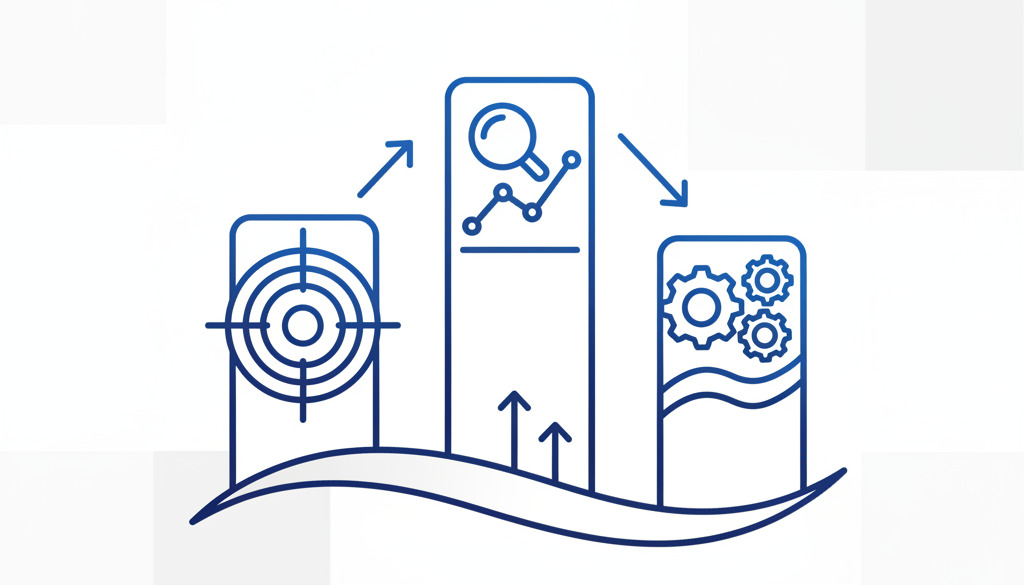
- What is a Scalable Content Strategy? It's a system for creating a consistent flow of high-quality, SEO-optimized content that drives predictable business growth, not just publishing more articles.
- Why AI is a Game-Changer: Artificial intelligence automates and accelerates time-consuming tasks like research, drafting, and optimization, allowing businesses to scale content production without a proportional increase in costs or manpower.
- Human Oversight is Crucial: AI is a powerful tool, but it is not a replacement for human expertise. Your strategy, creativity, brand voice, and fact-checking are essential for creating content that connects with readers and ranks well.
- The Core Benefits: Implementing an AI-powered strategy leads to improved SEO rankings, consistent organic traffic, higher lead generation, and a significant competitive advantage in the digital marketplace.
- Getting Started is Accessible: You don't need to be a tech expert. Modern AI platforms and "done-for-you" services make it possible for any business owner to leverage this technology for sustainable growth.
The Imperative of Scalable Content in Today's Digital Landscape
In today's crowded online marketplace, being visible isn't a luxury; it's a necessity. For business owners, especially those who built their companies offline and are now navigating the digital world, the pressure to "be online" can feel immense. You know you need a blog, you know you need to post on social media, you know you need to show up in Google search results. But the demand for fresh, relevant, and engaging content is relentless. This is where the concept of scalable content becomes critical.
Scalable content isn't just about churning out more blog posts. It’s about creating a predictable system that consistently produces high-quality content that your ideal customers are searching for. It’s content that works for you 24/7, attracting visitors, building trust, and turning readers into customers. The challenge, of course, is that traditional content creation is anything but scalable.[2] It's slow, expensive, and heavily reliant on a handful of individuals. But what if there was a way to break that model? A way to feed your blog and your business with a consistent stream of valuable content, almost on demand? That way is now here, and it’s powered by Artificial Intelligence (AI).
Understanding the Core Concepts: Why Your Business Needs Scalable Content
If you've ever tried to manage a business blog, you're familiar with the common hurdles. The initial enthusiasm fades, daily operations take priority, and soon the blog becomes a digital ghost town. This inconsistency is poison to your online growth. The challenges of traditional content creation are significant:
- Time Constraints: As a business owner, your time is your most valuable asset. Spending hours or days writing a single blog post is often not a feasible option.
- Resource Limitations: Hiring a dedicated in-house writer or a top-tier marketing agency can be prohibitively expensive for many small to medium-sized enterprises (SMEs).
- Inconsistent Quality: When you're rushed or delegating to someone who doesn't fully grasp your brand, the quality of the content can suffer, damaging your credibility.
A scalable content strategy directly addresses these problems. By establishing a repeatable process for creating and distributing content, you create a powerful engine for business growth. Consistent, high-quality content is the fuel Google and other search engines run on. Every well-optimized article you publish is another door for customers to find you, another chance to demonstrate your expertise, and another asset that generates organic traffic and leads long after it’s published. A scalable strategy turns content from a burdensome chore into a predictable, growth-driving business function.
The Fundamental Pillars of a Scalable Content Strategy
Before introducing AI into the equation, it’s essential to understand that technology only amplifies the strategy you have in place. A successful scalable content strategy rests on three unwavering pillars. Without these, even the most advanced AI will fail to deliver results.
Pillar 1: Audience-Centricity
You are not writing for everyone. You are writing for your specific customer. Understanding them isn't just good practice; it's the foundation of all effective marketing.
Identifying Your Ideal Customer Profile (ICP)
Your ICP is a detailed description of the perfect customer for your business. Go beyond basic demographics. What are their biggest challenges and pain points (that your business solves)? What are their goals? Where do they look for information online? When you have a crystal-clear picture of who you're talking to, creating content that resonates becomes infinitely easier.
Mapping the Customer Journey and Content Needs at Each Stage
A potential customer goes through several stages before making a purchase: awareness (they have a problem), consideration (they are researching solutions), and decision (they are choosing a provider). Your content needs to meet them at each stage. A person just realizing they have a problem needs a different article than someone who is comparing your service to a competitor.
Pillar 2: SEO Optimization
The most brilliant article is useless if no one can find it. Search Engine Optimization (SEO) is the non-negotiable process of making your content discoverable by search engines like Google.[1]
Keyword Research for Long-Term Traffic
Keywords are the search terms your ideal customers are typing into Google. Your goal is to identify keywords that have sufficient search volume but are not impossible to rank for. Focus on keywords that show intent to solve a problem your business addresses. These are the terms that bring qualified traffic to your site.
On-Page and Technical SEO Essentials
This involves optimizing individual content pieces with your target keyword in the title, headings, and body text. It also includes technical aspects of your website, like site speed and mobile-friendliness, which are crucial ranking factors.
Pillar 3: Content Quality & Consistency
This is the bedrock of trust. Every piece of content you publish is a reflection of your brand. Quality and consistency are what build authority and keep your audience coming back.
Defining "High-Quality" in Your Niche
High-quality content is comprehensive, accurate, well-written, and genuinely helpful to the reader. It answers their questions thoroughly and provides actionable insights. It’s not about word count; it’s about value.
Establishing a Sustainable Publishing Cadence
Consistency signals to both users and search engines that you are a reliable source of information. Whether it's one post a week or one a month, choose a schedule you can realistically stick to. A scalable strategy makes this possible.
Introducing Artificial Intelligence: The Catalyst for Content Scalability
For many business owners, the three pillars seem logical but monumentally difficult to execute consistently. This is where Artificial Intelligence steps in as the great enabler. When we talk about AI in content, we’re not talking about sentient robots writing novels. We’re talking about powerful software designed to augment human intelligence, not replace it. AI acts as a tireless assistant, streamlining the most repetitive and time-consuming tasks in the content lifecycle, allowing you to focus on strategy and adding that final human touch of expertise.
AI’s role is to handle the 80% of the work that is process-driven, so you can pour your expertise into the 20% that requires creativity, empathy, and strategic insight. It’s about working smarter, not harder.
By analyzing vast amounts of data in seconds, AI can uncover opportunities, accelerate production, and help you make data-driven decisions far more efficiently than any human team ever could. It’s the key to making a high-performance content strategy achievable for any business.
AI-Powered Content Ideation: Never Run Out of Topics Again
One of the first walls content creators hit is the "what to write about" wall. AI tools can effectively tear down that wall forever. Instead of guessing what your audience wants, you can use AI to get data-backed answers. These tools connect to the internet and can:

- Identify Trending Topics: Analyze social media, news sites, and forums in your niche to see what topics are currently gaining traction.
- Analyze Competitor Content: Input a competitor’s website, and an AI tool can instantly report back on what their most successful articles are, what keywords they rank for, and where the "content gaps" are—topics they haven’t covered that you can own.
- Brainstorm Content Clusters: A modern SEO strategy involves creating "topic clusters"—a main "pillar" page on a broad topic, linked to several "cluster" pages on more specific sub-topics. AI can help you map out these clusters to establish topical authority in your niche.
AI-Assisted Content Creation: From Drafts to Polished Pieces
This is where the magic of scalability truly happens. AI’s ability to process language allows it to generate human-like text, turning hours of writing into minutes of editing and refining. This isn’t about pressing a button and getting a perfect article. It’s about collaboration.
Generating Blog Post Outlines and Introductions
Staring at a blank page is intimidating. You can give an AI a topic or a keyword, and it will instantly generate several potential outlines for your article, complete with H2 and H3 headings. It can also write compelling introductions to hook your reader from the first sentence.
Drafting Sections of Articles and Product Descriptions
Once you have an outline, you can ask the AI to draft specific sections. For example: "Write a 300-word section on the benefits of using a professional landscaping service for commercial properties." The AI will generate a solid draft that you can then edit, fact-check, and infuse with your brand’s unique voice and expertise. The heavy lifting is done, allowing you to be the expert editor.
The key is to use the AI-generated text as a starting point. This process ensures accuracy and originality while dramatically cutting down on creation time. This is where solutions like the service offered by "More Customers From Your Blog" come into play. They leverage advanced, proprietary AI to generate professional SEO content that is then refined to resonate perfectly with your audience, handling the entire workflow for you.
The Power of AI in SEO Optimization and Keyword Integration
Creating great content is only half the battle; it must be optimized to be found. AI is an incredibly powerful SEO assistant, going beyond simple keyword stuffing to a more sophisticated level of optimization.
As recent industry reports note, AI is becoming central to how platform algorithms determine visibility. AI tools can analyze top-ranking articles for a given keyword and provide a blueprint for what Google wants to see. This includes:
- Refining Keyword Selection: AI can suggest semantically related keywords (LSI keywords) and long-tail variations that you might have missed. Including these makes your content more comprehensive and helps you rank for a wider range of search queries.
- Ensuring Natural Keyword Placement: AI can analyze your draft and suggest where to naturally integrate keywords in your headings, paragraphs, and meta descriptions without sounding robotic.
- Optimizing for Readability: Many AI writing tools have built-in readability scores, helping you simplify complex sentences and ensure your content is accessible to a broader audience, which is a subtle but important ranking factor.
Scaling Content Distribution and Promotion with AI
Your content’s job isn’t done when you hit "publish." It needs to be promoted. AI can also help automate and optimize this crucial step. Based on trend analysis from 2024 to today, predictive algorithms now help forecast engagement even before content goes live. AI tools can:
- Identify the Best Channels: Based on your content’s topic and your audience’s known behavior, AI can recommend whether a piece is best promoted on LinkedIn, Facebook, a specific industry forum, or through email.
- Automate Social Media: AI can help write social media captions for your articles, tailored to each platform. Some tools can even schedule posts for optimal engagement times based on when your audience is most active.
- Personalize Recommendations: If you have an email list, AI can help you segment your audience and send them articles specifically related to their past reading behavior, dramatically increasing engagement and click-through rates.
Measuring Success: AI-Powered Content Analytics and Reporting
To know if your strategy is working, you must measure it. While tools like Google Analytics are powerful, AI-driven analytics platforms can provide even deeper insights, connecting content performance directly to business outcomes.
The key performance indicators (KPIs) you should track include:
| KPI | What It Measures | Why It Matters |
|---|---|---|
| Organic Traffic | Visitors who arrive at your site from a search engine. | The primary indicator that your SEO efforts are working. |
| Keyword Rankings | Your position in search results for your target keywords. | Directly impacts traffic volume and visibility. |
| Engagement Rate | Metrics like time on page, bounce rate, and comments. | Shows whether your content is resonating with readers. |
| Conversions/Leads | The number of readers who take a desired action (e.g., fill out a contact form). | The ultimate measure of your content's ROI. |
AI can sift through this data to identify patterns. For instance, it might find that articles with a certain structure or tone have a 30% higher conversion rate, providing actionable feedback to refine your future content and continuously improve your strategy.
Case Study: How a Local Service Business Achieved Scalable Growth with AI Content
Consider a hypothetical business: "Oak & Iron," a custom cabinetry company run by a skilled craftsman in his 50s. He knew his work was top-tier, but his website was stagnant, generating almost no leads. His attempts to blog were sporadic, producing maybe one article every few months about a recent project. He simply didn't have the time to write.
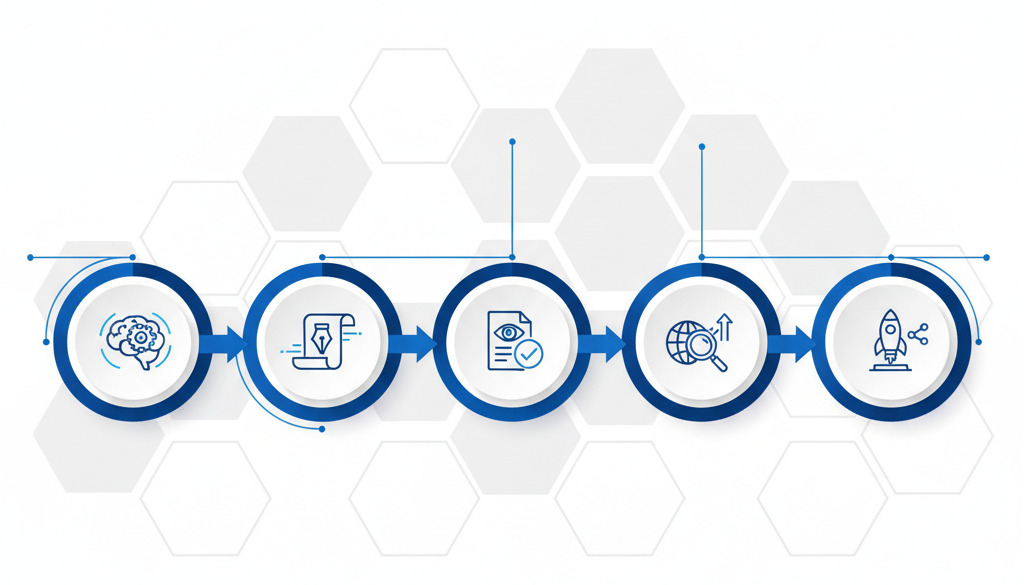
Facing this challenge, he adopted an AI-assisted content strategy. The process was straightforward:
- Ideation: An AI tool analyzed search trends and competitor sites, identifying a cluster of topics around "custom kitchen island ideas," "cost of custom cabinets vs. stock," and "best wood types for bathroom vanities."
- Creation: Using these prompts, an AI writing assistant generated initial drafts for a series of blog posts. Each draft took about 15 minutes to produce.
- Human Refinement: The owner, the true expert, then spent about an hour on each draft. He corrected technical details, added personal anecdotes from his 30 years of experience, and inserted photos of his own work. He was no longer a writer, but an editor and expert validator.
- Optimization & Publishing: The content was optimized for local SEO terms ("custom cabinets in Dallas") and published consistently, once a week.
The results over six months were transformative. Organic traffic to the website increased by over 400%. The company started ranking on the first page of Google for several valuable local keywords. Most importantly, the website went from generating zero leads to bringing in 5-7 qualified quote requests per month, creating a predictable pipeline of new business. The AI handled the heavy lifting, and the owner’s expertise provided the authenticity that closed the deal.
Addressing Common Concerns and Misconceptions about AI in Content
For any business owner, adopting new technology comes with valid questions and concerns. It’s important to separate the myths from reality.
- Myth: AI content is robotic and low-quality. This was true of early-generation AI. Today’s advanced models can produce nuanced, sophisticated text. However, the true quality comes from the human-AI partnership, where your expertise refines the AI’s draft into something truly valuable.
- Myth: Google penalizes AI-generated content. This is a common misconception. Google does not penalize content simply because it was created with AI. Instead, Google’s focus is on the quality and helpfulness of the content itself, regardless of how it was produced. Content that is clearly AI-generated and low-quality will not rank well, but well-crafted, informative content, even if AI-assisted, can and will rank.
- Myth: AI will replace human content creators. AI is a tool that enhances human capabilities. It automates tedious tasks, freeing up creators to focus on strategy, creativity, and unique insights that only humans can provide. The best content strategies will always involve a human touch for authenticity, brand voice, and complex problem-solving.
- Myth: You need to be a tech expert to use AI for content. The market for AI tools has become incredibly user-friendly. Many platforms offer intuitive interfaces, and numerous services provide "done-for-you" solutions that handle the technical aspects, making AI accessible to everyone.
By understanding these points, you can approach AI-powered content creation with confidence, knowing it’s a powerful, accessible, and ethical way to scale your business's online presence.
Keep reading
Hand-picked guides that go deeper — open the one you need next:
- Mastering AI Article Writers for Engaging Content in 2026
- Achieve SEO Consistency with AI: Your Automated Content Strategy
- Automate Your Content Strategy: The Power of Blog Content Autopilot
- GMB Automation AI: Revolutionizing Local Search Success
→ Read the full AI Content guide