
Beyond Keywords: How AI Crafts Truly Engaging SEO Content
Key Takeaways
- SEO is No Longer Just About Rankings: With AI Overviews and generative search, success now means being cited in AI-generated answers, not just ranking #1. More than 58% of Google searches are now "zero-click."
- AI Accelerates, It Doesn't Replace: Artificial intelligence is a powerful tool for keyword research, outlining, and drafting, but human oversight is crucial for ensuring accuracy, brand voice, and genuine engagement.
- Focus on User Intent: AI excels at analyzing search data to understand what users truly want. This allows businesses to create content that directly answers questions and solves problems, which is highly valued by modern search engines.
- Quality and Authority are Paramount: Search engines reward high-quality, authoritative content. AI can help produce this content at scale, but it must be edited and fact-checked by a human expert to build trust.
- Strategic Adoption is Key for Business Owners: For busy entrepreneurs, AI content solutions can save immense time and resources, allowing you to focus on your core business while still driving organic traffic and leads through a consistent online presence.
I. Introduction: The New Frontier of Content Creation
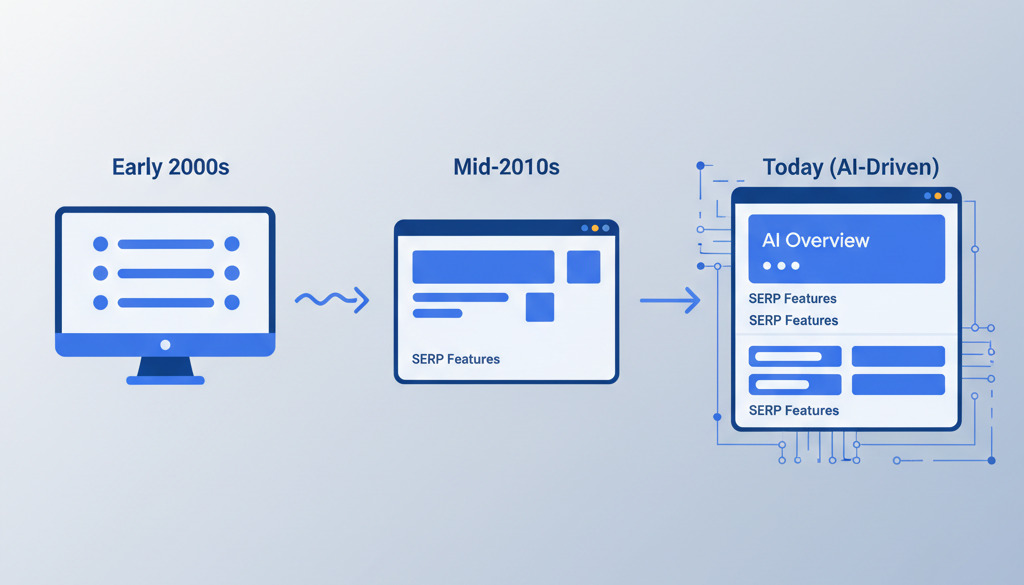
The way your customers find you online has fundamentally and irrevocably changed. For years, the goal of search engine optimization (SEO) was simple: get your website to the top of Google's ranked list of blue links.[1] But we are now in a new era. According to recent 2026 industry data, over 58.5% of all Google searches end without a single click. Why? Because the answers are being delivered directly on the results page by artificial intelligence.
A. The Evolving Digital Landscape and the Growing Importance of SEO Content
This shift, driven by technologies like Google's AI Overviews, signifies a structural transformation in search.[2] Visibility no longer depends solely on page position but on whether your brand is cited and trusted by AI systems. The content on your website has become more than just marketing material; it's now the raw data that feeds these intelligent engines. For a business owner, this means your online articles, blog posts, and service pages are the foundation of your digital visibility and brand integrity.
B. Introducing the Concept of AI-Powered SEO Content Generation
Enter AI-powered SEO content generation. This isn't about churning out robotic, soulless text. It's about leveraging sophisticated artificial intelligence to research, structure, and draft high-quality, engaging content that is optimized for both human readers and the new AI-driven search landscape. It’s a tool designed to work in synergy with human expertise, making the process of creating effective online content faster, more data-driven, and ultimately more impactful.
C. Briefly outline the article's purpose: to guide business owners in leveraging AI for effective SEO content
If you're a business owner who knows an online presence is critical but lacks the time, expertise, or desire to become a full-time content creator, this guide is for you. We will demystify how AI can be your most powerful ally in crafting expert, business-like content that attracts customers. We will explore how to go beyond simple keywords to create truly engaging articles that build authority and drive growth, allowing you to focus on what you do best: running your business.
II. Understanding SEO Content: The Foundation of Online Visibility
Before diving into the role of AI, it’s essential to grasp what we mean by "SEO content." It’s a term that gets thrown around a lot, but its meaning is crucial for any successful digital strategy.
A. Defining SEO Content: What it is and why it matters for businesses
At its core, SEO content is any content created with the primary goal of attracting search engine traffic. This can include blog posts, service pages, product descriptions, and FAQ sections. However, great SEO content does more than just attract visitors; it engages them, answers their questions, solves their problems, and guides them toward becoming a customer. For your business, it's the magnet that pulls potential customers to your website when they are actively searching for solutions you provide.
B. Key Components of Effective SEO Content (keywords, readability, user intent)
Truly effective SEO content is built on three pillars:
- Keywords: These are the terms and phrases your audience uses when searching. Content must be optimized around these keywords to be discoverable.
- Readability: The content must be easy to read and understand. Complex sentences and jargon can deter readers and hurt your rankings. A 7th-9th grade reading level is often the sweet spot for general audiences.
- User Intent: This is the "why" behind a search query. Is the user looking for information, comparing products, or ready to make a purchase? Your content must match this intent to be considered relevant by search engines.
C. The Traditional Challenges of SEO Content Creation (time, expertise, cost)
For most business owners, the roadblock to a thriving blog or website isn't a lack of desire, but a lack of resources. Crafting high-quality SEO content has traditionally been:
- Time-Consuming: A single, well-researched article can take hours, if not days, to write and edit.
- Expertise-Dependent: It requires knowledge of SEO best practices, keyword research, and compelling writing.
- Costly: Hiring a professional writer or an agency can be a significant financial investment.
These challenges are precisely what AI is now helping businesses overcome.
III. The Rise of AI in Content Generation: A Paradigm Shift
While the buzz around AI might seem recent, its roots in search technology run deep. Google itself has been using machine learning since 2001 to improve spelling suggestions. The recent explosion of generative AI, however, marks a true paradigm shift for content creation.
A. A Brief History of AI and its progression into content creation tools
Early AI was focused on understanding and processing language. As a user, you experienced this through better search results and features like auto-complete. In recent years, the focus has shifted to *generative* AI, where models can create entirely new text, images, and code. This advancement is powered by Large Language Models (LLMs), which have been trained on vast amounts of internet data.
B. How AI models work to generate human-like text
Think of an LLM as an incredibly sophisticated prediction engine. When given a prompt, it predicts the most statistically likely sequence of words to follow, based on the patterns it learned during its training. It doesn't "understand" in the human sense, but it is exceptionally good at mimicking human grammar, style, and tone, making its output feel remarkably natural.
C. Differentiating AI-generated content from basic automated text
It's important to distinguish modern AI content from the "article spinning" software of the past. Old tools simply swapped out words with synonyms, resulting in nonsensical, unreadable text that was quickly penalized by Google. Today's AI, in contrast, generates content from the ground up, creating structurally sound, grammatically correct, and often insightful drafts that can serve as a powerful starting point for a finished piece.
IV. AI's Role in SEO Content Creation: Beyond Automation
The true power of AI in SEO isn't just about writing faster; it's about making the entire content creation process smarter and more data-driven. It acts as a tireless research assistant, a strategic planner, and an efficient writer rolled into one.
A. AI for Keyword Research and Topic Ideation
AI tools can analyze thousands of search queries and competitor articles in seconds. This allows you to uncover not just primary keywords but also related long-tail keywords and semantic variations that your human competitors might miss, helping you discover exactly what your audience is searching for.
B. AI for Content Structuring
Once a topic is chosen, AI can generate a logical and comprehensive outline. By analyzing top-ranking content for a given keyword, it can suggest a structure that covers all essential subtopics, ensuring your article is thorough and satisfies user intent.
C. AI for Drafting and Writing
This is where AI truly shines for busy entrepreneurs. It can take a detailed outline and produce a full-length draft in minutes, eliminating writer's block and providing a solid foundation that can then be refined and personalized.
D. AI for Optimization
After the draft is written, AI can analyze it for SEO best practices. It can check for keyword density, suggest improvements for readability, and even recommend internal and external links, fine-tuning the content for maximum search engine performance.
V. The "Polished, Expert, and Business-Like" Tone: Achieving Professionalism with AI
A common concern is whether AI can produce content that reflects a professional brand voice. The answer is yes—with the right guidance. The quality of the output is directly related to the quality of the input.
A. Maintaining Brand Voice and Consistency in AI-Generated Content
You can "train" AI on your brand voice by providing it with examples of your existing content or by creating a detailed style guide. By specifying a *polished, expert, and business-like tone* in your prompts, you guide the AI to generate content that aligns with your brand’s professional image.
B. Strategies for Guiding AI to produce sophisticated and professional language
The key is specificity. Instead of asking for "an article about SEO," you would provide a prompt like: "Write a professional blog post for an audience of non-technical business owners, explaining the strategic benefits of AI in SEO. Use a formal, expert tone and avoid slang or overly casual language." The more detailed your instructions, the better the result.
C. The importance of human oversight and editing for a polished output
AI is a tool, not a magic wand. The final 10-20% of the work, which involves human editing, is what elevates good AI content to great content. A human touch is essential for adding unique insights, personal anecdotes, and ensuring the tone is perfectly aligned with your brand. This final polish is non-negotiable for maintaining a high-quality, professional reputation.
VI. AI-Powered Keyword Research: Uncovering Untapped Opportunities
Effective SEO starts with understanding what your customers are looking for. AI has revolutionized this process, allowing you to move beyond basic tools and uncover deep insights into audience behavior.
A. Moving beyond basic keyword tools: How AI can identify long-tail and semantic keywords
Traditional tools often focus on high-volume, single-word keywords. AI, however, can analyze context and nuance to identify long-tail keywords (longer, more specific phrases) and semantic keywords (related concepts and synonyms). These often have lower competition and higher conversion rates because they reflect more specific user intent.
For example, instead of just targeting "roof repair," AI might suggest "emergency roof leak repair cost in Dallas" or "how to find a trustworthy roofer after a storm." This specificity attracts highly qualified leads.
B. Analyzing competitor keyword strategies with AI
AI tools can crawl your competitors' websites and identify the keywords they are ranking for. This provides invaluable intelligence, revealing gaps in their strategy that you can exploit and demonstrating which topics are resonating with your shared target audience.
C. Understanding search intent with AI: Matching content to user needs
AI excels at categorizing keywords by intent: informational, navigational, commercial, or transactional. By understanding that a search for "what is content marketing" requires a different type of article than "content marketing services," AI helps you create content that perfectly matches the user's needs at each stage of their journey.
VII. Crafting Compelling Content Outlines with AI
A great article is built on a strong foundation. Before a single paragraph is written, a logical and comprehensive outline ensures the final piece is well-structured, thorough, and easy for readers to follow.
A. AI's ability to suggest comprehensive and well-structured article outlines
By analyzing the top-ranking articles for your target keyword, AI content generators understand what topics Google considers relevant and important. They can then synthesize this information to create a detailed outline, often including H2 and H3 headings, that covers the topic from all necessary angles.
B. Ensuring all key aspects of a topic are covered logically
This data-driven approach prevents you from missing crucial sub-topics. If every top-ranking article on "small business cybersecurity" includes a section on employee training, the AI will ensure your outline includes it too. This ensures your content is perceived as authoritative and comprehensive by search engines.
C. Defining unique angles for each H2 heading to avoid repetition
A good AI tool doesn't just list topics; it helps structure them in a logical flow. It works to ensure that each H2 heading covers a distinct subtopic, preventing the repetitive, generic filler content that plagues so many websites. The goal is for each section to add new, unique value for the reader.
VIII. Generating High-Quality Drafts: The Power of AI Writers
For many business owners, the most daunting part of content creation is staring at a blank page. This is where AI writers provide their most immediate and tangible benefit: speed and efficiency.
A. AI's capacity to generate initial drafts quickly and efficiently
Once you have an approved outline, an AI writer can generate a complete first draft of a 2,000-word article in a matter of minutes, not hours. This draft will be grammatically correct, well-structured, and based on the outline you provided.
B. Overcoming writer's block with AI as a starting point
This speed is a game-changer for overcoming writer's block. It’s far easier to edit and refine an existing draft than it is to create one from scratch. The AI-generated text provides the raw material, allowing you to focus your valuable time on the higher-level tasks of adding your unique expertise and brand voice.
C. Customizing AI outputs to fit specific content requirements
The first draft is just the beginning. You can instruct the AI to rewrite sections in a different tone, expand on certain points, or simplify complex topics. This iterative process allows you to quickly shape the content to meet your exact needs before you even begin the final human editing phase.
IX. Optimizing AI-Generated Content for Search Engines
Writing the content is only half the battle. To be effective, it must be optimized for search engines to find and understand it. AI provides powerful capabilities for on-page SEO analysis and refinement.
A. AI-driven analysis of content for on-page SEO factors
Specialized AI SEO tools analyze your draft against a checklist of critical on-page SEO factors. This includes checking for a well-optimized title, proper heading structure (H1, H2, H3s), and the presence of a meta description. It automates technical checks that are easy for humans to miss.
B. Ensuring natural keyword integration and semantic relevance
Gone are the days of "keyword stuffing." Modern SEO is about semantic relevance. AI tools can analyze your text to ensure your target keyword and its variations are included naturally, not forcefully. They will also suggest adding related LSI (Latent Semantic Indexing) keywords to help Google better understand the topic of your page.
C. Enhancing readability scores and user engagement signals
User engagement is a critical ranking factor. If users click on your page and immediately leave, Google takes that as a negative signal. AI can analyze your content for readability, sentence length, and paragraph structure, providing suggestions to make the text more engaging and easier to digest for human readers.
X. The Human Touch: Essential for AI-Engaging SEO Content
Let's be unequivocally clear: AI cannot do it all. Relying solely on raw, unedited AI output is a recipe for mediocre content that fails to connect with readers and can even damage your brand's credibility.
A. Why AI alone is not enough: The irreplaceable role of human editors
AI models are trained on existing internet data. They can synthesize and restructure information, but they cannot create truly novel ideas, share personal experiences, or provide unique, brand-specific case studies. The human editor is the source of originality and authority.
B. Fact-checking, nuance, and adding unique insights
AI can sometimes make factual errors or "hallucinate" information. A human expert must fact-check every claim and statistic. Furthermore, a human editor can add the nuance, industry-specific insights, and personal stories that build trust and connection with an audience. This is how you create content that is not just informative but also memorable.
C. The synergy of AI and human expertise for superior results
The optimal workflow is a partnership. AI provides the speed, data analysis, and efficiency to handle 80% of the content creation process. The human expert provides the critical final 20% of strategy, verification, and unique value. This combination produces content that is superior to what either could create alone.
XI. Addressing Common Concerns: The Reality of AI Content
As with any transformative technology, AI content generation comes with a set of valid questions and concerns. It’s important to address these head-on with a clear understanding of how the technology works.
A. Is AI content plagiarism-free? Understanding AI's learning process.
Reputable AI content generators create original content and do not plagiarize. They are not "copying and pasting" from other sources. Instead, they generate new sentences word by word based on statistical patterns. That said, because they learn from the same internet as everyone else, their output can occasionally resemble existing content. It is always a best practice to run a plagiarism check as part of your editing process.
B. Can AI produce truly unique and creative content?
AI is excellent at producing unique combinations of existing ideas but struggles with true, out-of-the-box creativity. Its strength lies in writing authoritatively about established topics. For deeply creative, narrative, or opinion-driven pieces, AI should be used more as an assistant for brainstorming and research rather than as the primary writer.
C. Ethical considerations and responsible AI content generation
Responsible AI use means being transparent and honest. Never present AI-generated content as written by a specific human who did not contribute to it. The primary ethical guideline is to ensure the final published piece is accurate, helpful, and provides real value to the reader, regardless of the tools used to create it.
XII. Integrating AI Content into Your Business Strategy: A Practical Approach
Adopting AI doesn't require you to overhaul your entire business. It can be integrated strategically to target the most impactful areas of your content marketing.
A. Identifying suitable content types for AI generation (blog posts, product descriptions, FAQs)
AI is particularly well-suited for creating:
- Informational Blog Posts: Answering common customer questions.
- Product/Service Descriptions: Generating consistent and detailed descriptions at scale.
- FAQ Sections: Quickly developing comprehensive answers to frequently asked questions.
- Social Media Posts: Creating captions and posts based on your blog articles.
B. Developing a workflow for AI content creation and review
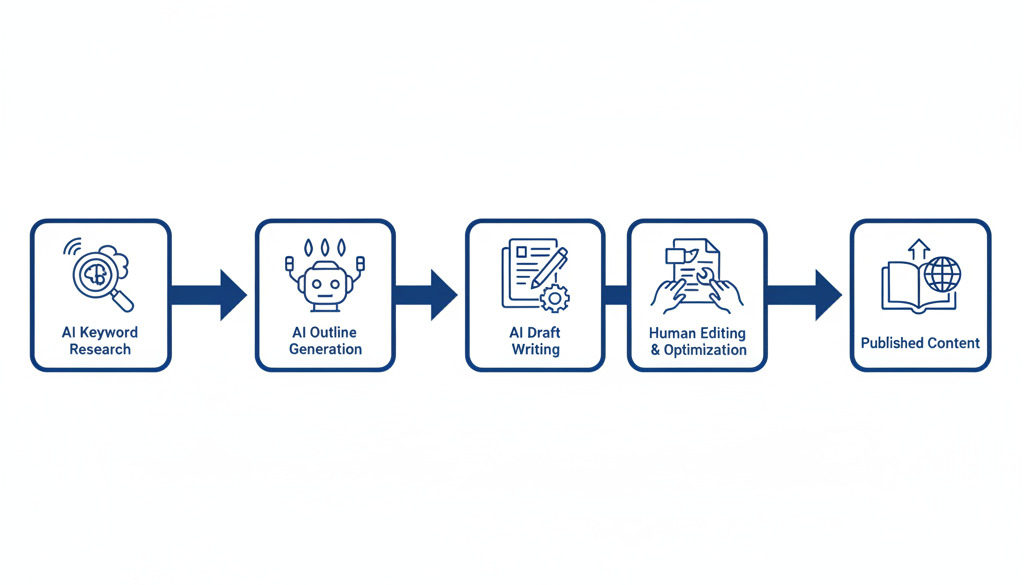
A successful workflow looks like this:1. Strategy (Human): Define goals and choose topics.2. Research & Outlining (AI & Human): Use AI for data analysis, with human approval of the final outline.3. Drafting (AI): Generate the initial text.4. Editing & Enhancement (Human): Fact-check, add unique insights, and refine the brand voice.5. Publishing (Human): Final review and publish.
C. Setting realistic expectations for AI-powered content production
AI is an efficiency tool, not a replacement for strategy. Expect it to significantly reduce the time it takes to produce a high-quality article, but do not expect it to produce a perfect, ready-to-publish piece with the click of a button. The goal is to elevate your content quality and consistency while saving valuable time.
XIII. The Benefits for Business Owners: Time, Cost, and Results
For a busy small or medium-sized business owner, the advantages of strategically adopting AI for content are profound and directly impact the bottom line.
A. Reclaiming valuable time: Shifting focus from content creation to core business
The single greatest benefit is time. The hours spent researching and writing blog posts can now be redirected to sales, customer service, product development, and other core business functions that only you can do. You get the benefit of a professional content marketing engine without becoming a professional writer.
B. Cost-effectiveness: Comparing AI solutions to traditional content outsourcing
While hiring freelance writers or agencies is a valid strategy, it can be expensive, with costs for a single blog post often running into hundreds of dollars. AI-powered services and platforms can deliver content at a fraction of that cost, making consistent publishing financially viable for more businesses.
C. Driving organic traffic and customer acquisition through consistent, high-quality content
Consistency is king in SEO. By enabling you to publish high-quality, optimized content on a regular schedule, AI helps you build topical authority, improve search rankings, and create a system where customers will find you on their own in Google, month after month.
XIV. Case Study Spotlight: Success Stories with AI Content
The shift to AI-driven content isn't just theoretical; businesses are already seeing tangible results. Across various industries, companies are leveraging this technology to increase their online visibility and drive revenue.
A. Showcasing how businesses are already benefiting from AI-driven content
Consider a local HVAC company. By using AI to generate a series of blog posts answering common questions like "Why is my AC unit making a loud noise?" and "How often should I service my furnace?", they can attract local homeowners actively searching for solutions. Each article acts as a digital salesperson, working 24/7 to bring in qualified leads.
B. Highlighting quantifiable results (e.g., increased traffic, improved rankings)
These efforts translate into measurable success. Another example is a B2B consulting firm that saw a 150% increase in organic traffic within six months of implementing an AI-assisted content strategy. They consistently published in-depth articles targeting niche industry problems, establishing themselves as thought leaders and capturing high-value leads.
C. A brief mention of how specialized services exemplify this success
This model of success is precisely what solution providers in this space aim to deliver. A great example is the service ethos behind "More Customers From Your Blog"—a concept focused on having AI do the heavy lifting of writing articles for you. This approach is designed to help businesses achieve that exact outcome by transforming their blog into a self-sustaining customer acquisition channel.
XV. Choosing the Right AI Tool: What to Look For
The market is flooded with AI writing tools, but not all are created equal, especially for SEO. It’s crucial to choose a solution that is built for creating high-ranking content.
A. Key features and functionalities essential for SEO content
Look for tools that integrate the entire workflow: keyword research, SERP analysis, content outlining, writing, and on-page optimization. A generic AI chatbot is not an AI SEO tool.
B. Ease of use and integration with existing workflows
For a business owner who is not a digital native, the platform must be intuitive and easy to navigate. The best solutions are those that simplify complexity, not add to it. Automated publishing to platforms like WordPress is also a major plus.
C. Evaluating AI tools for quality, scalability, and support
Before committing, evaluate the quality of the output. Does it sound natural? Is it well-researched? Consider whether the tool can scale with you as your content needs grow. For many, a "done-for-you" service model is preferable. For instance, some specialized providers offer a solution where their proprietary artificial intelligence writes professional SEO blog articles for your website in minutes—almost like magic, removing the need for you to manage the software yourself.
XVI. The Future of AI and SEO Content: Evolving Trends
The world of AI and search is evolving at a breakneck pace. As of 2026, the trend is clear: search is becoming a conversation, and content is the fuel for that conversation.
A. Predictable advancements in AI language models and their impact on content
AI models will become even more nuanced and capable of understanding context and generating sophisticated arguments. They will get better at real-time fact-checking and integrating current events, making their output more timely and reliable.
B. The growing integration of AI in the entire SEO process
We are moving toward a future where AI assists with every part of SEO, from technical site audits and backlink analysis to predictive analytics on which topics will trend next. As Adobe notes, the goal is shifting from "ranking higher" to "becoming the answer."
C. How to stay ahead of the curve in AI-driven content marketing
The key to staying ahead is to remain focused on the fundamentals: E-E-A-T (Experience, Expertise, Authoritativeness, and Trustworthiness). Use AI as a tool to scale the production of high-quality, helpful content, but always ensure it is reviewed and enhanced by genuine human expertise. This human-AI synergy is the future of sustainable SEO.

XVII. Getting Started with AI for Your Business: A Step-by-Step Guide
Ready to put AI to work for your business? Here’s a simple, low-risk way to begin.
A. Defining your content goals and objectives
Start by asking: What do I want my content to achieve? Is it to attract more website visitors, generate leads for a specific service, or build my reputation as an expert? Clear goals will guide your content strategy.
B. Experimenting with AI tools and understanding their capabilities
Many tools offer free trials or credits. Use this opportunity to experiment. Give the AI a few different topics and prompts. See how it performs. Understand its strengths and limitations before making a financial commitment.
C. Implementing a pilot program for AI content generation
Choose one area of your business or one specific service to focus on. Commission a small batch of 3-5 articles on that topic. Edit them, publish them, and monitor their performance. This provides a low-risk, manageable way to test the waters. To make this even easier, some dedicated services make it incredibly simple to get started. For example, some AI content partners offer a promotion where your first 5 posts are free, providing a completely risk-free entry point to experience the benefits firsthand.
XVIII. Maximizing ROI: Measuring the Success of AI-Engaging SEO Content
Creating content is only worthwhile if it delivers a return on investment (ROI). It's critical to track performance and understand what’s working.
A. Key performance indicators (KPIs) for evaluating content effectiveness
While clicks and traffic are still important, the new environment requires new metrics. As recent research highlights, you should also track:
- Keyword Rankings: Are you moving up in search results for your target terms?
- Organic Traffic: Are more people visiting your site from search engines?
- Impressions & Citations: Is your brand being mentioned in AI Overviews and featured snippets, even if it doesn't result in a click?
- Conversions: Are visitors taking the desired action (e.g., filling out a contact form, making a purchase)?
B. Using analytics to track the impact of AI-generated content
Use tools like Google Analytics and Google Search Console to monitor these KPIs. Track the performance of each AI-assisted article you publish. Which topics are driving the most traffic? Which ones are leading to conversions? This data is invaluable for refining your strategy over time.
C. Iterative improvement based on data and performance
SEO is a long-term game. Use the performance data to double down on what works and adjust what doesn’t. Perhaps articles with case studies perform better, or maybe your audience responds well to numbered lists. Let the data guide your future content creation efforts.
XIX. The Power of Delegation: Partnering for Exceptional Content
As a business owner, your time is your most precious asset. You may understand the value of AI in SEO but still not have the bandwidth to manage the process yourself. This is where delegation becomes a powerful growth strategy.
A. Recognizing when to delegate AI content management and optimization
If you find that you’re becoming a bottleneck in the content process—if drafts are sitting unedited or you don’t have time to analyze performance—it’s time to delegate. Your role is strategy and oversight, not day-to-day execution.
B. The benefits of working with specialized AI content services
Partnering with a specialized service that focuses on AI-driven SEO content offers several advantages. They have the expertise, the optimized workflows, and the dedicated resources to deliver consistent, high-quality content without taking up any of your time. This approach has become so effective that more than 500 companies already use solutions like these because they deliver reliable results without the internal management overhead.
C. Focusing on your strengths by letting experts handle your content
By entrusting your content creation to a dedicated partner, you free yourself to focus on running and growing your business. It allows you to leverage the power of AI and SEO without having to become an expert in either field, creating a true win-win scenario.
XX. Conclusion: Embracing AI for Sustainable Business Growth
The seismic shifts in search engine technology are not a threat, but an opportunity. For the business owner who feels overwhelmed by the demands of digital marketing, artificial intelligence offers a lifeline. It provides a way to create the high-quality, engaging, and optimized content that modern SEO demands, but in a fraction of the time and at a fraction of the cost.
A. Recap of the key benefits of AI-engaging SEO content
By partnering with AI, you can consistently publish expert content that answers your customers' questions, establishes your authority, and builds trust. The synergy between AI's speed and data-processing power and your human expertise is the new formula for success—a formula that saves you time, reduces costs, and delivers measurable results.
B. Encouragement for business owners to embrace AI as a strategic advantage
Don’t view AI as another complex technology to master. Instead, see it as a strategic partner that can handle the tasks you don’t have the time or inclination for. By embracing this tool, you can compete on a level playing field, regardless of the size of your business.
C. Final thoughts on how AI empowers businesses
Ultimately, AI empowers you to achieve the goal of all marketing: to be there when your customer needs you. It helps create a powerful, self-sustaining system where customers find you automatically through Google, allowing you to build a more profitable and sustainable business for the future.
Frequently Asked Questions
1. Will Google penalize my site for using AI-generated content?
No. Google's official stance, updated in 2023, is that they reward high-quality content, regardless of how it is produced. Their focus is on content that is helpful, reliable, and people-first. As long as you are using AI to create original, valuable content and not to manipulate search rankings, it is perfectly acceptable. The key is the human oversight that ensures quality and accuracy.
2. How much human editing is really needed for AI content?
It depends on the complexity of the topic and the quality of the AI tool, but a good rule of thumb is to dedicate at least 15-25% of the total creation time to human editing. This includes fact-checking, adding unique insights and personal examples, refining the tone to match your brand voice, and performing a final SEO optimization check. The raw AI draft should be considered a starting point, not a final product.
3. Can AI really understand my specific, niche business?
AI can be surprisingly effective in niche industries, provided you give it the right information. By including specific terms, customer pain points, and industry-specific context in your prompts, you can guide the AI to generate relevant and accurate content. For very deep, technical niches, the AI-generated draft will require more intensive review and editing by a subject matter expert, but it still serves as a powerful time-saving tool.
4. Isn't using an AI content service expensive?
Compared to traditional methods, AI content services are typically much more cost-effective. Hiring a good freelance writer for a single, well-researched blog post can cost several hundred dollars. An AI-powered service or platform can often produce a higher volume of content for a similar or lower monthly investment, providing a better ROI and making a consistent publishing schedule financially feasible for small and medium-sized businesses.
5. How can I ensure my AI content doesn't sound robotic?
The key to avoiding a robotic tone is in the prompting and editing phases. First, provide detailed prompts that specify the desired tone of voice (e.g., "professional yet approachable," "expert and authoritative," "friendly and helpful"). Second, during the human editing phase, focus on infusing the text with your brand's unique personality. Add personal anecdotes, ask engaging questions, and break up long paragraphs to improve flow. This human touch is what transforms generic text into engaging content.
6. How long does it take to see results from AI-powered SEO content?
SEO is a long-term strategy, whether the content is created by a human or with AI assistance. While AI can significantly speed up the content production process, it can still take 3-6 months to see significant results in organic traffic and rankings. The key is consistency. By using AI to publish high-quality content regularly, you build topical authority and trust with search engines, which leads to sustainable growth over time.
Keep reading
Hand-picked guides that go deeper — open the one you need next:
- Free AI Article Trial: Unlock SEO Growth with Volteruno
- DIY SEO Articles: Generate High-Quality Content with AI Writer
- Expand Your Reach: SEO Content in 25 Languages with AI
- Beyond Keywords: Advanced AI SEO Strategies