
Expand Your Reach: SEO Content in 25 Languages with AI

Key Takeaways
- Unlock Global Markets: Over 75% of internet users don't use English as their primary language. Multilingual content is essential for global reach.
- AI Overcomes Barriers: Artificial Intelligence automates the creation of multilingual SEO content, drastically reducing the time, cost, and complexity compared to traditional methods.
- Beyond Translation: AI excels at localization, adapting content to cultural nuances, regional dialects, and local search behaviors, which is critical for effective international SEO.
- Scalability and ROI: AI enables businesses to produce high volumes of optimized content for dozens of languages simultaneously, offering a significant and measurable return on investment through increased traffic and conversions.
- Human-AI Collaboration: The best approach involves using AI for heavy lifting (drafting, translation, optimization) and human experts for final review, strategy, and quality assurance.
The Untapped Potential of Global Markets: Why Multilingual Content Matters Today
In today's interconnected digital economy, limiting your business to a single language is like opening a shop but keeping the door closed to three out of every four potential customers. The internet has erased geographical borders, but linguistic barriers remain a significant hurdle. If your content only speaks English, you're ignoring a massive, engaged, and profitable global audience. The reality is, the English-speaking internet is a mature, saturated market, while vast opportunities lie in catering to users in their native tongue.
The Numbers Don't Lie: The Non-English Internet
Consider the data. English speakers make up only about 25.9% of all internet users worldwide.[2] Chinese, Spanish, Arabic, Portuguese, and many other languages represent hundreds of millions of users each. These are not niche markets; they are entire digital civilizations with booming e-commerce sectors. By 2025, the global e-commerce market is projected to exceed $7.4 trillion, with a significant portion of that growth coming from non-English-speaking regions in Asia, Latin America, and the Middle East.
Providing content in a user's native language is no longer a courtesy—it's a fundamental aspect of user experience (UX) and a powerful driver of business growth. When you speak your customer's language, you build immediate trust and rapport.
Fostering Trust and Driving Conversions
Imagine you're searching for a complex B2B software solution. You find two websites with comparable products. One is in broken, machine-translated English. The other is perfectly written in your native language, addressing your specific pain points with culturally relevant examples. Which company would you trust with your business? The answer is obvious. Localized content demonstrates a commitment to the customer, signaling that you understand and respect their market. This trust translates directly into higher engagement rates, lower bounce rates, and, most importantly, increased conversion rates.
Navigating the Landscape of International SEO without AI: The Traditional Hurdles
For decades, taking a brand global was a Herculean task reserved for corporations with immense resources. The traditional approach to multilingual content creation is fraught with challenges that make it impractical for most small and medium-sized enterprises (SMEs). These hurdles are not just inconvenient; they are often prohibitively expensive and complex, effectively locking businesses out of international markets.
The Staggering Cost of Human Translation
The primary barrier has always been the sheer cost and time involved. Professional human translation is a specialized skill. A typical workflow involves:
- Translation: A professional translator converts the source text.
- Editing: A second linguist reviews the translation for accuracy and style.
- Proofreading: A final check for any grammatical errors or typos.
This multi-step process is essential for quality, but it's slow and expensive. Costs can range from $0.10 to $0.30 per word. For a single 2,000-word blog post, that’s $200-$600. Now, imagine translating your entire website—including dozens of pages and hundreds of blog posts—into five, ten, or twenty languages. The cost quickly spirals into tens or even hundreds of thousands of dollars.
The Complexity of True Localization
Beyond simple translation lies localization. This is the art of adapting your content to fit the specific cultural context of a target market. It involves:
- Keyword Research: A keyword in one country may have a completely different search volume and intent in another.[1] "Holiday deals" in the US become "summer sales" in the UK. This research must be done from scratch for each market.
- Cultural Nuances: Colors, symbols, idioms, and humor can vary wildly. A marketing campaign that is successful in the US could be ineffective or even offensive in Japan or Brazil.
- Tone and Style: The preferred tone for business communication might be direct and informal in one culture, but formal and hierarchical in another.
Manually managing these subtleties across multiple languages requires a team of in-country experts, adding another layer of complexity and cost.
Consistency and the Risk of Human Error
When working with multiple freelance translators or agencies, maintaining a consistent brand voice and terminology is a constant struggle. A term as simple as "shopping cart" might be translated as "shopping basket," "bag," or something else entirely across different pages of your site, leading to a disjointed user experience. The table below illustrates the stark differences between the traditional approach and an AI-powered one.
| Factor | Traditional Manual Process | AI-Powered Process |
|---|---|---|
| Cost | High (per-word fees, project management) | Low (subscription-based, fixed cost) |
| Speed | Slow (days or weeks per article) | Extremely Fast (minutes per article) |
| Scalability | Limited and expensive to scale | Highly scalable; generate content for 25+ languages simultaneously |
| Consistency | Difficult to maintain across translators | Perfectly consistent with brand terminology |
| Localization | Requires dedicated, expensive in-country experts | Built-in cultural adaptation and keyword localization |
AI's Paradigm Shift: Automating Multilingual Content Creation
Just as the assembly line revolutionized manufacturing, Artificial Intelligence (AI) is causing a paradigm shift in digital content. The cumbersome, expensive, and slow processes that defined traditional multilingual SEO are being replaced by automated, intelligent, and incredibly efficient systems. AI is not just another tool; it's a transformative technology that democratizes global marketing, making it accessible to any business with the ambition to grow.
From Manual Labor to Automated Intelligence
At its core, AI for content creation is about leveraging computational power to perform tasks that previously required human intellect. Instead of a person manually translating text word by word, sophisticated algorithms can now do it in a fraction of a second. But modern AI goes far beyond the clunky, literal translations of early tools like Google Translate. It can now understand context, nuance, and intent, producing content that is not only grammatically correct but also stylistically appropriate and culturally resonant.
Addressing the Core Limitations
This technological leap directly addresses the fundamental challenges of the old model. The barrier of cost is shattered by affordable subscription models. The barrier of time evaporates when articles can be generated in minutes, not weeks. The barrier of complexity is lowered by systems that can perform keyword research, adapt tone, and optimize for SEO across dozens of languages simultaneously. AI takes the prohibitively complex and makes it push-button simple, finally unlocking the door to global markets for everyone.
The Mechanics of Multilingual SEO AI: How it Works Under the Hood
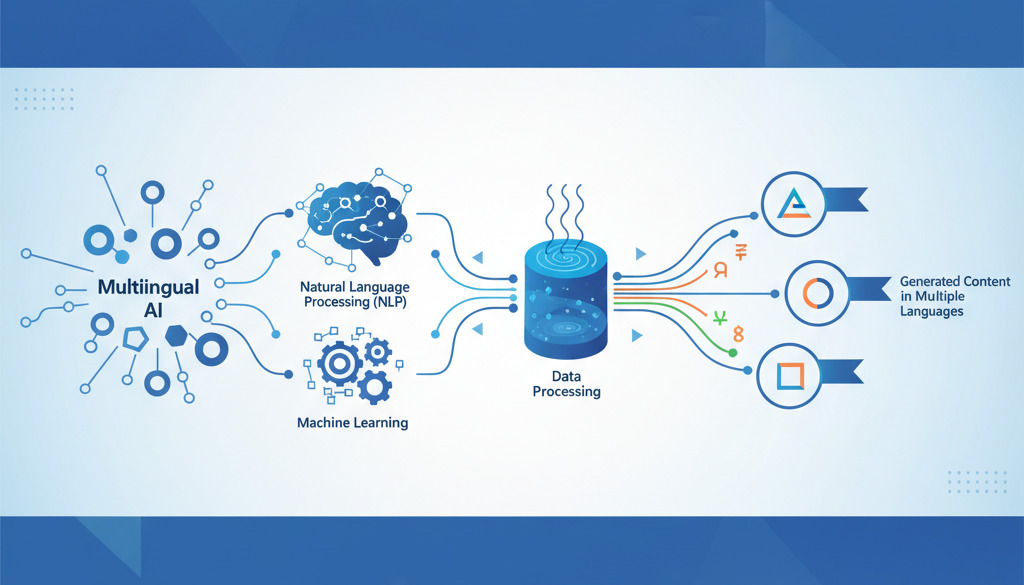
The "magic" of AI content generation isn't actually magic at all; it's the product of decades of research in computer science and linguistics. Understanding the basic principles can help you appreciate the power of these tools and trust the quality of their output. The technology rests on two main pillars: Natural Language Processing (NLP) and Machine Learning (ML).

Foundations: NLP and Machine Learning
Natural Language Processing (NLP) is a field of AI that focuses on enabling computers to understand, interpret, and generate human language. Think of it as the bridge between human communication and computer data. Machine Learning (ML) is a subset of AI where algorithms are trained on vast amounts of data to "learn" patterns and make predictions or decisions without being explicitly programmed for the task.
The Learning Process
A multilingual AI model is trained on an enormous dataset, often called a corpus, containing billions of sentences, articles, books, and websites in many different languages. By analyzing this data, the ML algorithms learn:
- Grammar and Syntax: The rules of how words and sentences are structured in each language.
- Semantics: The meaning behind words and phrases, including context and ambiguity.
- Relationships: How concepts translate between languages, including idioms and cultural references.
This training process allows the AI to build a deep, mathematical understanding of language. When you ask it to generate an article, it's not just "copying and pasting." It's using its learned patterns to construct new, original sentences that fit the requested topic and language.
Specialized Training for Business
For business applications, general language knowledge isn't enough. Advanced platforms train their AI on more specific datasets, such as industry-specific jargon, marketing copy, or content tailored to a particular audience. This enables the AI to produce text that uses the right terminology and adopts a tone appropriate for your business goals, whether it's a formal B2B whitepaper or a casual e-commerce product description.
Strategic Keyword Localization: Beyond Direct Translation
One of the most common and costly mistakes in international SEO is assuming that keyword research is a one-time task. Many businesses simply translate their English keywords and hope for the best. This approach is doomed to fail because it ignores a fundamental truth: people in different countries search in different ways, even when talking about the same thing. Effective multilingual SEO requires deep keyword localization, a task where AI excels.
Why Direct Translation Fails
Direct translation doesn't account for regional dialects, slang, or differing search intent. A few classic examples illustrate the point:
- An American looking for "auto insurance" would find very few results if a company only optimized for the UK term, "car insurance."
- A German looking for a mobile phone plan searches for "handyvertrag," not a direct translation of "mobile phone contract."
- In Latin America, the word for "computer" can be "computadora" or "ordenador" depending on the country.
Using the wrong keyword means your content is invisible to your target audience. Your beautifully crafted page will never rank because no one is searching for the terms you’ve optimized for.
AI-Powered Competitive and Intent Analysis
This is where AI becomes an indispensable strategic partner. Modern multilingual AI tools can analyze the entire search landscape for a given market. They don't just translate your seed keywords; they:
- Identify Local Competitors: The AI finds the top-ranking pages for your topic in the target country.
- Analyze Their Keywords: It extracts the exact keywords, long-tail phrases, and related terms that these successful competitors are using to attract traffic.
- Determine Search Intent: By analyzing the type of content that ranks (e.g., how-to guides, product pages, reviews), the AI understands what users are actually looking for (informational, transactional, etc.).
This process uncovers the authentic, high-value keywords that a local audience genuinely uses, ensuring your content is perfectly aligned with market demand from the very beginning.
Crafting Culturally Resonant Content: AI's Nuance
If keyword localization is about what you say, cultural resonance is about how you say it. To truly connect with a global audience, your content must feel like it was written by a local, not by a foreign company. It needs to reflect a deep understanding of local customs, values, and communication styles. While this was once the exclusive domain of expensive in-country marketing teams, advanced AI can now achieve a remarkable degree of cultural nuance.
Adapting Tone, Style, and Formality
The level of formality in business communication varies dramatically around the world. An AI can be instructed to adapt a single piece of content to different stylistic requirements:
- For the US market: A friendly, informal, and direct tone might be used, incorporating popular idioms.
- For the Japanese market: The same content would be rewritten with a more formal, respectful, and indirect tone, avoiding casual language.
- For the German market: The focus would be on precision, data, and technical details, presented in a structured and professional manner.
AI achieves this by learning from the vast amounts of text it has processed, identifying the stylistic patterns associated with high-quality content in each culture.
Avoiding Costly Cultural Faux Pas
Cultural missteps can be embarrassing at best and brand-damaging at worst. A marketing slogan that is clever in English might be nonsensical or even offensive when translated literally. An image that is perfectly acceptable in a Western context could be inappropriate in the Middle East. AI, when properly trained on culturally diverse datasets, can help identify and avoid these pitfalls. It learns to recognize potentially sensitive topics, inappropriate analogies, or biased language, flagging them for review or automatically selecting a more neutral and universally acceptable alternative. This automated sensitivity read is an invaluable risk-management tool for any brand going global.
Enhancing User Experience Through Native Language Interfaces and Content
Ultimately, the goal of multilingual SEO is not just to attract visitors but to convert them into customers. A superior user experience (UX) is the bridge between traffic and revenue, and nothing enhances UX more powerfully than providing a seamless, native-language journey. When a user lands on your site and finds everything—from the navigation menu to the blog posts—in their own language, their trust and engagement skyrocket.
The Psychology of Linguistic Comfort
Interacting with a website in a foreign language is mentally taxing. Even for users who are fluent in English as a second language, processing information requires more cognitive effort. This creates friction. By providing a native-language experience, you eliminate that friction entirely. The user feels understood, respected, and "at home" on your site. This psychological comfort leads to measurable improvements in key SEO and engagement metrics.
Studies have consistently shown that users spend more time on sites in their own language and are significantly more likely to make a purchase. Nelson Norman Group found that 72.4% of consumers said they would be more likely to buy a product with information in their own language.
Improving Engagement Metrics that Google Loves
Search engines like Google pay close attention to user engagement signals. When users are comfortable and engaged, they behave in ways that Google interprets as a sign of high-quality content:
- Lower Bounce Rate: Users who immediately understand the content are less likely to "bounce" back to the search results.
- Higher Time on Page: Engaged users will spend more time reading your articles, watching your videos, and exploring your site.
- Increased Pages per Session: A seamless native-language experience encourages users to click on internal links and discover more of your content.
By using AI to generate high-quality content across your entire site for each target language, you create this superior experience, which in turn sends strong positive signals to search engines, boosting your international rankings.
The Power of Scale: Generating Volume Multilingual Content Efficiently
Perhaps the most profound advantage of AI in multilingual content creation is its ability to operate at a scale that is simply impossible for humans. In the competitive world of SEO, content volume and consistency are critical ranking factors. To establish authority in a new market, you need a steady stream of fresh, relevant content. AI provides the engine to produce this content at an unprecedented velocity and efficiency.
From One to Many, Instantly
Imagine you’ve just written a comprehensive, 3,000-word guide for your core market. With a traditional workflow, creating versions for ten other languages could take months and cost tens of thousands of dollars. With a powerful AI platform, you can input the English article and receive ten fully translated, localized, and SEO-optimized versions in minutes. This speed allows you to execute a global content strategy that would have been a logistical nightmare just a few years ago.
Unlocking Cost-Effective Content Production
This efficiency translates directly to massive cost savings. Instead of paying per word for translation, you can leverage a subscription-based AI service. This changes the economic equation of global expansion. For business owners who know they need online content but lack the time or resources, this is a game-changer. Platforms like More Customers From Your Blog are built on this principle. Their proprietary artificial intelligence is designed to do the heavy lifting for you, allowing you to focus on your business. Their service promise captures this perfectly: "Our proprietary artificial intelligence writes professional SEO blog articles for your website in minutes—almost like magic." It transforms content creation from a major capital expense into a predictable, affordable operational cost.
Keep reading
Hand-picked guides that go deeper — open the one you need next:
- Mastering SEO Optimized Blog Articles: A Strategic Blueprint
- Demystifying SEO: A Non-Technical Guide for Business Owners Using AI
- Boost SEO: How AI Blog Writing Drives Organic Traffic
- Free AI Article Trial: Unlock SEO Growth with Volteruno