
Unlock Organic Growth: The SME's Guide to AI-Powered Content
Key Takeaways
- Overcome Content Hurdles: For SME owners who are short on time and content creation expertise, AI automation is a game-changer, turning a major business challenge into a growth opportunity.
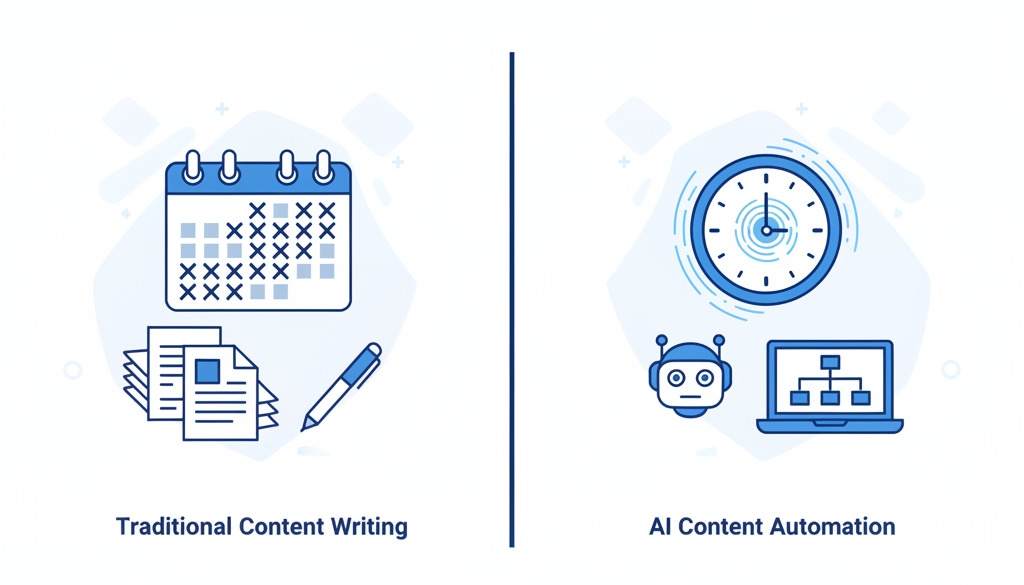
- Boost Efficiency & Save Money: AI can produce high-quality content drafts in minutes, not days, drastically reducing the cost and time compared to hiring writers or agencies. This frees you up to focus on running your business.
- Enhance SEO and Visibility: AI tools are designed to create content that ranks on search engines like Google. They strategically use keywords and optimal structures to help customers find your business organically.
- Maintain Human Control: AI is a powerful assistant, not a replacement for your expertise. The best approach combines AI-generated drafts with human review to ensure accuracy, brand voice, and strategic alignment.
- Start with Low Risk: You can begin exploring AI content automation without a major investment. Many solutions, including platforms that can get you more customers from your blog, offer free trials or introductory offers to prove their value.
Understanding the Content Challenge for Modern SMEs
In today's digital world, your customers are online, and their journey almost always begins with a search. They look for solutions, compare options, and read reviews long before they ever contact a business. For small and medium-sized enterprises (SMEs), this means that having a strong online presence isn't just an option—it's a requirement for survival and growth. At the heart of this presence is high-quality content.
Content: The Engine of the Customer Journey
Think about the last time you needed a service or product. You likely went to Google. The businesses that appeared, providing helpful blog posts, clear service descriptions, and informative articles, were the ones that earned your attention. This is the modern customer journey in action. Content is the fuel that powers this journey, attracting potential clients and guiding them toward a purchase. It builds trust, establishes your authority, and keeps your business top-of-mind.
The Time and Resource Vacuum
As a business owner, you already wear multiple hats. You are the CEO, the head of sales, the finance department, and the customer service manager. The thought of adding "full-time content creator" to that list is overwhelming. Creating just one good blog post can take hours of research, writing, and editing. Creating content consistently—which is key to success—feels like an impossible task. This is the content vacuum: it demands significant time and resources that most SME owners simply do not have, pulling focus away from the core operations that generate revenue.
The Risk of Being Invisible
While you're busy running your business, your competitors might be actively publishing content. They are answering the questions your potential customers are asking, capturing valuable search engine traffic, and building relationships with your target audience. Every day you delay creating content is a day you are essentially invisible online. This digital silence leads to missed opportunities, a shrinking market share, and the very real risk of being outpaced by more digitally savvy competitors.
The Emerging Landscape of AI in Business Operations
The term "Artificial Intelligence" (AI) might conjure images of science fiction, but the reality is that AI has quietly become a fundamental part of modern business.[1] It's no longer a futuristic concept reserved for tech giants in Silicon Valley. Today, AI is a practical, accessible tool that is revolutionizing how businesses of all sizes operate, from managing finances to improving customer service.
Recent data underscores this shift. A 2026 survey by the OECD highlighted that SME adoption of AI tools is increasing rapidly, with most businesses using off-the-shelf products to boost efficiency and growth. This proves that AI is not just for large corporations; it's a viable and increasingly necessary component of a modern SME's toolkit. For business owners who recognize the need for an online presence but lack the time, AI offers a direct path to bridging that gap.
Defining AI Content Automation: What It Is (and Isn't)
It’s important to have a clear understanding of what AI content automation means for your business. In simple terms, AI content automation is the use of artificial intelligence technology to assist in the creation, optimization, and management of written content. This can range from blog posts and website copy to social media updates and email newsletters.
More Than Just a Writing Tool
This technology goes far beyond simple spell-check or grammar correction. Sophisticated AI models can research topics, understand user intent behind search queries, and generate coherent, well-structured, and relevant articles with minimal human input. They can analyze data to determine what topics will resonate with your audience and how to structure content for optimal search engine performance. It's about creating a strategic content workflow that is both efficient and effective.
An Assistant, Not a Replacement
A common misconception is that AI is here to replace human creativity and expertise. This couldn't be further from the truth. The most successful businesses view AI as a powerful assistant or co-pilot. AI handles the heavy lifting—the initial research, the first draft, the structural organization—freeing up the business owner or expert to focus on higher-value tasks. This includes adding unique insights, ensuring the content aligns with the brand's voice, and fact-checking for absolute accuracy. The final product is a blend of AI's efficiency and human intelligence.
Core Benefits of AI Content Automation for SMEs
For SME owners who feel stretched thin, the practical advantages of integrating AI into their content strategy are immediate and substantial. It directly addresses the most significant barriers to content marketing: time, cost, and consistency.
Efficiency and Time Savings
The most profound benefit is the massive amount of time saved. Crafting a well-researched blog post can easily consume 4-8 hours of your time. An AI content automation tool can produce a solid, comprehensive first draft in a matter of minutes. This reclaimed time is invaluable. Instead of wrestling with a blank page, you can dedicate those hours to strategic planning, customer engagement, or product development—the activities that only you can do.
Cost-Effectiveness
Consider the traditional alternatives for content creation:
- Hiring a freelance writer: This can cost anywhere from $100 to $500+ per article, depending on the writer's experience and the topic's complexity.
- Working with a marketing agency: This often involves monthly retainers that can run into thousands of dollars.
Scalability and Consistency
Search engines like Google reward consistency. A business that publishes valuable content regularly is seen as more authoritative and relevant. However, maintaining a consistent posting schedule is a common struggle. AI automation solves this problem. It enables you to scale your content production effortlessly, ensuring a steady stream of articles for your blog, social media, and newsletters. Whether you need one post a week or five, the AI is ready to deliver, helping you build momentum and keep your audience engaged.
Enhancing SEO Through AI-Driven Content Generation
Creating content is one thing; getting it seen is another. This is where Search Engine Optimization (SEO) becomes critical. SEO is the practice of optimizing your content to rank higher in search engine results for relevant queries. For SME owners, this is the key to having customers find you organically. AI content automation is exceptionally powerful in this regard, as many platforms are built with SEO as a core component.
Strategic Topic and Keyword Selection
Advanced AI tools don't just write; they strategize. Before generating a single word, they can analyze search trends, identify low-competition keywords your customers are using, and even dissect competitor content to find gaps and opportunities. This data-driven approach ensures that you're not just creating content, but creating the right content—content that directly answers the questions of your target audience and has a high probability of ranking on Google.
Built-in SEO Optimization
AI can automatically weave relevant keywords and phrases into your articles naturally. It understands the importance of proper structure, using headings (H2s, H3s), bullet points, and short paragraphs to make the content easy for both humans and search engine crawlers to read. Many tools also generate meta descriptions and title tags, which are crucial for attracting clicks from the search results page. For business owners, this takes the guesswork out of a complex and often confusing discipline. For expert advice on this, Mastering SEO Optimized Blog Articles: A Strategic Blueprint provides a deeper dive.
Leveraging Specialized SEO-AI Platforms
The true power is realized in platforms that fuse AI and SEO into a single, seamless service. For instance, specialized solutions exist under brand promises like "More Customers from Your Blog — We Write the SEO Articles for You." These platforms leverage their own AI to produce professional SEO articles in minutes, specifically designed to help customers find your business organically on Google. This shifts the focus from merely creating text to achieving a tangible business outcome: attracting new customers.
Improving Blog Performance with AI Automation
A business blog is often the cornerstone of an SME's content strategy. It's the perfect platform to demonstrate expertise, build a community, and drive traffic to your website. AI automation can transform an inactive or inconsistent blog into a dynamic and powerful marketing asset.
Maintaining a Consistent Publishing Cadence
As mentioned, consistency is crucial. A regularly updated blog signals to Google that your website is active and relevant. It also gives your audience a reason to keep coming back. AI makes it simple to plan and generate content for weeks or even months in advance, ensuring you never miss a publishing day. This steady rhythm builds audience expectations and algorithmic favor, both of which are essential for long-term growth.
Generating Diverse and Engaging Content
Stuck in a rut of writing the same type of post over and over? AI can help you diversify. Based on simple inputs, you can generate a wide variety of blog post formats that keep your content fresh and engaging:
- Listicles: "5 Ways to Prepare Your Business for Tax Season"
- How-To Guides: "A Step-by-Step Guide to Setting Up a Home Office"
- Informative Posts: "Understanding the Latest Changes in Local Business Regulations"
- FAQ-Style Articles: "Answering the Top 10 Questions About Our Services"
Generating Website Copy and Marketing Materials with AI
Beyond the blog, AI content automation can be a powerful tool for all the other written materials your business needs. It ensures a consistent and professional voice across all your customer touchpoints, from your website's homepage to your email campaigns.
AI excels at creating persuasive copy for landing pages, designed to guide a visitor toward a specific action, like filling out a contact form or making a purchase. It can generate clear, concise, and benefit-oriented product descriptions for e-commerce sites or detailed explanations of services for professional firms. This capability extends to drafting entire email marketing sequences, engaging social media posts, and even the text for online ads, allowing for rapid iteration and testing to see what resonates most with your audience.
AI Content Automation and Expertise: Finding the Right Balance
A critical point for any business owner is the protection of their brand and expertise. The idea of a machine writing about your industry can be concerning. However, the most effective use of AI content automation involves a partnership between technology and human knowledge. AI should be seen as a tool to augment your expertise, not replace it.
Think of the AI as a highly efficient junior assistant. It can conduct initial research and provide a well-structured first draft on a topic you’ve chosen. This saves you the time-consuming groundwork. Your role, as the subject matter expert, is to then step in. You can refine the content, add personal anecdotes or case studies, inject your unique brand voice, and verify that all information is accurate and up-to-date. This collaborative process combines the speed of AI with the irreplaceable value of human insight, resulting in content that is both high-quality and highly efficient to produce.
Choosing the Right AI Content Automation Tool for Your SME
The market for AI tools is exploding, which can be overwhelming. As a recent LinkedIn report on AI for SME leaders noted, the biggest mistake is buying the wrong tool for the wrong problem. To avoid this, focus on your specific needs as a business owner.
Key Features to Look For
When evaluating options, consider the following:
- Content Quality: Does the output sound natural and authoritative? Test it with a topic you know well.
- Ease of Use: As someone who isn't an online native, you need a tool with a simple, intuitive interface. You don't have time for a steep learning curve.
- SEO Capabilities: Does the tool help with keyword research, optimization, and other SEO-related tasks?
- Customization: Can you provide inputs to guide the tool on tone of voice and style?
- Specific Use Case: Some tools are general-purpose, while others are highly specialized. If your main goal is to drive traffic through your blog, a specialized tool is often better.
Solutions Built for Your Goals
For example, some services build their entire offering around a single, powerful premise. You might find a proprietary artificial intelligence that writes professional SEO blog articles for your website in minutes, promising that customers will find you organically on Google. This type of specialized solution can be ideal for an SME owner whose primary goal is lead generation through search, as it’s designed for that specific outcome rather than trying to be a jack-of-all-trades.

Implementing AI Content Automation: A Step-by-Step Approach
Adopting AI doesn't have to be a complex, all-at-once transition. A phased approach allows you to learn and adapt, ensuring the technology serves your business goals from day one.
Phase 1: Define Your Content Strategy
Before you even look at a tool, answer some basic questions. Who is your target audience? What are their pain points? What do you want your content to achieve (e.g., generate leads, build brand awareness, educate customers)? A clear strategy will be your guide for everything that follows.
Phase 2: Select Your AI Tool(s)
Based on your strategy, now you can evaluate tools. If your goal is website traffic, look for a tool strong in blog post generation and SEO. If you need help with email, focus there. Take advantage of free trials to test the tools with real-world tasks. For example, if you run a business on a popular platform, you might look for articles like the WordPress SEO Automation with AI: A Strategic Guide to find tailored solutions.
Phase 3: Integrate and Train
Once you’ve chosen a tool, take some time to learn its features. The "training" here is twofold: you train yourself on how to use the platform effectively, and you "train" the AI by providing it with clear instructions, brand guidelines, and target keywords to ensure the output aligns with your objectives.
Phase 4: Review, Refine, and Publish
Establish a simple workflow. The AI generates the first draft. You or a team member then reviews it, refines the language, adds specific examples from your business, and gives it a final polish. This human-in-the-loop system ensures quality and accuracy. Then, publish your content consistently and start monitoring its performance.
Overcoming Common Hesitations and Concerns
It's natural for business owners, especially those who pride themselves on their reputation and quality, to have reservations about AI. Let's address the most common ones.
Fear of Impersonal, "Robotic" Content
Early AI-generated text could often feel stiff and generic. However, modern AI models are far more sophisticated. Furthermore, the content should always be reviewed by you. Your final edit is where you infuse your brand's personality, warmth, and unique perspective. The AI provides the structure; you provide the soul.
Worries About Quality and Accuracy
This is a valid concern and highlights the importance of the human review process. AI is not infallible and should not be used to create content on sensitive topics (like medical or financial advice) without expert verification. For most business topics, the AI provides a highly accurate and well-researched starting point, but it is your responsibility to be the final authority on what gets published under your name.
The Economic Impact: Measuring ROI with AI Content Automation
Every investment in your business should deliver a return, and AI content automation is no different. The return on investment (ROI) can be measured in several tangible ways.
First, calculate the direct cost savings compared to hiring writers or an agency. Second, track the time you and your team save, and assign a value to that time. More importantly, monitor key performance metrics like website traffic, lead generation, and conversion rates. As your AI-powered content strategy takes effect, you should see a noticeable increase in organic traffic from Google. This translates directly to more potential customers discovering your business without you having to pay for ads. Over the long term, this sustained organic growth can dramatically reduce your customer acquisition costs and become a significant driver of revenue.
The Future of AI Content Automation for SMEs
The technology behind AI content automation is advancing at a breathtaking pace. Looking ahead, we can expect AI to become even more integrated, sophisticated, and personalized. Future tools will likely offer deeper strategic insights, automate more of the distribution and promotion process, and even generate hyper-personalized content that adapts to individual customer profiles.
For SME owners, this means that the barrier to entry for creating a world-class digital presence will continue to fall. Embracing the technology now positions your business to take full advantage of these future advancements, ensuring you remain competitive and relevant in an increasingly digital marketplace.

Real-World Success Stories: SMEs Embracing AI
This isn't just theory; it's happening now. Across the country, thousands of SMEs are quietly using AI to punch above their weight class in content marketing. While individual case studies vary, the pattern is consistent.
For example, take a local contracting company. By using AI to generate weekly blog posts on topics like "How to Choose the Right Roofing Material" and "5 Signs Your Home Needs New Siding," they can start ranking for local search terms. A customer searching for roofing help finds their helpful article, builds trust, and fills out the contact form. This is the power of AI-driven content in action. Platforms built on the promise of "More Customers from Your Blog" report that over 500 companies are already using their service to achieve exactly these kinds of results, turning their blogs into automatic lead-generation machines.
Getting Started: Your First Steps with AI Content Automation
Feeling motivated but unsure where to start? The best approach is to start small and experiment without any major commitment. The goal is to demystify the technology and see the benefits for yourself.
Identify one small, nagging content need. Maybe it’s the "About Us" page you’ve been meaning to rewrite, or perhaps you want to start a blog but don’t have a single post. This is your pilot project. Explore some of the tools mentioned and look for those offering free trials or introductory offers. For instance, a service that helps you get more customers from your blog might offer to write your first 5 posts for free. This is an ideal, no-risk way to experience the process and see the quality of AI-generated SEO content. By taking this first step, you can move from intrigued observer to an active participant in the future of digital marketing.
Conclusion
For the busy SME owner who knows they need to be online but lacks the time and expertise, AI content automation is not just a novelty; it's a fundamental breakthrough. It directly solves the persistent challenges of content creation, transforming it from a resource-draining chore into an efficient and powerful engine for growth. By leveraging AI, you can save invaluable time, reduce marketing costs, enhance your SEO to help customers find you on Google, and publish consistently engaging content.
The key is to view AI not as a threat to your expertise, but as a strategic partner that handles the heavy lifting, allowing your knowledge and brand personality to shine. The future of SME marketing is here, and it is more accessible and powerful than ever before. We encourage you to take that first, small step, explore the available tools, and embrace the future of content marketing to unlock sustainable, organic growth for your business.
Frequently Asked Questions
1. Is AI-generated content safe for SEO? Will Google penalize my site?
Yes, AI-generated content is safe for SEO, provided it is high-quality, relevant, and helpful to the reader. Google has been clear that their focus is on the quality of content, not how it is produced. Low-quality, spammy content—whether written by a human or AI— will perform poorly. The key is to use AI as a tool to create well-researched, user-focused articles and to always review and refine the output to ensure it meets your quality standards.
2. Will content created by AI sound robotic and impersonal?
While early AI models could sound robotic, modern technology is much more sophisticated. The top AI content tools can produce text that is remarkably natural and human-like. More importantly, AI content should always be part of a human-led workflow. Your role is to take the AI-generated draft and infuse it with your unique brand voice, personal insights, and specific examples. This combination ensures the final product is both polished and authentic.
3. I'm not a tech expert. Are these tools difficult to use?
Not at all. The best AI content automation tools are designed for business users, not programmers. Most feature very simple, intuitive interfaces. Typically, you only need to provide a topic or a few keywords, select a tone of voice, and click a button. If you can write an email, you have all the technical skill you need to get started with the leading AI content platforms.
4. How much does AI content automation cost for a small business?
Costs can vary, but AI content automation is significantly more affordable than traditional methods like hiring freelance writers or an agency. Many tools offer monthly subscriptions that can range from as little as $20 to a few hundred dollars, depending on the volume of content and features included. Some specialized services even offer introductory packages, such as a free set of initial articles, making it a very low-risk investment for any SME.
5. Can AI really understand my specific industry or niche business?
You might be surprised. Modern AI models are trained on a vast portion of the internet, giving them a broad knowledge base across many industries. While they may not know the unique intricacies of your specific business on day one, you can "teach" the AI by providing clear, detailed prompts and background information. When you combine the AI's broad knowledge with your specific expertise during the review and editing phase, you can create highly relevant, expert-level content for your niche.
Keep reading
Hand-picked guides that go deeper — open the one you need next:
- Volteruno's AI Content Workflow: Idea to Publication
- The Ultimate Guide to a 'Blog on Autopilot'
- Content Marketing Automation: A Strategy for Entrepreneurs
- Blog Autopilot for Business: The Strategy for Scalable Growth
→ Read the full AI Content guide