
The Strategic Value of an AI Content Calendar for Growth
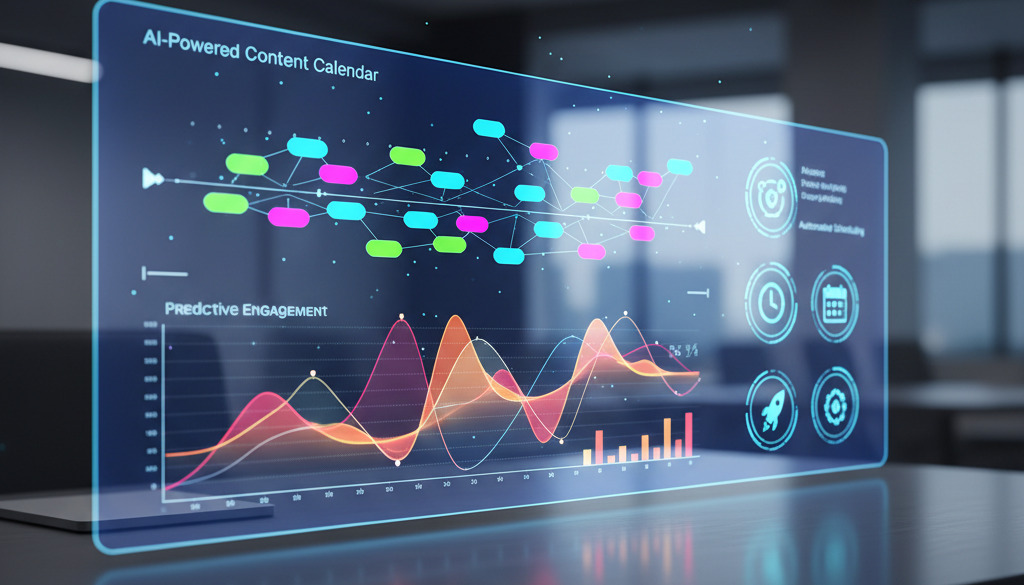
In the high-stakes arena of modern marketing, the "content hamster wheel" has become a significant bottleneck for growth. Traditional content planning, characterized by static spreadsheets and reactive brainstorming sessions, is increasingly inadequate in a digital ecosystem that moves at the speed of light. As businesses strive to maintain visibility across fragmented channels, the need for a more sophisticated, data-driven approach has never been more urgent.
Enter the AI content calendar. This is not merely a digital upgrade of an old tool; it represents a fundamental shift in how organizations conceptualize, plan, and execute their communication strategies. By leveraging artificial intelligence, marketing teams can move beyond guesswork and manual scheduling to a model of predictive relevance.[1] This article explores the strategic imperative of integrating AI into your content planning, providing a roadmap for moving from rigid schedules to a dynamic, high-performance content engine.
Redefining the Content Calendar: From Static Schedules to Dynamic Roadmaps
For decades, the content calendar was a rigid document—often a shared spreadsheet or a basic project management board—that dictated what would be published and when. While functional, these static tools suffer from a major flaw: they are disconnected from real-time market shifts. When a sudden industry trend emerges or a competitor launches a disruptive campaign, a static calendar becomes an anchor rather than a guide.
An AI content calendar redefines this relationship. It functions as a dynamic roadmap that continuously recalibrates based on incoming data. Unlike traditional systems that require manual updates for every change, AI-powered platforms can suggest shifts in priority, identify "content gaps" in real-time, and even pause scheduled posts if they conflict with sensitive global events. This agility ensures that a brand remains relevant and responsive, transforming the calendar from a mere schedule into a strategic asset that captures opportunities as they arise.
Core AI Capabilities Powering the Modern Content Calendar
The transition to an intelligent calendar is supported by three primary technological pillars. Understanding these is essential for any leader looking to modernize their marketing stack.
- Natural Language Processing (NLP): This technology allows machines to "read" and understand human language. In the context of a calendar, NLP scans thousands of industry articles, social media conversations, and customer reviews to identify emerging themes. It doesn't just look for keywords; it understands the sentiment and context behind them, helping strategists decide if a topic is a fleeting fad or a foundational shift.
- Machine Learning (ML) for Prediction: ML algorithms analyze historical performance to forecast future outcomes. For instance, if data shows that your audience engages most with technical deep dives on Tuesday mornings, the AI will prioritize those slots for your highest-value white papers. These systems get smarter over time, refining their predictions as more data points are collected.
- Data Analytics and Pattern Recognition: AI excels at finding the "signal in the noise." It can analyze your past three years of content performance to uncover non-obvious patterns—such as the fact that specific color palettes in thumbnails lead to a 15% higher click-through rate (CTR) for your B2B audience.
Setting the Foundation: Data Inputs and Integration for AI Calendar Success
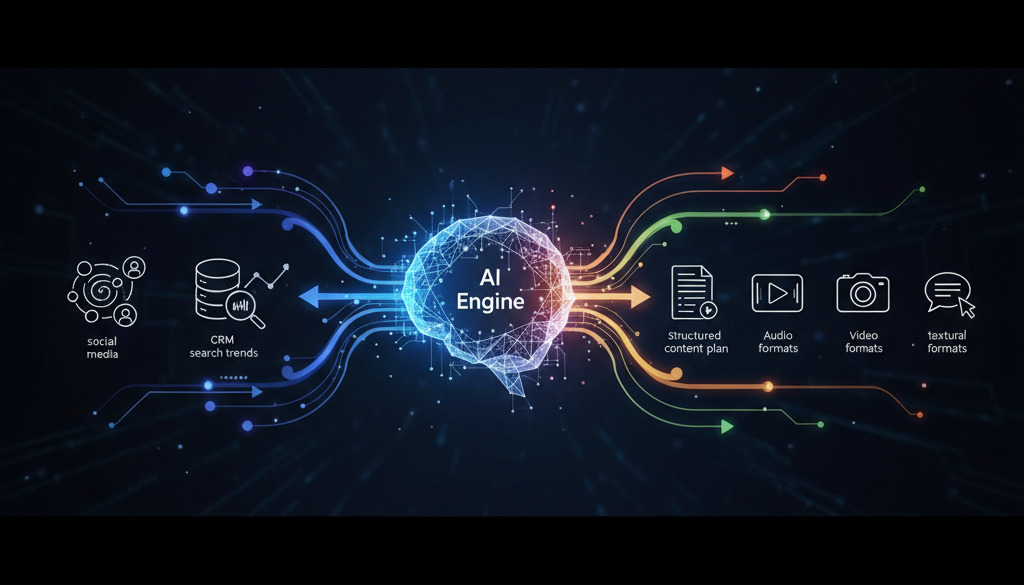
An AI is only as effective as the data it consumes. To build a high-performing AI content calendar, organizations must integrate diverse data streams to provide a holistic view of the market and the audience. Successful implementation requires three specific categories of data input:
Audience Data
This includes deep integration with your Customer Relationship Management (CRM) system and website analytics (like Google Analytics 4). By understanding who is buying, who is churning, and what content preceded a conversion, the AI can suggest topics that move the needle on revenue rather than just "vanity metrics" like likes or shares.
Performance Data
To optimize for the future, the AI needs a comprehensive record of the past. This involves feeding the tool every metric available from social platforms, email marketing software, and CMS platforms. The goal is to create a closed-loop system where the results of today's post automatically influence the scheduling of next month's campaign.
External Trend Data
Modern AI tools leverage APIs from search engines and social listening platforms. By integrating Google Trends and industry-specific RSS feeds, the calendar can alert the team to rising search volumes for specific terms, allowing them to adjust the schedule to capitalize on "search intent" before the competition does.
AI-Driven Content Ideation: Uncovering Tomorrow's Viral Topics
One of the most significant hurdles in content marketing is the creative "blank page." AI-driven ideation eliminates this by acting as a 24/7 research assistant that identifies high-potential topics based on empirical evidence.
Trend Spotting and Predictive Analysis
AI tools can now detect "micro-trends" before they hit the mainstream. By analyzing velocity—how fast a topic is spreading across different digital sub-cultures—AI can predict whether a topic will peak in three days or three months. This allows teams to schedule content at the exact moment of maximum interest.
Audience Persona Mapping
Generic content is a recipe for invisibility. AI maps identified trends directly to your specific audience personas. For example, it might identify that while "Sustainability" is a broad trend, your "C-suite Executive" persona is specifically interested in "Circular Economy ROI." The AI calendar then suggests specific angles that resonate with different segments of your database.
Competitor Gap Analysis
By monitoring the content calendars of your competitors (via their public feeds), AI can highlight "white space." If every competitor is writing about "Cloud Security for Beginners," the AI might suggest your calendar focus on "Advanced Encryption for Hybrid Environments"—a topic your data shows your audience is searching for but nobody is adequately covering.
Optimizing Content Creation Workflows with AI
Strategic planning is useless if the production team cannot keep up. AI content calendars bridge the gap between planning and execution by streamlining the actual creation process. Leading platforms like Lately can now take a single long-form blog post and automatically generate 30+ unique social media snippets, each optimized for different platforms based on historical performance data.
Beyond simple repurposing, AI can suggest personalization variations. For a global brand, the calendar might present a "master schedule" while automatically suggesting localized hooks for different regions. Furthermore, resource allocation features help managers understand team capacity; the AI can flag if the calendar is too heavy on video production for the upcoming week, suggesting a shift to lower-resource text formats to prevent team burnout while maintaining a consistent posting cadence.
Measuring and Iterating: The AI Feedback Loop for Continuous Improvement
The true power of an AI-powered content calendar lies in its ability to learn from its mistakes. Traditional reporting is often "post-mortem," looking at what happened last month. AI provides a real-time feedback loop. Recent data suggests that brands using AI for scheduling and optimization see an engagement lift of 25% to 40% because the system constantly iterates on posting times and content types.
If a specific content pillar is underperforming, the AI dashboard won't just report the low numbers; it will suggest a hypothesis for why. Perhaps the headlines are too passive, or the visual style is fatiguing the audience. Many advanced systems now offer automated A/B testing suggestions directly within the calendar view, allowing strategists to approve "challenger" versions of headlines or calls-to-action (CTAs) with a single click. This transition from "reporting the news" to "improving the news" is what separates market leaders from laggards.
Implementing an AI-Powered Content Calendar: A Strategic Roadmap
Transitioning to an AI-driven model requires more than just a software subscription; it requires a structural change in how the marketing department operates. Organizations should follow a phased approach to ensure long-term adoption and success.
- Phase 1: Assessment and Data Readiness: Audit your current tech stack. Ensure your data isn't siloed in different departments. Clean your CRM data and verify that tracking pixels are correctly firing across all digital touchpoints.
- Phase 2: Tool Selection and Integration: Choose a platform that aligns with your specific needs. Enterprise teams may require tools with robust approval workflows and brand governance (like Sprout Social), while smaller, agile teams might prioritize rapid repurposing (like Lately).
- Phase 3: Pilot Program and Training: Do not attempt to move the entire year's strategy at once. Start with a single product line or social channel. Train the team not just on the software, but on how to interpret AI suggestions without losing their creative agency.
- Phase 4: Full-Scale Deployment: Once the pilot shows a demonstrable ROI—such as a reduction in planning time or an increase in reach—roll the system out globally. Establish a quarterly "AI Audit" to ensure the algorithms are still aligned with the brand's long-term business goals.
Navigating the Ethical and Practical Considerations of AI in Content Calendars
As AI takes a more prominent role in planning, businesses must navigate several critical challenges. The most prominent is the maintenance of brand voice. An AI can suggest a trend, but if it recommends a tone that is inconsistent with a brand's 20-year heritage, it can do more harm than good. The "human-in-the-loop" model remains vital; AI should be seen as a co-pilot that handles the data-heavy lifting, leaving the final creative "veto" to human editors.
Furthermore, transparency and bias are significant concerns. If the training data for an AI is biased toward a specific demographic, the content recommendations will follow suit. Businesses must vet their AI providers for algorithmic transparency. Finally, the role of the content strategist must evolve. Instead of spending 10 hours a week in spreadsheets, the strategist's value now lies in high-level creative direction and managing the AI system itself—ensuring that the machine's efficiency is directed toward meaningful, human-centric goals.

The Future of Content Calendars: Predictive, Personalized, and Proactive Dominance
As we look toward 2026 and beyond, the AI content calendar will move from being a "tool" to being a central "operating system" for the entire customer journey. We are moving toward a future of hyper-personalization at scale, where an AI calendar doesn't just schedule a post for "the audience," but orchestrates thousands of individualized "content journeys" simultaneously.
Imagine a system that detects a specific user has interacted with your top-of-funnel LinkedIn post, then automatically adjusts the email calendar to send that specific user a deep-dive case study 48 hours later, while simultaneously alerting the sales team. This level of orchestration—where the content calendar is seamlessly integrated with the entire customer lifecycle—is the next frontier of marketing efficiency. The companies that master this proactive dominance will not only out-publish their competitors; they will out-connect them.
Embracing the AI-Augmented Content Revolution
The adoption of an AI content calendar is no longer a luxury reserved for Silicon Valley giants; it is a strategic necessity for any business operating in a saturated digital market. The benefits are undeniable: a 3x increase in content output without increasing headcount, a 40% lift in engagement through optimized delivery, and the ability to stay ahead of market trends with predictive analysis.
However, the greatest value of AI is not just the time it saves, but the creative energy it unblocks. By automating the logistical burden of scheduling and the analytical burden of data processing, AI allows marketing teams to return to what they do best: storytelling and human connection. Businesses that view AI as a powerful co-pilot rather than a replacement will find themselves better equipped to navigate the complexities of the modern attention economy. The revolution is here; it's time to let AI take the wheel of your content planning.
Scaling Strategic Content Initiatives with an AI Content Calendar
The deployment of an AI content calendar extends far beyond mere scheduling optimization; it represents a fundamental shift towards proactive, data-driven content strategy that fuels scalable business growth. By analyzing vast datasets encompassing market trends, competitor activities, audience engagement patterns, and conversion funnels, an AI content calendar can identify high-impact content opportunities with unparalleled precision. This allows marketing teams to move beyond reactive content creation, where topics are chosen based on immediate perceived relevance, to a predictive model that anticipates future audience needs and market shifts. Imagine an AI continuously monitoring industry publications, social media conversations, and search engine queries, flagging emerging themes or keywords that are gaining traction. This intelligence can then be translated into a strategic content roadmap, ensuring that your organization is not just participating in current conversations but actively shaping them and establishing thought leadership before competitors even identify the trend.
The strategic value of this predictive capability is immense for businesses focused on sustainable growth. Instead of relying on anecdotal evidence or limited internal analysis, an AI content calendar provides objective, data-backed insights into what content will resonate most effectively with specific audience segments at different stages of their journey. This granular understanding enables hyper-personalized content delivery, a crucial factor in today's attention-scarce environment. For instance, an AI might identify that a particular segment of your audience, having shown interest in foundational product features, is now ripe for educational content exploring advanced use cases and ROI. The AI content calendar can then automatically suggest and schedule a series of blog posts, webinars, or downloadable guides tailored to this specific need, ensuring that each piece of content serves a strategic purpose in nurturing leads and driving conversions. This systematic approach minimizes content waste and maximizes the return on investment for your content marketing efforts, making it an indispensable tool for companies aiming for aggressive yet efficient expansion.
Furthermore, an AI content calendar democratizes strategic planning within larger organizations. Traditionally, content strategy development can be siloed or limited to a few key individuals. However, by presenting actionable insights and suggesting optimized content plans, AI empowers a broader range of team members, including content creators, social media managers, and even sales representatives, to contribute to and understand the overarching content strategy. This fosters a more cohesive and aligned marketing function, where everyone is working towards common growth objectives. The AI acts as a universal translator, converting complex data into understandable content recommendations that guide daily execution. This collaborative environment, facilitated by intelligent automation, is crucial for scaling content initiatives effectively. As a company grows, the volume and complexity of content demands increase exponentially, and an AI content calendar provides the robust framework necessary to manage this scale without compromising strategic coherence or creative quality. It ensures that as your marketing team expands, your content strategy remains agile, responsive, and consistently aligned with business objectives, laying a solid foundation for sustained competitive advantage and accelerated revenue growth.
FAQ
What is an AI content calendar?
An AI content calendar is a tool that leverages artificial intelligence to plan, organize, and optimize your content creation schedule. It goes beyond a traditional calendar by using AI to suggest topics, identify publishing windows, and even predict content performance.
How does an AI content calendar help with business growth?
By automating planning, identifying high-performing content opportunities, and ensuring consistent publishing, an AI content calendar streamlines your content marketing efforts. This leads to increased audience engagement, better SEO rankings, and ultimately, driving more leads and sales for your business.
Can small businesses benefit from using an AI content calendar?
Absolutely! An AI content calendar can democratize sophisticated content strategy, allowing small businesses to compete more effectively. It provides data-driven insights that were previously only accessible to larger organizations with dedicated analytics teams.
Keep reading
Hand-picked guides that go deeper — open the one you need next:
- From Zero to Hero: Build Your Online Presence With AI
- AI Scalable Content Strategy for Rapid Growth
- Scale Your Business with AI: Content Marketing for Growth
- AI Keyword Research: Beyond Basic Keywords
→ Read the full AI Content guide