
AI Content Conversion Optimization: The 2026 Strategy Guide

In the high-stakes environment of modern digital marketing, the sheer volume of content is no longer the primary indicator of success.[1] As we navigate 2026, the marketplace has reached a point of content saturation where traditional production cycles are failing to move the needle on the only metric that truly matters: conversions. This is where AI content conversion optimization enters the fray, shifting the focus from simple output to measurable impact. It is the strategic application of machine learning, natural language processing, and predictive analytics to refine every digital touchpoint for maximum persuasion.
For executive leadership and marketing directors, the challenge is no longer "How do we create more content?" but rather "How do we make our content work harder?" By integrating AI into the optimization funnel, businesses can move beyond the "guess and test" era. This article explores the transformative role of AI in bridging the gap between content creation and revenue generation, providing a blueprint for high-performing, data-backed content strategies.
Understanding the Core Principles of Conversion Optimization
Conversion optimization is the systematic process of increasing the percentage of website visitors who take a specific, desired action. Whether that action is completing a purchase, signing up for a newsletter, or requesting a B2B demo, the goal remains the same: maximizing the efficiency of your existing traffic. In a landscape where the cost of customer acquisition (CAC) is rising—often outpacing inflation—optimizing for conversions is the most direct path to increasing Return on Ad Spend (ROAS) and overall profitability.
Successful optimization relies on a granular understanding of key metrics. It is not enough to look at total revenue; sophisticated teams monitor click-through rates (CTR) on specific CTAs, bounce rates on high-intent landing pages, and the Customer Lifetime Value (CLV) of users acquired through different content pillars. However, the data is only half the story. The core of conversion optimization is the human element. Every data point represents a person with specific intent, psychological triggers, and friction points within their buyer journey. AI content conversion optimization succeeds because it allows marketers to analyze these human behaviors at a scale and depth previously unimaginable, identifying exactly where a user is being "lost" and why.
AI as a Catalyst for Data-Driven Content Insights
The limitation of human-led content audits is the biological threshold of data processing. A human analyst can review a dozen heatmaps and a few hundred survey responses; an AI model can ingest millions of data points from diverse sources—CRM logs, session recordings, and social sentiment—to uncover patterns of friction. AI excels at identifying "micro-conversions"—those subtle steps a user takes before the final purchase—that are often invisible to the naked eye.
For example, AI-powered analytics can reveal that users who engage with a specific long-form comparison guide are 45% more likely to convert, yet that guide is buried three clicks deep in the architecture. It can identify that a specific tone of voice in product descriptions correlates with higher returns in the electronics category but lower returns in luxury goods. These hidden correlations allow businesses to double down on what works and ruthlessly eliminate content that serves as a bottleneck. By shifting from anecdotal evidence to algorithmic certainty, organizations ensure their content budget is allocated toward high-impact assets.
Leveraging AI for Audience Segmentation and Personalization
Generic content is the enemy of conversion. In 2026, consumers expect—and reward—personalization. AI takes segmentation far beyond basic demographics like age or location. It utilizes predictive behavioral segmentation, grouping users based on their likelihood to churn, their price sensitivity, or their specific "intent signals." For instance, a user who has visited a pricing page three times in 48 hours is in a different segment than a first-time blog reader.
AI enables hyper-personalization at scale. Using dynamic content modules, a website can serve a "Technical Case Study" to a CTO while showing a "ROI Calculator" to a CFO on the same landing page. Adobe’s research highlights that moving from adoption to operational maturity in AI allows organizations to close the "execution gap," ensuring that personalized messaging isn't just a goal, but a real-time reality. This level of relevance significantly reduces friction, as the content directly addresses the user's current stage in the decision-making process.
AI-Powered Content Generation and Enhancement for Conversion
While generative AI has been maligned for flooding the internet with low-quality text, its role in optimization is surgical. High-level AI tools are now used to enhance existing content for better performance. AI-assisted copywriting is no longer just about generating a draft; it’s about generating 50 variants of a headline to see which resonates with a specific segment. It can rewrite calls-to-action to be more persuasive based on established psychological principles of influence.
Beyond the words themselves, AI optimizes for readability and SEO synchronously. It can analyze whether a piece of content is too dense for its target audience or if the keyword density is hampering the user experience. Furthermore, AI tools now facilitate automated content repurposing. A high-converting whitepaper can be instantly transformed into a series of punchy LinkedIn posts or a summarized executive brief. This ensures that the core value proposition of your best content reaches users in whichever format they prefer, maximizing the surface area for conversion.
Optimizing the User Journey with AI-Driven Content Placement and Sequencing
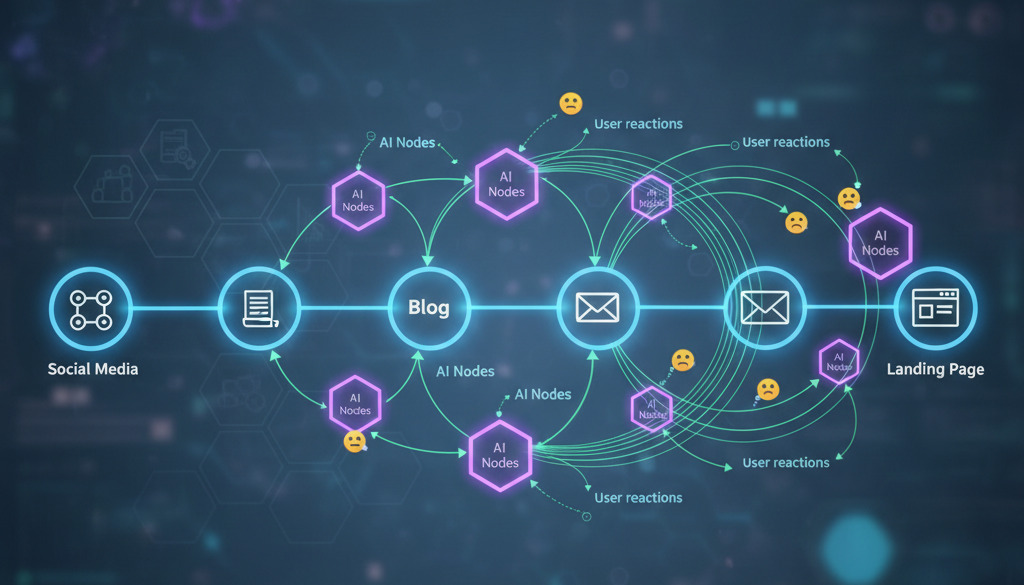
The path to purchase is rarely linear. AI helps marketers map the "messy middle" of the user journey, predicting the optimal sequence of content to move a lead through the funnel. Instead of a static "one-size-fits-all" email sequence, AI can dynamically adjust content delivery based on real-time behavior. If a user skips a video but spends ten minutes on a technical documentation page, the AI can trigger a follow-up offering a deep-dive webinar rather than a generic promotional discount.
This dynamic sequencing ensures that content placement is always contextually relevant. AI "next-best-action" engines analyze millions of previous journeys to suggest the content most likely to result in a conversion at that specific moment. This reduces the cognitive load on the user; they don't have to search for the next step because the AI has already placed it in their path. For eCommerce, this might mean showing a "complete the look" recommendation, while in B2B, it might mean serving a relevant industry-specific testimonial just as the lead reaches the decision phase.
AI-Powered A/B Testing and Experimentation for Conversion Breakthroughs
Traditional A/B testing is often slow and limited to testing one variable at a time (e.g., green button vs. red button). AI-driven experimentation allows for multivariate testing at a speed humans cannot match. These systems can test thousands of combinations of images, headlines, layouts, and CTAs simultaneously, using "multi-armed bandit" algorithms to shift traffic toward winning versions in real-time. This eliminates the "regret" of sending traffic to a losing variant during a long testing period.
The statistical rigor provided by AI is a significant advantage. It can identify complex interactions that a human would miss—for example, that CTA "A" works best with Image "B" for mobile users, but CTA "C" works best with Image "D" for desktop users. This level of granular optimization can lead to compound gains, where small improvements in multiple areas result in a massive overall increase in conversion rates. According to industry statistics, organizations that close the AI measurement gap see up to 2.4x better content ROI because they are iterating based on algorithmic proof rather than gut feeling.
Content Analysis and Performance Prediction with AI
One of the most valuable applications of AI in content strategy is predictive modeling. Before a single word is published, AI can analyze a draft against historical performance data to forecast its likely conversion impact. It looks at semantic structures, reading level, and emotional resonance to give the content a "conversion score."
This allows marketing teams to prioritize their efforts. Instead of spending equal time on all pieces of content, teams can focus their high-level human creativity on the assets that AI identifies as having the highest potential for impact. Furthermore, AI can conduct periodic "content health audits," identifying once-successful pages that are now declining in performance due to market shifts or competitor activity. This proactive approach ensures the content library remains a high-yielding asset rather than a warehouse of decaying material.
Ethical Considerations and Human Oversight in AI Content Optimization
As powerful as AI is, it lacks the nuanced understanding of brand ethics, cultural sensitivity, and long-term brand equity. AI-optimized content can sometimes lean too hard into "dark patterns" or overly aggressive persuasion tactics that might boost short-term conversions at the expense of long-term trust. This is why human oversight remains non-negotiable. The role of the marketer is shifting from "creator" to "editor and strategist."
Human experts must ensure that AI tools maintain the brand’s unique voice and do not hallucinate facts or produce content that is technically accurate but emotionally hollow. Ethical AI use also involves transparency regarding data privacy; as users become more aware of how they are being tracked, brands that use AI responsibly and provide genuine value will win the conversion battle. AI is a tool for augmentation, not replacement; it provides the data and the drafts, but humans provide the soul and the strategy.
Implementing an AI Content Conversion Optimization Strategy: A Practical Framework
Integrating AI into your workflow requires a structured approach to avoid "pilot purgatory"—where tools are tested but never fully adopted. The first step is data consolidation. AI is only as good as the data it feeds on, so ensuring your CRM, website analytics, and content CMS are integrated is critical. Next, identify a specific bottleneck in your funnel (e.g., high cart abandonment or low whitepaper downloads) and deploy a targeted AI solution to address it.
Selecting the right tech stack is equally important. In 2026, the market is flooded with tools, from all-in-one platforms like Adobe Experience Cloud to specialized AI writers like Jasper or Copy.ai. Choose tools that offer API flexibility and clear reporting. Finally, foster a culture of experimentation. Train your team to view AI insights as a starting point for innovation rather than a threat to their expertise. A data-informed culture is the only way to ensure that AI-driven gains are sustained over time.

Case Studies: Real-World Successes in AI Content Conversion Optimization
The theoretical benefits of AI are best illustrated through real-world application. Consider a major global eCommerce retailer that struggled with low conversion rates on its product pages. By implementing an AI-powered content enrichment system, they were able to generate personalized product descriptions that adapted to the user's browsing history. For example, if a user frequently bought eco-friendly products, the AI highlighted the sustainability features of a new item. The result was a 22% increase in add-to-cart rates within the first quarter.
In the B2B SaaS sector, a software provider used AI-driven journey mapping to optimize their lead nurturing. The AI identified that their "one-size-fits-all" email drip was boring prospects. By switching to a dynamic sequence that served content based on the prospect's specific industry and interactions with the trial software, they saw a 35% increase in "trial-to-paid" conversions. These cases demonstrate that when AI is applied to solve specific friction points in the user journey, the ROI is both rapid and substantial.
Conclusion: The Future of AI-Augmented Content for Peak Performance
We are entering an era of "Performance Content," where the line between content marketing and conversion rate optimization (CRO) has completely blurred. AI content conversion optimization is the engine driving this evolution. It provides the scale, speed, and precision necessary to meet the demands of the 2026 consumer, who expects every digital interaction to be relevant, valuable, and seamless.
The future belongs to the "augmented marketer"—the professional who leverages AI to handle the heavy lifting of data analysis and variant generation, while focusing their own energy on high-level strategy and creative storytelling. By embracing AI as a catalyst for data-driven insights and hyper-personalization, businesses can transform their content from a cost center into a powerful, self-optimizing engine for growth. The opportunity is clear: those who master the intersection of human psychology and machine intelligence will dominate the digital landscape.
Keep reading
Hand-picked guides that go deeper — open the one you need next:
- The Ultimate Guide to AI Product Description Generators
- Volteruno's AI Content Workflow: Idea to Publication
- The Ultimate Guide to a 'Blog on Autopilot'
- Content Marketing Automation: A Strategy for Entrepreneurs
→ Read the full AI Content guide