
Small Business Content Marketing: Your AI Assistant for Growth
Key Takeaways
- Overcome Time Constraints: AI content marketing automates the creation process, freeing up valuable time for small business owners to focus on core operations.
- Enhance SEO and Visibility: AI tools can generate SEO-optimized content, from blog posts to meta descriptions, helping you rank higher on Google and attract organic traffic.
- Data-Driven Strategy: Artificial intelligence analyzes data to identify your target audience, suggest relevant topics, and refine your content strategy for maximum impact.
- Cost-Effective Scalability: Produce a high volume of quality content at a fraction of the cost of traditional methods, allowing you to compete with larger businesses.
- Human Oversight is Crucial: AI is a powerful assistant, but the best results come from an "AI + Human" approach. Always edit and refine AI-generated content to ensure accuracy, brand voice, and authenticity.
The Evolving Landscape of Small Business Marketing
In today's digital-first economy, an online presence is no longer a luxury for a small business; it's the bedrock of survival and growth. Your customers are online, searching for solutions you provide. If they can't find you, for all intents and purposes, you don't exist. However, for many established small business owners, particularly those who built their companies with grit and handshake deals, the digital marketing world can feel like a relentless, time-consuming treadmill. The demands for fresh blog posts, social media updates, and email newsletters are constant.
You know you need to be creating content, but who has the time? Between managing inventory, serving customers, handling payroll, and a dozen other daily fires, content creation often falls to the bottom of the list. This is a common and understandable challenge. The good news is that a groundbreaking technology has emerged that acts as a force multiplier for businesses just like yours: Artificial Intelligence (AI) is here to be your content marketing assistant.[1]
What is AI Content Marketing and Why Does It Matter for SMEs?
At its core, AI content marketing is the use of artificial intelligence technologies to assist in the creation and optimization of marketing content.[2] Think of it not as a magical black box, but as an incredibly sophisticated and efficient assistant. It's a tool that can draft articles, brainstorm ideas, analyze trends, and personalize messages on a scale that was previously unimaginable for a Small or Medium-sized Enterprise (SME).
For your business, this matters for three key reasons:
- Efficiency: It drastically reduces the time it takes to produce high-quality content. What might take you a full day to write can be drafted by AI in minutes.
- Scalability: It allows you to produce a consistent stream of content, keeping your website and social media channels fresh, which is a key factor in search engine rankings and audience engagement.
- Data-Driven Insights: AI can process vast amounts of data to tell you what your customers are searching for, helping you create content that directly answers their questions and meets their needs.
Crucially, as noted by marketing experts, the most effective strategy is a partnership. The future of marketing isn't AI vs. human; it's AI + human. AI handles the heavy lifting, and you provide the strategy, nuance, and final human touch.
Decoding Artificial Intelligence in Content Creation
The term "Artificial Intelligence" can sound intimidating, but the concepts powering it are quite understandable. The main technologies at play are Natural Language Processing (NLP) and Machine Learning (ML). In simple terms, NLP is what allows a computer to understand and generate human-like text. Machine Learning is what allows it to learn from vast amounts of data—every book, website, and article it's been trained on—to improve its responses.
AI-Generated vs. AI-Assisted
It's helpful to differentiate between two approaches:
- AI-Generated Content: This is where the AI creates the content from scratch based on a prompt you provide. It's fast and excellent for creating first drafts.
- AI-Assisted Content: This is where AI helps you improve your own writing, suggesting better phrasing, optimizing for search engines, or expanding on a point.
Setting realistic expectations is key. AI is not a mind reader. Its output is directly related to the quality of your input (your prompts and instructions). It’s a tool that requires guidance, not a replacement for your business knowledge.
Overcoming the "No Time, No Tech Skills" Hurdle with AI
This is where AI becomes a true game-changer for the busy business owner. The core challenges you face—not enough hours in the day, not being a "tech person," and feeling uninspired—are precisely what AI is designed to solve. It levels the playing field, allowing you to execute a professional-level content strategy without needing a large in-house marketing team or extensive technical expertise.
Think of it as the ultimate democratizing force. You no longer need to be a coding expert or a professional writer to have a powerful online presence. AI-powered platforms are designed with user-friendly interfaces that are as easy to use as sending an email. Moreover, if even that feels like too much, a new wave of services has emerged that handles the entire AI content process for you. This strategy of outsourcing AI content creation is incredibly efficient, providing you with finished, SEO-optimized articles without you having to touch the technology at all.
Identifying Your Target Audience with AI-Powered Insights
Effective marketing starts with deeply understanding your customer. Who are they? What problems do they have that you can solve? What questions are they typing into Google? Traditionally, answering these questions required expensive market research and surveys. Today, AI can provide these insights faster and more accurately.
AI tools can analyze online conversations, search trends, and competitor data to create detailed customer personas. It can tell you the demographics, interests, and—most importantly—the pain points of your ideal clients. For example, an AI might find that potential customers for a local accounting firm are frequently searching for "small business tax deduction tips" or "how to manage cash flow effectively." This is gold. Armed with these insights, you can direct your AI content assistant to create articles that specifically address those needs, making your business an invaluable resource.
Crafting a Content Strategy Aligned with Business Goals
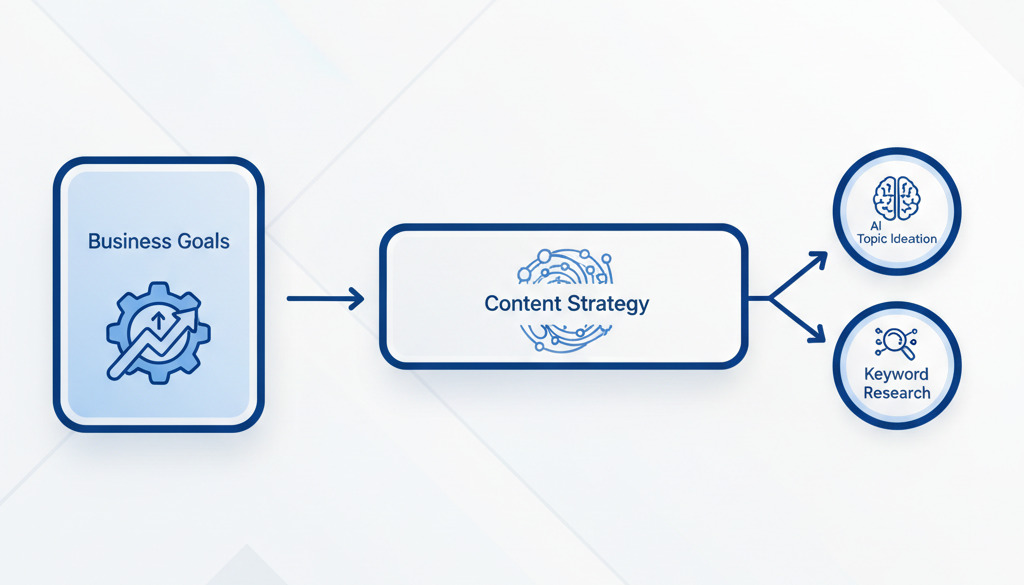
Before you generate a single word, you need a plan. Content without a strategy is just noise. Your business goals must drive your content marketing efforts. Are you trying to increase foot traffic to your physical store? Generate more leads through your website? Build a name for yourself as the local expert?
Use the SMART goal framework to define your objectives:
- Specific: "I want to increase web leads from my blog by 20%."
- Measurable: Track leads via a contact form on your blog posts.
- Achievable: Is a 20% increase realistic based on your current traffic?
- Relevant: Does getting more web leads support your primary goal of increasing sales?
- Time-bound: "I want to achieve this in the next 6 months."
Once you have your goals, AI can help you build the strategy. AI tools can perform sophisticated keyword research to find the terms your target audience is using and suggest a "topic cluster" strategy—a series of interconnected articles that establish your authority on a subject—to help you dominate those search terms.
Leveraging AI for SEO-Optimized Blog Content
Search Engine Optimization (SEO) is the process of making your website more visible on search engines like Google. A primary driver of SEO is high-quality, consistent content that answers user questions. This is an area where AI excels.

From Keywords to Content
AI doesn't just find keywords; it helps you use them effectively. It understands concepts like keyword density, semantic keywords (related terms), and user intent. You can instruct an AI to write a 1,500-word blog post on "small business cash flow management" that is optimized for SEO. It will naturally weave in relevant long-tail keywords and related phrases, structure the article with proper headings (H2s, H3s), and even suggest a meta description to improve your click-through rate from Google.
For many business owners who don’t have the time to become SEO experts, this is a revolutionary capability. Services like More Customers From Your Blog build upon this by using a proprietary AI specifically trained to write professional SEO articles for your website in minutes. It’s designed to answer the questions your customers are asking, so they can find you organically through search engines.
AI-Driven Content Ideation: Never Run Out of Ideas Again
Every business owner has experienced it: the dreaded blank page. You know you need to post a new article, but you have no idea what to write about. AI completely eliminates this problem. It can be your ultimate brainstorming partner.
You can use AI tools to:
- Analyze Competitors: Give an AI the URL of a competitor's blog, and it can analyze their most popular articles, giving you inspiration for topics you can cover better and more comprehensively.
- Monitor Trends: AI can scan news articles, social media, and industry forums to identify emerging trends and hot topics relevant to your business before they become saturated.
- Answer Customer Questions: You can feed AI a list of questions you frequently get from customers, and it can generate a dozen different blog post ideas based on those queries.
With AI, you can transform a simple prompt like "lawn care tips for spring" into a full content calendar with titles like "The Ultimate Spring Lawn Care Checklist for Homeowners," "5 Common Lawn Diseases and How to Treat Them," and "When is the Best Time to Fertilize Your Lawn in the Northeast?"
The Power of Automation in Content Creation Workflow
Beyond ideation, AI brings powerful automation to the entire content creation workflow, streamlining what used to be a series of manual, time-consuming tasks. It accelerates the process from concept to publication, dramatically improving your efficiency.
Consider the typical content lifecycle. AI can automate:
- Creating Outlines: Provide a topic, and AI can generate a logical, well-structured outline with H2 and H3 headings in seconds. This provides the skeleton for your article, ensuring all key points are covered.
- Drafting Content: As discussed, AI can take that outline and produce a full first draft, saving you hours of writing time.
- Generating Variations: Need a shorter version of your blog post for an email newsletter? Or a series of social media posts based on its key points? AI can instantly repurpose your core content for different channels, each with the appropriate tone and length.
- Suggesting Headlines: AI can generate 10-20 different headline options for a single article, allowing you to A/B test or choose the one most likely to grab a reader's attention.
This level of automation frees you and your team to focus on high-value activities: refining strategy, engaging with customers, and, of course, running your business.
Generating High-Quality Blog Posts with Ease
Let's walk through the practical process. Generating a blog post with a modern AI platform is remarkably straightforward. It generally involves these steps:
- Choose a Topic and Goal: Based on your strategy, decide on the topic (e.g., "Patio Design Ideas for Small Backyards") and the goal (e.g., attract local landscaping clients).
- Write a Detailed Prompt: This is the most important step. Don’t just say "Write a blog post about patio ideas." A good prompt would be: "Act as an expert landscape designer. Write a 2000-word SEO-optimized blog post for homeowners in the US. The target audience is looking for budget-friendly ideas for small backyards. Include sections on container gardening, space-saving furniture, outdoor lighting, and using pavers vs. decking. The tone should be inspiring but practical."
- Generate the Draft: The AI will process your prompt and produce a comprehensive draft, complete with an introduction, body paragraphs, and a conclusion.
- Review and Refine: This is where the "human" part of the "AI + Human" formula comes in. Read through the draft, check facts, inject your own anecdotes or local examples, and ensure the tone perfectly matches your brand voice.
The speed is what makes this so transformative. With some AI-powered services, this entire process is streamlined. For example, a platform like More Customers From Your Blog uses its proprietary AI to generate professional SEO articles for your website in minutes—it truly feels like magic, turning a complex task into a simple one.
Beyond Blog Posts: AI for Other Content Formats
While long-form blog content is a cornerstone of SEO, your marketing needs are far more diverse. AI's versatility extends across the full spectrum of content formats required for a holistic digital marketing strategy.
AI for a Multichannel Presence
You can leverage AI to create:
- Social Media Updates: Generate engaging captions for Instagram, intriguing questions for Facebook groups, and professional updates for LinkedIn. AI can adapt the same core message to fit the unique style and character limits of each platform.
- Email Newsletters: Draft compelling subject lines and body copy for your weekly or monthly newsletters, promoting your latest blog posts, announcing sales, or sharing company news.
- Product Descriptions: For e-commerce businesses, AI can write persuasive and detailed product descriptions that highlight benefits and features, optimized for search.
- Ad Copy: Quickly generate multiple variations of ad copy for Google Ads and social media campaigns, allowing you to test what resonates best with your audience.
- Video Scripts: As AI video generation tools become more accessible, you can use text-based AI to draft scripts for short promotional videos or tutorials.
This ability to rapidly generate content for every channel ensures your brand maintains a consistent, active presence everywhere your customers are, without multiplying your workload.

Choosing the Right AI Content Marketing Tools for Your Business
The market for AI tools is exploding, which can be overwhelming. How do you choose the right one for your small business? The key is to focus on your specific needs and avoid getting distracted by features you'll never use.
Evaluation Checklist:
When looking at different platforms, consider the following:
- Ease of Use: Is the interface intuitive? Or does it feel like you need a degree in computer science to operate it? For a busy owner, simplicity is paramount.
- Output Quality: Does the generated content sound natural and human-like? Is it well-structured and grammatically correct? Run some test generations to evaluate the quality.
- Customization and Control: Can you provide detailed instructions? Can you set a specific tone of voice (e.g., "professional," "witty," "empathetic")?
- Features: Does it specialize in blog posts, or does it offer tools for social media, SEO, and other formats you need?
- Pricing: Does the pricing model fit your budget? Is it a monthly subscription or pay-per-use?
"The best tool for your business is the one you will actually use. Complicated software with a steep learning curve often ends up as wasted money. Start simple."
Many services understand this and offer a way to get started without a major commitment. For instance, some platforms offer a free trial, which is an excellent way to test the waters. A service like the one from More Customers From Your Blog goes even further by making your first 5 posts completely free, allowing you to see the real-world results before investing.
The Crucial Role of Human Editing and Fact-Checking
To truly unlock the power of AI content, you must embrace the "AI + Human" philosophy. Left on its own, AI can sometimes make mistakes. It can "hallucinate" facts, create awkward phrasing, or produce content that is technically correct but lacks a soul.
Your role as the human expert is non-negotiable. After the AI generates a draft, your job is to:
- Fact-Check Everything: AI models are not connected to the internet in real-time and their knowledge has a cutoff date. Always verify any statistics, dates, or specific claims. If the AI mentions "a recent study," find that study.
- Inject Your Brand Voice: The AI doesn't know your company’s story or your unique perspective. Edit the text to sound like YOU. Add personal anecdotes, local references, and industry-specific insights that only you can provide.
- Check for Nuance and Tone: Ensure the tone of the article is appropriate for the topic and your audience. An article about a sensitive topic requires a more careful touch than a simple listicle.
Think of the AI as a brilliant but inexperienced junior writer. It does 90% of the work, and you, the senior editor, provide the final 10% of polish that turns a good draft into a great article.
Maintaining Your Brand Voice and Authenticity with AI
Authenticity is the currency of modern marketing. Customers connect with real brands run by real people. A common fear is that using AI will make your content sound robotic and generic, erasing the very personality you’ve worked so hard to build. This is a valid concern, but one that can be managed with the right approach.
Maintaining your brand voice requires you to be an active guide for the AI. Many advanced tools allow you to create a "brand voice" profile, where you can input examples of your writing, define your tone (e.g., "authoritative but approachable," "playful and witty"), and list specific terms to use or avoid. This "trains" the AI to better mimic your unique style over time.
Even without these features, your final edit is where authenticity is forged. This is your opportunity to weave in storytelling, share your mission, and speak directly to the customer in a way that resonates emotionally. The AI provides the structure; you provide the heart. An authentic connection is still built on human understanding and empathy, and no AI can replace that.
Tracking Key Performance Indicators (KPIs) for AI Content
Creating content is only half the battle. To know if your efforts are successful, you need to measure their impact. Tracking Key Performance Indicators (KPIs) tells you what’s working, what’s not, and where to focus your energy for the best results.
Using a free tool like Google Analytics, you can monitor essential metrics for the pages where you publish your AI-generated content:
- Website Traffic (Users & Sessions): Are more people visiting your site after you started publishing content consistently?
- Traffic Source: Are visitors coming from "Organic Search"? This indicates your SEO efforts are paying off.
- Time on Page: Are people actually reading your articles? A higher time on page suggests the content is engaging.
- Bounce Rate: What percentage of visitors leave after viewing only one page? A high bounce rate might mean the content
Keep reading
Hand-picked guides that go deeper — open the one you need next:
- Local SEO AI: The Ultimate Guide to Dominating Local Search
- Small Business AI Content: A Guide to Scalable Growth
- Small Business, Big Impact: Leveraging AI for Professional Content Marketing
- Boost Your SEO in 2026: The AI Edge for Small Businesses
→ Read the full Small Business guide