
AI SEO Guide for Small Businesses
Key Takeaways
- SEO is Crucial: Online visibility is no longer optional for small businesses. SEO is the most effective way to attract customers actively looking for your services.
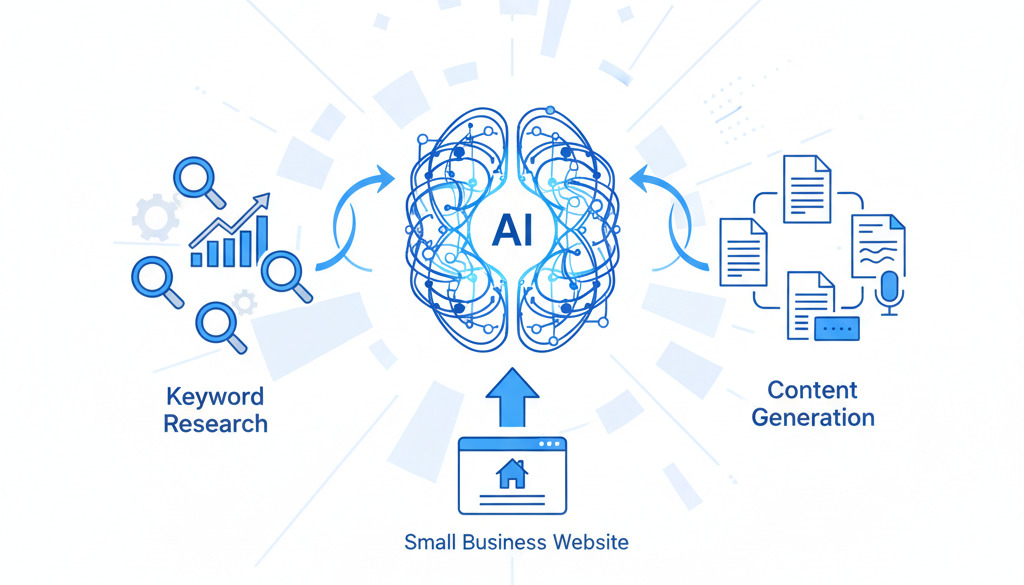
- AI is the Solution: Artificial Intelligence (AI) makes powerful SEO accessible for busy small business owners, automating tasks that were once time-consuming and complex.
- Focus on Intent: Modern SEO, powered by AI, is less about stuffing keywords and more about directly answering customer questions and satisfying their search intent.
- Content is King, AI is the Kingmaker: AI tools can generate high-quality, SEO-optimized blog posts and articles in minutes, helping you build authority and attract organic traffic consistently.
- Smart Automation Saves Time: From technical website audits to keyword research and performance analytics, AI can handle the heavy lifting, freeing you to focus on running your business.
- Human Oversight is Key: AI is a powerful assistant, but the best results come from combining its capabilities with your unique business knowledge and a final human touch.
Navigating the Evolving Digital Landscape: Why SEO is Non-Negotiable for Small Businesses
In today's market, your customers' journey almost always begins with a search engine. Whether they need a local plumber, a boutique coffee shop, or a specialized consulting service, their first instinct is to turn to Google. This makes your online visibility not just a marketing tactic, but a fundamental pillar of business survival and growth. However, for many small business owners—especially those over 40 who are experts in their trade but not necessarily in digital marketing—the world of Search Engine Optimization (SEO) can feel overwhelming.[1] The common challenges are always the same: a lack of time, a steep learning curve, and the high cost of hiring experts. This is where Artificial Intelligence (AI) enters the picture, not as another complicated technology to master, but as a powerful, accessible partner. AI is revolutionizing SEO, leveling the playing field and empowering small businesses to compete for visibility, traffic, and customers like never before.
Demystifying Search Engine Optimization (SEO): The Core Principles for Business Growth
Before diving into AI, it's important to understand what SEO is and why it matters so much. At its core, Search Engine Optimization is the process of making your website more attractive to search engines like Google. When your website is properly optimized, it ranks higher in search results for the keywords and phrases your potential customers are using. This results in more organic—or "free"—traffic to your site, leading directly to more leads, sales, and business growth. For the 53% of all website traffic that comes from organic search, being on the first page is critical.
The Pillars of Successful SEO
Think of SEO as having four main pillars that hold up your online presence:
- Technical SEO: This ensures your website is built in a way that search engines can easily crawl and understand it. It includes factors like site speed, mobile-friendliness, and having a secure connection (HTTPS).
- On-Page Optimization: This involves optimizing the individual pages of your website. It includes using the right keywords in your titles, headings, and text, as well as making sure your content is high-quality and easy to read.
- Off-Page Optimization: This refers to activities done outside of your own website to raise its authority, most notably acquiring backlinks (links from other reputable websites to yours).
- Content: This is the heart of modern SEO. Creating valuable, relevant, and consistent content like blog posts establishes your business as an expert, builds trust with your audience, and gives search engines more reasons to rank your site.
For a busy business owner, consistently creating content is often the biggest hurdle. Yet, without it, your website remains static and invisible. This is precisely the challenge AI is perfectly suited to solve.
The AI Revolution in Digital Marketing: What it Means for Your Business
Artificial Intelligence might sound like something out of a science fiction movie, but it's already a practical tool that's reshaping the business world.[2] In digital marketing, AI refers to systems and software that can perform tasks that typically require human intelligence, such as understanding language, analyzing data, and even creating original content. AI is not here to replace business owners. Instead, think of it as the most efficient employee you could ever hire—one that works 24/7 to analyze data, identify opportunities, and execute tedious tasks with superhuman speed. For small businesses, this means gaining access to insights and capabilities that were once only available to large corporations with huge marketing departments. The key is to see AI as a tool to augment your own expertise, not replace it.
AI-Powered Keyword Research: Uncovering Your Customers' Search Intent
Traditional keyword research involved brainstorming terms and using tools to see their search volume. This was often a time-consuming guessing game. AI has transformed this process entirely. AI-powered tools don't just look at keywords; they analyze the search intent behind them. They help you understand what a customer is *really* asking when they type something into Google.

Moving Beyond Simple Keywords
AI tools can analyze millions of searches and identify patterns, long-tail keywords (longer, more specific phrases), and—most importantly—the questions your customers are asking. For example, instead of just targeting the broad keyword "roof repair," an AI tool might reveal that customers in your area are searching for "how much does a shingle roof repair cost in Dallas?" or "emergency leak repair near me." As recent SEO studies show, content structured to answer these direct questions is far more likely to be featured in Google's AI-powered summaries and search results. AI helps you find these high-value, low-competition opportunities that your competitors might be missing.
Generating High-Quality SEO Content at Scale: The AI Advantage
Here is where AI becomes a true game-changer for the time-strapped business owner. After identifying what your customers are searching for, you need to create content that answers their questions. Historically, this meant spending hours writing blog posts or paying expensive copywriters. Today, AI content generators can produce well-written, structured, and SEO-optimized articles in a matter of minutes.
How AI Creates Content for You
These advanced platforms work by analyzing vast amounts of information from the internet to understand topics deeply. You provide a keyword or a topic, and the AI drafts a comprehensive article, complete with headings, paragraphs, and lists. The quality of these tools has skyrocketed, producing content that is coherent, informative, and ready for publication with minimal editing. For business owners, this is revolutionary. There are even specialized services that take this a step further, built on the promise of getting you 'more customers from your blog by writing the SEO articles for you.' They leverage their own sophisticated AI systems to deliver professionally crafted content directly to your website, effectively putting your entire blog strategy on autopilot. This approach is designed for owners who know they need content but have absolutely no time or desire to create it themselves.
Of course, the best practice is to always add your own unique voice and expertise. Use the AI-generated draft as a strong foundation, then inject your personal stories, case studies, and business-specific insights to make it truly yours. For more on this, check out this guide to mastering AI article writers for engaging content.
Optimizing Existing Content with AI: Refreshing and Re-engaging Your Audience
SEO isn't just about creating new content; it's also about making the most of what you already have. Many businesses have a backlog of old blog posts that are underperforming. AI can breathe new life into this existing content. AI-powered SEO tools can analyze your website and identify pages that have low traffic, poor rankings, or outdated information. From there, the AI can provide specific, actionable recommendations. It might suggest adding new, relevant keywords, improving the headings for clarity, expanding sections to provide more depth, or restructuring the article for better readability. Refreshing old content is a highly effective and low-effort SEO tactic, as it signals to Google that your website is active and up-to-date, often resulting in a quick boost in rankings and traffic.
AI for Technical SEO Audits: Ensuring Your Website is Search-Engine Friendly
Technical SEO is arguably the most intimidating aspect of SEO for non-tech-savvy individuals. Issues like slow page speed, broken links, or problems with how Google "crawls" your site can severely harm your rankings without you even knowing why. In the past, diagnosing these problems required specialized knowledge or a costly audit from an agency. AI completely automates this process. Modern AI-powered SEO tools can scan your entire website in minutes and generate a simple, easy-to-understand report that flags every technical issue, often categorizing them by priority. More importantly, they provide clear, step-by-step instructions on how to fix them. This empowers you to either make the changes yourself or hand a straightforward action list to a web developer, saving you time and diagnostic fees.
On-Page Optimization Driven by AI: Maximizing Your Content's Visibility
Even with great content, small details can mean the difference between getting clicks and being ignored. On-page optimization involves fine-tuning these details. AI excels at this, operating with a level of data-driven precision that humans can't match. For example, AI tools can analyze the top-ranking pages for your target keyword and recommend the optimal length for your article, the exact related keywords you should include, and even the best structure for your headings.
Perfecting Your First Impression
AI can also help you craft the perfect meta titles and descriptions—the short text snippets that appear in Google search results. By analyzing what gets the most clicks, AI can suggest compelling, keyword-rich titles and descriptions that entice users to choose your page over a competitor's. Furthermore, AI can scan your article and suggest internal linking opportunities, which involves linking to other relevant pages on your own website. This is crucial for helping both users and search engines navigate your site, spreading "link equity" and boosting the authority of your most important pages.
Leveraging AI for Link Building Strategies: Enhancing Your Website's Authority
Backlinks—links from other websites to yours—are like votes of confidence in the eyes of Google. They are a powerful signal that your site is trustworthy and authoritative. However, actively acquiring backlinks can be a challenging and manual process of outreach. AI can significantly streamline this. AI-powered tools can analyze your industry and competitors to identify websites that are likely to link to content like yours. They can even uncover "unlinked brand mentions," which are instances where another site has mentioned your business name but hasn't linked to it, presenting a perfect opportunity for a quick backlink.
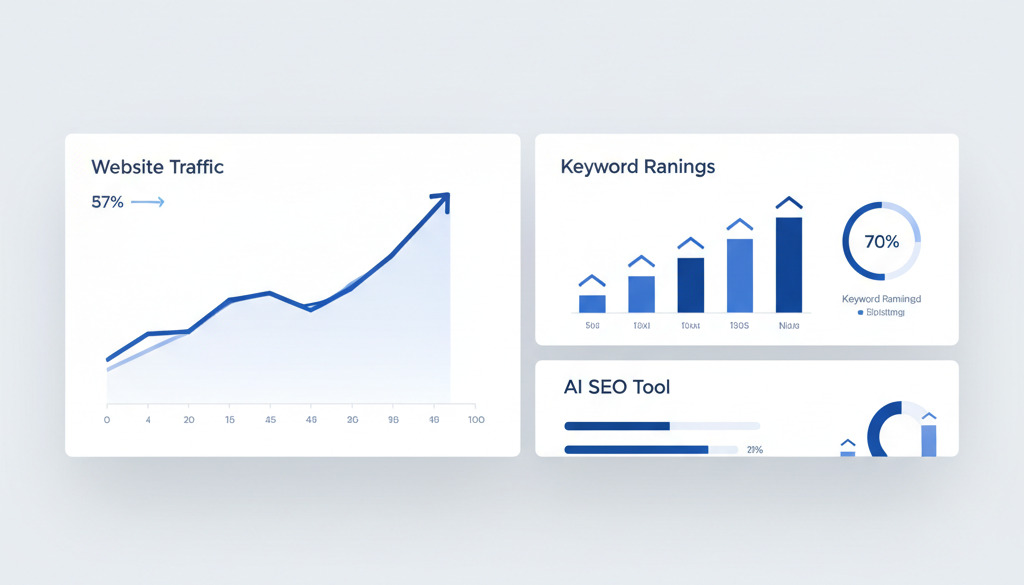
Because small businesses often have limited resources and a smaller online presence, leveraging AI for SEO can be a game-changer. AI tools can automate time-consuming tasks, provide deeper insights than manual analysis, and help small businesses compete more effectively in crowded digital marketplaces. For a small business owner, the initial investment in AI-powered SEO tools might seem daunting, but the long-term benefits in terms of increased visibility, targeted traffic, and ultimately, customer acquisition, can far outweigh the costs. This guide will walk you through how to integrate AI into your SEO strategy, focusing on practical applications tailored to the needs and budgets of small businesses. We'll cover how to identify the right AI tools, implement them for content optimization, understand keyword research with AI assistance, and analyze performance to continuously refine your approach. The goal is to empower small businesses with the knowledge and tools to harness the power of AI for sustainable online growth, ensuring they don't get left behind in the rapidly evolving landscape of digital marketing.AI-Powered Content Creation and Enhancement for Small Businesses
Content is the backbone of any SEO strategy, and for small businesses, creating high-quality, relevant content consistently can be a significant hurdle. AI offers powerful solutions to overcome these challenges, enabling small businesses to produce more engaging and search-engine-optimized content efficiently. This not only saves time and resources but also helps in crafting content that resonates with their target audience and ranks better in search results.Streamlining Content Ideation and Generation
One of the most significant challenges for small businesses is generating fresh content ideas that align with their brand and audience interests. AI tools can analyze vast amounts of data, including trending topics, competitor content, and popular search queries within a specific niche, to suggest relevant content ideas. These tools can identify gaps in existing content, highlight frequently asked questions by customers, and even predict future trends. For instance, an AI content ideation tool might suggest blog post topics like "5 Common Plumbing Issues for Homeowners in [Your City]" or "The Benefits of Natural Skincare Ingredients for Sensitive Skin," based on local search data and popular beauty trends. Once ideas are generated, AI can assist in the actual content creation process. While it's crucial to remember that AI-generated content should always be reviewed and edited by a human for accuracy, brand voice, and originality, AI can significantly speed up the drafting process. Tools can help generate outlines, write introductory paragraphs, expand on specific points, or even rephrase existing content for different platforms. For a small business with a limited marketing team, this means they can produce more blog posts, social media updates, and website copy in less time. For example, an AI writing assistant could draft an initial version of a product description for a new handmade soap, highlighting its natural ingredients and benefits, which a small business owner can then refine with their unique brand story and specific product details. This hybrid approach ensures that the content is both SEO-friendly and authentically reflects the business's personality.Optimizing Existing Content for Search Engines
Beyond creating new content, AI excels at optimizing existing content to improve its search engine performance. Small businesses often have a wealth of content spread across their website, some of which may be outdated or underperforming. AI tools can conduct in-depth content audits, identifying pages that need improvement. They can analyze factors like keyword density, readability, internal linking structure, and the presence of relevant entities and topics. Based on this analysis, AI can provide actionable recommendations, such as suggesting specific keywords to incorporate, recommending changes to headings and subheadings, or highlighting opportunities to add more relevant outbound or internal links. Furthermore, AI can help in optimizing content for voice search, which is becoming increasingly important. Voice searches are often more conversational and question-based. AI tools can analyze these query patterns and help small businesses craft content that directly answers these questions, using natural language. For instance, if many voice searches in the local area are asking "What time does the best bakery in downtown open?", an AI tool might prompt a bakery owner to include a clear statement like "Our doors open bright and early at 7 AM every morning, serving the freshest pastries in downtown!" prominently on their website. This type of optimization ensures that the business's content is discoverable not just through traditional text searches but also through the growing use of voice assistants. By continuously analyzing content performance and suggesting data-driven improvements, AI helps small businesses keep their online presence fresh, relevant, and highly visible to their target audience, driving organic traffic and improving user engagement. This iterative process of content creation, optimization, and refinement is fundamental to sustained SEO success, and AI makes it more accessible and effective for businesses of all sizes.Leveraging AI for Advanced Content Strategy and User Experience
Beyond keyword suggestions and basic optimization, AI can significantly elevate a small business's content strategy by uncovering deeper audience insights and personalizing user experiences. AI-powered analytics platforms can go beyond simple site traffic to understand user behavior in granular detail. They can identify patterns in how users navigate a site, which content resonates most, and where potential customers drop off. For a small business, this means moving from a broad understanding of their audience to a nuanced one. For example, an AI might detect that a significant portion of visitors interested in a specific product category, like artisanal cheeses, consistently visit a particular blog post about cheese pairings before abandoning their cart. This insight, if recognized manually, could take weeks of analysis. An AI can flag this immediately, prompting the business owner to consider enhancing that blog post with clearer calls-to-action, direct links to featured products, or even an embedded chatbot offering personalized cheese recommendations. This data-driven approach allows small businesses to allocate their limited resources more effectively, focusing on content initiatives that demonstrably drive engagement and conversions.
This advanced level of analysis extends to audience segmentation. AI can identify distinct customer personas based on browsing history, demographics (if available and ethically sourced), and engagement metrics. Instead of a one-size-fits-all content approach, small businesses can leverage AI-generated insights to tailor content for these specific segments. If an AI identifies a segment of "budget-conscious DIY enthusiasts" and another of "premium quality seekers" for a home improvement store, the business owner can use this information to create targeted content. For the DIY segment, blog posts and guides on "affordable home upgrades" or "DIY project inspiration on a budget" would be effective. For the premium segment, content might focus on "superior material selection" or "long-term investment value of high-end tools." AI can even assist in drafting initial versions of this content, ensuring it aligns with the persona's language and perceived needs. This personalization not only improves user experience by delivering relevant information but also acts as a powerful SEO signal, as search engines prioritize content that accurately addresses user intent.
Furthermore, AI can play a crucial role in maintaining content freshness and identifying gaps in a small business's existing portfolio. Regularly updating and refreshing existing content is a key SEO tactic, but it can be time-consuming. AI tools can scan a website's content and compare it against current search trends and competitor offerings, flagging outdated articles that need revision or new topics that are gaining traction but are not yet covered. For instance, an AI might notice that while a local bakery has excellent content about its sourdough bread, there's a growing search volume for "vegan baking recipes" in the area, with no corresponding content on the bakery's website. This presents a clear opportunity to create new, relevant content that captures this emerging audience. Moreover, AI can analyze the performance of existing content, identifying pieces that are underperforming despite relevant keywords. This might indicate issues with readability, user experience, or lack of internal linking, all of which AI can help diagnose and rectify. By proactively managing content lifecycle and identifying new opportunities, AI empowers small businesses to maintain a dynamic and competitive online presence, ensuring their website remains a valuable resource for both users and search engines.
Predictive SEO and Competitive Analysis with AI
AI's capabilities extend into predictive SEO, allowing small businesses to anticipate search trends rather than just react to them. By analyzing vast datasets of historical search queries, news, social media buzz, and industry-specific publications, AI algorithms can identify emerging topics and shifts in user behavior before they become mainstream. This foresight is invaluable for small businesses with limited marketing budgets, enabling them to strategically create content around topics that are likely to gain traction, thus capturing early search visibility and establishing themselves as authorities. Imagine a small travel agency specializing in eco-tourism. An AI could forecast an increase in searches for "sustainable travel destinations in Southeast Asia" based on growing environmental consciousness and emerging travel patterns. The agency can then proactively develop engaging blog posts, destination guides, and even package deals focusing on this niche, well ahead of competitors who are still relying on traditional keyword research tools.
Competitive analysis is another area where AI brings a significant advantage to small businesses. Manually tracking competitor performance across numerous keywords, content types, and backlink profiles is an arduous task. AI tools can automate this process, providing concise reports on what competitors are doing well, where they are falling short, and what keywords they are ranking for that a small business might be missing. This analysis isn't just about identifying ranking opportunities; it's about understanding the *strategy* behind a competitor's success. An AI might reveal that a rival small business is consistently outranking a particular local business for "best coffee shop downtown" not just due to better on-page optimization, but due to a strong local citation strategy and a higher number of positive online reviews, bolstered by specific community engagement efforts. This granular competitive intelligence allows small businesses to benchmark their efforts and develop targeted strategies to either match or surpass their rivals. They can identify competitor weaknesses to exploit, such as a lack of mobile optimization or poor user experience on key landing pages, and focus their own limited resources on improving those areas.
The insights derived from predictive and competitive analysis can directly inform content creation and resource allocation. For example, if AI identifies that a local boutique is consistently being outranked by larger competitors for "unique fashion accessories" due to a lack of visual content, the small business owner can prioritize creating high-quality product photography and video content. Similarly, if AI indicates a competitor is gaining traction with in-depth "how-to" guides for a certain DIY product, a small business selling similar items can leverage this by developing their own, perhaps more specialized or locally relevant, instructional content. This strategic application of AI-driven insights ensures that a small business's content efforts are not only reactive but proactive and highly targeted, maximizing the return on investment for their content marketing initiatives and establishing a stronger, more resilient online presence in a competitive digital landscape.
Leveraging AI for Enhanced Local SEO and Customer Engagement
Beyond just understanding rankings and content gaps, AI offers powerful tools to dramatically improve a small business's local SEO efforts and foster deeper customer engagement. For brick-and-mortar businesses, local search visibility is paramount. AI can analyze vast datasets of local search queries, map data, and user behavior to identify the most critical local keywords that potential customers are using. This goes beyond simple keyword matching; AI can discern intent behind queries, such as distinguishing between someone looking for a "pizza delivery near me" versus someone researching "best pizza recipes." By understanding these nuances, small businesses can optimize their Google Business Profile (GBP) listings with highly relevant descriptions, services, and posts that directly address local search intent. For instance, an AI might suggest optimizing a restaurant's GBP for terms like "outdoor seating family-friendly restaurant [city name]" if it detects a growing trend in such searches within the business's service area. This targeted approach ensures that when local customers are actively searching for what a business offers, that business appears prominently in their search results and map pack listings.
Furthermore, AI can assist in managing and responding to online reviews, a cornerstone of local SEO. Platforms employing AI can monitor review sites like Google, Yelp, and TripAdvisor, alerting businesses to new reviews, both positive and negative. More advanced AI tools can even draft personalized responses to these reviews, saving business owners valuable time while maintaining a consistent and professional brand voice. For positive reviews, AI can generate responses that thank the customer and subtly highlight key products or services. For negative reviews, AI can suggest empathetic and constructive replies that aim to de-escalate the situation and demonstrate a commitment to customer satisfaction. This proactive review management not only improves a business's online reputation but also signals to search engines that the business is actively engaged with its customer base, a factor that increasingly influences local search rankings.
AI also plays a crucial role in understanding local customer sentiment and preferences, which can be directly translated into improved products, services, and marketing campaigns. By analyzing social media conversations, forum discussions, and the content of customer reviews, AI can identify emerging trends, common pain points, and highly desired features within a specific geographic market. Imagine a local bakery using AI to analyze mentions of "gluten-free options" or "vegan pastries" in their city. If the AI identifies a significant and growing interest in these areas, the bakery can then strategically adjust its product offerings, potentially introducing new dedicated lines or improving existing ones. This data-driven approach to product development and service enhancement ensures that a small business remains aligned with the evolving needs and desires of its local customer base, fostering loyalty and driving repeat business.
Personalizing Customer Journeys with AI-Powered Insights
The ability of AI to analyze individual customer data opens up unprecedented opportunities for personalization, transforming the customer journey from a broad experience into a tailored interaction. For small businesses, this means moving beyond generic marketing messages to deliver content and offers that resonate deeply with specific customer segments, or even individual customers. AI can track user behavior across a website, analyzing pages visited, products viewed, time spent on site, and past purchase history. Based on this data, AI-powered tools can dynamically adjust website content, recommend relevant products, and even personalize email marketing campaigns. For example, an online retailer of artisanal cheeses might use AI to identify a customer who frequently browses their selection of aged cheddar. The AI could then trigger an email showcasing new arrivals of aged cheddars, offering a special discount, or suggesting complementary items like crackers and fruit preserves that pair well with cheddar. This level of personalization not only enhances the customer's shopping experience but also significantly increases the likelihood of conversion and repeat purchases.
AI can also contribute to a more seamless and efficient customer service experience. Chatbots, powered by natural language processing (NLP) and machine learning, can handle a high volume of common customer inquiries 24/7, freeing up human agents for more complex issues. These AI-driven chatbots can answer frequently asked questions about store hours, shipping policies, product availability, and even guide customers through basic troubleshooting steps. As the AI learns from each interaction, its ability to understand and respond accurately improves. For a small business, this means providing instant support to customers, regardless of the time of day, thereby increasing customer satisfaction and reducing the burden on staff. Furthermore, AI can analyze customer service interactions to identify recurring problems or areas where customers frequently struggle, providing valuable feedback that can be used to improve products, services, or website usability.
Finally, AI's predictive capabilities can anticipate customer needs before they are even explicitly expressed. By analyzing historical data patterns, AI can forecast future purchasing behavior and identify opportunities for proactive outreach. For instance, an AI might predict that a customer who purchased a specific piece of equipment a year ago is likely due for a maintenance service or a replacement part. The business can then proactively send a targeted reminder or offer a discount on the related service or product, presenting a helpful and timely solution. Similarly, if AI detects a customer showing interest in a particular product category but not yet making a purchase, it can trigger a series of personalized follow-up communications, perhaps offering additional information, testimonials, or a limited-time incentive, nudging them closer to a decision. This predictive personalization moves beyond mere responsiveness to a truly proactive approach, fostering a sense of care and attention that builds strong, lasting customer relationships and solidifies a small business’s competitive edge.
AI SEO FAQ
What is AI SEO for small businesses?
AI SEO for small businesses involves leveraging artificial intelligence tools and techniques to improve your website's visibility in search engine results. This can include AI-powered content creation, keyword research, and technical SEO analysis to help your business rank higher and attract more organic traffic.
How can AI help small businesses with SEO?
AI can automate repetitive SEO tasks, analyze vast amounts of data to identify trends and opportunities, personalize content for target audiences, and predict algorithm changes more effectively than manual methods, ultimately saving time and resources.
Is AI SEO expensive for small businesses?
While some advanced AI SEO tools can be costly, many AI-powered solutions offer free trials or tiered pricing plans suitable for small business budgets. Furthermore, the efficiency gains and improved ROI from AI SEO can often offset the initial investment.
Keep reading
Hand-picked guides that go deeper — open the one you need next:
- AI Content Strategy for Small Business SEO
- AI for Google Profile: Publish Location Blogs
- Local SEO Supercharged: AI for Hyper-Targeted Content
- Hyperlocal Marketing AI: Target Local Growth
→ Read the full Small Business guide