
Customizing AI Content: Control Message, Automate Blog
Key Takeaways
- Beyond Automation to Intelligence: AI content customization goes beyond simple automation; it uses machine learning and NLP to tailor messages to micro-audience segments, user context, and journey stage for hyper-relevance.
- Strategic Business Advantage: Implementing AI for content personalization leads to measurable improvements in key business metrics, including higher engagement rates, increased conversions, and enhanced customer loyalty.
- Data is the Engine: The success of AI customization hinges on the quality and analysis of behavioral, demographic, and transactional data to understand user intent and motivations deeply.
- Human-AI Collaboration is Crucial: AI is a powerful tool, not a replacement for human strategy. The most effective approach combines AI's speed and data-processing power with human creativity, ethical oversight, and brand stewardship.
- SEO and Personalization are a Power Couple: Modern AI tools can simultaneously optimize content for search engines and personalize it for human readers, bridging the gap between attracting and converting audiences.
- Start with a Strategy: Successful adoption requires a clear plan. Businesses should define goals, choose the right tools, and consider pilot programs to test and scale their AI customization efforts effectively.
1. Introduction: The Shifting Landscape of Content Engagement
In the expansive digital marketplace, businesses face a dual challenge: the overwhelming volume of online content and the shrinking attention spans of consumers. Standing out is no longer about shouting the loudest; it's about speaking the most relevant language. This is where AI content customization emerges not just as a technological novelty, but as a strategic necessity. It represents a paradigm shift from a one-to-many broadcast model to a one-to-one conversational approach, at scale.
AI content customization is the strategic application of artificial intelligence technologies to dynamically adapt and tailor content—be it articles, website copy, or marketing messages—to the specific needs, preferences, and context of an individual user or audience segment.[1] It moves beyond the rudimentary personalization of using a customer's first name in an email. Instead, it alters the message, tone, and even the substance of the content itself.
This article explores the transformative power of AI in personalizing content. We will dissect the mechanisms that drive it, outline actionable strategies for its implementation, and provide a clear framework for measuring its impact on your business. The objective is to equip you with the knowledge to move beyond generic content and toward precision-targeted communication that resonates, engages, and converts.
2. Understanding the Core of AI Content Customization
To truly grasp the potential of AI content customization, it’s essential to look under the hood at the technologies that power it. This isn't about simple, rule-based automation; it's about systems that learn and adapt. The core of this intelligence lies in three key areas.
H3: The Technological Trio: NLP, ML, and Data Analytics
At its heart, AI content customization is driven by a synthesis of powerful technologies:
- Natural Language Processing (NLP): This is the branch of AI that enables machines to understand, interpret, and generate human language. NLP allows an AI to analyze a customer review, understand the sentiment of a social media comment, or generate a product description in a specific tone (e.g., professional, witty, or empathetic).
- Machine Learning (ML): ML algorithms are the "brains" of the operation. They process vast amounts of data to identify patterns and make predictions without being explicitly programmed. In content customization, an ML model might learn that customers from a certain industry respond better to case studies than to technical whitepapers, and then prioritize showing them that type of content.
- Data Analytics: This is the foundation upon which everything is built. AI systems ingest and analyze massive datasets—including user behavior, demographics, and past interactions—to build a rich, multi-dimensional understanding of the audience.
H3: Beyond Traditional Personalization
Traditional personalization tactics, like segmenting an email list by industry, are static. You define the rules. AI customization, however, is dynamic. It creates its own rules based on data. Consider the difference:
Traditional Personalization: "Show all visitors from the finance industry this specific landing page."
AI Customization: "Analyze the real-time behavior of this specific visitor—who happens to be in finance, is browsing on a mobile device after work hours, and has previously read two articles about cybersecurity—and dynamically assemble a landing page featuring a relevant cybersecurity case study, a concise call-to-action, and a summary that is easy to read on a small screen."
This leap from broad segments to an individualized experience is the key benefit. AI enables businesses to move from a one-size-fits-all or one-size-fits-few model to creating truly bespoke content experiences that make each user feel uniquely understood and valued.
3. The Strategic Imperative: Why Customize Content with AI?
In today's competitive environment, delivering a generic customer experience is a liability. Consumers, whether in B2B or B2C markets, have grown accustomed to the highly personalized worlds curated by platforms like Netflix, Amazon, and Spotify. They now expect a similar level of relevance from every brand they interact with. This pressure to personalize is no longer a "nice-to-have"—it is a core driver of business success.
AI-driven customization directly addresses this demand by providing the tools to understand customer nuance and intent at an unprecedented scale. While a human marketer can intuit the needs of a few key clients, AI can extrapolate and act on the subtle signals of millions of users simultaneously. It deciphers the underlying "why" behind a user's actions, allowing you to respond not just to what they did, but to what they are likely to do next.
The advantages of embracing this strategy are not merely theoretical; they are concrete and measurable:
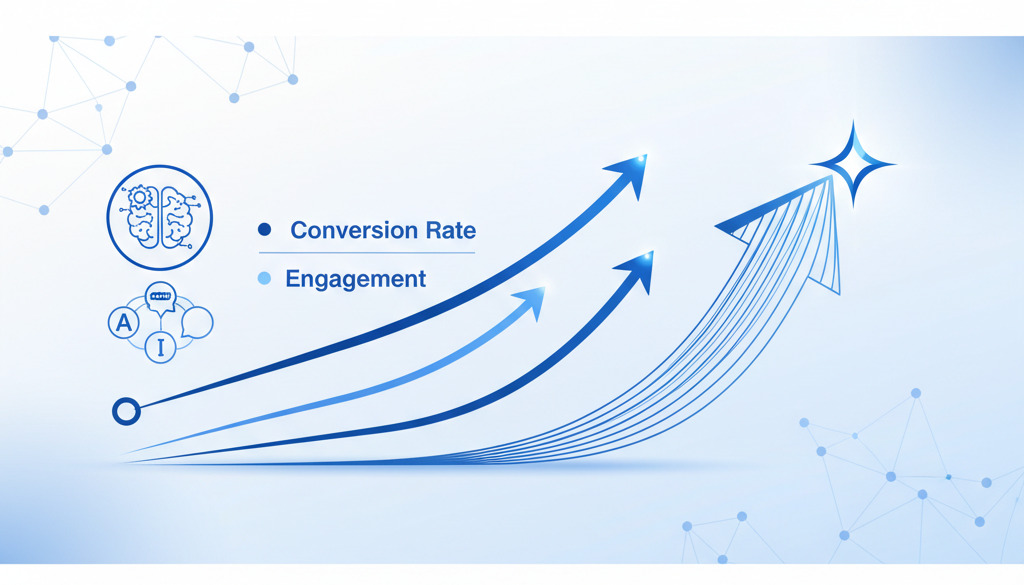
- Increased Engagement: When content speaks directly to a user's interests, pain points, or current stage in the buying journey, they are far more likely to consume it, share it, and return for more. This boosts dwell time, reduces bounce rates, and strengthens your brand's authority.
- Improved Conversion Rates: Relevance is the key that unlocks conversions. AI customization ensures that calls-to-action, product recommendations, and marketing offers are aligned with the user's immediate context and profile, drastically increasing the likelihood of a positive response.
- Stronger Brand Loyalty: A brand that consistently delivers valuable, relevant content feels less like a seller and more like a trusted partner. This fosters a deeper relationship, turning one-time buyers into loyal advocates for your brand. In an era of fleeting customer attention, this loyalty is one of the most durable competitive advantages a business can build.
4. Decoding the AI Customization Process: From Data to Delivery
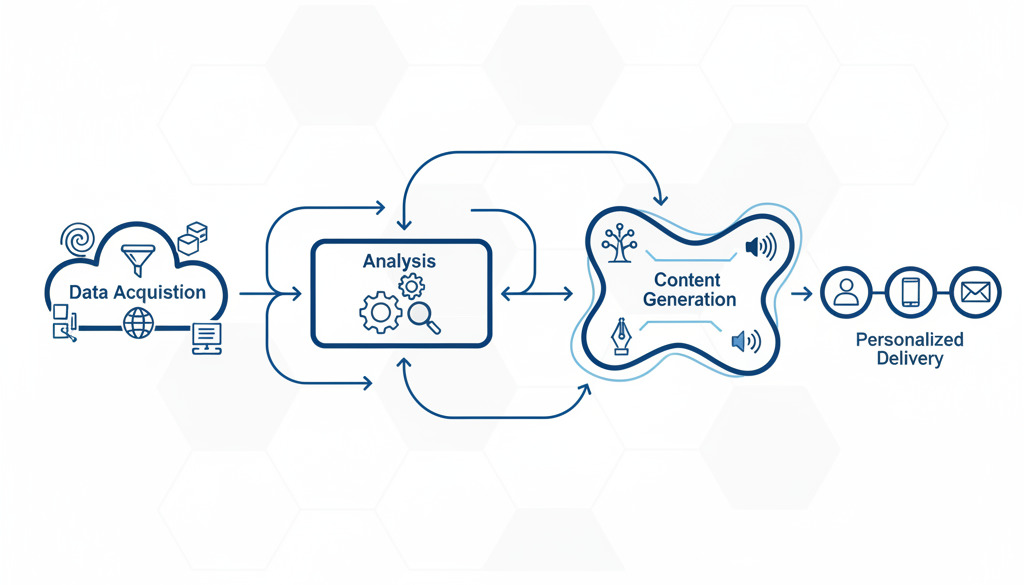
The magic of AI content customization isn't an inscrutable black box. It’s a logical, cyclical process that turns raw data into relevant experiences. This process can be broken down into three distinct, yet interconnected, phases: data acquisition and analysis, content generation and adaptation, and intelligent delivery and iteration.
H3: Phase 1: Data Acquisition and Analysis
This is the foundation. An AI is only as smart as the data it learns from. It ingests a wide variety of information to build comprehensive audience profiles:
- Demographic Data: Basic information like age, location, and job title.
- Behavioral Data: How users interact with your website, app, or emails. This includes pages visited, time spent, clicks, and download history.
- Psychographic Data: More nuanced information about a user’s interests, values, and lifestyle, often inferred from the content they consume.
- Transactional Data: Past purchase history, order value, and product preferences.
The AI analyzes this combined data to spot hidden correlations and create sophisticated, multi-layered audience profiles that go far beyond simple labels like "moms" or "IT managers."
H3: Phase 2: Content Generation and Adaptation
Once the AI understands *who* it’s talking to, it can determine *what* to say. This phase involves creating or modifying content to match the discovered profiles. This is where concepts like Dynamic Content Optimization (DCO) come into play. A DCO-enabled platform can automatically assemble a webpage or an ad from a library of components (headlines, images, body copy, CTAs) to create the combination best suited for a specific viewer. For blog content, an AI might generate different introductions or conclusions for an article based on the reader's estimated expertise level, which it infers from their reading history.
H3: Phase 3: Delivery and Iteration
Finally, the customized content must be delivered. The AI ensures the right message reaches the right person on the right channel at the right time. But the process doesn’t end there. AI customization is a continuous learning loop. The system meticulously tracks the performance of each content variation—which headline got more clicks? Which image led to more form fills? This performance data is fed back into the system, allowing the machine learning models to refine their understanding and make even smarter decisions next time. It’s a self-improving engine for content relevance.
5. Personalizing for Impact: Key Customization Strategies
Understanding the process is one thing; applying it effectively is another. True impact comes from a strategic approach to personalization. AI enables several sophisticated strategies that were previously impractical to execute at scale. These strategies work together to create a cohesive, individually tailored content experience.
H3: Audience Segmentation Refined
AI transforms audience segmentation from a blunt instrument into a surgical tool. Forget broad categories like "small businesses." AI can identify hyper-specific micro-segments based on complex behavioral and psychographic patterns. For example, an AI might identify a segment of "price-sensitive founders in the SaaS industry who have recently researched competitor A and respond best to content in the evening."
With these granular segments, you can tailor everything: the messaging can focus on cost-effectiveness, the tone can be direct and entrepreneurial, and the content can be delivered via an email scheduled for 7 PM. This level of specificity makes your communication feel exceptionally relevant and resonant.
H3: Contextual Relevance
This strategy involves customizing content based on the user’s immediate situation. It answers the question: "What does this person need *right now*?" Contextual factors can include:
- Device: A user on a mobile device might receive a concise, thumb-friendly version of a webpage, while a desktop user sees a more detailed layout with high-resolution images.
- Time of Day: A business professional browsing during work hours might be shown a technical whitepaper, whereas the same person browsing in the evening could be offered a link to a webinar they can watch later.
- Geographic Location: A retail brand could show a user content featuring items available at their nearest physical store.
- Previous Interaction: If a user just finished reading a blog post about a specific feature of your product, the homepage they see next can be dynamically updated to highlight that same feature.
H3: Journey Stage Optimization
A potential customer at the beginning of their journey has very different needs than one who is ready to make a purchase. AI can infer a user's stage in the customer journey based on their behavior and customize the content accordingly.
- Awareness Stage: The user is just identifying a problem. Here, AI can serve them high-level, educational content like blog posts, articles, and ebooks that help them understand their challenge without a hard sell.
- Consideration Stage: The user is now evaluating solutions. AI can provide more targeted content like comparison guides, case studies, product webinars, and detailed feature breakdowns.
- Decision Stage: The user is ready to buy. This is the time for AI to deliver highly specific, conversion-focused content like pricing pages, free trial offers, demos, and testimonials.
By mapping AI-customized content to each stage, you create a seamless, supportive journey that nurtures the user from initial curiosity to final conversion.
6. AI for SEO Content: A Powerful Partnership
For years, content creators have faced a difficult balancing act: creating content for search engine algorithms while also making it engaging for human readers. Historically, these two goals were often at odds. AI content customization is finally bridging this divide, creating a powerful partnership between SEO and personalization. Modern AI understands that the best SEO strategy is a great user experience.
AI platforms can analyze top-ranking content for a target keyword, identify the core questions users are asking (search intent), and recognize semantic keywords and related topics. It then uses this data not just to generate keyword-rich text, but to structure a comprehensive article that genuinely answers the user's query. This aligns perfectly with Google's focus on helpful, user-centric content.
But it doesn’t stop there. The true power lies in layering personalization on top of this optimized foundation. For instance, some platforms are built entirely around this principle. The service **More Customers From Your Blog**, for example, uses a proprietary AI to write professional SEO blog posts that are automatically tailored to attract and engage a business's ideal customer profile found via Google searches. This ensures your content isn’t just optimized to be *found*, but is also perfectly calibrated to resonate with the person who finds it, turning search traffic into loyal customers.
7. Enhancing User Experience Through Tailored Narratives
Ultimately, the goal of content is to create a positive user experience (UX) that builds a relationship with your audience. Generic, one-to-all content often feels intrusive and irrelevant, creating friction in the user journey. AI content customization works to remove that friction by crafting tailored narratives that feel helpful and natural.
Imagine a user landing on your blog. Instead of being presented with a static list of recent posts, an AI-powered system can showcase articles directly related to the search term they just used or the last page they visited on your site. This creates a "conversational" flow, where the website seems to anticipate their needs and proactively offers the next logical piece of information. This reduces the frustration of searching and makes the user feel understood.
This approach transforms your website from a passive brochure into an active, intelligent guide. By anticipating questions and providing relevant information before the user even has to ask, AI can significantly reduce friction points in the customer journey. For a business owner who is not a digital native, this translates into a website that simply *works better* for their customers, guiding them smoothly towards a solution without requiring complex navigation or frustrating searches.
8. The AI Content Customization Toolkit: Platforms and Technologies
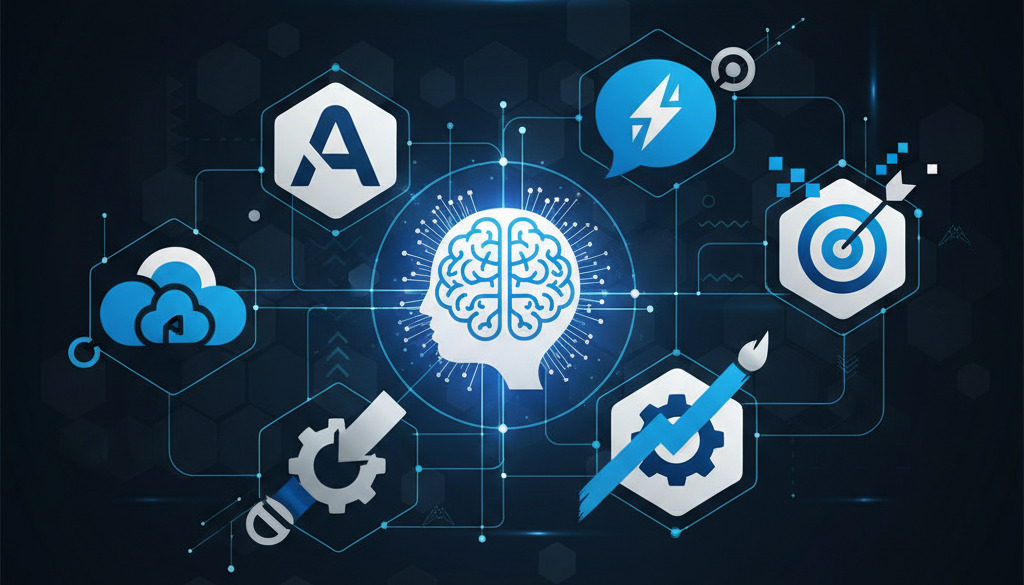
The market for AI tools that facilitate content customization is rapidly expanding. For business leaders, navigating this landscape is key to finding the right solution for their needs. The tools generally fall into a few major categories, each serving a different function within the marketing stack.
H3: Types of AI Customization Tools
- AI Writing Assistants: These tools (like Jasper or Copy.ai) help create the raw content itself. More advanced versions can generate multiple variations of copy (e.g., different tones, lengths, or targeting different personas) that can be used in customization campaigns.
- Dynamic Content Optimization (DCO) Platforms: These are specialized systems that plug into your website or ad network. They store a library of content components (images, headlines, CTAs) and use AI to assemble the optimal combination for each individual user in real time.
- Advanced Analytics and Personalization Engines: These platforms (often part of larger marketing clouds) are the data powerhouses. They track user behavior across multiple channels, build the deep user profiles, and then use that intelligence to instruct other parts of the marketing stack on how to personalize the experience.
H3: The Power of Integrated Solutions
While many tools integrate into your existing workflow, some businesses opt for all-in-one solutions that simplify the entire process. This can be particularly beneficial for small and medium-sized businesses that may not have a large, dedicated marketing technology team. The proprietary AI used by **More Customers From Your Blog**, for instance, is designed to handle the entire process from SEO analysis to final article generation. This streamlined approach makes the sophisticated power of AI-driven SEO and content creation incredibly efficient and accessible for business owners who need results without a steep learning curve.
9. Overcoming Challenges in AI Content Customization
Adopting AI content customization offers immense rewards, but it is not without its challenges. A prudent business leader must be aware of the potential hurdles to navigate them effectively. The main obstacles fall into three categories: data, ethics, and brand consistency.
- Data Quality and Privacy: The saying "garbage in, garbage out" is especially true for AI. If your customer data is inaccurate, incomplete, or siloed, the AI's ability to personalize effectively will be severely hampered. Furthermore, collecting and using user data comes with significant responsibility. Businesses must adhere to privacy regulations like GDPR and CCPA, be transparent with users about what data is being collected, and ensure that data is stored securely.
- Human Oversight and Ethical Considerations: AI algorithms are created by humans and trained on data from the real world, which means they can inherit and even amplify existing biases. Without careful monitoring, an AI could inadvertently create exclusionary content or discriminatory user experiences. It is crucial to have human oversight to review AI-generated content, monitor for biases, and ensure that the personalization efforts remain ethical and fair.
- Maintaining a Consistent Brand Voice: One of the biggest concerns for marketers is that AI might dilute their carefully crafted brand voice. If an AI generates content in a thousand different variations, how do you ensure it all sounds like it’s coming from your brand? This requires "training" the AI on your existing content, creating detailed style guides for the AI to follow, and having human editors review and refine the output to ensure it aligns with the brand’s tone and personality.
10. The Future of Content: Hyper-Personalization at Scale
The current state of AI content customization is already transformative, but the technology is continuously evolving. Looking ahead, the trend is moving towards what experts call hyper-personalization—the ability to create a completely unique content experience for every single user. This goes beyond swapping out a few content blocks; it involves generating entirely bespoke narratives in real time.
Imagine a future where two users visiting the same blog post see two entirely different articles. The core topic is the same, but the examples used, the data points cited, the complexity of the language, and the conclusion are all generated on-the-fly to perfectly match each user’s industry, knowledge level, and inferred goals. This is the promise of hyper-personalization at scale.
Beyond this, we can anticipate new frontiers like:
- Predictive Content: AI will not only respond to a user's current behavior but will proactively predict their future needs. It might automatically generate and queue up a series of articles on a topic it predicts a user will become interested in next week, based on subtle signals in their current browsing patterns.
- Sentient Content: The line between content and chatbot will blur. Articles and webpages will become interactive entities, able to answer follow-up questions and modify their own text in response to user queries, creating a truly dynamic and responsive information experience.
For businesses, this future means the ability to build deeper, more meaningful relationships with customers by providing unparalleled relevance at every single touchpoint. The era of static content is ending, and the era of living, intelligent content is just beginning.
11. Case Study: Implementing AI for Business Growth
To illustrate the tangible impact of AI content customization, consider the case of "Innovatech Solutions," a mid-sized B2B software company. Innovatech had a solid blog that attracted decent traffic but suffered from a low conversion rate. Their content was well-researched but generic, failing to speak to the diverse needs of their audience, which ranged from CTOs to project managers across various industries.
H3: The Challenge and The Solution
The primary challenge was a "leaky bucket." Visitors would read a post and leave without taking action because the content and calls-to-action weren't relevant to their specific roles or problems. Innovatech decided to implement an AI-powered content customization strategy. They used an AI platform to analyze their website traffic and segment their audience based on behavior, inferred job roles, and industry. Then, they deployed dynamic content on their key landing pages and blog posts.
H3: Strategies Employed and Results
A visitor identified as a CTO from the healthcare industry would see a homepage banner highlighting data security and compliance, with a case study from a hospital. A project manager from the manufacturing sector would see a banner about improving efficiency, with a call-to-action to download a whitepaper on workflow automation. The results were transformative.
Here’s a snapshot of their key metrics, six months after implementation:
| Metric | Before AI Customization | After AI Customization | Percentage Change |
|---|---|---|---|
| Website Bounce Rate | 75% | 52% | -30.7% |
| Average Time on Page | 1:45 min | 3:10 min | +81.0% |
| Blog Lead Conversion Rate | 1.2% | 4.8% | +300% |
| Marketing Qualified Leads (MQLs) | 150/month | 620/month | +313% |
By tailoring the narrative, Innovatech made each visitor feel understood. The highly-relevant user experience led directly to a dramatic increase in engagement and, most importantly, a substantial growth in qualified leads for their sales team. This demonstrates that AI customization is not just a marketing gimmick; it's a powerful engine for business growth.
12. Ethical Considerations and Responsible AI in Content Creation
The power of AI to influence and persuade brings with it a profound responsibility. As businesses adopt these tools, it is imperative to establish a strong ethical framework to guide their use. Responsible AI in content creation is built on the pillars of transparency, fairness, and accountability.
H3: Transparency and Avoiding Deception
Users have a right to know when they are interacting with AI-driven content, especially when that content is personalized to them. While not always legally required, providing a simple disclosure like "This article was created with AI assistance and reviewed by our editorial team" or "Our product recommendations are tailored for you by our AI engine" builds trust. The goal is to use AI to be more helpful, not to be deceptive. Hiding the use of AI can lead to a backlash if discovered, eroding the customer loyalty you aim to build.
H3: Mitigating Bias in AI Algorithms
AI models learn from data, and if that data contains historical biases (related to gender, race, age, or other factors), the AI will learn and perpetuate them. In content, this could manifest as an AI that only shows certain job-related articles to men, or uses stereotypical imagery for certain demographic groups. To combat this, businesses must:
- Audit their data: Actively look for and correct biases in the data used to train AI models.
- Test the output: Regularly review the personalized content experiences the AI is creating for different segments to ensure they are fair and equitable.
- Involve diverse teams: Having people from different backgrounds involved in developing and overseeing AI systems can help spot potential biases that others might miss.
Ultimately, ethical AI is a human responsibility. It requires establishing clear internal guidelines for how AI tools will be used, investing in ongoing monitoring, and prioritizing the user's well-being and trust above short-term gains.
13. Measuring Success: KPIs for AI Content Customization
To justify the investment in AI content customization, you must be able to measure its impact. The right Key Performance Indicators (KPIs) will show you not only if the strategy is working, but also *how* it is working, allowing you to refine your approach over time. Your KPIs should move beyond simple traffic metrics and focus on user behavior and conversion.
Here are some of the most important KPIs to track:
| KPI | What It Measures | Why It Matters for Customization |
|---|---|---|
| Engagement Rate | A combined metric of clicks, shares, comments, and time on page. | This is the primary indicator of relevance. If content is truly customized, users will interact with it more deeply. |
| Conversion Rate by Segment | The percentage of users in a specific audience segment who take a desired action (e.g., sign up, download, buy). | This shows which micro-segments are responding best to your tailored content, allowing you to double down on what works. |
| Reduced Bounce Rate | The percentage of visitors who leave your site after viewing only one page. | A lower bounce rate suggests that the content on the initial landing page was relevant enough to encourage further exploration. |
| Customer Lifetime Value (CLV) | The total revenue a business can expect from a single customer account. | Effective customization builds loyalty, which leads to repeat purchases and a higher CLV over time. This is a crucial long-term metric. |
| Content Path Analysis | Tracking the sequence of pages a user visits. | This helps you see if your customized content is successfully guiding users along the intended customer journey. |
By tracking these metrics, you can create a performance dashboard that provides a clear, data-backed picture of your AI customization ROI. This moves the conversation from "I think this is working" to "I can prove this is driving X% growth in customer value."
14. Building Your AI Content Customization Strategy
Adopting AI content customization can feel daunting, but a structured approach can make the process manageable and effective. This is not just about buying a tool; it's about integrating a new capability into your marketing DNA. Here is a five-step framework for building your strategy.
- Assess Current Capabilities and Define Objectives: Start by looking inward. What data are you currently collecting? What are your biggest content challenges? Then, set clear, measurable goals. Do you want to increase lead quality by 25%? Or reduce website bounce rate by 15%? Your objectives will guide your entire strategy.
- Choose the Right Tools: Based on your goals and budget, select the right technology. You may not need a massive, all-encompassing platform from day one. You might start with an AI writing assistant to create content variations and a simple personalization plugin for your website.
- Start with a Pilot Program: Don't try to personalize everything for everyone all at once. Choose a specific, high-impact area for a pilot program. For example, you could focus on personalizing the homepage for your top three audience segments. This allows you to test, learn, and demonstrate value before a full-scale rollout.
- Develop a Content Component Library: For dynamic content to work, the AI needs building blocks. Create a library of approved headlines, images, customer testimonials, and calls-to-action that the AI can use. Ensure all components are on-brand and pre-vetted by your team.
- Scale and Iterate: Once your pilot program proves successful, you can begin to scale your efforts. Apply your learnings to other parts of your website, email campaigns, and ad strategies. Remember that AI customization is a process of continuous iteration. Use your KPIs to constantly refine and improve performance.
For businesses new to this, starting with a manageable pilot is key. This is where services like **More Customers From Your Blog** offer a distinct advantage by providing the first five SEO articles for free. It’s an accessible, zero-risk way for business owners, especially those who are busy running their company, to experience the power of AI content automation firsthand and build a foundational asset for future customization efforts.
15. The Role of Human Expertise in an AI-Powered World
As AI’s capabilities grow, a common fear arises: will it make human marketers obsolete? The answer is an emphatic no. AI content customization is a powerful tool, but it is most effective when wielded by a skilled human expert. The relationship is not one of replacement, but of collaboration—a synergy where AI handles the scale and computation, while humans provide the strategy, creativity, and soul.
Think of the AI as a brilliant but hyper-literal junior analyst. It can process more data in a second than a human could in a lifetime, but it lacks genuine understanding, cultural nuance, and a sense of the bigger picture. The role of the human expert evolves to become more strategic:
- The Strategist: A human must define the overarching business goals. The AI can optimize for a goal, but it can’t tell you what your goal should be.
- The Brand Guardian: Humans are the custodians of the brand’s voice, values, and personality. They must train, guide, and edit the AI’s output to ensure it aligns with the brand’s identity.
- The Creative Director: While AI can generate competent copy and design combinations, true breakthrough creativity—the kind that captures hearts and minds—still comes from human imagination.
- The Ethicist: As discussed, humans must provide ethical oversight, monitoring AI systems for bias and ensuring they are used responsibly.
AI can create a perfectly optimized sentence, but a human strategist understands why that sentence matters to the customer. AI is the engine, but the human is the driver, providing the direction, judgment, and destination.
16. Conclusion: Embracing the Era of Intelligent Content
We are firmly in the era of intelligent content. The days of broadcasting a single message to a monolithic audience are over. The modern consumer demands and rewards relevance, and AI content customization is the most powerful tool businesses have to meet that demand. By leveraging machine learning and data analytics, companies can move beyond guesswork and create deeply personalized experiences that resonate on an individual level.
As we’ve explored, this transformation offers a cascade of benefits, from dramatically improved engagement and conversion rates to stronger, more resilient brand loyalty. It allows businesses to automate not just the production of content, but the nuanced process of matching that content to the right person at the perfect moment.
While challenges around data, ethics, and brand consistency exist, they are surmountable with a strategic, human-guided approach. The future does not belong to the businesses that simply adopt AI, but to those that master the collaboration between human insight and machine intelligence. By embracing this new paradigm, you can control your message with unprecedented precision, automate your communication at scale, and build the kind of customer relationships that define market leaders.
Frequently Asked Questions
1. Is AI-generated content penalized by Google?
No, Google's official stance is that it rewards high-quality content, regardless of how it is produced. The key is value. AI-generated content that is spammy, unhelpful, or designed purely to manipulate search rankings may be penalized. However, high-quality, user-centric content that is created with AI assistance and reviewed by humans is perfectly acceptable and can rank very well, as it often aligns with Google's goal of answering user queries effectively.
2. Can AI really capture my brand's unique voice?
On its own, a generic AI model will produce generic content. However, you can "train" a modern AI to adopt your brand voice. This is done by providing it with a detailed style guide and feeding it examples of your existing on-brand content (like blog posts, website copy, and marketing materials). With human oversight and refinement, AI can become very adept at generating content that consistently reflects your brand's unique tone, personality, and messaging.
3. How much does AI content customization cost?
The cost varies dramatically depending on the solution. Simple AI writing assistants can cost as little as $20-$50 per month. More comprehensive platforms, such as enterprise-level personalization engines or DCO systems, can cost thousands of dollars per month. There are also service-based models, such as those that provide AI-written articles, which offer a different pricing structure. The key is to match the investment level to your business goals and start with a solution that offers a clear ROI for your specific needs.
4. What is the difference between AI personalization and customization?
These terms are often used interchangeably, but there's a subtle difference. Personalization typically refers to using data to present existing, pre-made content to a user (e.g., showing a product you previously viewed). Customization is a more advanced step where the content itself is altered or generated for a specific user. For example, personalizing is showing a user an article; customizing is changing the introduction of that article to match their industry.
5. How do I get started with AI content customization if I'm not a tech expert?
The best way to start is small and with a user-friendly platform. You don't need to be a data scientist. Many business owners, especially those over 40 who are focused on running their business, find success by starting with a single, clear goal. For example, automating blog content for SEO. Look for platforms designed for accessibility, such as services that handle the technical side for you. For instance, solutions like **More Customers From Your Blog** are built for business owners who want the results of AI without the complexity, making it an excellent first step.
6. How do I ensure the data I use for AI customization is compliant with privacy laws?
First, always be transparent with your users by having a clear and accessible privacy policy. Second, ensure your data collection methods are compliant with regulations like GDPR and CCPA, which often means getting explicit consent from users. Third, work with AI vendors who prioritize security and compliance. It's also a best practice to only collect the data you actually need for customization and to anonymize it whenever possible to protect user privacy.
Keep reading
Hand-picked guides that go deeper — open the one you need next:
- The Ultimate Guide to a 'Blog on Autopilot'
- Content Marketing Automation: A Strategy for Entrepreneurs
- Blog Autopilot for Business: The Strategy for Scalable Growth
- Mastering AI Article Writers for Engaging Content in 2026
→ Read the full AI Content guide
→ Read the full AI Content guide