
From Zero to Hero: Building a Blog with AI for New Businesses

Key Takeaways
- AI is a Game-Changer for SMBs: For business owners over 40 who are short on time, AI tools are no longer a futuristic concept but a practical solution to create high-quality blog content efficiently.
- Blogging Drives Growth: A consistent blog improves your Google rankings (SEO), establishes your business as an authority, and attracts customers organically without a massive ad spend.
- Strategy First, AI Second: AI is most effective when guided by a clear content strategy. You must define your audience, goals, and brand voice before using AI to generate articles.
- Human Oversight is Crucial: AI accelerates content creation, but it doesn't replace human expertise. Editing, fact-checking, and adding your unique insights are essential for authenticity and quality.
- AI Powers the Entire Process: Modern AI can assist with everything from finding topics and keywords your customers are searching for to drafting, optimizing, and even helping you measure the performance of your blog.
- Start Small and Scale: You don't need to be a tech expert. You can start by using AI to generate ideas or a single post. Services exist that make it easy to get started, some even offering free initial articles to prove their value.
The Evolving Business Landscape and the Content Imperative
In today's digital-first world, a business without a strong online presence might as well be invisible. For established small and medium-sized business owners, particularly those over 40, you've built your company a certain way—through relationships, quality service, and word-of-mouth.[2] You understand that having online content is critical for modern growth, but the reality is daunting. Who has the time to become a professional writer, a search engine optimization expert, and a digital marketer on top of running a business? The answer, for most, is no one.
This is a common and frustrating pain point. You know you should be publishing blog articles to attract customers through Google, but the hours required for research, writing, and editing are hours you simply don't have. This is precisely where a revolutionary technology comes into play: Artificial Intelligence (AI).[1] Once the realm of science fiction, AI is now a powerful, accessible business tool that can level the playing field, offering unparalleled efficiency and effectiveness in content creation. It promises a new way forward, one where you can build a powerful online presence without sacrificing the time needed to run your core business.
Why Your Business Needs a Blog (Even If You're Short on Time)
Before we delve into the "how" of AI, let's solidify the "why." You might wonder if a blog is still relevant in an age of social media and video. The answer is an emphatic yes. A business blog is not just a collection of articles; it is a foundational asset for your digital marketing and a powerful engine for growth.
Building Brand Authority and Trust
A consistently updated blog packed with helpful information positions your business as an expert in your field. When a potential customer is searching for answers or solutions and finds them on your website, you immediately build credibility. You are no longer just a company trying to sell something; you are a trustworthy resource. This authority is invaluable and fosters a long-term relationship with your audience.
The Unparalleled Power of SEO
Search Engine Optimization, or SEO, is the process of making your website more visible on search engines like Google. Every blog post you publish is a new page that Google can index and show to users. When you create content that answers the specific questions your potential customers are asking, you start to rank for those searches. This brings highly qualified, organic traffic to your website—people who are actively looking for the products or services you offer.
Nurturing Leads and Driving Sales
Your blog acts as a 24/7 salesperson. It can guide a reader from initial awareness of a problem to understanding why your business is the best solution. Through strategic calls-to-action within your articles, you can guide visitors to subscribe to your newsletter, request a quote, or make a purchase. It’s a continuous conversation that nurtures potential leads and turns them into loyal customers.
Understanding Artificial Intelligence in Content Creation
Artificial Intelligence can sound intimidating, but its application in content creation is surprisingly straightforward. In essence, AI content tools are sophisticated computer programs, known as Large Language Models (LLMs), that have been trained on vast amounts of text and data from the internet. This training allows them to understand language, context, and structure.
Think of it like an incredibly knowledgeable and fast research assistant and writer rolled into one. You provide a prompt, a set of instructions, or a topic, and the AI uses its training to generate human-like text based on your request. For a business owner, this means you can ask it to:
- Brainstorm a list of blog post ideas for a landscaping company.
- Write a draft for an article titled "5 Ways to Improve Your Home's Curb Appeal."
- Summarize a complex industry report into easy-to-understand bullet points.
- Rewrite a paragraph to have a more professional tone.
It’s important to distinguish between general-purpose AI chatbots and specialized solutions built for business. While general tools are impressive, solutions designed specifically for SEO and business blogging are pre-optimized to understand the goals of content marketing, making them far more effective for attracting customers.
The Strategic Advantage of AI-Generated Blog Content
The primary advantage of using AI is not just speed; it’s about gaining a strategic edge in your market. For a busy entrepreneur, AI completely changes the calculus of content marketing.
Overcoming "Blank Page Syndrome"
One of the biggest hurdles in writing is starting. Staring at a blank screen can be paralyzing. AI eliminates this problem entirely. By providing a topic or a few keywords, you can have a complete, well-structured draft in minutes. This draft can then serve as a strong foundation for you to edit, refine, and add your personal touch, transforming a multi-hour task into a 30-minute one.
Leveraging Data for Relevant Content
Guesswork is a poor marketing strategy. AI tools can analyze real-time search trends, competitor content, and discussions happening online to suggest topics that are currently resonating with your target audience. This ensures that you’re not just creating content, but creating content that people are actively searching for, maximizing your return on effort.
Achieving Unprecedented Scalability
Consistency is key to a successful blog. Google rewards websites that publish fresh, high-quality content regularly. For a one-person marketing department (or a zero-person one), this is nearly impossible to maintain manually. AI allows you to scale your content production, moving from one article a month to one a week, or even more. This consistent output powerfully signals to search engines that your site is a relevant and active authority.
Identifying Your Target Audience with AI
You can’t create compelling content if you don’t know who you’re talking to. While you likely have a good sense of your customer base, AI can help you create a data-driven, highly detailed customer profile or persona. These tools can analyze market data, social media trends, and customer feedback to uncover deep insights about your ideal customers, such as:
- Demographics: Age, location, income level, and job roles.
- Pain Points: The specific problems and challenges they face.
- Interests: What topics they care about, what media they consume, and what their hobbies are.
- Online Behavior: Which social media platforms they use and what kind of search terms they type into Google.
With this detailed understanding, you can instruct your AI content generator to write articles that speak directly to the needs and desires of your audience, making your content dramatically more effective.
Crafting a Compelling Content Strategy with AI Assistance
Great content isn’t created in a vacuum; it’s born from a great strategy. Before you write a single word, you need a plan. AI can be an invaluable partner in this process.
Elements of a Strong Content Strategy
Your strategy should be a simple document that outlines:
- Your Goals: What do you want to achieve? (e.g., Increase website traffic by 20%, generate 10 new leads per month).
- Your Target Audience: Who are you trying to reach? (Use the AI-driven insights from the previous step).
- Content Pillars: 3-5 broad topic areas your brand will "own." For a financial advisor, these could be "Retirement Planning," "Investment Strategies," and "Estate Planning."
- Content Calendar: A schedule of what posts you will publish and when.
How AI Enhances Strategy Development
AI can assist at every stage. It can perform market research to identify what your competitors are writing about and where the gaps are. It can help you brainstorm your content pillars and then generate dozens of specific article ideas for each pillar. It can even help you populate a content calendar, suggesting a logical flow of topics over several months.
While AI can help you plan, executing that plan consistently is another challenge. This is where done-for-you services built on AI, like 'More Customers From Your Blog,' come in. They take your strategy and handle the complex article generation for you, ensuring a steady stream of high-quality content while you focus on your core business.
The Nuances of AI-Powered SEO Content Generation
Creating content is one thing; creating content that ranks on Google is another. This is where the true power of specialized AI shines. Effective SEO content isn’t just about stuffing keywords into a page. It’s about structure, relevance, and user experience—all areas where AI can excel.
Strategic Keyword Integration
Modern AI tools understand the concept of semantic SEO. Instead of just repeating a primary keyword, they can naturally weave in related terms, synonyms, and question-based phrases that signal to Google what your article is about. You can instruct the AI to "write an article about home staging, and be sure to include information on decluttering, curb appeal, and neutral paint colors."
Optimizing for Search Intent
AI can analyze top-ranking pages for a given keyword to understand the *search intent*. Is the user looking for a "how-to" guide, a list of products, or a definition? The AI can then structure its output to match that intent, significantly increasing its chances of ranking well.
Automating Meta-Information
Crucial SEO elements like the meta title (the title that appears in Google search results) and the meta description (the short summary below the title) can be generated by AI. It can create compelling, concise copy that is optimized for both search engines and human click-through rates.
Exploring Different Types of AI-Generated Blog Posts
AI is not a one-trick pony. It can be guided to create a wide variety of blog post formats, allowing you to keep your content calendar fresh and engaging.
How-To Guides and Tutorials
These are pillars of great content marketing. You can prompt an AI with "Write a step-by-step guide for a beginner on how to repot a houseplant." The AI will generate a logical, easy-to-follow process that is genuinely helpful to the reader.
Listicles (Numbered Lists)
Articles like "Top 10 Benefits of Yoga" or "7 Mistakes to Avoid When Filing Your Taxes" are highly shareable and easy for readers to scan. AI is exceptionally good at creating these structured posts, complete with introductions and conclusions for each point.
Explanatory and "What Is...?" Articles
Does your business involve complex topics? Use AI to create clear, simple-to-understand articles that break down jargon and establish your expertise. An example prompt could be, "Explain what blockchain is in simple terms for a business owner."
Product and Service Spotlights
While you should avoid overt sales pitches, you can use AI to draft articles that highlight the benefits of your offerings. For example: "Write a blog post about the key features of our new widget and create a section on who would benefit most from using it."
Leveraging AI for Topic Ideation and Keyword Research
One of the most time-consuming parts of blogging is figuring out what to write about. AI transforms this from a chore into a creative and data-driven process.
Uncovering Trending Topics
AI models can be connected to real-time search data to identify which topics in your industry are suddenly gaining popularity. Writing about these trends as they emerge can result in a significant, fast-acting boost in traffic and position you as a thought leader.
Finding Your Niche with Long-Tail Keywords
Broad keywords like "real estate" are incredibly competitive. However, more specific, longer phrases—known as long-tail keywords—are much easier to rank for. Examples include "what is the average closing cost for a house in Austin" or "how to prepare a home for a winter sale." AI tools are brilliant at uncovering these valuable, low-competition phrases that signal high purchase intent from searchers.
Answering Your Customers' Questions
AI can analyze forums like Reddit, Quora, and industry-specific message boards to find the actual questions your customers are asking. By creating blog posts that directly answer these questions, you are creating content with a guaranteed audience and perfect problem-solution fit.
Streamlining Content Production: The Efficiency of AI
The efficiency gain from using AI is staggering. What once took a content team days or weeks can now be accomplished by a single person in a fraction of the time. This frees up your most valuable resource—your time—to focus on strategy, customer service, and business growth.
Let's compare a traditional workflow to an AI-assisted one for creating a single, 1500-word blog post.
Traditional vs. AI-Assisted Content Workflow
| Task | Traditional Workflow Time | AI-Assisted Workflow Time |
|---|---|---|
| Topic Ideation & Keyword Research | 2-4 hours | 15-30 minutes |
| Outlining | 1-2 hours | 5 minutes |
| Drafting Content | 4-8 hours | 15-30 minutes |
| Finding Data & Sources | 1-2 hours | 10 minutes |
| Editing & Formatting | 2-3 hours | 1-2 hours |
| Total Time | 10-19 hours | 1.5-3.5 hours |
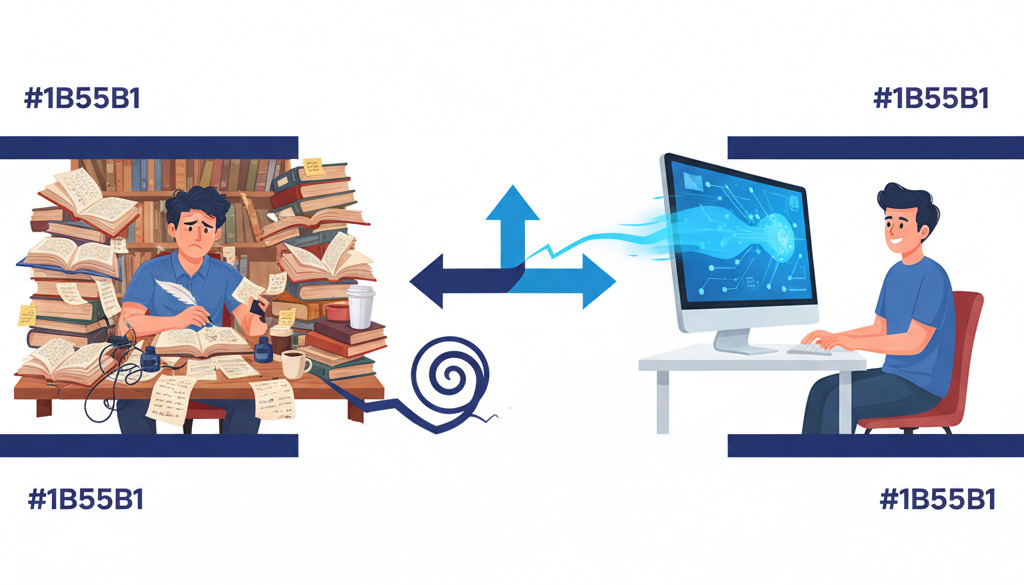
As the table illustrates, the time savings are dramatic. Imagine turning a week's worth of content work into a few minutes or a couple of hours. That is the power of dedicated AI solutions. For instance, some services have proprietary artificial intelligence that can write professional SEO blog articles for your website in minutes—almost like magic. This completely changes the economics and feasibility of content marketing for a small business.
Maintaining Brand Voice and Authenticity with AI
A common and valid concern is that AI-generated content will sound robotic, generic, or not like *your* brand. This is where the "human-in-the-loop" approach becomes critical. You are the conductor, and the AI is the orchestra. You must guide it to create content that reflects your unique voice.
The Art of the Prompt
Your input determines the output. Instead of a simple prompt like "write about gardening," a more effective prompt would be: "Write a blog post about urban gardening for beginners. Use a friendly, encouraging, and slightly humorous tone. Our brand voice is like a helpful neighbor giving advice over the fence. The target audience is millennials living in apartments." The more detailed your instructions, the better the result.
Creating a Style Guide
You can provide the AI with a style guide. This can include a list of words to use or avoid, a description of your brand’s personality (e.g., "professional and authoritative," "fun and conversational"), and even examples of your existing writing for it to emulate.
The Essential Role of the Human Editor
The AI-generated draft is just that—a draft. The final, crucial step is for you or someone on your team to read through it. This is where you inject personality, add personal anecdotes or case studies, check for factual accuracy, and ensure the tone is perfect. This hybrid approach delivers the speed of AI with the authenticity and quality of a human expert.
The Role of Human Expertise in AI-Powered Content
It is vital to view AI as a tool to augment human intelligence, not replace it. While AI can handle the heavy lifting of writing, human strategic thinking remains irreplaceable. The most successful AI content strategies are a partnership between human and machine.
Human-Led Roles in the AI Process:
- Strategist: The business owner or marketer who sets the goals, defines the audience, and creates the overall content plan.
- AI Prompt Engineer: The person who translates the strategy into clear, detailed instructions for the AI.
- Editor & Fact-Checker: The expert who reviews the AI-generated draft for accuracy, tone, and brand alignment, adding unique insights.
- Publisher: The individual who takes the final content, formats it in the website’s content management system (CMS), adds images, and hits "publish."
This collaborative workflow ensures you get the best of both worlds: the efficiency and scale of artificial intelligence combined with the nuance, creativity, and strategic oversight that only a human can provide.
Measuring the Success of Your AI-Generated Content
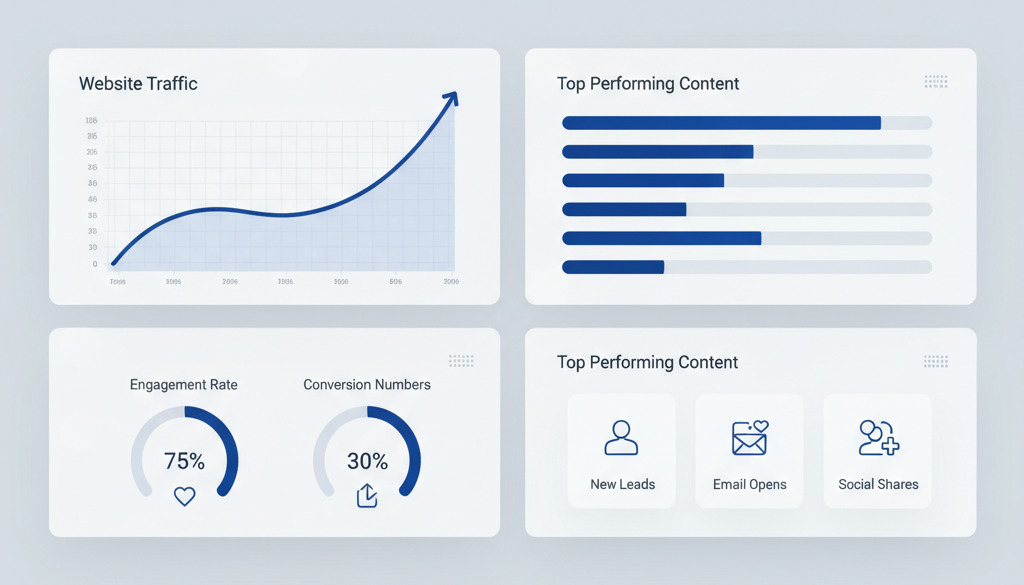
Creating content is pointless if you don’t know if it’s working. Measuring the performance of your blog is critical for understanding your return on investment (ROI) and refining your strategy over time.
Key Performance Indicators (KPIs) to Track
Using free tools like Google Analytics and Google Search Console, you can track several important metrics:
- Organic Traffic: How many visitors are coming to your blog from search engines? Is this number growing over time?
- Keyword Rankings: For which search terms are your articles appearing on Google? Are you moving up in the rankings?
- Time on Page: How long are visitors staying to read your articles? A longer time indicates engaging, valuable content.
- Bounce Rate: What percentage of visitors leave after viewing only one page? A high bounce rate might signal that your content isn’t matching their expectations.
- Conversions: Are readers taking the next step? This could be signing up for your newsletter, filling out a contact form, or making a purchase. This is the ultimate measure of success.
Using Data to Refine Your Strategy
By analyzing this data, you can see which types of articles perform best. If you notice your "how-to" guides get a lot of traffic and have a long time on page, that’s a signal to create more of them. If a particular topic drives a lot of conversions, you should explore that topic in greater depth. This feedback loop of publishing, measuring, and refining is the key to long-term content marketing success.
Overcoming Common Challenges with AI Content Creation
While AI is a powerful tool, it’s not without its pitfalls. Being aware of these challenges is the first step to mitigating them and ensuring you only publish high-quality, responsible content.
Factual Inaccuracies or "Hallucinations"
AI models can sometimes generate information that sounds plausible but is factually incorrect. This is why human fact-checking is non-negotiable, especially when dealing with statistics, dates, or technical subjects. Always verify important claims from a reliable source before publishing.
Potential for Bias
Since AI is trained on vast amounts of internet text, it can inadvertently learn and replicate biases present in that data. It’s important to review content to ensure it is fair, inclusive, and does not perpetuate harmful stereotypes.
Lack of Original Thought
AI is a master of synthesizing existing information, but it cannot create truly original thoughts, opinions, or groundbreaking research. That must come from you. The most valuable content often combines AI-generated background information with your unique human experience and insights.
"AI can give you a B+ draft on almost any topic in seconds. The human expert's job is to take that B+ draft and turn it into an A+ masterpiece that no machine could write on its own."
The Future of AI in Business Content and Marketing
The field of artificial intelligence is advancing at an incredible pace. For businesses, this means the tools will only get better, more integrated, and more powerful.
Hyper-Personalization at Scale
In the near future, AI may be able to personalize blog content for individual visitors in real-time. Imagine a visitor arriving at your blog, and the AI slightly alters the examples or tone of an article to better match that person's industry or known interests. As McKinsey noted, this can lead to massive improvements in customer satisfaction and retention.
Predictive Content Generation
AI will be able to analyze market trends and predict what your customers will be searching for *next week* or *next month*, allowing you to create content proactively and capture interest before your competitors even know a trend is emerging.
Seamless Multimodal Content
The line between text, images, and video will blur. You might ask an AI to "write a blog post about our new product and also create three social media images and a short video script to promote it." This integrated approach will further streamline the entire marketing process.
Embracing AI now is not just about catching up; it’s about preparing your business for the future of digital marketing and gaining a significant competitive edge.
Getting Started: Your First Steps with AI for Business Blogging
Feeling motivated? Getting started is easier than you think. You don't need a degree in computer science to leverage AI for your blog.
- Define ONE Goal: Don't try to do everything at once. Start with a simple, clear goal. For example, "I want to publish one high-quality, SEO-optimized blog post every week for the next three months."
- Choose Your First Topic: Pick a topic that directly relates to a common customer question. What is the one thing people always ask you about? Write about that.
- Select Your Tool: You can start with a general-purpose AI tool to get a feel for it, but for the best business results, consider a service designed specifically for SEO content.
- Prompt, Edit, and Publish: Follow the hybrid workflow. Give the AI a detailed prompt, then take the time to edit the draft, infuse your personality, and ensure it’s genuinely valuable to your reader.
The best way to see the impact is to simply try it. Many platforms understand that business owners need to see results. A great example is the "Your first 5 posts are free" offer from services like 'More Customers From Your Blog.' It provides a completely risk-free way for business owners to experience the power of AI-driven content firsthand and see customers start finding them through Google search.
Conclusion: Empowering Your Business with Intelligent Content
For the established business owner, your time is your most precious asset. The demands of digital marketing are real, but they no longer have to be a barrier to growth. Artificial Intelligence has matured from a buzzword into an accessible, powerful, and practical tool that can revolutionize how you create content. By embracing an AI-assisted approach, you can finally achieve the consistency and quality needed to build authority, dominate search rankings, and attract a steady stream of new customers—all without taking you away from the work you do best.
The journey from zero to content hero is no longer a long, arduous path. With AI as your co-pilot, you have the power to unleash incredible growth, connect with more customers, and secure your business's position as a leader in the digital age. The time to start is now.
Frequently Asked Questions
1. Is AI-generated content penalized by Google?
No. Google has been very clear that it rewards high-quality content, regardless of how it is produced. Their focus is on content that is helpful, reliable, and created for people, not for search engines. As long as you are using AI to create valuable, original content and not just to generate low-quality spam, you are perfectly safe. The key is the "human-in-the-loop" approach, ensuring final content is edited and provides real value.
2. Will using AI make my blog sound generic and robotic?
It can, but only if used improperly. The quality of AI output is directly related to the quality of the input (the "prompt"). By providing detailed instructions about your desired tone, style, and target audience, you can guide the AI to produce content that aligns with your brand. The most important step is human editing, where you add your unique anecdotes, expert opinions, and personality to make the content truly yours.
3. How much does it cost to use AI for blogging?
Costs vary widely. Some general-purpose AI tools have free tiers or cost as little as $20 per month. More specialized SEO and business content platforms can range from $50 to several hundred dollars per month, depending on the volume of content and features. There are also full-service models, like 'More Customers From Your Blog,' which handle everything for a set fee, and many offer free trials, like their "first 5 posts are free" offer, so you can test the value before committing.
4. I'm not a tech person. Is this going to be too complicated for me?
No, not at all. The user experience of modern AI tools is designed for non-technical users. If you can write an email or a social media post, you can write a prompt for an AI. The interfaces are typically very intuitive, asking simple questions to guide you. The focus is on your business knowledge, not your technical skill.
5. Can AI create content for very specific or niche industries?
Yes, absolutely. Because AI models are trained on a vast and diverse set of data from the internet, they have knowledge across a huge range of industries, from manufacturing and construction to law and healthcare. While you will always be the ultimate subject matter expert, the AI can provide an incredibly strong and well-researched foundation on even the most niche topics, which you can then refine with your expert knowledge.
6. How long does it take to see results (like more traffic) from an AI-powered blog?
Content marketing, whether AI-powered or not, is a long-term strategy. You likely won't see a huge spike in traffic overnight. However, with the consistency that AI allows, you can expect to see positive movement in traffic and keyword rankings within 3 to 6 months. By consistently publishing high-quality, SEO-optimized content, you are building a valuable asset that will pay dividends in organic traffic for years to come.
Keep reading
Hand-picked guides that go deeper — open the one you need next:
- The Future of Content Marketing: AI for Small Business
- Boost Local Rankings with Volteruno's AI Content
- Local SEO for Plumbers: Attract More Customers with AI Content
- AI: The Game Changer for Small Business SEO in 2026
→ Read the full Small Business guide
→ Read the full Small Business guide