
AI: The Game Changer for Small Business SEO in 2026

Key Takeaways
- SEO is Evolving, Not Dying: By 2026, search engines will function as an "answer engine," prioritizing direct, AI-summarized answers over traditional ranked links.
- AI Levels the Playing Field: Artificial intelligence gives small businesses powerful tools to compete with large corporations by automating complex tasks like keyword research, content creation, and technical analysis.
- Focus on User Intent: Success in AI-driven SEO hinges on understanding and answering the specific questions your customers are asking, rather than just targeting keywords.
- Structured Content is Crucial: AI algorithms favor well-structured, easy-to-scan content. Using clear headings, lists, and schema markup is no longer optional.
- Embrace New Metrics: Traditional metrics like rank position are becoming less important. Businesses must now track "citation frequency" in AI answers and AI-generated referral traffic.
- Human Oversight is Irreplaceable: AI is a powerful assistant, but the strategic direction, creativity, and final approval of a human expert remain essential for authentic and effective SEO.
Introduction: The Evolving Landscape of Small Business SEO
In the fiercely competitive digital marketplace, showing up on the first page of Google isn't just a marketing goal; it's a fundamental requirement for survival and growth. For small businesses, search engine optimization (SEO) has long been the great equalizer, a way to gain visibility against competitors with much larger budgets. But as we look toward 2026, the very definition of "search" is undergoing a seismic shift, driven by the exponential advancements in artificial intelligence.[1]
This isn't a distant, futuristic concept—it's happening now. The familiar list of blue links is increasingly being replaced by direct, AI-generated answers, conversational results, and hyper-personalized suggestions. For a business owner who is busy running daily operations and perhaps not a digital native, this can sound intimidating. However, this evolution isn't a threat; it's the single greatest opportunity for small businesses to thrive in the coming years.
This comprehensive guide will walk you through exactly why AI is a game-changer for your SEO strategy in 2026. We'll demystify the technology, provide actionable steps, and show you how to leverage AI to not only compete but to dominate your niche, attract more customers, and reclaim your valuable time.
Understanding the Core Principles of SEO in 2026
While AI is introducing transformative changes, it's crucial to understand that it builds upon, rather than replaces, the foundational pillars of good SEO. The core principles you may have already learned about still matter—they are just viewed through a new, more sophisticated lens.
Timeless SEO Foundations
The basics remain the bedrock of any successful strategy. These include:
- Keywords: The terms and phrases your customers use to find you are still vital, though our approach to finding and using them is becoming more nuanced.
- Backlinks: Links from other reputable websites continue to be a powerful signal of your site's authority and trustworthiness.
- Site Structure: A logically organized website with a clean, crawlable structure is essential for both search engines and users.
The Primacy of User Experience (UX)
In 2026, user experience is no longer just a ranking factor; it is the ranking factor. Google's AI-driven algorithms are exceptionally adept at measuring how users interact with your site. Are they finding answers quickly? Are they engaging with the content or immediately bouncing back to the search results? A slow, confusing, or unhelpful website will be heavily penalized. Your goal must be to create a seamless, intuitive, and valuable experience from the moment a user lands on your page.
The Shift to Nuanced Search Intent
Previously, SEO often focused on the "what" of a search (the keyword). Now, the focus is squarely on the "why" (the intent). Does the searcher want to buy something, learn something, or find a specific location? AI helps search engines understand this intent with incredible accuracy. Your content must be precisely aligned with answering that underlying intent to be considered relevant.
The Rise of AI-Powered Search: What Small Businesses Need to Know
The engine behind the search engine is getting smarter every day. Google's algorithms are no longer static rules but dynamic, learning systems that mimic human understanding. This is fundamentally changing what users see on the results page.
The Evolution of Search Algorithms
You may have heard of terms like RankBrain, BERT, and MUM. Think of these as intelligence upgrades for Google. They allow the search engine to understand natural language, context, and the relationship between different topics. Instead of just matching keywords in a query to keywords on a page, AI can now understand that a search for "how to fix a leaky faucet" is related to content about "plumbing repair services" or "common household water leaks," even if the exact keywords don't match. For small businesses, this means your content has a better chance of being discovered if it thoroughly covers a topic, demonstrating true expertise.
Conversational and Voice Search Impact
With the rise of voice assistants and more natural search queries, people are searching the way they speak. Instead of typing "HVAC repair Dallas," they might ask their phone, "Who is the best air conditioning repair company near me?" AI is what enables search engines to understand and answer these conversational questions. Your SEO strategy must adapt to target these longer, more natural-sounding phrases.
The Future is Predictive and Personalized
AI is already moving toward predictive search, anticipating what you need before you even finish typing. By 2026, search results will be hyper-personalized based on your location, past searches, and online behavior. For a small business, this means a golden opportunity to connect with local, high-intent customers at the exact moment they need your services.
Leveraging AI for Keyword Research in 2026
Keyword research has evolved from a simple guessing game to a sophisticated data science. AI takes the guesswork out, providing deep insights that were once only available to enterprise-level marketing teams.
AI for Topic Clusters and Semantic Search
Instead of focusing on single keywords, modern SEO is about building authority around broad topics. This is known as the "topic cluster" model. AI tools can analyze millions of data points to help you identify a main "pillar" topic (e.g., "Small Business Accounting") and all the related "cluster" subtopics your customers are searching for (e.g., "how to choose accounting software," "quarterly tax tips for freelancers," "small business payroll"). By creating content for the entire cluster, you signal to Google that you are a comprehensive authority on the subject.
Uncovering Niche Opportunities with AI
AI excels at finding patterns in data that humans would miss. This allows it to identify underserved, long-tail keywords (longer, more specific search phrases) that have high purchase intent and low competition. These are the goldmines for small businesses, allowing you to attract highly qualified traffic that is ready to convert.
"Before, big brands dominated because of backlinks and authority. Now, smaller websites can appear more visible simply because their content answers questions better and fits how AI systems read information."
AI's Impact on Content Creation and Optimization
Perhaps the most significant impact of AI for a time-strapped business owner is in content creation. The barrier to creating high-quality, optimized blog posts and web pages has been dramatically lowered.
Generating Ideas and Overcoming Writer's Block
Staring at a blank page is a common frustration. AI tools can instantly generate hundreds of content ideas, blog post outlines, and headlines based on a single topic. This allows you to focus your energy on refining the ideas and adding your unique human expertise, rather than starting from scratch.
Refining and Optimizing Your Content
AI doesn't just help create new content; it can supercharge your existing pages. AI-powered writing assistants can analyze your text for readability, tone of voice, and SEO performance. They provide real-time suggestions to improve sentence structure, add relevant keywords naturally, and ensure your content is as effective as possible.
For business owners who know they need content but simply don't have the time or inclination to write it, this is a revolutionary development. Solutions have emerged that handle the entire process. For example, services like More Customers From Your Blog utilize their own proprietary AI to generate professional, SEO-optimized articles in minutes. This approach is designed for busy entrepreneurs, allowing them to establish thought leadership and attract customers organically through Google without the heavy lifting of content creation.
AI-Assisted On-Page Optimization Strategies
On-page SEO refers to the optimization of elements on your actual website pages. AI can now automate and improve many of these technical, time-consuming tasks.
Automating Meta Descriptions and Title Tags
Writing compelling title tags and meta descriptions for every single page of your website is tedious but vital for click-through rates. AI tools can now generate optimized, engaging suggestions in seconds, ensuring your search snippets are always working hard to attract clicks.
Identifying and Fixing Technical SEO Issues
Is a broken link hurting your user experience? Is a missing image alt tag making your site less accessible? AI-powered site crawlers can continuously monitor your website for hundreds of potential technical SEO problems and provide clear, prioritized instructions on how to fix them, even if you're not a technical expert.
AI-Driven Internal Linking
Internal linking (linking from one page on your site to another) is crucial for distributing authority and helping users navigate your content. AI tools can analyze your content and automatically suggest relevant internal links, strengthening your site's structure and SEO performance with minimal effort.
The New Frontier of Off-Page SEO: AI and Link Building
Off-page SEO primarily involves building your site's authority through backlinks. AI is bringing a new level of intelligence and efficiency to this critical discipline.
Identifying High-Quality Backlink Opportunities
AI can sift through the entire web to identify relevant, high-authority websites that might be interested in your content. It can analyze the type of content they typically link to and even help you find the right contact person to reach out to, dramatically increasing the effectiveness of your outreach efforts.
Analyzing Competitor Backlink Profiles
Want to know why your competitor is outranking you? AI can perform a deep analysis of their backlink profile in minutes. It can show you exactly which websites are linking to them, what kind of content is earning them links, and where you have opportunities to acquire similar or better links to close the gap.
The Ethics of AI in Link Building
It's important to use these powerful tools ethically. AI should be used to identify genuine opportunities for relationship-building and to promote high-quality content that deserves to be linked to. Any attempt to use AI to generate spammy or manipulative links will quickly be identified by search engines and will harm your site in the long run.
AI for Local SEO: Dominating Local Search Results
For businesses that serve a specific geographic area, local SEO is paramount. AI offers powerful new ways to enhance your visibility in local search results and map packs.
Optimizing Your Google Business Profile
Your Google Business Profile (GBP) is your most important asset in local SEO. AI tools can analyze top-ranking competitor profiles and provide recommendations for optimizing your own listing. This includes suggestions for categories, attributes, services, and even the content of your Q&A section and posts to maximize your visibility in the local "map pack."
Citation Management and Reputation Monitoring
AI can automate the process of building and cleaning up your business citations (mentions of your Name, Address, and Phone number) across the web. It can also constantly monitor review sites and social media for mentions of your brand, alerting you to new reviews so you can respond promptly, which is a key signal for local search rankings.
Creating Hyper-Local Content
AI can help you identify local search trends and questions people in your area are asking. This allows you to create highly specific content like "The Best Landscaping Materials for Dallas, TX Weather" or "Common Springtime Pest Problems in Austin," attracting a targeted local audience.
Measuring Success: AI-Powered SEO Analytics and Reporting
The goal of SEO is to drive business results, and AI is revolutionizing how we measure and understand performance. It enables a shift from vanity metrics to actionable intelligence.
Beyond Basic Metrics: AI-Powered Insights
Traditional analytics might tell you how many people visited a page. AI-powered analytics can tell you why. These tools can analyze user behavior paths, identify which content contributes most to conversions, and pinpoint where users are dropping off in the customer journey. This allows you to make data-driven decisions to improve your website experience and conversion rates.
Predictive Analytics for SEO
The future of analytics is predictive. New AI platforms can forecast your future SEO traffic, identify ranking opportunities before they become mainstream, and alert you to potential ranking drops before they happen. This proactive approach allows you to stay ahead of the curve and your competition.
Actionable, Automated Reporting
Instead of drowning in spreadsheets of data, AI can generate clear, concise reports that highlight what matters most. More importantly, these reports often include plain-English, actionable recommendations, telling you exactly what to do next to improve your performance. It’s like having an SEO consultant on call 24/7.
| Metric Type | Traditional Metric | AI-Powered Metric (2026) | Business Implication |
|---|---|---|---|
| Visibility | Keyword Ranking Position | Citation Frequency in AI Overviews | Are you the source of the answer? |
| Traffic | Total Clicks / Sessions | AI-Generated Referral Traffic | Is AI directly sending converting users to you? |
| Engagement | Bounce Rate | User Journey Path Analysis | Do users find value and navigate deeper? |
| Authority | Number of Backlinks | Contextual Authority Score | Is your expertise recognized within your topic? |
AI Tools and Platforms for Small Business SEO
The market for AI SEO tools is exploding, offering solutions for every need and budget. Understanding the different categories can help you choose the right one for your business.
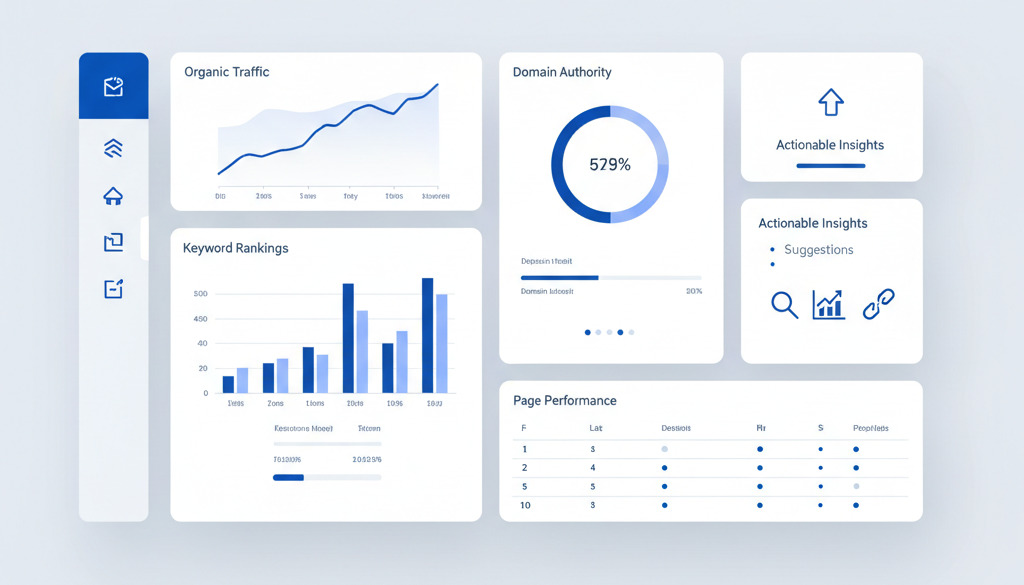
Categories of AI SEO Tools
- All-in-One Platforms: Tools like Semrush and Ahrefs are incorporating AI features for keyword research, competitor analysis, and site auditing.
- Content Optimization Tools: Platforms like Surfer SEO and Frase specialize in using AI to analyze top-ranking content and help you write pages that are perfectly optimized for a target query.
- Generative AI Writing Assistants: Tools built on models like GPT-4 can draft entire articles, emails, and social media posts.
- Done-For-You Services: For the busiest entrepreneur, some platforms are built on sophisticated AI to simplify the entire workflow. Services like More Customers From Your Blog are ideal for business owners who want the results of expert SEO content without the steep learning curve of complex tools.
Selecting the Right Tools
When choosing a tool, consider:
- Your Goal: Do you need help with research, writing, or technical analysis?
- Your Time: Do you have time to learn a complex tool, or do you need a simpler, more automated solution?
- Your Budget: Prices range from free to hundreds of dollars per month. Start with what you can afford and scale up.
AI Chatbots and Their SEO Implications
The chatbot in the corner of a website is more than just a customer service tool; it's becoming an integral part of the SEO ecosystem.
Improving User Engagement and Dwell Time
An effective AI chatbot can engage visitors the moment they land on your site. By answering questions and providing instant help, chatbots can significantly increase dwell time (the amount of time a user spends on your site). This is a strong positive signal to search engines that your site provides a valuable experience.
Guiding Users to Relevant Content
A well-programmed chatbot can act as a personal concierge, guiding users to the exact blog post, product page, or resource they need. This not only improves the user experience but also helps search engines understand the structure and relevance of your content through user actions.
Integrating Chatbot Data into Your SEO Strategy
The questions users ask your chatbot are a goldmine of SEO data. They are a direct line into the minds of your customers. Analyzing these chat logs can reveal new content ideas, common pain points, and valuable long-tail keywords to target in your next blog post.
Voice Search Optimization: The AI Advantage
As mentioned earlier, voice search is fundamentally conversational. AI is both the engine driving voice assistants and the tool you can use to optimize for them.
The Continued Growth of Voice Search
By 2026, voice-based shopping is expected to be a multi-billion dollar market. Optimizing for how people speak will be essential for capturing this traffic. Queries are longer, more specific, and often phrased as a question.
Using AI to Target Conversational Keywords
AI tools are perfect for this task. They can analyze your topic and generate hundreds of question-based keywords that people are likely to ask. This includes who, what, where, when, why, and how questions that you can answer directly in your content.
Structuring Content for Voice Assistants
Voice assistants look for concise, clear answers to pull from. To be featured, structure your content with the question as a heading (e.g., an H2 or H3) and provide a direct, succinct answer in the first paragraph immediately following it. Using FAQ sections on your pages is an excellent strategy for this.
The Ethical Considerations of AI in SEO
With great power comes great responsibility. As we integrate AI into our SEO strategies, it's crucial to do so ethically and transparently to maintain trust with both users and search engines.
Transparency and Disclosure
While Google has stated it will not penalize AI-generated content, it does prioritize content that demonstrates expertise, experience, authority, and trust (E-E-A-T). Best practice suggests that AI should be used as a tool, with a human expert always guiding, editing, and fact-checking the output. Being transparent about your use of AI can build trust with your audience.
Avoiding AI-Driven Manipulation
Do not use AI to create low-quality, spammy content at scale (a practice known as "content farms"). Do not use it to generate fake reviews or manipulative links. Search engine AI is becoming just as good at detecting spam as it is at creating content. The golden rule is simple: use AI to create genuine value for the user, not to try and trick an algorithm.
Aligning with Search Engine Guidelines
Always stay up-to-date with Google's webmaster guidelines. As AI technology evolves, so will the rules of engagement. Focus on a user-first approach, and your strategy will almost always align with Google's goals.
Building an AI-Ready SEO Team and Workflow
Adopting AI doesn't mean replacing your people; it means empowering them. For a small business, "team" might just mean you and a part-time helper, but the principle is the same.
Upskilling to Work Alongside AI
The SEO professional of 2026 is not a technical wizard but a strategic thinker who knows how to ask AI the right questions. The key skills are now strategy, creativity, critical thinking, and editing. Focus on learning how to use AI tools as a partner to execute your vision more efficiently.
Identifying New Roles and Skill Gaps
New roles like "AI Prompt Engineer" or "AI Content Editor" are emerging. For a small business, this simply means learning how to write effective prompts to get the desired output from AI and how to expertly review and refine that output to reflect your brand's unique voice and expertise.
Developing an Integrated Workflow
A modern SEO workflow might look like this:
- Use an AI tool to identify a topic cluster and a list of long-tail keywords.
- Use a generative AI to create a detailed outline for an article.
- Write the first draft yourself, or use the AI to generate it, then heavily edit and add your own stories, examples, and expertise.
- Use an AI optimization tool to refine the content for readability and SEO.
- Publish the content and use AI analytics to track its performance and find opportunities for improvement.
Future-Proofing Your Small Business SEO Strategy with AI
The only constant in SEO is change. By embracing AI now, you are not just optimizing for 2026; you are building a resilient, adaptable marketing strategy for the future.
The Importance of Adaptability
The business owners who succeed will be those who are willing to learn, experiment, and adapt. The AI tools and search engine algorithms of 2026 will be even more advanced than today. By starting your AI journey now, you develop the mindset and skills needed to evolve along with the technology.
The Long-Term Competitive Advantage
Your competitors who are still manually researching keywords and slowly writing blog posts will be left behind. By leveraging AI, you can produce higher quality content, gain deeper insights, and execute your strategy faster and more efficiently. This creates a powerful and sustainable competitive advantage.
AI as an Indispensable Partner
By 2026, using AI in SEO will be as standard as having a website. It will be the indispensable partner that allows small business owners to reclaim their time, focus on what they do best, and achieve marketing results that were previously unimaginable.
Getting Started with AI for Your Small Business SEO
Feeling overwhelmed? Don't be. The key is to start small, focus on one area at a time, and build from there. You don't need to become an AI expert overnight.
Practical First Steps
- Choose One Area to Improve: Do you struggle most with coming up with blog ideas? Start there. Use a free AI tool to generate 20 blog titles related to your business.
- Optimize an Existing Page: Take one of your underperforming blog posts and run it through an AI content optimization tool. Apply its suggestions and monitor the results.
- Analyze Your Local Presence: Use an AI tool to analyze your Google Business Profile and see what simple changes you can make to improve your local visibility.
Start Small and Iterate
The goal is progress, not perfection. Every small improvement you make compounds over time. The most important step is simply the first one. Commit to spending just one hour per week experimenting with an AI SEO tool.
For those who want to see the power of AI in action with virtually zero effort, it's an ideal time to explore a done-for-you service. A platform like More Customers From Your Blog makes it incredibly easy, offering a free introductory package that provides your first five AI-generated SEO articles at no cost. This is a risk-free way to experience firsthand how high-quality, optimized content can start attracting customers almost immediately.
Overcoming Common AI Adoption Challenges
Adopting any new technology comes with potential hurdles. Being aware of them is the first step to overcoming them.
Addressing Resistance to New Technology
If you have a team, some may be hesitant or fearful of AI. Frame it as a tool that enhances their skills and frees them from tedious tasks, allowing them to focus on more strategic, creative work. For yourself, overcome any personal reluctance by focusing on the time you will save and the new customers you will gain.
Managing Expectations
AI is not a magic wand. It won't triple your sales overnight. It's a powerful tool that requires strategic direction. You will still need to understand your customer and your business goals. AI provides the leverage; you provide the strategy.
Budgeting for AI SEO
While many powerful AI tools have a subscription fee, the return on investment is often immense. Consider the cost of your own time. If a $50/month tool saves you 10 hours of work, it has already paid for itself many times over. Start with free tools or low-cost plans and scale as you see results.
Case Studies: Small Businesses Thriving with AI SEO
The proof is in the results. Here are a couple of examples of how small businesses are already winning with AI.
The Local Plumber: From Invisible to #1 in the Map Pack
A family-owned plumbing company in a competitive suburb of Chicago was struggling to get service calls from Google. They used an AI tool to completely overhaul their Google Business Profile, identify question-based keywords their customers were searching ("cost to replace a water heater in Naperville"), and create a series of short, helpful blog posts answering those questions. Within three months, they moved into the top 3 "map pack" for their most important services, leading to a 40% increase in qualified phone calls.

The Handmade Jewelry E-commerce Store: Finding a Global Niche
An online store selling handmade jewelry was lost in a sea of mass-market competitors. By using AI keyword research, the owner discovered a passionate niche audience searching for "ethically sourced gemstone engagement rings." She used AI to help create in-depth content about her sourcing process, the meaning of different gemstones, and how to care for the jewelry. This highly-targeted content began to rank, attracting buyers from around the world and doubling her online sales in six months.
The Role of AI in Personalizing the Customer Journey
Beyond simply attracting visitors, AI can help you create a website experience that feels personally tailored to each user, dramatically increasing engagement and conversions.
Tailoring Content and Offers
By analyzing a user's behavior—which pages they visit, how long they stay, what they have purchased before—AI can dynamically adjust the content they see. Someone who has read several blog posts about "organic dog food" could be shown a special offer for that product on the homepage. This level of personalization was once exclusive to giants like Amazon.
Guiding Individual Customer Journeys
AI can guide a customer from their first visit to their final purchase. It can recommend the next blog post to read, suggest a related product, or trigger a helpful chatbot message if a user seems stuck on a certain page. This creates a smooth, intuitive journey that builds trust and encourages conversion.
Connecting Personalization with SEO
This enhanced user experience sends powerful positive signals back to Google. When users stay longer, view more pages, and convert more often, search engines take notice. They interpret this as a sign of a high-quality, relevant site, which in turn boosts your overall SEO performance. It creates a virtuous cycle of success.
Conclusion: Embracing the AI-Powered Future of Small Business SEO
The digital landscape of 2026 is one defined by artificial intelligence. For the small business owner, this is not a moment for fear or hesitation, but one for excitement and opportunity. AI is the great democratizer, putting an unprecedented level of marketing power into the hands of entrepreneurs who are ready to embrace it.
By shifting your focus from chasing rankings to answering questions, from creating content to creating value, and from using tools to leveraging intelligence, you can build a formidable online presence. AI handles the complexity, automates the tedious, and provides the insights, freeing you to focus on running your business and serving your customers.
The path forward is clear. Start today. Learn, experiment, and integrate AI into your SEO strategy. By doing so, you won't just be keeping up; you'll be building a thriving, future-proof business that can compete and win in the new age of search.
Frequently Asked Questions
1. Do I still need to know basic SEO if I use AI?
Yes, absolutely. Think of AI as an incredibly powerful assistant, but you are still the strategist. Understanding basic SEO principles like user intent, keyword relevance, and site structure is essential for you to give the AI the right instructions and to effectively evaluate its output. AI makes execution easier, but human strategy is what drives results.
2. Can AI completely replace my content writer or SEO expert?
Not yet, and likely not ever completely. While AI can generate impressive drafts, it lacks genuine human experience, emotion, and creativity. The best results come from a partnership: AI handles the initial research and drafting, and a human expert refines, edits, and adds the unique brand voice, personal stories, and true expertise that builds trust with an audience. AI is a tool, not a replacement for talent.
3. How much does it cost to get started with AI for SEO?
You can start for free. Many top-tier AI platforms offer free trials or limited-use free plans that are perfect for experimenting. There are also entirely free generative AI tools. Paid plans can range from $20/month for a specialized tool to several hundred for an all-in-one platform. The key is to start small, prove the ROI for your business, and then scale your investment.
4. Is AI-generated content penalized by Google?
No. Google has officially stated that it rewards high-quality content, regardless of how it is produced. Their focus is on the value it provides to the user. Low-quality, spammy content will be penalized whether it was written by an AI or a human. The reverse is also true: helpful, well-written, and user-focused content is rewarded, regardless of its origin.
5. What is the single most important change I should make for 2026?
Shift your content mindset from "selling" to "answering." Review your website and ask, "Does this page directly answer a question my ideal customer is asking?" Structure your content with clear headings that pose a question and initial paragraphs that answer it concisely. This one change will better align your website with how both users and AI-powered search engines operate in 2026.
Keep reading
Hand-picked guides that go deeper — open the one you need next:
- Small Business SEO: AI Levels the Playing Field
- Professional Content Marketing on a Budget: The AI Advantage
- Local SEO AI: The Ultimate Guide to Dominating Local Search
- Small Business AI Content: A Guide to Scalable Growth
→ Read the full Small Business guide