
Small Business SEO: AI Levels the Playing Field

Key Takeaways
- AI is a game-changer for small businesses, offering a way to compete with larger companies in SEO without needing a huge budget or dedicated team.
- The focus of SEO has shifted from just keywords to providing direct answers for AI-driven search results like Google's AI Overviews.
- AI tools can automate and enhance key SEO tasks including keyword research, content creation, on-page optimization, and technical analysis.
- Using AI saves significant time and money, allowing business owners to focus on their core operations while still growing their online presence.
- The most effective approach is to use AI as a powerful collaborator, with human oversight to guide strategy, refine brand voice, and ensure quality.
- Specialized AI platforms designed for SEO offer superior results compared to generic writing tools, creating content that is built to rank and convert.
Introduction: The Digital Dilemma for Small Businesses
For many small business owners, competing for online attention feels like a David vs. Goliath battle. You have a superior product or service and a deep connection with your customers, but you lack the marketing budget and technical army of your larger competitors. You know that being visible on Google is critical, but the world of Search Engine Optimization (SEO) seems complex, time-consuming, and expensive.[2] It’s a common frustration for entrepreneurs over 40 who have built successful businesses but are not digital natives; you know you need online content, but you have neither the time nor the inclination to create it yourself.
This is where Artificial Intelligence (AI) enters the picture, not as another complicated piece of technology to master, but as a transformative solution.[1] AI is leveling the playing field, dismantling the traditional barriers to effective SEO. It offers a way to bridge the gaps in time, budget, and expertise, empowering small and medium-sized enterprises (SMEs) to achieve the kind of online visibility that was once reserved for corporations with deep pockets.
Understanding the Landscape: Why SEO is Non-Negotiable for SMEs
At its core, Search Engine Optimization (SEO) is the process of making your website more attractive to search engines like Google. When a potential customer searches for a product or service you offer, good SEO helps your website appear higher in the search results. Think of it as securing a prime location in a digital shopping mall where millions of customers are actively looking for solutions.
The impact of strong SEO on a small business can be profound:
- Increased Organic Traffic: These are visitors who find your website through a search engine, not through paid ads. It is highly targeted and cost-effective traffic.
- High-Quality Lead Generation: People searching on Google have a specific need or question. By providing the answer, you attract potential customers who are already interested in what you have to offer.
- Enhanced Brand Authority: Consistently appearing in search results for topics related to your industry positions your business as a credible and trustworthy expert.
In today's digital marketplace, neglecting SEO is no longer an option. It means being invisible to the vast majority of potential customers. Your competitors are almost certainly using SEO, and every day you delay is another day they are capturing market share that could be yours.
The AI Revolution in Content Creation for SEO
When we talk about Artificial Intelligence in this context, we aren't talking about science fiction robots. We mean sophisticated software systems designed to perform tasks that typically require human intelligence, such as understanding language, recognizing patterns, and making decisions. In the realm of SEO and content marketing, AI has become a powerful engine for creating and optimizing the very content that Google uses to rank websites.
AI tools can automate, accelerate, and elevate nearly every aspect of your content strategy. They analyze vast amounts of data to understand what search engines and users want to see, and then help you create it. For small businesses, this is revolutionary. It democratizes advanced SEO capabilities, making top-tier digital marketing strategies accessible without a top-tier price tag.
How AI Empowers Small Business SEO: The Core Mechanics
So, how does AI actually work its magic on your SEO? It’s not a single, mystical process but a series of precise, data-driven functions that streamline the most critical components of a successful SEO strategy.
Keyword Research Reimagined
Traditionally, keyword research was a manual, time-consuming process of guessing what customers might search for. AI transforms this into a strategic, predictive science.
- Identifies High-Intent Keywords: AI algorithms can sift through millions of search queries to pinpoint keywords that signal a user is close to making a purchase, while also identifying those with less competition.
- Analyzes and Predicts Trends: AI can analyze search data to spot emerging trends, allowing your business to create content that captures new waves of customer interest before your competitors do.
- Generates Long-Tail Variations: It excels at finding long-tail keywords—longer, more specific phrases (e.g., "emergency plumbing repair for leaking pipe in Brooklyn") that indicate high purchase intent and are easier to rank for.
Content Generation at Scale
The biggest hurdle for most SMEs is consistently producing high-quality content. AI solves this problem directly. Instead of spending hours staring at a blank page, you can generate professional articles in minutes. For instance, specialized services like the "More Customers From Your Blog" platform use a proprietary AI purpose-built to write SEO-optimized blog posts. This isn't about creating generic, soulless text. It's about producing unique, informative, and engaging content tailored to your specific business needs, at a scale and speed that was previously unimaginable for a small team.
On-Page Optimization Driven by AI
Creating the content is only half the battle. AI also ensures it’s perfectly optimized for search engines.
- Metadata Suggestions: AI tools can instantly suggest SEO-friendly meta titles and descriptions that improve click-through rates from search results.
- Content Structure and Readability: As noted in recent SEO research, search engines now prioritize content that is structured for answers. AI helps format your articles with clear headings, short paragraphs, and simple language that appeals to both humans and AI-driven search crawlers.
- Internal Linking: AI can analyze your website and suggest relevant internal links within your new articles, a crucial practice for distributing authority across your site and helping Google understand its structure.
Strategic Advantages of AI-Powered SEO for SMEs
Adopting an AI-powered approach to SEO provides small businesses with a powerful set of strategic advantages that directly address their most common pain points. The benefits go far beyond simply ranking higher on Google; they fundamentally change how you can compete in the digital arena.
| Factor | Traditional SEO Approach | AI-Powered SEO Approach |
|---|---|---|
| Time Investment | High (dozens of hours per month) | Low (a few hours per month) |
| Cost | High (agency retainers, staff salaries) | Low (affordable monthly subscriptions) |
| Speed of Execution | Slow (weeks or months to see results) | Fast (content created in minutes, faster insights) |
| Scalability | Limited by human resources | Highly scalable on demand |
| Data Analysis | Manual, often based on limited data sets | Automated, based on massive, real-time data |
- Saving Time and Resources: This is the most immediate and impactful benefit. AI automates the laborious tasks of research, writing, and optimization, freeing you from a task you likely don't enjoy and giving you back precious hours to run your business.
- Cost-Effectiveness: The cost of a specialized AI SEO tool is a fraction of the expense of hiring a marketing agency or a full-time content writer. It provides an incredible return on investment by generating organic traffic leads for a minimal outlay.
- Enhanced Competitiveness: Before AI, big brands could dominate search results simply by outspending and out-producing everyone else. As experts have noted, AI has leveled the playing field. Now, the best answer wins, not necessarily the biggest website. AI gives you the tools to provide those winning answers.
- Focus on Core Business: By entrusting your content creation and SEO to a reliable AI system, you can concentrate on what you do best—serving your customers and growing your business.
The Magic Behind the Scenes: Our AI's Approach to SEO Content
Not all AI tools are created equal. Many generic AI writers produce content that is bland and not optimized for the nuances of search engines. The "More Customers From Your Blog" service, however, utilizes a proprietary AI engine designed with one goal in mind: generating high-quality SEO articles that rank and convert.
Our system operates with remarkable speed and efficiency, writing a complete, professional blog post in mere minutes. For business owners, this capability feels almost like magic. You provide the topic, and the AI handles the intricate process of structuring the article, weaving in relevant keywords, and writing compelling copy. It's designed so that customers find you on their own in Google, attracted by content that genuinely answers their questions and addresses their needs. This user-centric approach is precisely what Google’s modern algorithms are built to reward.
Beyond Content: AI's Broader Impact on SEO
While content creation is a major component, AI’s influence extends across the entire spectrum of SEO, touching on technical aspects, competitive intelligence, and performance measurement.
Technical SEO Assistance
Technical SEO refers to the behind-the-scenes optimizations that help search engines crawl and index your site more effectively. AI tools can automatically scan your website to:
- Identify issues like slow page speed, broken links, or problems with mobile-friendliness.
- Analyze your site architecture and suggest improvements for better crawlability.
- Help generate structured data (Schema markup), which gives Google detailed context about your business, services, and location, increasing your chances of appearing in rich results.
Competitor Analysis with AI
AI gives you an x-ray view into your competitors' strategies. It can automatically track their keyword rankings, analyze their most successful content, and examine their backlink profiles. This allows you to identify gaps in their strategy—and in the market—that your small business can exploit for a competitive advantage.

Performance Tracking and Analytics
AI-powered analytics tools can distill complex performance data into clear, actionable insights. Instead of drowning in spreadsheets, you can get summaries of what’s working, what’s not, and even receive predictive forecasts about future search trends to help you proactively adjust your strategy.
Crafting Your AI Content Strategy: A Step-by-Step Guide
Integrating AI into your business isn't about pressing a button and hoping for the best. It requires a thoughtful strategy to ensure the technology serves your specific goals.
- Define Your Goals: What do you want to achieve? Is it more leads through your contact form? More phone calls? Increased local foot traffic? Your goals will determine the topics you target and the calls-to-action you include in your content.
- Choose the Right AI Tools: Look for platforms designed specifically for SEO content. Generic AI writers are less effective. Consider ease of use, the quality of the output, and customer testimonials. The success of over 500 companies using a specialized service speaks volumes about its effectiveness.
- Integrate AI into Your Workflow: Decide on a publishing cadence. Will you publish one new article a week? Two? Consistency is key. Use the AI to generate the draft, then have a human (you or an employee) perform a quick review to add personal anecdotes, check for brand voice, and ensure factual accuracy for your niche.
Overcoming Common Concerns About AI in SEO
It's natural to be skeptical of new technology, especially when it comes to something as vital as your business's online reputation. Let's address the most common concerns.
"The best small businesses aren't choosing between automation and personal service. They're finding AI solutions that deliver both speed and soul."
- Content Originality and Plagiarism: Reputable AI SEO tools are designed to generate 100% unique content. They don't copy and paste from other sources; they synthesize information and generate new text based on their training data, and a good system will pass any plagiarism check.
- The "Human Touch": AI is an incredibly powerful tool, but it works best as a collaborator. The ideal workflow involves using AI for the heavy lifting (80-90% of the writing) and applying a human touch for review, personalization, and strategic direction.
- Google Algorithm Updates: Google’s official stance is that it rewards high-quality content, regardless of how it’s produced. Since AI helps create well-structured, comprehensive, and helpful content, it aligns perfectly with Google’s guidelines. In fact, AI can help you adapt to algorithm updates faster than manual methods.
- Ethical Considerations: The responsible use of AI involves being transparent and ensuring the content is accurate and helpful to the user. The goal is to inform and assist, not to deceive or manipulate search rankings with low-quality content.
Real-World Impact: Success Stories with AI-Powered SEO
The proof, as they say, is in the pudding. Across the country, small business owners are already seeing transformative results by integrating AI into their SEO strategies. Consider these typical scenarios:
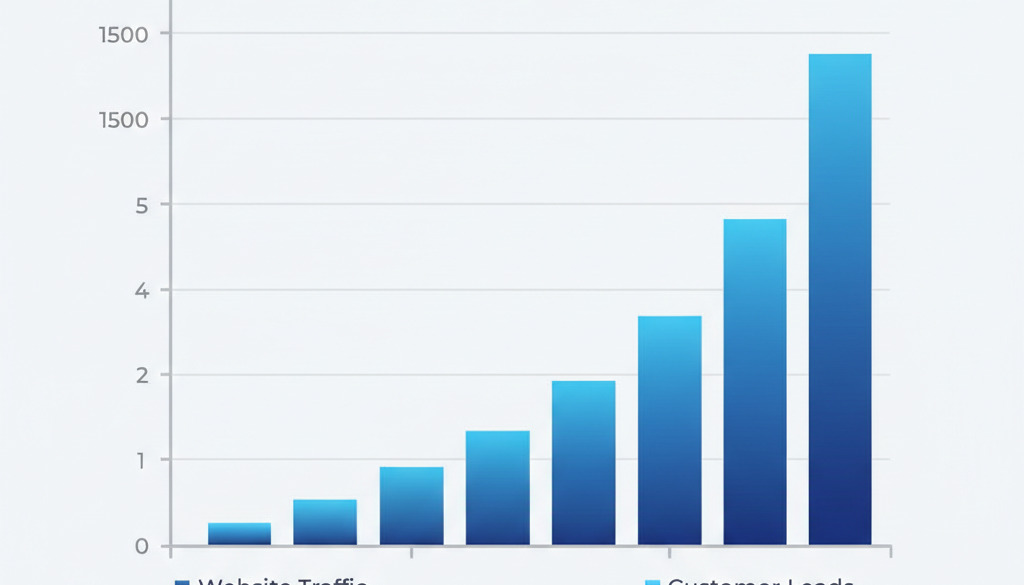
- A local contractor in Texas who never had time for marketing started publishing two AI-generated blog posts a week. Within three months, his website traffic from Google tripled, and he was receiving 5-7 new quote requests per week directly from his site.
- A financial consultant for retirees was struggling to compete with large investment firms online. Using an AI tool specialized in SEO, she began producing detailed articles answering very specific client questions. Today, she ranks on the first page of Google for several key long-tail keywords, establishing her as a go-to expert in her community.
These are not isolated incidents. Over 500 companies are already using specialized AI content platforms to drive organic growth, proving that this technology is not just hype—it's a practical tool delivering tangible business results.
The Future of Small Business SEO: An AI-Driven Horizon
The integration of AI into SEO is not a passing trend; it is the future of digital marketing. We are moving away from a web of linked pages to a web of interconnected data and answers, and AI is the engine that understands and organizes this new reality. In the coming years, expect AI to become even more sophisticated, helping businesses with:
- Hyper-Personalization: Delivering content dynamically based on a user's specific location, past behavior, and intent.
- Voice and Visual Search Optimization: Automatically structuring content to be the top result for voice assistants like Alexa and Google Assistant.
- Predictive SEO: AI will not just react to data but will pro-actively tell you which topics to cover and which strategies to implement for future success.
For a small business owner, this means that your strategic partner in SEO will only get smarter, more efficient, and more valuable over time.
Getting Started with AI for Your Small Business: A Practical Approach
Embracing AI doesn't require a massive upfront investment or a degree in computer science. The key is to start small, experiment, and see the results for yourself.
Think about the return on investment (ROI). If a single new customer is worth $500 to your business, and an AI tool that costs less than a hundred dollars a month brings you just one new customer, it has already paid for itself several times over. The "try before you buy" mentality is crucial here. Look for platforms that offer a free trial, allowing you to experience the power of the technology firsthand. For example, some specialized services allow you to generate your first 5 articles for free. This removes all risk and lets the results speak for themselves.
Differentiating AI Solutions: Beyond Generic Content Generators
A quick search will reveal dozens of "AI writers." However, a generic AI writer designed for creative writing or social media captions is not the same as an AI platform built specifically for SEO. An effective AI SEO solution is different because it is laser-focused on the features that actually impact Google rankings and drive customer acquisition. It understands keyword density, semantic relevance, search intent, and how to structure an article to be chosen for an AI Overview. The value proposition of a platform like "More Customers From Your Blog" is its specialization: it doesn’t just write words, it builds strategic content assets designed to attract buyers from search engines.
The Human Element: AI as a Collaborator, Not a Replacement
It’s important to reinforce a critical point: AI is here to augment your expertise, not replace it. You are the expert in your business. You know your customers, your products, and your industry better than any algorithm ever could. The most successful AI implementation is one where technology handles the legwork, and a human provides the strategic direction and final polish. Think of the AI as a highly skilled, incredibly fast junior marketer. You are still the marketing director, setting the strategy and giving the final approval.
Legal and Ethical Considerations for AI-Generated Content
As with any new technology, it's wise to be aware of the legal and ethical landscape. The key principles are transparency and quality.
- Ownership: When you use a commercial AI tool to generate content, you typically own the copyright to the output. You are free to use it on your blog, social media, or other marketing channels.
- Transparency: While not legally required, it's a good practice to be transparent. However, the more important factor for users and search engines is the quality and accuracy of the information.
- Google's Guidelines: Google has been very clear: their focus is on the quality of the content, not the method of its creation. As long as the content is original, helpful, and user-focused, it fully complies with Google's guidelines. AI-generated spam is penalized, but high-quality AI-assisted content is rewarded.
Measuring Success: Key Performance Indicators for AI SEO
To know if your AI SEO strategy is working, you need to track the right metrics. Don't get lost in vanity numbers. Focus on the Key Performance Indicators (KPIs) that directly impact your business goals:
- Organic Traffic: An increase in visitors coming from search engines.
- Keyword Rankings: Tracking your position in Google for your target keywords.
- Conversion Rate: The percentage of visitors who complete a desired action (e.g., fill out a form, make a call).
- Bounce Rate & Time on Page: These metrics can indicate how engaging and relevant your content is to visitors.
Many AI tools have built-in analytics dashboards that make tracking these KPIs simple and intuitive.
Building Authority and Trust with AI-Assisted SEO
Trust is the currency of the internet. A consistent stream of high-quality, helpful content is the fastest way to build topical authority and establish your business as a trusted resource. When you regularly publish articles that answer your customers' most pressing questions, Google takes notice. It begins to see your website as an authority in its niche. AI makes this level of consistency achievable for any small business, helping you build a library of valuable content that fosters trust with both potential customers and search engines.
Common Pitfalls to Avoid When Implementing AI SEO
While AI is powerful, it's not foolproof. Avoid these common mistakes to ensure your success:
- "Set It and Forget It": Never publish AI content without a quick human review. Check for tone, accuracy, and add a personal touch.
- Ignoring Technical SEO: Great content on a technically flawed website will still struggle to rank. Use AI tools to identify and fix technical issues.
- Using Generic Prompts: Be specific when you ask the AI to generate content. Provide context about your audience, goals, and the specific question you want to answer.
- Neglecting Analytics: Don't just publish content; track its performance. See what’s working and use that data to refine your future content strategy.
- Choosing a Generic Tool: The biggest mistake is using a general-purpose AI writer and expecting expert SEO results. Invest in a tool that is specialized for the task.
Conclusion: Embracing the AI Advantage for Sustainable Small Business Growth
The digital landscape has fundamentally shifted, and the tools for success have evolved with it. For the small business owner who has felt left behind by the complexities of digital marketing, AI is more than just a new technology—it's a powerful equalizer. It offers a direct, effective, and affordable path to increasing your online visibility, attracting more customers, and competing on a level playing field.
By automating the heavy lifting of keyword research and content creation, AI saves you invaluable time and resources, allowing you to focus on your passion. It enhances your competitiveness, ensuring that the quality of your ideas, not the size of your budget, is what determines your success online. To start reclaiming your time and attracting more customers, explore a specialized solution like the "More Customers From Your Blog" platform. With the ability to try it for free, you have nothing to lose and a world of new customers to gain.
Frequently Asked Questions
1. Will Google penalize my website for using AI-generated content?
No. Google has officially stated that it rewards high-quality, helpful content that serves the user, regardless of how it is produced. The key is "quality." Using AI to produce unique, well-structured, and informative articles is perfectly acceptable and aligns with Google's guidelines. Low-quality, spammy content will be penalized, whether written by AI or a human.
2. Is AI SEO expensive for a small business?
No, it's one of the most cost-effective marketing strategies available. Compared to hiring a marketing agency (which can cost thousands per month) or a full-time content writer, a subscription to a quality AI SEO platform is a very small investment. Given the potential return in organic traffic and leads, the ROI is typically very high.
3. How much human work is still needed if I use AI?
The best approach is to think of AI as a 90% solution. The AI does the heavy lifting: research, structuring, and writing. The remaining 10% is your human touch. A quick 5-10 minute review of each article to check facts, inject your brand's unique voice, and add personal anecdotes is all that's needed to elevate the content from good to great.
4. Can AI really understand my niche business or industry?
Yes. Modern AI models are trained on a vast range of information from the internet, allowing them to write knowledgeably about a huge variety of topics, from local plumbing services to complex financial planning. For highly specialized or technical niches, the human review step becomes even more important to ensure perfect accuracy, but the AI provides an excellent and comprehensive starting point.
5. How quickly can I expect to see results from AI SEO?
SEO is a marathon, not a sprint. While you can create content much faster with AI, it still takes time for Google to crawl, index, and rank it. Generally, you can start to see positive movement in traffic and rankings within 3 to 6 months of consistently publishing high-quality, AI-assisted content. The speed of results depends on your industry's competitiveness, your starting point, and your publishing consistency.
6. What's the difference between a tool like ChatGPT and a specialized AI SEO platform?
While ChatGPT is a powerful general-purpose language model, it is not specialized for SEO. A dedicated AI SEO platform is purpose-built with features that directly address search engine ranking factors. It incorporates real-time SEO data, understands content structure for search, helps with keyword optimization, and is designed from the ground up to produce content that ranks and converts, a task that requires more than just good writing.
Keep reading
Hand-picked guides that go deeper — open the one you need next:
- AI Blog Writing: A Small Business Guide to Google Rank
- From Zero to Hero: How AI Content Transformed My Small Business Blog
- Local SEO AI Content: Strategies for 2026 Dominance
- From Zero to Hero: How AI Content Automation Levels the Playing Field for Small Businesses
→ Read the full Small Business guide
→ Read the full Small Business guide