
Local SEO for Small Businesses: Dominate Local Search

Key Takeaways
- Focus on Google Business Profile (GBP): Your GBP is your digital storefront. Keep it complete, accurate, and active with posts and reviews to dominate the Google Maps "local pack."
- Create Location-Specific Content: Go beyond just mentioning your city. Write content about local events, neighborhood guides, and customer stories to signal strong local relevance to search engines.
- NAP Consistency is Crucial: Ensure your Name, Address, and Phone number (NAP) are identical across all online directories and citations. Inconsistencies can harm your local ranking.
- Leverage Online Reviews: Actively encourage and respond to customer reviews. They are a major ranking factor and build trust with potential customers.
- Embrace AI for Efficiency: For busy business owners, AI-powered tools can generate high-quality, SEO-optimized local content in minutes, saving you time and helping you attract customers effortlessly.
What is Local SEO and Why It Matters for Small Businesses
Local SEO, or Local Search Engine Optimization, is the process of making your business more visible in local search results on Google.[1] When someone in your area searches for "plumber near me" or "best coffee shop in [Your City]," local SEO is what determines if your business appears at the top of the results. For any small business that serves a specific geographic area—be it a storefront, a restaurant, or a home service provider—it is not just important; it is absolutely essential for survival and growth.
Think of it this way: your customers are no longer flipping through the Yellow Pages. They are pulling out their smartphones. Being found in that exact moment of need is the single most powerful way to generate new business. Local search is highly targeted, connecting you with potential customers who have a specific need and are physically close enough to buy from you, often on the same day.
The Small Business Owner's Dilemma: Time, Expertise, and Online Presence
As a business owner, you are likely juggling a dozen different roles. You understand that having an online presence is critical—you see your competitors showing up on Google Maps and you know you need to be there too. But herein lies the dilemma: you have limited time, may not have a background in digital marketing, and the thought of writing "content" for your website feels overwhelming. You’d rather focus on what you do best: running your business and serving your customers.
This article is built for you. It is a straightforward guide to help you understand and implement a powerful local SEO content strategy without needing a marketing degree or endless hours to spare. We will break down the essential components into actionable steps and show you how modern tools can do most of the heavy lifting, allowing you to establish a dominant online presence and let new customers find you.
How Customers Find Local Businesses in 2024
The way customers find local businesses has evolved dramatically. It's no longer just about a simple search on Google.com. Today, a customer's journey can start in many different places, and search engines are focused on providing immediate answers, not just links.
The Modern Local Search Journey
In 2024 and beyond, local visibility means appearing across a diverse ecosystem. This includes:
- Google Search & The "Local Pack": This is the block of three businesses that appear with a map at the top of the search results. It is the most coveted real estate in local search, and a well-optimized Google Business Profile is your ticket in.
- Google Maps: Many users skip Google search entirely and look directly within the Google Maps app. If your business isn’t listed and optimized here, you are invisible to a huge segment of ready-to-buy customers.
- Voice Search: "Hey Google, find an emergency plumber near me." Voice queries on smartphones and smart speakers are on the rise. These searches are highly conversational and demand direct, clear answers, which search engines pull from well-structured website content.
- AI-Generated Answers: Search engines now use AI to provide direct summaries and answers at the top of the page. Your content must be structured to directly answer customer questions to have a chance at being featured.
The common thread is the "near me" phenomenon. Searches including phrases like "near me" or "in [city name]" have exploded, and search engines are smart enough to infer local intent even when the user doesn't specify a location. Statistics consistently show that these local searches have a very high conversion rate, with a majority leading to a store visit or phone call within 24 hours.
The Power of the Google Business Profile (GBP) - Your Local Digital Storefront
If you take only one thing away from this guide, let it be this: your Google Business Profile (GBP) is the most important tool for local SEO. It is a free profile from Google that allows you to manage how your business appears on Google Search and Google Maps. Think of it as your digital storefront—often, it’s the very first impression a potential customer will have of your business.
Optimizing Your Digital Storefront
An un-claimed or incomplete profile is like having a shop with a broken sign and boarded-up windows. To truly make it work for you, your GBP must be fully optimized and actively managed. Key elements include:
- Complete and Accurate Information: Your business name, address, phone number (NAP), website, and hours of operation must be 100% correct and consistent everywhere online.
- Primary and Secondary Categories: Choose the most accurate primary category for your business (e.g., "Plumber," not "Home Services") and add all relevant secondary categories.
- Compelling Photos and Videos: Showcase your work, your team, and your location. High-quality images build trust and engagement.
- Products and Services: List out everything you offer with descriptions and even prices. This helps Google understand your business in detail.
- Customer Reviews: Encourage and respond to all reviews. This is a massive trust signal for both customers and Google.
A complete and active GBP is the primary driver for appearing in the valuable "map pack" results. For businesses looking to streamline this, exploring options like GMB Automation with AI can help manage posts and updates efficiently.
Local Search Intent: Matching Content to Customer Needs
To win at local SEO, you need to understand what your customers are actually looking for. This is called search intent. In a local context, search intent usually falls into one of three categories.
The Three Types of Local Search Intent
- Informational Intent: The user is looking for information. For a local business, this could be "how to fix a leaky faucet" or "what are the signs of a bad car battery?" Creating helpful blog posts or guides that answer these questions positions you as a local expert.
- Navigational Intent: The user is trying to find your specific business. They might search for "[Your Business Name]" or "directions to [Your Business Name]." An optimized GBP with an accurate address is critical here.
- Transactional Intent: The user is ready to make a purchase or take action. These are high-value searches like "emergency plumber in [City]," "get a quote for landscaping," or "book a table at an Italian restaurant near me." Your service pages and GBP must be optimized to capture this intent.
By understanding which type of intent you want to target, you can create a piece of content that perfectly matches the customer's need. A blog post serves informational intent, while a service page serves transactional intent. Matching your content to the user's needs is fundamental to ranking well and converting searchers into customers.
On-Page Optimization: The Foundation of Local Visibility
While your Google Business Profile is your star player, your website is the home field. On-page SEO involves optimizing the content on your website to tell search engines exactly who you are, what you do, and where you do it. Without this foundational work, even the best GBP will struggle to rank for competitive terms.
Key On-Page Elements for Local SEO
You need to send strong, clear signals about your geographic area of service. Here’s how:
- Location Pages: If you serve multiple cities or neighborhoods, create a dedicated page on your website for each one. This allows you to target queries like "roof repair in [Specific Town]" with hyper-relevant content.
- City/Region Keywords: Your homepage and service pages should naturally include your city, county, or main service area in headings, body text, and meta titles. For example, instead of just "Our Services," use "Landscaping Services in Dallas, Texas."
- NAP Consistency: Your Name, Address, and Phone number (NAP) should be clearly visible on your website, typically in the footer and on the contact page. It must match your GBP information exactly.
- Mobile-Friendliness: The vast majority of local searches happen on mobile devices. If your website is difficult to use on a phone, customers will leave, and Google will rank you lower. Your site must be responsive and load quickly.
The Anatomy of a High-Ranking Local Service Page
Your service pages are your money pages. They are designed to capture customers with transactional intent who are ready to hire you. A generic page with a list of services won’t cut it. An effective local service page is a sales tool that needs to be structured for both users and search engines.
Must-Have Elements for a Local Service Page
To create a page that converts, include these components:
- Clear Service Definition: The H1 heading should state the service and location (e.g., "Expert Electrical Repair in Sacramento").
- Location-Specific Benefits: Explain why customers in *your* area should choose you. Mention local landmarks, service areas, or community involvement.
- Client Testimonials & Reviews: Feature quotes from happy local customers to build immediate trust.
- Strong Call to Action (CTA): Make it incredibly easy for customers to take the next step. Use prominent buttons like "Get a Free Quote," "Call Us Now," or "Schedule Your Service."
- Embedded Google Map: Including a map of your service area or office location is a powerful local signal.
- Frequently Asked Questions: Answer common questions about the service directly on the page. This helps capture long-tail keyword searches and demonstrates expertise.
Crafting these pages can be time-consuming. For business owners short on time, this is where AI can be a massive help. Solutions that exist today can help you draft professionally optimized service pages in minutes, ensuring all these critical elements are included from the start.
Leveraging Local Keywords: More Than Just Your City Name
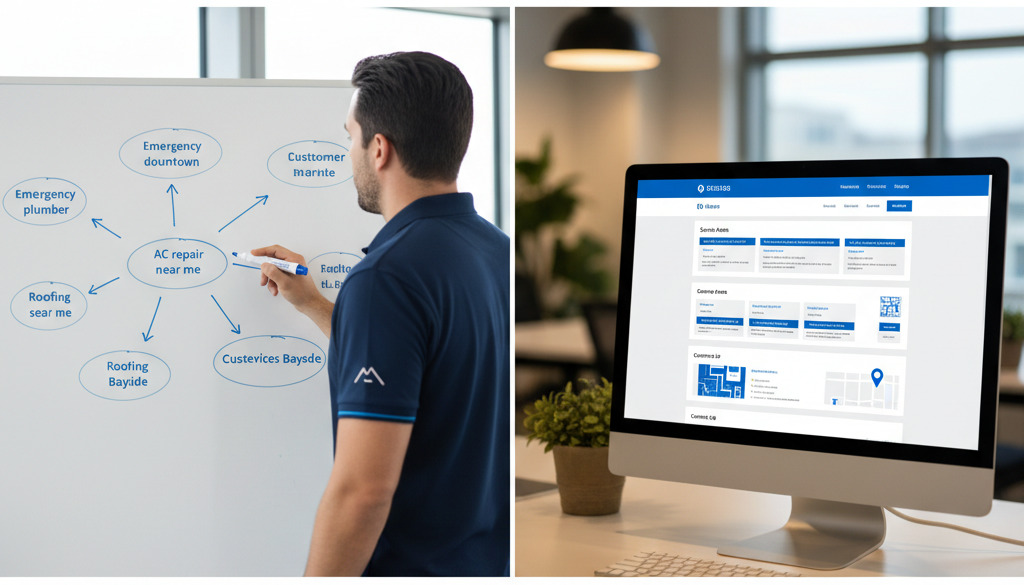
Effective local SEO requires you to think like your customers. What words and phrases are they typing into Google? While including your city name is important, a truly effective strategy goes much deeper. You need to target long-tail local keywords—longer, more specific phrases that indicate a strong intent to buy.
Finding Your Local Keyword Gold
Here’s how to uncover these valuable keywords:
- Think Hyper-Locally: Brainstorm keywords that include specific neighborhoods, districts, or well-known local street names (e.g., "water heater installation in the Heights" instead of just "in Houston").
- Use Modifiers: Add words like "emergency," "affordable," "best," "24-hour," or "near" to your core service keywords (e.g., "24-hour AC repair near downtown Phoenix").
- Answer Questions: Structure your content to answer common questions. These often make great long-tail keywords (e.g., "how much does it cost to fix a clogged drain"). Check out this guide on AI-powered keyword research for more advanced strategies.
- Look at "People Also Ask": When you search for one of your services on Google, look at the "People Also Ask" box. This is a goldmine of related questions and keywords your customers are searching for.
By building content around these specific, long-tail phrases, you face less competition and attract customers who are much further along in the buying cycle.
Structuring Content for Local Search Engine Understanding
Even the best content can fail if search engines can't understand it. Proper structure not only makes your content easier for human visitors to read but also provides a clear roadmap for search engine crawlers, including the AI systems that generate summary answers.[2]
Implementing a Clear Content Hierarchy
- Use Headings Correctly: Your page title should be the main heading (H1). Use H2 headings for major subtopics and H3 headings for points within those subtopics. This creates a logical outline. For example:
- H1: Residential Plumbing Services in Austin
- H2: Our Drain Cleaning Services
- H3: Kitchen Drain Clogs
- H3: Bathroom Drain Clogs
- H2: Water Heater Repair and Installation
- Keep Paragraphs Short: Large walls of text are intimidating on any screen, especially on mobile. Keep your paragraphs to 2-3 sentences to make your content scannable.
- Use Lists: Bulleted and numbered lists are perfect for breaking down services, benefits, or processes into digestible points.
- Implement Local Business Schema: Schema markup is a piece of code you add to your website that explicitly tells search engines details about your business, such as your address, phone number, hours, and review ratings. It’s like a cheat sheet for Google, significantly improving its ability to display your information correctly in local results.
The Art of Local Link Building: Earning Trust and Authority
A "link" is when another website points to yours. In SEO, links act as votes of confidence. When a reputable, locally-relevant website links to you, it signals to Google that your business is a trusted authority in your area. Local link building is the process of earning these valuable votes.
Actionable Tactics for Local Links
Forget complex, spammy tactics. The best local links come from real-world relationships and community engagement.
- Local Directories and Citations: Get listed on major directories like Yelp, Angi, and any industry-specific portals. Consistency is key (see the NAP section below).
- Chamber of Commerce: Joining your local Chamber of Commerce almost always comes with a link from their high-authority website.
- Local Sponsorships: Sponsoring a local youth sports team, a charity event, or a community festival often results in a link from their website. This is great for both SEO and brand building.
- Partnerships with Other Local Businesses: Partner with non-competing businesses that serve a similar clientele. For example, a roofer could partner with a real estate agent. You can promote each other and link to each other's websites.
- Host a Local Event or Workshop: This can attract attention and links from local news outlets, bloggers, and community calendars.
Harnessing the Power of Online Reviews for Local SEO
Online reviews are not just for customers; they are a direct and powerful local search ranking factor. Google’s algorithm sees a steady stream of positive reviews as a strong signal that your business provides a high-quality experience, and it will reward you with better visibility. Furthermore, a high star rating and glowing testimonials directly influence a customer’s decision to contact you over a competitor.
Strategies for Generating and Managing Reviews
- Just Ask: The most effective way to get reviews is to ask for them. Instruct your team to ask satisfied customers at the end of a service or transaction.
- Make It Easy: Provide customers with a direct link to your Google Business Profile review section. You can send this via email, text message, or even a QR code on an invoice.
- Respond to Every Review: This is non-negotiable. Thank customers for positive reviews. For negative reviews, respond professionally and publicly offer to resolve the issue offline. This shows potential customers that you care and are proactive.
- Leverage Reviews in Your Content: Feature your best reviews directly on your website’s homepage and service pages. This is powerful social proof.
Creating Location-Specific Content Beyond Your Service Pages
To truly become a local authority, you must create content that demonstrates your deep connection to the community. This means going beyond your service pages and publishing blog content that locals will find genuinely useful and interesting. This is a key part of an advanced local SEO content strategy.
Ideas for Hyper-Local Blog Content
- Community Guides: Write a guide to the "Best Dog-Friendly Parks in [Your Neighborhood]" if you're a veterinarian, or the "Top 5 Hiking Trails Near [Your City]" if you sell outdoor gear.
- Neighborhood Spotlights: Feature a specific neighborhood you service each month. Talk about its history, landmarks, and why you enjoy working there.
- Local Event Recaps or Previews: If you sponsor or participate in a local festival, farmer's market, or charity run, write a blog post about it. Include pictures and tag other participants.
- Case Studies of Local Jobs: Write a post about a recent project you completed in a specific area. "How We Solved a Complex Roofing Challenge in the [Neighborhood Name] Historic District." Be sure to get customer permission.
This type of content shows you are an integrated member of the community, not just another faceless company. It builds powerful local relevance signals and can attract links and social media shares from other local entities.
The Role of Citations and NAP Consistency Across the Web
A "citation" is any online mention of your business’s Name, Address, and Phone number (NAP). These can appear in online business directories (like Yelp, Yellow Pages, Angi), on social media sites, or on other local websites. Google uses these citations to verify the legitimacy and location of your business.
The most important rule of citations is NAP Consistency. The way your name, address, and phone number are listed must be absolutely identical everywhere. For example, if your GBP lists "Main Street," your Yelp profile should not say "Main St." These tiny variations can confuse search engines and dilute the power of your local SEO signals.
How to Manage Your Citations
- Audit Your Current Citations: Use an online tool or manually search for your business to see where it’s listed and identify any inconsistencies.
- Build Foundational Citations: Ensure you have complete and consistent listings on the top 50+ major data aggregators and directories.
- Clean Up Incorrect Citations: This can be tedious, but it's crucial. You must contact each site with an incorrect listing and request a correction.
Overcoming the Content Creation Hurdle: Time-Saving Tactics
We’ve covered a lot of different types of content: service pages, location pages, blog posts, and more. For a busy small business owner, the immediate reaction is often, "I don't have time for all of this." This is the single biggest hurdle to successful content marketing, but it can be overcome with the right approach.
Practical Methods for Efficient Content Production
- Batch Your Content: Instead of trying to write one blog post every week, set aside one day a month to outline and draft four posts at once. This "assembly line" approach is far more efficient.
- Repurpose Existing Materials: Do you have a brochure explaining your services? Turn those points into a service page. Did you answer a customer's question thoroughly via email? Polish it up and turn it into a blog post.
- Create Templates: Develop a standard template for your service pages and local case studies. This way, you’re just filling in the blanks each time instead of starting from scratch.
- Outsource with AI: The most significant leap in efficiency comes from leveraging technology built specifically for this problem.

Introducing AI-Powered Content Generation: A Game Changer for Small Businesses
For decades, creating content meant one of two things: spending countless hours writing it yourself or paying expensive agencies and freelancers. Today, there’s a third option that is revolutionizing how small businesses compete online: AI-powered content generation.
Modern AI is now capable of writing professional, well-researched, and SEO-optimized articles in minutes. This is not about creating generic, robotic text. It’s about using a powerful tool to do the heavy lifting of research, drafting, and formatting, so you can focus on ensuring the final piece reflects your brand’s voice and expertise.
The "More Customers From Your Blog" Approach
For example, our service was built specifically for business owners who know they need online content but don't have the time or desire to create it. Our proprietary AI writes professional SEO articles directly for your website—almost like magic. The entire process is designed to be effortless for you, with a single goal: to create content that helps customers find you on their own in Google.
This approach solves the core dilemma of time versus expertise. Instead of staring at a blank page, you get a fully drafted, locally-optimized article ready for your review. It’s a strategy already being used by over 500 companies to scale their online presence and attract a steady stream of local leads.
Crafting a Local Content Calendar: The Power of Planning
Consistency is key in SEO. Publishing content sporadically whenever you have a spare moment is far less effective than following a deliberate plan. A content calendar is a simple schedule that maps out what content you will publish and when. This ensures a steady drumbeat of local signals for Google and keeps your audience engaged.
A Simple Framework for Your Calendar
- Choose a Monthly Theme: Dedicate each month to a specific service or topic. For example, a landscaping company could focus on "Spring Cleanup" in March, "Lawn Fertilization" in April, and "Patio Design" in May.
- Identify Key Local Dates: Look at the calendar for local holidays, annual festivals, or seasonal events relevant to your business and plan content around them.
- Mix and Match Content Types: Plan for a mix of content. Your calendar might include one new service page, two local blog posts, and one customer case study per month.
- Integrate AI and Human Review: Schedule time not just for creating content, but for reviewing it. You can have AI generate the initial drafts at the beginning of the month, then schedule 30 minutes each week to review and approve them.
Measuring Your Local SEO Content Success: Key Metrics
How do you know if your efforts are actually working? Tracking your performance is crucial for understanding what resonates with customers and where to focus your energy. You don't need to be a data scientist; just focus on a few key metrics.
Metrics That Matter for Local Businesses
- Local Search Rankings: Are you appearing higher in the search results for your target keywords? Is your business showing up in the Local Pack?
- Google Business Profile Insights: GBP provides its own analytics. Pay close attention to:
- Views: How many people saw your profile.
- Searches: The keywords customers used to find you.
- Actions: The most important metric. This tracks website clicks, phone calls, and requests for directions. An increase in actions means your SEO is driving real business.
- Website Traffic from Organic Search: Using a tool like Google Analytics, you can see how many people are visiting your website from unpaid search results.
- Lead Generation: Ultimately, the goal is more business. Track the number of contact form submissions and phone calls that are coming from your website.
Building Trust and Credibility Through Valuable Content
Consistent, high-quality local content does more than just impress search engines; it builds a powerful bond of trust with your customers. When a homeowner finds your helpful blog post on how to prevent frozen pipes in winter, you are no longer just a name on a list. You are a credible, helpful expert. When they eventually need a plumber, you will be the first person they call.
This authoritative content positions you as the go-to expert in your niche and your town. This reputation is invaluable and leads directly to stronger customer loyalty and more word-of-mouth referrals—the lifeblood of any small business.
Staying Ahead of the Competition in Local Search Results
Local SEO is not a "set it and forget it" task. It is a continuous effort. Your competitors are also working to improve their rankings, and Google’s algorithms are constantly being updated. The businesses that win in the long run are the ones that commit to a consistent strategy of creating fresh, relevant content and keeping their online information up-to-date.
By regularly publishing new local blog posts, updating your service pages, and ensuring your GBP is active, you are continually sending signals to Google that your business is active, relevant, and deserves a top spot. This sustained effort is what will keep you ahead of the competition month after month.
Your Next Step: Implementing Effective Local SEO Content
You now have a strategic blueprint for dominating your local search results. The key is to move from learning to doing. Start with the basics: completely optimize your Google Business Profile. Then, identify your most important service and build out a high-ranking local service page for it using the anatomy we described.
Feeling overwhelmed by the content creation part? This is the moment to embrace efficiency. Instead of letting a lack of time stop you, consider a solution built to solve exactly that problem. For those ready to see immediate progress, our AI service, which promises "More Customers from your Blog," offers a risk-free way to start. Your first 5 SEO blog posts are completely free, allowing you to see the quality and impact for yourself without any commitment.
Conclusion
Recap: The Path to Local Online Dominance
A strategic and consistent approach to local SEO content is the key to sustainable growth for any small business. By focusing on a well-optimized Google Business Profile, creating content that matches local search intent, and building authority through reviews and local links, you can ensure customers find you at the exact moment they need you. We’ve shown that even with limited time and resources, powerful and accessible strategies can place you at the top of local search results.
Final Encouragement and Call to Action
The journey to the top of Google may seem daunting, but it starts with a single step. Choose one action from this guide and implement it this week. Claim and optimize your GBP. Outline one helpful blog post. Ask one happy customer for a review. By taking small, consistent actions, you build momentum that will lead to more traffic, more leads, and more growth for your business. Start today, and you will be well on your way to attracting more local customers than ever before.
Frequently Asked Questions
1. What's the difference between regular SEO and local SEO?
Regular (or traditional) SEO focuses on ranking a website for broad keywords on a national or global scale (e.g., "how to write a blog post"). Local SEO is geographically constrained. It focuses on ranking your business for searches performed by people in your specific service area (e.g., "best Italian restaurant in Boston"). It involves a different set of signals, such as your Google Business Profile, local citations (NAP), and location-specific keywords.
2. How long does it take for local SEO to start working?
While some quick wins can be seen in a few weeks (like optimizing your Google Business Profile), a comprehensive local SEO strategy is a long-term investment. Generally, you can expect to see meaningful movement in rankings and traffic within 3 to 6 months of consistent effort. Factors that influence the timeline include the level of competition in your market, your starting point, and the consistency of your content and link-building efforts.
3. Can I do local SEO myself, or do I need to hire someone?
You can absolutely start local SEO yourself, especially if you have more time than budget. Following the foundational steps in this guide—optimizing your GBP, ensuring NAP consistency, and encouraging reviews—can make a significant impact. However, for a busy business owner, the content creation aspect can be very time-consuming. This is where using AI tools or hiring a specialist can provide a major advantage, allowing you to get expert-level results without sacrificing your time.
4. Is having a website necessary for local SEO?
While your Google Business Profile is incredibly powerful and can function as a mini-website, a dedicated professional website is still highly recommended and almost essential for competitive markets. Your website gives you full control over your brand message, allows you to create detailed service and location pages, and is the best platform for hosting in-depth blog content. It acts as the central hub for all your local SEO efforts, reinforcing the signals you send with your GBP.
5. What is the most important thing to focus on for a beginner?
If you are just starting out, your number one priority should be to claim, verify, and completely fill out your Google Business Profile (GBP). This single action will have the biggest and fastest impact on your visibility in local search and on Google Maps. Ensure every section is complete: accurate NAP, correct categories, high-quality photos, business hours, and a detailed description. This is your foundation.
6. How much does local SEO cost?
The cost of local SEO can vary widely. If you do it yourself, the primary cost is your time. If you hire a freelancer or an agency, retainer fees can range from a few hundred to several thousand dollars per month, depending on the scope of work and your market's competitiveness. A more modern, cost-effective approach is using AI-powered content services. These tools can handle the heavy lifting of content creation for a fraction of the cost of traditional agencies, making them an excellent option for small businesses.
Keep reading
Hand-picked guides that go deeper — open the one you need next:
- Google Business Profile AI: Strategy & Optimization Guide
- AI Content Strategy for Small Business SEO
- AI for Google Profile: Publish Location Blogs
- Local SEO Supercharged: AI for Hyper-Targeted Content
→ Read the full Small Business guide