
Google Business Profile AI: Strategy & Optimization Guide

In the rapidly shifting landscape of local digital marketing, the integration of Artificial Intelligence (AI) into Google Business Profile (GBP) represents the most significant paradigm shift since the platform's inception.[1] For the modern business owner, staying visible no longer relies solely on accurate NAP (Name, Address, Phone number) data; it requires a sophisticated understanding of how Google's machine learning algorithms interpret intent, sentiment, and local relevance. This deep dive explores how Google Business Profile AI is fundamentally changing the way businesses interact with customers and optimize their digital storefronts.
I. The Evolution of Google Business Profile: From Simple Listings to Intelligent Platforms
The journey of Google's local business tools has been one of increasing complexity and utility. Originally launched as Google Places in the early 2000s, the platform functioned essentially as a digital version of the Yellow Pages—a static directory where business owners could claim their location and ensure their phone number was correct. During this era, the "optimization" of a listing was a one-time task rather than an ongoing strategy.
As the mobile revolution took hold, Google transitioned the service into Google My Business (GMB). This move signaled a pivotal shift toward interactivity. Google introduced features like "Posts," direct messaging, and a more robust Q&A section, transforming the listing from a static card into a dynamic communication hub. This shift empowered customers to engage directly with brands through the search results page, creating a treasure trove of unstructured data—reviews, questions, and clicks—that Google would soon use to train its most advanced systems.
Today, the platform is known as Google Business Profile, and the "GMB" moniker has been retired to reflect a more integrated, AI-first approach. We are currently witnessing the "AI Infusion" phase, where Google’s broader advancements in Large Language Models (LLMs) and neural networks are being hardcoded into the GBP dashboard. No longer just a place to host information, GBP has become an intelligent platform that can draft content, summarize thousands of customer sentiments in seconds, and offer predictive advice on how to outrank local competitors.
II. Understanding the Core AI Capabilities Driving Google Business Profile
To leverage Google Business Profile AI effectively, one must understand the three pillars of technology holding up the architecture: Natural Language Processing (NLP), Machine Learning (ML), and Generative AI.
Natural Language Processing (NLP) for Insights
Google uses NLP to "read" and understand the context of every review and question posted to your profile. This goes beyond keyword matching. For example, if a customer writes, "The atmosphere was cozy but the service was a bit slow," NLP identifies two distinct sentiments: a positive one regarding "ambience" and a negative one regarding "waiting times." Google aggregates these thousands of micro-insights to provide businesses with sentiment analysis reports, highlighting what you are doing well and where you are failing, often before you even notice a trend in your sales data.
Machine Learning (ML) for Personalization and Ranking
The local "Map Pack" is governed by ML algorithms that weigh distance, relevance, and prominence. However, AI has made these factors hyper-personal. If a user frequently visits vegan restaurants, Google’s ML will prioritize listings for "restaurants near me" that have a high density of "vegan" keywords in their AI-summarized reviews, even if a non-vegan steakhouse is technically closer to the user's physical location. The ranking is no longer universal; it is tailored to the individual searcher's history and intent.
Generative AI for Content Creation
Generative AI is the newest and most visible addition. Google is currently piloting features that allow business owners to generate entire business descriptions simply by providing a few bullet points. In 2026, we are seeing the rollout of "AI-assisted responses" where the system reads a review and suggests a professional, context-aware reply for the owner to approve or edit. This reduces the friction of profile management, ensuring that even busy entrepreneurs can maintain a high response rate.
III. AI-Powered Features Transforming Business Operations on GBP
The integration of Google Business Profile AI isn't just theoretical; it manifests in specific tools that streamline daily operations for local businesses. One of the most impactful features is Automated Review Summarization. Instead of scrolling through hundreds of reviews, potential customers now see a "Review Highlight" section generated by AI. This section might say, "Customers often mention the high-quality organic coffee and fast Wi-Fi, but some noted that seating is limited during lunch hours." This gives the consumer an instant snapshot, making the decision-making process faster.
Furthermore, Intelligent Q&A Management is changing the "set it and forget it" nature of local search. When a user begins typing a question into the Q&A box, Google Business Profile AI can now surface "Proactive Answers." By scanning your existing posts, business description, and even your website content, the AI can present an answer before the user even hits "submit." For instance, if a user starts typing "Do you have outdoor seating?" the AI can instantly provide a response based on a photo caption or a previous review mentioning the patio.
Performance insights have also received an AI makeover. Traditional analytics showed you how many people clicked your phone number. AI-driven insights now provide "Search Query Themes," telling you not just *that* people found you, but the specific *intent* behind the search. It might suggest, "Your profile is frequently shown for 'quiet workspaces,' consider adding more photos of your seating area to increase conversions."
IV. The Tangible Benefits of AI Integration for Local Businesses
The primary benefit of Google Business Profile AI is enhanced visibility. Because AI can better understand the nuances of a business, long-tail search queries (e.g., "best place to get a gluten-free birthday cake for kids within 5 miles") are more likely to lead to a business that has optimized its profile with AI-rich content. This levels the playing field for small businesses that may not have the budget for massive SEO campaigns but have excellent, highly-rated service that the AI can detect through customer feedback.
Efficiency is the second major win. For a small business owner, responding to reviews can take hours every week. AI response suggestions can cut this time by up to 70%. By providing a draft that includes the customer's name and mentions specific details from their review, the owner only needs to spend seconds performing a "sanity check" and hitting send. This ensures that the business maintains a high engagement score, which is a known ranking factor in Google’s local algorithm.
Finally, there is the benefit of Improved Customer Satisfaction. When AI helps a business identify that three different customers mentioned a "broken door handle" in the last week through sentiment analysis, the business can fix it immediately. Without the AI's ability to aggregate and highlight that specific pain point, those reviews might have been buried under generic "great service" comments, resulting in continued customer frustration.
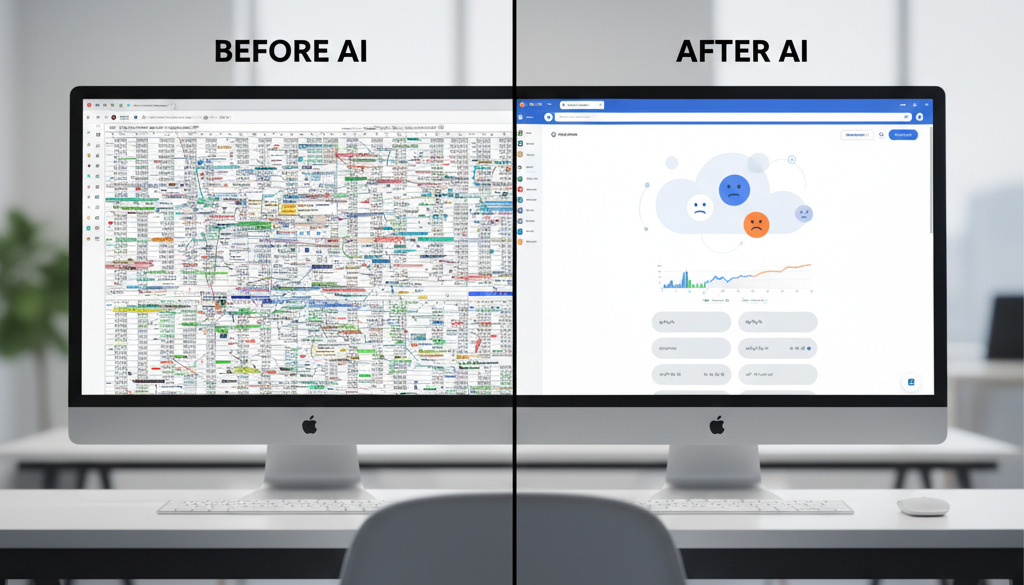
V. Optimizing Your Google Business Profile with AI: A Strategic Approach
Optimization in the AI era requires a blend of data-driven decisions and creative refinement. It is no longer enough to just "fill out the form." Business owners must learn to "feed the machine" the right information.
Analyzing Review Sentiment
Don't just look at your star rating. Use the Google Business Profile AI dashboard to look for recurring keywords in the sentiment analysis section. If the AI identifies "Value for Money" as a neutral or negative sentiment, it’s a signal to adjust your pricing transparency or highlight the premium nature of your components in your "Posts" section.
Discovering Customer Needs
Monitor the "Questions people ask" section, even the ones that have been answered. If AI shows a high volume of searches or questions about a service you don't yet offer—for example, "do you offer curbside pickup?"—this is AI-driven market research. Implementing that service based on search trends can provide a massive competitive jump.
Crafting Effective Business Descriptions
When using AI to draft your business description, don't accept the first iteration. Use a "Human-in-the-Loop" approach. Take the AI's technically accurate draft and inject your brand's unique voice. Ensure it includes local landmarks or community-specific references that a general AI might miss, as these add to your local "prominence" score.
Understanding Performance Analytics
Review the AI-powered "Business Profile Performance" reports monthly. Pay close attention to "Direct" vs. "Discovery" searches. If your discovery searches are dropping, the AI likely finds your content stale. Use the AI recommendation tool to identify which photos or posts are currently resonating with your local audience and double down on that content type.
VI. Ensuring Authentic Communication: The Role of Human Oversight in AI-Driven GBP
Despite the efficiency of Google Business Profile AI, human oversight remains non-negotiable. AI models, while sophisticated, can occasionally hallucinate or miss the emotional nuance of a disgruntled customer. A customer who writes a deeply emotional review about a bad experience at a funeral home, for example, should never receive a generic AI-suggested response like, "Thanks for stopping by! Hope to see you again soon!"
Maintaining a Brand Voice is also a human task. AI tends to gravitate toward a safe, corporate-neutral tone. If your business is a high-energy fitness center or a quirky boutique, you must edit AI-generated content to ensure the "personality" of your physical location is reflected online. This "Digital Twin" of your business needs to feel authentic, or customers will experience cognitive dissonance when they walk through your doors.
Ethical communication also involves transparency. While you don't necessarily need to label every response as "AI-generated," using automation to fake a sense of connection can backfire. The goal of AI within GBP should be to facilitate better human outcomes, not to replace the human element entirely. Always review AI-suggested responses for accuracy regarding store hours, specific staff names, or unique policy changes.
VII. Addressing Potential Challenges and Ethical Considerations
One of the most persistent challenges with Google Business Profile AI is the "Black Box" problem. Sometimes, a business might see their ranking drop or a perfectly valid review filtered out without a clear explanation. Because ML algorithms are complex, even Google's support staff can sometimes struggle to explain exactly why the AI made a certain decision. Businesses must remain agile, testing different types of content to see what currently "satisfies" the algorithm.
Accuracy and Bias are also significant concerns. If an AI model was trained on data that inadvertently favors larger chains over independent shops, small businesses could face a systemic disadvantage. Furthermore, if the AI incorrectly summarizes a review—perhaps missing sarcasm or local slang—it could display a "highlight" that misrepresents the business to thousands of potential customers. It is the business owner's responsibility to periodically verify that AI-generated summaries are factually correct.
Finally, Data Privacy remains a hot-button issue. As Google uses interactions on your profile to train more advanced models, business owners should be mindful of the information they share in messages and Q&A. While Google has robust security, the "AI for Main Street Act" and similar upcoming legislations indicate that the regulatory environment regarding how AI uses business data is still evolving.
VIII. Case Studies: Businesses Thriving with AI-Enhanced Google Business Profiles
In Austin, Texas, a local HVAC company utilized Google Business Profile AI's sentiment analysis to overhaul their business model. After the AI highlighted a recurring complaint about "uncertain arrival times," the business implemented a real-time tracking link for their technicians and began posting AI-optimized updates about their new "On-Time Guarantee." Within three months, their "Discovery" search traffic increased by 45%, as the AI promoted their profile for keywords related to "reliable" and "fast" HVAC services.
For a multi-location dental practice in Florida, managing 15 separate profiles was a logistical nightmare. By utilizing integrated AI management tools, they were able to maintain a 100% response rate to reviews across all locations. The AI helped identify that while the Miami office was praised for its "modern equipment," the Orlando office was winning on "friendly staff." They used these AI-generated insights to cross-train staff and synchronize their marketing message, leading to a 20% increase in patient bookings system-wide.
Even niche businesses, like a boutique yarn shop in Vermont, have seen success. By responding to AI-suggested performance prompts to "add photos of popular products," the owner began posting AI-assisted descriptions of new wool arrivals. These posts, optimized for local search intent, led to a surge in out-of-town visitors who found the shop through "near me" searches while on vacation.
IX. The Future of AI in Google Business Profile: Predictive Insights and Hyper-Personalization
Looking toward 2026 and beyond, we can expect Google Business Profile AI to move from "reactive" to "predictive." Imagine a dashboard that tells you, "Based on local search trends and upcoming weather patterns, we expect a 30% increase in demand for snow removal services next week. Would you like to schedule a promotional post now?" This level of predictive analytics will transform local businesses from passive participants to proactive market leaders.
Hyper-personalization will also reach new heights. Future AI iterations may allow for "Dynamic Listings," where the photos and services displayed first on your profile change based on who is looking. If a parent is searching for a restaurant at 5:00 PM, the AI might show photos of the high chairs and the kids' menu. If a couple is searching at 8:00 PM, the same business profile might prioritize photos of the cocktail list and the ambient lighting.
We also anticipate the rise of Conversational Google Business Profiles. Instead of just reading a profile, users might interact with a business-specific AI agent that can handle complex bookings, check live inventory, or provide detailed quotes based on the business's data—all within the Google search interface. This integration with Google’s broader AI initiatives, like Gemini and the Search Generative Experience (SGE), will make the GBP the central nervous system of local commerce.
X. Actionable Strategies for Businesses to Prepare for an AI-Driven GBP Landscape
To prepare for this future, businesses must prioritize Data Quality. AI is only as good as the information it is fed. Ensure every field in your GBP is filled out, your services are meticulously listed, and your hours are always 100% accurate. Inconsistent data confuses AI, which leads to lower rankings and lost trust.
Investing in Digital Literacy is equally important. Business owners should familiarize themselves with how "Search Generative Experience" works and how it pulls data from local profiles. Understanding the mechanics of AI-generated title links and review summaries will allow you to write content that the AI can easily parse and promote.
Finally, never lose sight of the Customer Experience. AI can get a customer through your door, but it cannot provide the service that keeps them coming back. Use AI to handle the "administrative burden" of digital marketing, but reinvest that saved time into person-to-person interactions. High-quality, authentic human experiences lead to the positive reviews and high engagement that the AI needs to prove your business is the best in town.
XI. Conclusion: Embracing the AI Revolution in Local Search
The rise of Google Business Profile AI is not a threat to local businesses; it is a powerful equalizer. By automating the mundane and providing deep, actionable insights into consumer behavior, AI allows small and medium-sized enterprises to compete with national brands on a global stage—all while remaining rooted in their local communities. The businesses that flourish in the coming years will be those that view AI as a collaborative partner—a tool that enhances their visibility, sharpens their operations, and allows them to focus on what they do best: serving their customers.
As we move deeper into this AI-driven era, the goal remains the same as it was in the days of paper directories: connecting people with the services they need. The tools have simply become more intelligent. By embracing these advancements today, you are not just optimizing a profile; you are future-proofing your business for the next generation of local search.
Keep reading
Hand-picked guides that go deeper — open the one you need next:
- Local SEO Made Easy: AI Content for Small Businesses
- AI SEO Guide for Small Businesses
- Small Business SEO Success: The Ultimate 2026 Growth Guide
- AI Content Strategy for Small Business SEO
→ Read the full Small Business guide