
Small Business SEO Success: The Ultimate 2026 Growth Guide
In the rapidly evolving digital marketplace, search engine optimization (SEO) has shifted from a "nice-to-have" marketing tactic to the absolute cornerstone of small business survival.[2] As we navigate the complexities of 2026, the landscape is no longer just about ranking for a few keywords; it is about establishing a comprehensive digital footprint that captures visibility across traditional search engines, AI-driven generative engines, and localized discovery platforms.[1] For the local hardware store, the boutique law firm, or the neighborhood bakery, SEO provides a level playing field, allowing smaller entities to outmaneuver corporate giants by claiming high-intent local traffic.
The goal of this guide is to move beyond the surface-level advice of "writing good content." We seek to provide a sophisticated, business-centric roadmap to small business SEO success. By focusing on high-impact strategies—ranging from technical foundations and local dominance to the emerging world of Generative Engine Optimization (GEO)—this article equips business owners and marketing directors with the actionable insights necessary to drive sustainable growth and measurable ROI.
I. Understanding the SEO Landscape for Small Businesses
For a small business, SEO is fundamentally different from the broad, national strategies employed by enterprise-level corporations. While a multinational retailer may focus on high-volume, generic terms, small business success is rooted in "Local SEO." This subset of optimization focuses on appearing in search results within a specific geographic area. The objective is not just traffic, but proximity-based relevance. When a user in your town searches for a service you provide, yours is the name they must see first.
The primary goals of small business SEO are three-fold: driving physical foot traffic, increasing local brand awareness, and generating high-quality digital leads. In 2026, this landscape is increasingly influenced by "Zero-Click Searches," where users find the answer to their query (like your phone number or hours) directly on the search results page without ever clicking through to your website. Consequently, success is measured not just by web sessions, but by "conversions" occurring across the entire Google ecosystem.
To navigate this, one must understand core concepts like "Search Intent"—the "why" behind a query. Is the user seeking information (Informational), looking for a specific brand (Navigational), or ready to make a purchase (Transactional)? Small businesses thrive by dominating transactional local queries where the intent is high and the location is immediate.
II. Laying the Foundation: Website Structure and Technical SEO
Before launching a content campaign, your digital infrastructure must be flawless. A technically deficient website acts as a leaky bucket; no matter how much traffic you pour in, it will fail to retain value or rank effectively. Technical SEO ensures that search engine crawlers can easily access, index, and understand your site.
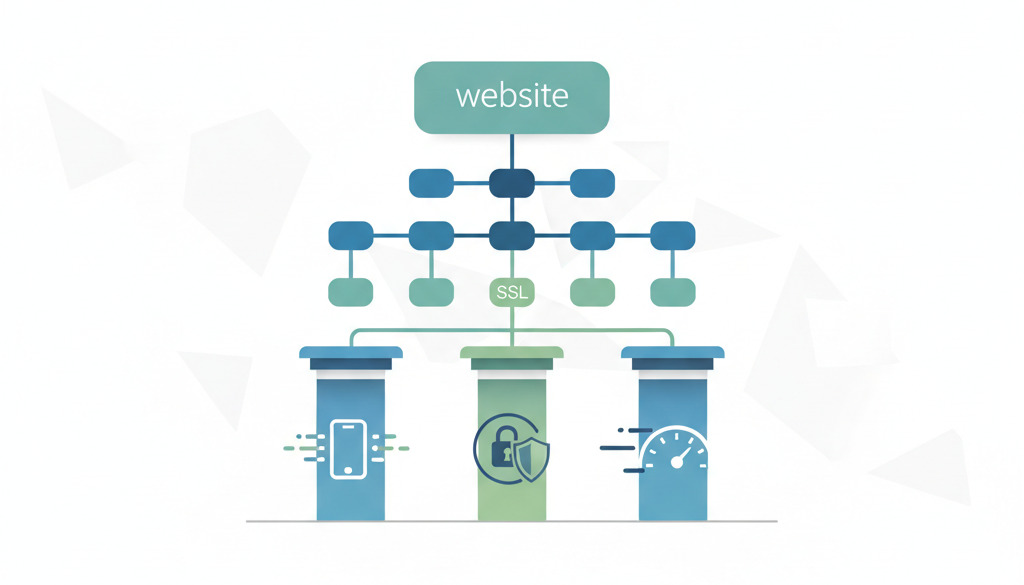
The modern standard for technical performance is non-negotiable. Mobile-friendliness is no longer a "feature"—it is the baseline, as Google utilizes mobile-first indexing for virtually all sites. Furthermore, site speed is a critical ranking factor and a massive driver of user experience. Recent data indicates that sites loading in under two seconds have significantly higher conversion rates than those taking even a second longer. Ensuring a secure connection via HTTPS is equally vital, not just for SEO, but for building the consumer trust necessary to handle transactions or personal data.
Your website architecture should follow a logical, hierarchical structure. A "flat" architecture, where any page can be reached within three clicks from the homepage, is ideal. This is supported by strategic internal linking, which distributes "link equity" (ranking power) throughout your site and helps search engines understand the relationship between different pages. Finally, the implementation of a clean XML sitemap and a correctly configured robots.txt file provides a clear roadmap for search bots, ensuring your most important pages are prioritized for indexing.
III. Mastering Local Keyword Research and Strategy
Keywords are the bridge between a customer's problem and your business's solution. For small businesses, the secret to success lies in granularity. While it may be tempting to target a broad term like "Plumber," the competition is immense and the intent is vague. Instead, the strategy must pivot toward "Local Long-Tail Keywords" and "Service-Area Modifiers."
Effective research involves identifying terms like "emergency drain cleaning in [City Name]" or "best family law attorney [City Name]." These phrases represent a lower search volume but a significantly higher conversion rate because they match specific, urgent needs with geographic proximity. Using tools such as Google Keyword Planner, SEMrush, or even the "People Also Ask" section of search results can reveal the specific language your local audience uses.
In 2026, we must also account for "Natural Language Queries." With the rise of voice search and AI assistants, people are searching in full sentences (e.g., "Where can I find a gluten-free bakery near the train station?"). Your keyword strategy should incorporate these conversational phrases into your FAQ sections and blog content to capture this growing segment of the market.
IV. Crafting High-Quality, Search-Optimized Content
Content is the vehicle through which you demonstrate authority and relevance. However, "thin" content—short, repetitive pages that offer little value—can actually harm your rankings. High-quality content must satisfy the user's search intent while adhering to Google's "E-E-A-T" principles: Experience, Expertise, Authoritativeness, and Trustworthiness.
On-page optimization is the process of making this content "legible" to search engines. This includes placing your primary keywords naturally within the H1 title tags, subheadings (H2, H3), and the first 100 words of the body copy. Meta descriptions, while not a direct ranking factor, serve as your "ad copy" in search results and must be optimized to drive clicks. Furthermore, the use of Latent Semantic Indexing (LSI) keywords—terms conceptually related to your main topic—helps search engines verify the depth of your content.
Visual assets are often overlooked but are essential for engagement. Images must be optimized for speed (using formats like WebP) and should include descriptive "alt text." This not only improves accessibility for visually impaired users but also allows your images to rank in Google Image Search, creating another entry point for potential customers.
V. The Power of Google Business Profile (GBP) for Local Dominance
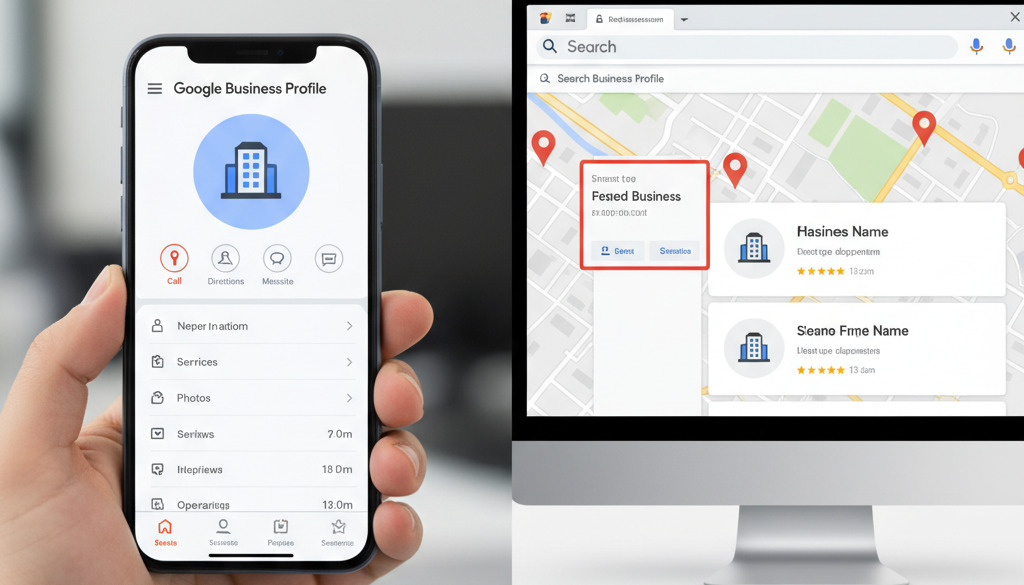
If you were to invest in only one SEO tool, it should be your Google Business Profile (GBP). Formerly known as Google My Business, this platform is the engine behind the "Local Map Pack"—the coveted three-business block that appears at the top of local search results. For a small business, ranking in the Map Pack is often more valuable than ranking #1 in organic results.
Optimizing your GBP is a continuous process. It begins with claiming and verifying your listing, and ensuring that every field—from business category to service area—is filled out with precision. The primary factors Google uses to rank these profiles are Proximity (how close you are to the searcher), Relevance (how well your profile matches the query), and Prominence (the overall "fame" of your business based on reviews and citations).
To maintain dominance, you must treat your GBP like a social media platform. Regularly post "Updates," share high-quality photos of your recent work, and keep your "Services" section updated. Actively responding to user-submitted questions in the Q&A section also signals to Google that your business is active and reliable, which can positively impact your visibility.
VI. Building Authority Through Local Citations and Link Building
Search engines determine your business's legitimacy by seeing how other reputable sources talk about you. This is the realm of "Off-Page SEO," focusing on citations and backlinks. A citation is any online mention of your "NAP"—Name, Address, and Phone number. Consistency is paramount here; if your address is listed as "123 Main St" on Yelp and "123 Main Street" on your website, search engines may perceive this as a lack of data integrity, which can suppress your rankings.
Beyond standard directories like Yellow Pages or Angie’s List, small businesses should focus on "Hyper-Local Citations." Mentions from your local Chamber of Commerce, neighborhood blogs, or local news outlets carry immense weight because they confirm your geographic relevance to the search engine. Navigating these relationships by sponsoring a local Little League team or joining a regional business association often results in high-quality local links.
In link building, the mantra is always "Quality over Quantity." One link from a high-authority local newspaper or an industry-specific trade organization is worth more than hundreds of low-quality, spammy links. Focus on building real-world relationships that naturally lead to digital endorsements.
VII. Leveraging Online Reviews and Reputation Management
In the digital age, your reputation is a ranking factor. Google’s algorithms are designed to recommend the "best" options to users, and online reviews are the most visible metric of quality. A high volume of positive, four- and five-star reviews significantly boosts your "Prominence" in the local algorithm. Furthermore, reviews that contain specific keywords related to your services (e.g., "Their HVAC repair was fast and affordable") help reinforce your relevance for those terms.
Active reputation management is essential. Small businesses should have a systematic approach to asking for reviews—perhaps via a follow-up email or a QR code at the point of sale. However, the work doesn't stop at receiving a review. Your response is equally important. Responding to positive reviews builds loyalty, but responding professionally to negative reviews is a critical damage-control move. It shows prospective customers that you are accountable and dedicated to customer satisfaction.
Monitoring mentions across the web—not just on Google, but on platforms like Yelp, Facebook, and TripAdvisor—ensures you can address feedback in real-time. This active engagement creates a positive feedback loop: better reviews lead to higher rankings, which lead to more customers, who then provide more positive reviews.
VIII. Measuring Success: Analytics and Performance Tracking
SEO is not a "set it and forget it" strategy; it is a cycle of action, measurement, and refinement. Without data, you are essentially flying blind. To track small business SEO success, you must focus on Key Performance Indicators (KPIs) that align with actual business growth. These include Organic Traffic (users arriving via search), Keyword Rankings for your core services, and Local Pack Visibility.
Google Analytics 4 (GA4) and Google Search Console (GSC) are the dual pillars of measurement. GA4 allows you to see what users do once they arrive on your site—which pages they visit and where they drop off. GSC, on the other hand, shows you how you are performing before users click, providing data on "impressions" (how many times you were seen) and "click-through rates" (CTR). Crucially, you should track "conversions," such as form submissions, clicks on your phone number, or directions requests, to determine your true Return on Investment.
Data should be reviewed monthly. If you notice a page is getting high impressions but low clicks, your title or meta description may need a rewrite. If traffic is high but conversions are low, your website's user experience (UX) likely needs improvement.

IX. Advanced Tactics for Sustained Small Business SEO Growth
As the basics become standard, competitive advantage is found in advanced tactics. One such area is "Schema Markup." This is a type of structured data code you add to your website to help search engines understand the specific nature of your content. For a small business, LocalBusiness Schema can tell Google your exact hours, menu, price range, and even your logo, which can result in "Rich Snippets"—more detailed and visually appealing search results that have higher click-through rates.
Another emerging frontier is Generative Engine Optimization (GEO). As AI tools like ChatGPT and Perplexity become search destinations, businesses must optimize for "brand mentions" within these Large Language Models. This involves appearing in authoritative third-party lists and ensures your brand is frequently mentioned in context with your specialized services across the web.
Finally, do not underestimate the power of Social Signals and Video SEO. Short-form videos (like Reels or TikToks) that answer common customer questions can rank in Google's "Video" tab. These assets provide "Social Proof" and keep users on your digital properties longer, which signals to Google that your brand is authoritative and engaging.
X. Common Small Business SEO Pitfalls to Avoid
The road to SEO success is often littered with well-intentioned mistakes. Perhaps the most common is "Keyword Stuffing"—the outdated practice of cramming as many keywords as possible into a page. This leads to a poor user experience and search engine penalties. Modern algorithms are sophisticated enough to understand context; write for humans first, and optimize for bots second.
Another significant pitfall is "NAP Inconsistency." Minor discrepancies in your business name or phone number across various directories can confuse search engines and dilute your local authority. Similarly, ignoring the "Mobile Experience" is a fatal error. If your site is difficult to navigate on a smartphone, you will lose a significant portion of local searchers who are looking for immediate solutions while on the go.
Lastly, small businesses must avoid "Black-Hat SEO" tactics, such as buying backlinks or using automated content generators without human oversight. Google’s spam filters are increasingly efficient at identifying and de-ranking sites that use these shortcuts. True SEO success requires patience; there are no overnight miracles in organic search, only the steady accumulation of authority and trust.
Conclusion
Achieving small business SEO success in today's environment is an exercise in persistence and precision. By focusing on the structural integrity of your website, mastering the nuances of local keyword research, and maintaining a dominant presence on Google Business Profile, you can effectively bypass larger competitors. The digital landscape will continue to shift as AI and generative search evolve, but the core principles remain the same: providing clear, authoritative, and geographically relevant value to your customers.
Remember that SEO is not a one-time project but a dynamic part of your business operations. Start small—optimize your homepage, claim your profiles, and ensure your NAP is consistent. As you begin to see the influx of organic leads and improved visibility, scale your efforts into advanced content and reputation management. The investment you make in SEO today will serve as the foundation for your business’s growth for years to come. If the technical complexities seem daunting, do not hesitate to consult with an expert who can help you navigate the ever-changing tides of search.
FAQ
What is the most crucial aspect of small business SEO success in 2026?
Local SEO remains paramount, focusing on optimizing your Google Business Profile and local citations. Ensuring your business appears in relevant "near me" searches will drive foot traffic and online engagement.
How can small businesses improve their search engine rankings without a large budget?
Content marketing, especially creating valuable and informative blog posts relevant to your niche, is a cost-effective strategy. Building backlinks through genuine outreach and collaborations also significantly boosts authority.
What role does mobile optimization play in achieving small business SEO success?
Mobile-friendliness is non-negotiable; most searches now happen on mobile devices. A fast-loading, responsive website ensures a positive user experience, which search engines heavily reward.
Keep reading
Hand-picked guides that go deeper — open the one you need next:
- Hyperlocal Marketing AI: Target Local Growth
- Scaling Content for Small Business: A Strategic Framework
- Affordable Content Marketing for Small Business Success
- Local SEO for Small Businesses: Dominate Local Search
→ Read the full Small Business guide