
Measuring Success: ROI of AI-Powered Content Marketing
Key Takeaways
- Defining ROI: The ROI of AI content goes beyond simple cost savings, encompassing increased organic traffic, lead generation, time efficiency, and enhanced brand authority.
- Cost vs. Value: AI drastically reduces the direct costs of content creation (by up to 60-70%), but its true value lies in accelerating the entire content marketing engine, from ideation to publication.
- Strategic Implementation: AI is a powerful tool, not a magic button. Success requires a human-led strategy for keyword targeting, editing, brand voice alignment, and performance analysis.
- The Efficiency Advantage: For busy SMB owners, AI's greatest return is often time. It can reduce content drafting time from days to minutes, freeing you up to focus on running your business.
- Measurement is Key: To prove ROI, you must track metrics like cost per article, website traffic from blog posts, lead conversions, and customer acquisition cost (CAC) attributed to your content.
The Evolving Landscape of Content Marketing ROI
For years, business owners have understood the importance of content marketing. You know you need a blog, you know you need to be on social media, but proving the direct, hard-dollar return on that investment has always been challenging. Traditional metrics like page views and social shares are nice, but they don’t directly pay the bills. This has left many small and medium-sized business (SMB) owners wondering if their content efforts are truly making a difference to the bottom line.
Today, with increasing pressure on every dollar in your marketing budget, the need for efficiency and demonstrable returns is more critical than ever. According to recent industry data, content marketing now accounts for over 26% of the average marketing budget. You need to know that this significant investment is working hard for you. This is where the true challenge lies: connecting your content to tangible business outcomes like leads and sales.
Furthermore, it’s crucial to consider the opportunity cost of inaction. While you deliberate, your competitors are publishing content, capturing search rankings, and attracting your potential customers. The cost isn’t just about what you spend; it’s about the revenue you are missing out on by not having an effective, high-volume content strategy in place. This is the new reality of digital marketing: visibility is a currency, and content is the engine that produces it.
Understanding AI in Content Creation: Beyond the Hype
The term "Artificial Intelligence" can be intimidating, often conjuring images of complex technology far removed from the day-to-day realities of running a business. However, in the context of content marketing, AI is simply a powerful new type of tool—much like your accounting software or your customer relationship management (CRM) system. It’s designed to make a specific business function more efficient.
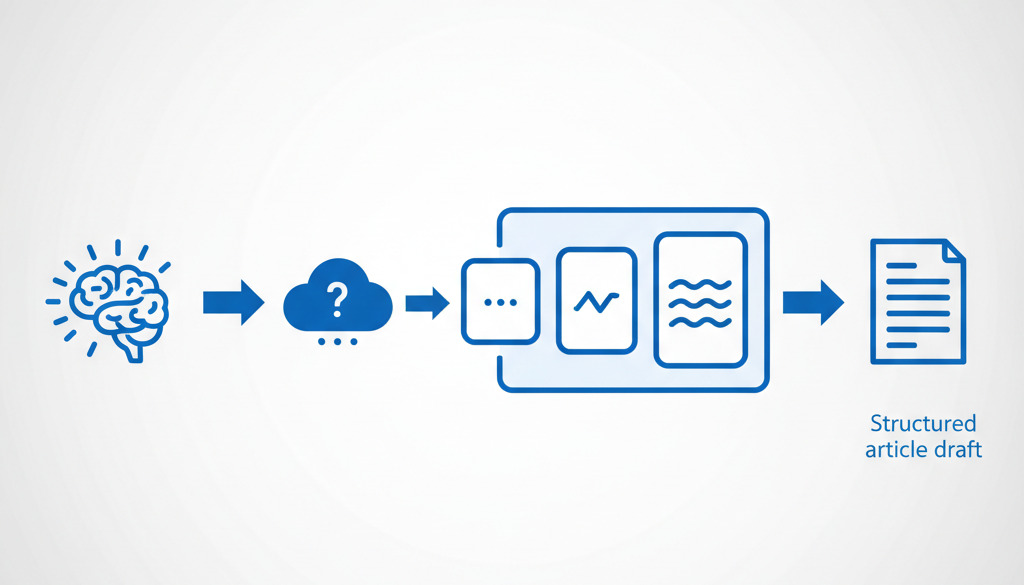
In simple terms, AI content generators are software platforms that use advanced language models to create human-like text based on your instructions. You provide a prompt—such as a topic, a keyword, and a desired tone—and the AI analyzes vast amounts of information on the internet to generate a structured piece of content, like a blog post draft, in response. It’s not magic; it’s a sophisticated pattern-matching and text-generation capability.
What AI Content Generators Do (and Don't Do)
- They DO: Rapidly generate drafts, outline articles, brainstorm ideas, write social media captions, summarize long documents, and help overcome writer's block.
- They DO NOT: Inherently understand your unique brand voice, know your confidential business strategy, or replace the need for human fact-checking and final editing. Think of AI as a brilliant but inexperienced assistant that creates a solid first draft for you, the expert, to refine.
A common fear is that AI-generated content is generic or will be penalized by search engines like Google. However, Google’s official stance is that it rewards high-quality content, regardless of how it is produced. The key is using AI as a tool to create helpful, relevant, and well-written material, not just to churn out low-value pages. Recent data shows that 67% of content marketers are already using AI tools daily, highlighting that adoption is now mainstream and a competitive necessity.
Identifying Key AI Content Marketing Use Cases for SMBs
For a small or medium-sized business, efficiency is paramount. You don’t have large marketing teams to handle every task. AI is uniquely suited to bridge this resource gap by automating and accelerating the most time-consuming aspects of content creation. It’s not about replacing your marketing function but about supercharging it.
Here are some of the most practical and high-impact use cases for SMBs:
- Blog Post Creation: This is the most popular use case. AI can take a target keyword (e.g., "energy-efficient windows for homes") and generate a comprehensive, well-structured article in minutes. This allows you to build out your blog and target dozens of valuable keywords without spending weeks on writing.
- Social Media Content: Coming up with daily posts for Facebook, LinkedIn, or Twitter is a drain on time. AI can generate a month’s worth of social media captions based on your blog topics or promotional calendar, ensuring a consistent and engaging online presence.
- Product and Service Descriptions: Writing compelling, SEO-friendly descriptions for all your products or services can be a tedious task. AI can create unique and persuasive copy for your website and e-commerce pages quickly.
- Email Marketing Copy: From promotional emails to customer newsletters, AI can draft subject lines and body copy designed to improve open rates and click-throughs. It can help you segment your messaging and create more personalized campaigns.
By leveraging AI for these tasks, you can effectively overcome the most common content bottleneck: a lack of time and resources. This allows you to move from thinking about creating content to actually executing a consistent publishing schedule that drives results.
The Direct Link Between AI Content and Organic Search Visibility
The single most powerful benefit of a strong content strategy is organic search visibility. When potential customers search on Google for solutions to their problems, you want your business to show up. The way you achieve this is by consistently publishing high-quality, helpful content that answers their questions and targets the keywords they are using.
This is where AI becomes a game-changer for your SEO (Search Engine Optimization) efforts. It allows you to produce content at a scale and consistency that would be impossible or prohibitively expensive otherwise. Instead of one blog post a month, you can publish one a week—or even more. Each new article is another opportunity to rank on Google for relevant search terms, another digital doorway for customers to find your business.
Think about it: every time a potential customer types a problem into Google that your business solves, they are raising their hand and showing high intent. Being there with a helpful article is the most cost-effective form of marketing there is. Recent studies confirm that content marketing generates three times more leads than outbound marketing at a 62% lower cost.
AI helps you create the volume of *optimized* content needed to build topical authority. This means showing Google that you are an expert in your niche by thoroughly covering a wide range of related topics. When you do this, Google is more likely to rank your pages higher, leading to a steady stream of high-intent, free traffic to your website. Suddenly, the goal of having customers find you automatically on Google, without you spending a fortune on ads, becomes achievable.
Quantifying the Cost Savings of AI Content Generation
One of the most immediate and measurable returns from adopting AI in your content process is a dramatic reduction in direct costs. Traditional content creation involves multiple expensive steps. For business owners who don’t have the time or expertise to write themselves, this has historically meant hiring freelance writers, which comes with significant costs.
Let’s break down the typical cost components of producing a single, well-researched blog post (approx. 1,500 words) the traditional way versus using an AI-powered workflow.
Traditional Content Creation vs. AI-Assisted Workflow
| Cost Component | Traditional Method (Freelance Writer) | AI-Assisted Method (Internal) |
|---|---|---|
| Research & Outlining | $100 - $200 (2-4 hours) | $10 - $20 (AI tool cost + 30 mins human review) |
| Writing & Drafting | $300 - $600 (6-12 hours) | $15 - $30 (AI tool cost + 1 hour human editing) |
| Editing & SEO Optimization | $75 - $150 (1.5-3 hours) | Included in human editing time above |
| Project Management | $50 - $100 (Finding writer, briefing, feedback) | Minimal |
| Total Estimated Cost per Article | $525 - $1,050 | $25 - $50 |
As the table illustrates, the cost savings are substantial. Even on the conservative end, you could be looking at a 90% reduction in the per-article cost. For a business that wants to publish four blog posts a month, this translates into savings of thousands of dollars every single month. This money can be re-invested into other growth areas of your business, making it a powerful ROI driver right from the start.
Measuring the Time Efficiency Gains with AI
For most business owners, time is the most valuable and scarcest resource. The financial cost of content is one thing, but the time investment is often an even bigger hurdle. The process of brainstorming topics, conducting research, outlining an article, writing thousands of words, and then editing it for clarity and tone is incredibly time-consuming. This is why so many business blogs are started with good intentions but are left abandoned after just a few posts.
AI-powered content creation fundamentally changes this equation. It compresses the content creation timeline from days or weeks into hours or even minutes. A task that would take a skilled writer 8-10 hours to complete—researching and writing a first draft—can be accomplished by an AI in under 5 minutes. This represents an enormous efficiency gain.
This is particularly transformative for the SMB owner who wears many hats. Instead of spending your weekend trying to write a blog post, you can generate a high-quality draft in the time it takes to drink your morning coffee. The time you save is not just a soft benefit; it’s a hard return on investment. That freed-up time can now be reallocated to higher-value strategic tasks that only you can do:
- Speaking with customers
- Developing new products or services
- Training your team
- Building strategic partnerships
- Analyzing business performance
Ultimately, services that leverage AI to write professional SEO blog posts in minutes are not just selling content; they are selling time. This allows you to maintain a powerful marketing presence without sacrificing the focus needed to run the rest of your business.
AI-Powered Content for Lead Generation: A Strategic Advantage
The ultimate goal of most content marketing is not just to attract visitors, but to convert those visitors into qualified leads. An effective blog acts as a powerful top-of-funnel machine, attracting people with a problem and guiding them toward your solution. AI enhances this capability by enabling you to be more strategic and personal with your content.
First, by increasing your content velocity, you naturally increase the number of entry points for potential leads. More articles targeting more keywords means more organic traffic. And with more traffic, you get more opportunities to capture a lead through a newsletter sign-up, a downloadable guide, or a "contact us" form.
Second, AI can help you create content tailored to the different stages of the buyer’s journey. For example:
- Awareness Stage: AI can help generate blog posts that address a prospect's problems in broad terms (e.g., "Why is my electricity bill so high?").
- Consideration Stage: You can create content that compares different solutions (e.g., "Solar Panels vs. Energy-Efficient Windows").
- Decision Stage: AI can help draft case studies or detailed service pages that showcase why your solution is the best choice.
This strategic approach ensures you are meeting potential customers with the right message at the right time. The connection is direct: AI helps you publish more optimized SEO content, which drives more targeted traffic, which in turn fills your pipeline with more qualified inbound leads who are actively looking for what you offer.
Enhancing Customer Engagement and Brand Authority with AI
In a crowded digital marketplace, trust is everything. Customers buy from businesses they know, like, and trust. A consistent, high-quality content strategy is one of the most effective ways to build that trust and establish your brand as an authority in its field. When you consistently provide valuable information that helps your audience, you are no longer just a vendor; you become a trusted resource.
However, maintaining this consistency is difficult. AI helps solve this by ensuring your content pipeline never runs dry. It can help you generate a diverse array of content types to keep your audience engaged across different platforms. For example, a single, in-depth blog post created with AI can be repurposed into:
- A series of LinkedIn thought leadership posts.
- An engaging Twitter thread with key statistics.
- A script for a short YouTube or TikTok video.
- Key talking points for a weekly customer newsletter.
This multi-channel presence, fueled by a core AI-generated content piece, keeps your brand top-of-mind. Fresh, relevant content encourages repeat visits to your website and social profiles, fostering a deeper connection with your audience. Over time, this consistent demonstration of expertise builds immense brand authority, making the sales process smoother and creating loyal customers who see you as the go-to expert in your industry.
The Role of AI in Overcoming Content Creation Inertia
For many business owners, the biggest challenge with content marketing isn't a lack of desire, but a state of paralysis.[1] You know you *should* be creating content, but the task seems so daunting that it’s hard to know where to even begin. "What should I write about?" "How do I structure the article?" "How do I find the time?" This "content creation inertia" is a powerful force that keeps many businesses from ever getting started.
AI acts as a powerful catalyst to break through this inertia. It dramatically lowers the barrier to entry for consistent content publishing. The dreaded "blank page" is no longer a problem. With a simple prompt, you can have a fully structured draft in front of you, ready for your expert review and personal touch.
This psychological shift is one of AI’s most underrated benefits. It transforms content creation from a monumental chore into a manageable, even enjoyable, task. It empowers you to *just get started*.
By handling the heavy lifting of the initial draft, AI allows you to transition into the role of an editor and strategist, rather than a writer. You can focus on infusing the content with your unique insights, customer stories, and brand personality. This makes the process far less intimidating and far more sustainable over the long term, ensuring your content marketing efforts finally get off the ground and start delivering results.
AI and SEO Synergy: A Deeper Dive
While using AI to write keyword-targeted articles is a powerful first step, its synergy with a sophisticated SEO strategy goes much deeper. Advanced use of AI can elevate your search performance from good to great by helping you build undeniable topical authority and outmaneuver your competition. This is where AI transitions from a writing assistant to a strategic SEO partner.
AI for Keyword Research and Gap Analysis
Modern AI tools can do more than just write about a keyword you provide. They can help you discover new keyword opportunities you might have missed. You can use AI to analyze your competitors' top-ranking pages and identify "content gaps"—topics they are covering that you are not. AI can also help you discover valuable long-tail keywords (longer, more specific search queries) that show high purchase intent. For example, instead of just "roof repair," AI might suggest "cost of emergency roof leak repair for flat roof," a query from a much more qualified potential customer.
AI for Content Structuring and Optimization
AI excels at understanding search intent—the "why" behind a user's search query. Is the user looking for information, a comparison of products, or a local service provider? AI can analyze the top-ranking results for a given keyword and suggest an optimal structure for your article, including the right headings (H2s, H3s) and subtopics to cover. This ensures your content comprehensively answers the user's query, which is a major ranking factor for Google. Furthermore, AI can instantly generate compelling meta descriptions and title tags optimized for higher click-through rates from search results pages.
The Human Element in AI-Driven Content Marketing
As powerful as AI is, it is crucial to understand its limitations. The most successful AI content strategies are not "set it and forget it." They are partnerships between artificial intelligence and human expertise. AI is the engine, but you are the driver. Ignoring the human element is the single biggest mistake businesses make, leading to generic content that fails to connect with an audience or drive real results.
Here are the essential roles that humans must play:
- Strategy and Direction: AI cannot set your business goals. A human marketer must define the target audience, determine the core topics, set the brand voice, and decide what you want each piece of content to achieve (e.g., generate leads, build awareness).
- Fact-Checking and Accuracy: AI models can sometimes "hallucinate" or present outdated or incorrect information. It is absolutely essential for a human expert to review every piece of content for factual accuracy, especially when dealing with technical topics or statistics.
- Brand Voice and Unique Insights: AI can mimic a tone, but it cannot replicate your authentic brand voice or share your unique, experience-based insights. The final editing pass is where you infuse the content with your personality, add personal anecdotes or customer stories, and ensure it truly sounds like it came from your business.
PwC research shows that the most successful companies treat AI as a "reinvention engine" guided by human vision. Using AI as a tool to augment your team—not replace it—is the key to unlocking its full potential and achieving superior ROI.
Calculating Your AI Content Marketing ROI: A Practical Framework
To truly measure success, you need a clear framework for calculating your return on investment. This means moving beyond vanity metrics and focusing on how AI is impacting your costs and your revenue. This calculation is what will allow you to justify your marketing spend and make strategic decisions about where to invest further.
The core formula for ROI is:
ROI (%) = [ (Net Profit from Investment - Cost of Investment) / Cost of Investment ] x 100
In the context of AI content marketing, we can break this down into tangible parts that you can track.

Cost Reduction Calculation
This is the most straightforward part of the ROI equation. It represents the money you are saving by using AI versus traditional methods.
Annual Cost Savings = (Average Traditional Cost per Article - Average AI-Powered Cost per Article) x Number of Articles per Year
Using our earlier example: ($700 - $40) x 48 articles/year = $31,680 in annual savings. This number alone often provides a compelling business case.
Revenue Generation Tracking
This part is more complex but is the true measure of success. You need to track the revenue generated from the traffic that your AI-powered content brings in. Here’s how:
- Set up Goal Tracking: Use a tool like Google Analytics to track "conversions" on your website. A conversion could be a form submission, a phone call, or a download of a brochure.
- Attribute Leads to Content: When a new lead comes in, identify how they found you. Most web forms can capture the source. Did they come from a Google search and land on a specific blog post? Your CRM should be able to track this.
- Calculate Lead Value: Determine the average value of a new lead. You can calculate this by dividing your total sales revenue from new customers by the number of leads it took to generate those sales.
- Calculate Content-Driven Revenue: Multiply the number of leads generated by your blog content by your average lead value to get an estimate of the revenue influenced by your AI content strategy. This is key to realizing the promise of getting "more customers from your blog."
By tracking both cost savings and revenue generation, you can get a complete picture of the powerful financial impact of an AI-driven content strategy.
Implementing AI Content: Getting Started Strategically
Adopting AI into your marketing workflow should be a deliberate, strategic process, not a rushed experiment. A phased approach will help you learn, adapt, and scale effectively without getting overwhelmed.
- Define Your Goals: What is your primary objective? Is it to increase website traffic by 50% in the next six months? To generate 10 new qualified leads per month from your blog? Start with clear, measurable Key Performance Indicators (KPIs).
- Choose the Right Tools or Partners: The market is full of AI writing tools. Some are general-purpose, while others are built specifically for SEO content. Evaluate which ones fit your needs and budget. Alternatively, consider a specialized service that handles the entire process for you.
- Start with a Pilot Program: Don't try to overhaul your entire content strategy overnight. Begin by using AI for one specific task, such as generating four blog posts for the upcoming month. Measure the time it takes, the quality of the output, and the editing effort required.
- Create a Workflow: Document your new process. It might look something like this: Human Keyword Strategy -> AI Draft Generation -> Human Editing & Fact-Checking -> Human Final Polish & Publishing -> Performance Tracking. A clear workflow ensures consistency and quality.
- Analyze, Learn, and Scale: After your pilot program, review the results against your KPIs. What worked well? What could be improved? Use these learnings to refine your workflow before scaling up your AI content production.
Case Studies: Real-World Success with AI Content
Hypothetical numbers are useful, but seeing the results in action provides true clarity. Let’s look at two examples of how businesses like yours can achieve tangible ROI with AI content.
Case Study 1: The Local HVAC Contractor
A heating and air conditioning company in a competitive suburban market was struggling to get leads outside of expensive pay-per-click ads. They had a basic website with no blog. They started an AI-powered content program, publishing two articles per week targeting long-tail keywords like "why is my AC unit making a humming noise" and "best time of year to replace furnace in Texas."
- Action: Using an AI content service, they published 25 articles over three months.
- Result: After six months, their organic website traffic had increased by 300%. They were ranking on the first page of Google for 15 new service-related keywords.
- ROI: They were generating an average of 10 new, high-quality inbound leads per month directly from their blog, reducing their reliance on paid ads and lowering their overall customer acquisition cost by 40%.

Case Study 2: The B2B Software Consultant
A small consulting firm specializing in accounting software for manufacturers wanted to establish itself as a thought leader. The founder, an expert in her field, had no time to write. They found customers at trade shows, but their online presence was minimal.
- Action: They partnered with a service whose mission is to get clients "more customers from their blog" through expert AI content. The service helped them create a content strategy around complex topics, generating in-depth guides and articles. The expert founder then spent just 30-60 minutes per article reviewing and adding her unique insights.
- Result: Within a year, their blog became a top industry resource. Website traffic from professionals in their target industry grew by 5x.
- ROI: They closed two major consulting projects valued at over $150,000 that originated from leads who discovered their blog guides. The ROI on their modest content investment was well over 10,000%. They are now being found on Google by their ideal clients, establishing a steady, scalable pipeline for new business.
The Future of AI in Content Marketing: What to Expect
The world of AI is evolving at a breathtaking pace, and its impact on marketing will only grow. What seems cutting-edge today will be standard practice tomorrow. Looking ahead, we can expect several key advancements that will further enhance the ROI of content marketing.
One major trend is the move toward hyper-personalization. AI will be able to dynamically adjust website content and email messaging in real-time based on a user’s behavior, demographics, and past interactions with your brand. Imagine a visitor comes to your blog, and the content on the page subtly rearranges itself to better match their industry or interests.
Another advancement is the rise of more autonomous "AI agents." As described in recent tech industry analyses, these are not just tools you command but systems that can manage multi-step marketing campaigns with human oversight. An agent might be tasked with a goal like "increase lead conversion from the blog by 10%," and it could then test different headlines, create new call-to-action buttons, and run A/B tests on its own to achieve that goal.
For business owners, the key takeaway is that AI is not a static technology. It is a field of continuous improvement. Embracing it now and building a culture of learning and adaptation will position your business to take advantage of these future capabilities and maintain a competitive edge.
Why Partnering for AI Content Creation Makes Sense
Even with powerful AI tools at your fingertips, the challenge of creating a successful content marketing strategy remains. You still need SEO expertise to choose the right keywords, marketing knowledge to guide the AI, and a disciplined process to ensure quality and consistency. For many business owners who already lack time, this can still be a significant burden.
This is why leveraging a specialized service for your AI content generation is often the most effective and efficient path to ROI. Instead of trying to become an AI expert yourself, you can partner with a team that has already built the workflows, mastered the technology, and understands how to align content with business goals.
A dedicated partner can handle the entire lifecycle: from keyword strategy and AI draft generation to professional human editing and performance reporting. This frees you to focus entirely on your business, secure in the knowledge that your content marketing engine is running professionally in the background. It’s the perfect solution for business owners who understand the critical importance of online content but simply lack the time, inclination, or in-house expertise to manage it themselves.
The "More Customers From Your Blog" Approach: Your AI Content Partner
One such approach comes from services built entirely around this need. Imagine a service whose entire mission is to get you more customers from your blog. Their model is simple: "We write the SEO articles for you." This isn't just about handing you a raw AI draft; it's a complete, done-for-you solution. Their proprietary artificial intelligence, refined for creating professional SEO blog posts, generates compelling articles for your website in minutes—almost like magic. The result is that a stream of new customers begins to find you on their own through Google, drawn in by the helpful, expert content on your site.
This model is already trusted by over 500 companies who have turned their blogs into powerful customer acquisition channels. As a testament to the confidence in this approach, businesses are often invited to try it with their first five blog posts completely free, providing a no-risk opportunity to witness the impact firsthand.
Conclusion
In today's competitive business environment, every dollar and every minute of your time matters. AI-powered content marketing is no longer a futuristic concept; it is a proven, practical, and powerful driver of tangible ROI. It directly addresses the biggest obstacles for SMBs—high costs and lack of time—while delivering on the core promises of content marketing.
By embracing AI, you can significantly reduce your content production costs, reclaim hundreds of hours of your valuable time, and, most importantly, build a scalable engine for organic growth. The synergy between AI-generated content and a smart SEO strategy leads directly to increased search visibility, consistent lead generation, and enhanced brand authority.
Whether you choose to adopt AI tools in-house or work with a strategic partner, the message is clear: the time for indecision is over. Start leveraging artificial intelligence to create the content that will get you found on Google, connect you with your ideal customers, and deliver measurable returns for your business.
Frequently Asked Questions
1. Will Google penalize my website for using AI-generated content?
No. Google's official guidance is that they reward high-quality, helpful content that demonstrates expertise and serves the user, regardless of how it is produced. They are against using AI *solely* to create low-quality, spammy content to manipulate search rankings. As long as you use AI as a tool to create well-researched, human-edited articles that provide real value, you are aligned with their guidelines.
2. Is AI content creation expensive for a small business?
Quite the opposite. AI content creation is one of the most cost-effective marketing strategies available. When compared to hiring freelance writers or an agency for traditional content creation, using AI tools or a specialized AI content service can reduce your costs by up to 90%. Many services offer affordable monthly subscriptions or free trials, making it highly accessible for any budget.
3. How much human editing is *really* needed for AI content?
This is critical. You should plan on a human editing every piece of AI-generated content. The AI produces a strong first draft, but a human expert (you or an editor) is needed for fact-checking, ensuring it aligns perfectly with your brand voice, adding personal anecdotes or unique insights, and giving it a final polish. The goal is "AI-assisted," not "AI-replaced." Typically, this review process takes a fraction of the time it would take to write the article from scratch.
4. Can AI really understand my specific, niche business and industry?
Yes, to a large extent. Modern AI models have been trained on an incredibly vast portion of the internet, including specialized and technical information across countless industries. You will be surprised by its ability to discuss niche topics intelligently. However, it will not know your company's specific trade secrets or unique market position. That is where your human review is essential—to add that final layer of proprietary expertise that only you possess.
5. How soon can I expect to see results from AI content marketing?
Content marketing, and the SEO that drives it, is a long-term strategy. You are building an asset that will pay dividends for years. While you will see immediate ROI in terms of cost and time savings, it typically takes 3-6 months of consistent publishing to see a significant, measurable increase in organic traffic and leads. The results are not instantaneous, but they are compounding and sustainable.
Keep reading
Hand-picked guides that go deeper — open the one you need next:
- The Ultimate Guide to a 'Blog on Autopilot'
- Content Marketing Automation: A Strategy for Entrepreneurs
- Blog Autopilot for Business: The Strategy for Scalable Growth
- Mastering AI Article Writers for Engaging Content in 2026
→ Read the full AI Content guide
→ Read the full AI Content guide
Sources