
Multilingual SEO AI Content: Scaling Global Growth in 2026

The digital frontier has moved beyond the constraints of a single language. As global connectivity deepens, businesses are no longer looking at international expansion as a secondary goal but as a primary driver of sustained growth. However, the complexity of managing a brand across dozens of languages and diverse search engines has traditionally been a bottleneck for all but the largest enterprises. This is where the convergence of Artificial Intelligence (AI) and Search Engine Optimization (SEO) represents a seismic shift.[1]
The evolving landscape of global digital reach is defined by the need for speed, cultural accuracy, and technical precision. AI-powered tools are revolutionizing multilingual SEO content, offering unprecedented efficiency and scalability. By leveraging Large Language Models (LLMs) and advanced Natural Language Processing (NLP), companies can now enter new markets in weeks rather than years. Yet, as we navigate this transition, a core truth remains: strategic human oversight is paramount for genuine connection and compliance. This article explores how to harness the power of AI to dominate global search results while maintaining the human touch that builds brand trust.
The Strategic Imperative of Multilingual SEO
In today's hyper-competitive market, reaching diverse language audiences is no longer a luxury—it is a strategic necessity. Statistics show that over 75% of consumers prefer to buy products in their native language, even if they are proficient in English. Furthermore, 40% of internet users will never buy from websites that are not in their own language. For businesses aiming for revenue growth, market penetration is directly tied to their ability to communicate effectively in the local dialect of their target demographic.
Localized content goes far beyond simple translation; it builds customer loyalty by demonstrating a brand's commitment to the local culture. When a user finds a website that speaks their language naturally and understands their regional nuances, the friction to convert is significantly reduced. This creates a powerful competitive advantage over rivals who may only offer a generic, English-only experience or a poorly translated alternative that feels "robotic."
However, relying solely on automated translation—the kind that merely replaces words—can be detrimental to user experience (UX). Search engines prioritize UX, and if a visitor bounces because the content makes little sense or feels culturally disconnected, your rankings will suffer. The strategic imperative, therefore, is to merge the efficiency of technology with a localized content strategy that respects the user's journey.
Understanding AI's Role in Content Generation
The backbone of modern multilingual SEO lies in advanced AI technologies, specifically Natural Language Processing (NLP) and Large Language Models (LLMs) like GPT-4 or Claude. These systems do not just store dictionaries; they understand syntax, semantics, and the underlying intent of a sentence. This allows them to generate various content formats—from long-form blog posts to punchy meta descriptions and engaging social media captions—across hundreds of languages with startling fluency.
The core benefits of AI in this space are speed, volume, and cost reduction. Traditionally, creating a 2,000-word article in five different languages required hiring five separate translators, followed by an SEO specialist for each region to optimize the text. This process could take weeks and cost thousands of dollars. AI shortens this timeframe to minutes, allowing teams to produce a high volume of content that matches the cadence of modern search engine indexing.
Moreover, AI tools are becoming increasingly adept at "SEO-first" generation. Instead of writing a piece and then optimizing it, these tools can be prompted to include specific keywords naturally throughout the draft, ensuring that the primary copy and the metadata are aligned with search engine requirements from the very first version.
AI-Powered Multilingual Content Creation: The Mechanics
To understand how AI facilitates global growth, one must distinguish between simple Machine Translation (MT) and AI-driven localization.[2] Traditional MT, like the early versions of Google Translate, operated on a word-for-word or phrase-based substitution. While useful for basic understanding, it often missed the "soul" of the message. In contrast, modern AI-driven translation considers context and intent. It understands that a "sale" in a retail context is different from a "sale" in a nautical context, and it adapts the target language accordingly.
The mechanics of a high-performing multilingual AI workflow usually follow an iterative process:
- AI Generation: The LLM creates the initial draft in the target language based on a source text or a detailed prompt.
- Cultural Adaptation: The AI is prompted to adjust the tone (e.g., more formal for Japanese markets, more direct for German markets).
- Human-in-the-Loop (HITL) Review: A native-speaking editor reviews the AI output to catch stylistic errors or nuance issues that the machine might have missed.
- Optimization Refinement: The content is cross-referenced with localized keyword data to ensure it meets technical SEO standards.
This "hybrid" approach ensures that while the machine does the heavy lifting of drafting, the final output feels authentic to a native reader. This evolution toward contextual accuracy is what separates modern AI content from the spammy, low-quality translations of a decade ago.
AI and Keyword Research for Global Audiences
Keyword research is the foundation of SEO, but in a multilingual context, it is often where brands stumble. You cannot simply translate a keyword from English to Spanish and expect it to have the same volume or intent. For example, "running shoes" translates to several different variations in Spanish depending on whether you are in Spain or Mexico. AI tools now assist in identifying these regional variations and long-tail keywords that human researchers might overlook.
By analyzing massive datasets of actual search behavior in different regions, AI can uncover cultural keyword nuances. It can identify that users in one country might search based on "problem-solving" queries (e.g., "how to fix a leaky faucet") while users in another might search for "brand-led" queries (e.g., "best plumber near me"). AI tools adapt keyword research strategies by accounting for these differing search behaviors and linguistic structures, such as the use of honorifics in Korean or complex compound words in German.
Analyzing search intent across linguistic markets is equally critical. AI can categorize keywords by intent—commercial, informational, or navigational—even if it doesn't speak the language fluently by recognizing patterns in SERP (Search Engine Results Page) layouts across different Google domains (e.g., Google.fr vs. Google.it).
Optimizing AI-Generated Multilingual Content for Search Engines
Generating the text is only half the battle; the other half is making sure search engines can find and properly categorize it. Technical SEO for multilingual sites is notoriously complex. One of the most critical elements is the use of hreflang tags. These tags tell Google which version of a page is meant for which language and region, preventing issues with duplicate content. AI can now automate the generation of these tags, ensuring that the code is perfect across thousands of URLs.
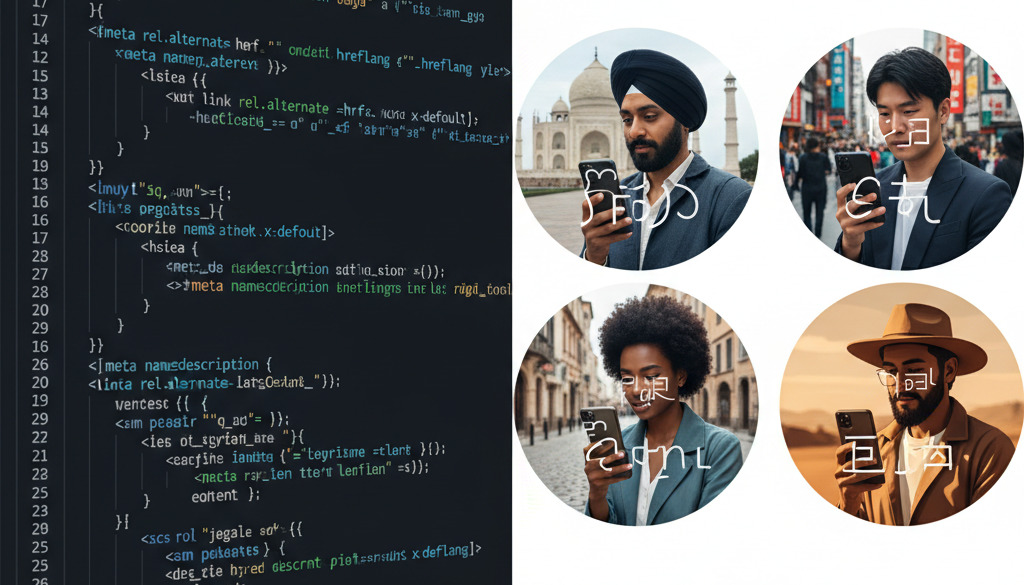
On-page optimization techniques for AI content also include the localization of title tags and meta descriptions. Since these are often the first thing a user sees in search results, they must be tailored specifically to the search habits of the local market. AI tools can analyze top-ranking competitors in a specific region and suggest header tag structures (H1, H2, H3) that align with what local search engines are currently rewarding.
Furthermore, AI helps maintain brand consistency. It can be trained on a "brand voice" manual to ensure that whether a blog post is in French, Mandarin, or Portuguese, the tone remains "innovative," "trustworthy," or "approachable," depending on the brand identity. This prevents the brand from sounding like a different company in every country it enters.
The Criticality of Human Oversight and Cultural Nuance
Despite the advancements in AI, it is not a "set it and forget it" solution. AI is a tool, not a strategist. The primary limitation of AI is its lack of lived cultural experience. It can mimic language, but it doesn't understand the emotional weight of a cultural reference or the potential offensiveness of certain idioms. This is why the role of human translators, editors, and cultural consultants remains essential.
AI pitfalls are well-documented: factual hallucinations (where the AI confidently asserts something false), cultural insensitivity, and idiom misinterpretations. For instance, a common American idiom like "shoot for the moon" might be translated literally in another language, leaving the reader confused or even offended. Human oversight ensures that the content resonates on an emotional level and adheres to local regulations.
There are also ethical and legal implications. In many jurisdictions, especially within the EU and North America, there are strict laws regarding advertising claims and data privacy. Using poorly localized or inaccurate AI content could lead to legal challenges if descriptions are misleading. A human reviewer acts as the final safeguard, protecting the brand's reputation and its legal standing.
Scaling Multilingual Content Strategies with AI
The true power of AI lies in its ability to scale. Before AI, a company might choose to localize its website into three languages because of budget constraints. With AI, that same company can scale to 30 languages with a marginal increase in cost. This democratizes the global market, allowing SMEs to compete with multinational corporations.
Effective workflows for scaling typically look like this:
- Bulk Generation: Use an AI platform to generate initial drafts for product descriptions or blog posts in 10+ languages.
- Quality Filtering: Use another AI-driven utility to score the quality of the translation and flag potential errors.
- Selective Human Review: Assign human experts to the high-value pages (homepage, landing pages, top-performing blogs) while using lighter review for low-traffic pages.
The ROI of investing in AI tools for multilingual content is often realized through a dramatic decrease in the "cost per word" and a significant increase in "speed to market." By getting content live faster, brands can begin ranking and collecting data sooner, leading to a faster feedback loop and quicker revenue generation from new territories.
Measuring the Success of Multilingual SEO AI Content
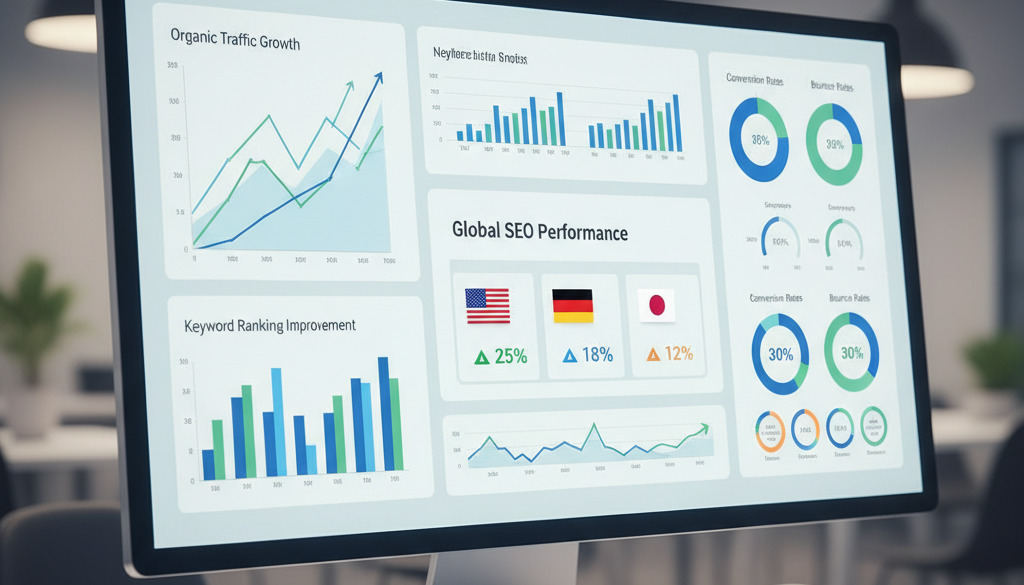
What gets measured gets managed. When deploying AI-generated content globally, it is vital to track Key Performance Indicators (KPIs) specific to each linguistic segment. Success isn't just about total traffic; it’s about organic traffic by region. If your site is getting hits from the US but zero from France, your French AI content strategy needs adjustment.
Other critical metrics include:
| Metric | What it Tells You |
|---|---|
| Keyword Rankings (Local) | Are you appearing in the top 10 for native terms? |
| Conversion Rate (Segmented) | Is the localized content convincing users to take action? |
| Bounce Rate (by Country) | If high, the content may feel unnatural or non-native. |
Fortunately, AI can also assist in performance analysis. Advanced analytics platforms use machine learning to identify why certain pages are underperforming. They can suggest areas for further optimization, such as adding more internal links or adjusting the reading level of the text to better match the local audience.
The Future of Multilingual SEO and AI
Looking toward 2026 and beyond, the integration of AI and multilingual SEO will only deepen. We are moving toward a world of hyper-personalization. Instead of just having a "Spanish version" of a site, AI will enable brands to have content that dynamically adjusts based on the user's specific region, browsing history, and cultural context—all in real-time.
Predictive trends suggest that AI will become more sophisticated in handling "zero-search" discovery. As AI search engines (like Perplexity or Google's SGE) become more popular, content will need to be optimized not just for keywords, but for AI discovery. This means providing structured data and clear, authoritative answers in every language to ensure your brand is the one the AI-native assistant recommends.
For SEO professionals, the role is shifting from manual implementers to "AI orchestrators." The expertise will lie in knowing how to prompt the machines, how to audit the results, and how to integrate these tools with broader marketing technologies like CRMs and automated sales funnels. The human focus will move away from "translation" and toward "strategic cross-cultural communication."
Conclusion: Strategic Integration for Global Dominance
The combination of AI and multilingual SEO allows businesses to break down the final barriers to global trade. By utilizing these technologies, companies can produce high-quality, optimized content at a scale that was once impossible. However, the true winners in the next decade will not be those who replace humans with AI, but those who effectively bridge the gap between them.
A hybrid approach—leveraging AI for its speed and scalability while prioritizing human expertise for cultural accuracy and emotional resonance—is the only way to achieve lasting global dominance. As we move forward, ensure your global strategy is built on a foundation of technical excellence, cultural empathy, and the relentless pursuit of authentic connection with every user, no matter what language they speak.
Keep reading
Hand-picked guides that go deeper — open the one you need next:
- Expand Your Reach: SEO Content in 25 Languages with AI
- Beyond Keywords: Advanced AI SEO Strategies
- AI Keyword Research: Unlock Hidden Opportunities
- Boost Your Google Rankings: AI for SEO Optimization Explained