
Multilingual SEO Made Easy: Expand Your Reach with Volteruno's AI

Key Takeaways
- Go Global, Grow Bigger: Entering international markets is no longer just for large corporations. With the right strategy, small and medium-sized businesses (SMBs) can find significant growth by reaching customers in their native language.
- AI is a Game-Changer: Artificial Intelligence (AI) can produce high-quality content drafts in multiple languages at a scale and speed previously unimaginable, dramatically reducing the cost and effort of global expansion.
- Translation Isn't Enough: Effective multilingual SEO involves deep cultural and keyword localization. You must understand how local audiences search, not just translate your existing keywords.
- Human + AI = Success: The best results come from a hybrid approach. Use AI for initial content generation and scale, then rely on human experts to refine, localize, and ensure brand voice consistency.
- Technical SEO is Crucial: Proper technical implementation, using elements like hreflang tags and the right URL structure, is essential for search engines to understand and correctly rank your international content.
The Untapped Potential of Global Markets for SMBs
In today's interconnected world, your next big customer could be anywhere. While you may be focused on your local market, a vast, untapped ocean of potential clients exists across the globe. For many small and medium-sized business owners, the idea of international expansion seems daunting, expensive, and reserved for multinational corporations.[1] However, the digital landscape has leveled the playing field. Reaching diverse customer bases online is not just possible; it’s one of the most significant growth opportunities for your business.
Imagine doubling or tripling your potential market overnight. That is the power of a well-executed multilingual digital strategy. By speaking to customers in their own language, you build trust, enhance user experience, and show that you understand and respect their culture. This approach can be a powerful differentiator, setting you apart from competitors who only cater to a single language market. The question is no longer *if* you should go global, but *how* you can do it efficiently and effectively.
What is Multilingual SEO?
Many business owners believe multilingual SEO is simply about translating their website content into different languages. This is a common and costly misconception. True multilingual SEO is a far more sophisticated discipline that combines language, culture, and technology to optimize your online presence for users in different geographical regions.
Beyond Simple Translation
At its core, multilingual SEO is the practice of offering optimized content for different languages and regions. This means not just translating words, but adapting your entire message. For example, a marketing slogan that works wonders in the United States might fall flat or even be offensive in Japan. Local searcher intent—what users in a specific country are actually looking for and the language they use to find it—is paramount.
The Technical Foundation
Beyond the content itself, multilingual SEO has a critical technical component. Search engines like Google need clear signals to understand which version of a page to show to which user. Key technical elements include:
- Hreflang Tags: These are snippets of code that tell search engines what language a specific page is in and which geographical region it is intended for. This prevents you from competing against yourself with duplicate content and ensures, for instance, a user in France sees your French content, not your Spanish version.
- URL Structure: You must decide how to structure your international content. The main options are using country-code top-level domains (ccTLDs, like `yourbrand.fr`), subdomains (`fr.yourbrand.com`), or subdirectories (`yourbrand.com/fr/`). Each has its own SEO advantages and resource implications.
Without this strategic and technical foundation, even the best translated content will fail to rank and reach its intended audience.
The Rise of AI in Content Creation
In parallel with the growing need for global reach, another technological revolution has been unfolding: Artificial Intelligence. More than 75% of marketers report using AI tools to streamline their work, and for good reason. AI content generation platforms can now produce human-like text, from blog posts to product descriptions, in a matter of seconds.
These tools work by analyzing vast amounts of data from the internet to understand language patterns, context, and structure. When you provide a prompt, the AI uses this knowledge to generate new, original content. The primary benefits for a busy business owner are undeniable:
- Speed: Create a first draft of an article in minutes, not hours or days.
- Scale: Produce a large volume of content consistently, which is crucial for SEO.
- Overcoming Writer's Block: Generate ideas and outlines instantly when you don’t know where to start.
However, it's important to have realistic expectations. While incredibly powerful, AI is an assistant, not a replacement for human strategy and expertise. It can generate text, but it lacks genuine cultural understanding, personal experience, and the ability to perfectly capture your unique brand voice without guidance.
Bridging the Gap: AI-Powered Multilingual Content
This is where two powerful trends converge. What if you could combine the global necessity of multilingual content with the speed and scale of AI? This is the core of an AI-powered multilingual content strategy. By leveraging AI, you can dramatically accelerate the most time-consuming part of international SEO: generating foundational content in multiple languages.
Instead of hiring freelance writers for every single language—a costly and slow process—you can use AI to generate high-quality drafts for each target market. This AI-generated content can serve as a robust starting point. The process becomes one of refinement and localization, not creation from scratch. This makes a global content strategy accessible even for businesses without a dedicated, multilingual marketing department.
The synergy between AI and multilingual needs is clear: AI provides the scale, while human experts provide the nuance. This combination unlocks an efficient, affordable, and effective path to global market penetration.
Identifying Your Target Global Audiences
Before you write a single word in a new language, you must know who you're writing for. A data-driven approach to selecting international markets is essential to avoid wasting time and resources. Don't just assume which countries want your product; do the research.
How to Research New Markets
Start by analyzing your existing data. Where does your current international traffic come from? You can find this information in Google Analytics under Audience > Geo > Location. If you see a surprising amount of traffic from a non-English-speaking country, that could be a prime market for expansion.
Factors to Consider
When evaluating potential markets, look at several key factors:
- Market Size and Digital Penetration: How many people are online in that country? Is there a large enough audience to justify the investment?
- Local Competition: Who are the local competitors? How strong is their online presence? A market with high demand and weak competition is a golden opportunity.
- Economic Viability: What is the average purchasing power? Can the local population afford your product or service?
- Language and Cultural Overlap: Is the culture similar to your existing markets? While not a deal-breaker, cultural similarity can make the transition smoother.
Understanding these elements will help you prioritize markets and build a phased global expansion strategy.
Crafting a Multilingual Keyword Strategy
Once you’ve chosen your target markets, the next step is to understand how your new audience searches. This is another area where simply translating your existing keywords will lead you astray. _Localized keyword research_ is the practice of finding the unique terms and phrases that people in a specific region use to search for products or information like yours.
Direct Translation vs. Localized Research
Consider the term "car insurance."
- In the US, people search for "car insurance."
- In the UK, they are more likely to search for "car insurance" but also "motor insurance."
- In Spain, the direct translation is "seguro de coche," which is widely used.
- However, in many Latin American countries, people might search for "seguro de auto" or "seguro para carros."
These subtle differences are critical. Ranking for the wrong term means you are invisible to your potential customers. A proper keyword strategy involves using SEO tools to discover these local search terms, analyze their search volume, and understand the intent behind them. Is the user looking to buy, learn, or compare? The answer will shape the content you create.
Leveraging AI for Scalable Multilingual Content Production
Herein lies the biggest challenge for most SMBs: creating enough high-quality, localized content to compete in a new market. This is where AI transforms from a novelty into a strategic business asset. AI tools can take your localized keyword strategy and produce a massive volume of foundational content—blog posts, landing pages, product descriptions—in a fraction of the time it would take a human team.
Imagine you have identified 10 core topics for your blog. With AI, you can generate initial drafts for all 10 topics across three different languages in a single afternoon. This allows you to build a content footprint in a new market with unprecedented speed.
For business owners who lack the time to manage this process, services like Volteruno have emerged. Their platform uses a proprietary AI to generate professional SEO articles in minutes, essentially acting as a dedicated content team that gets you more customers from your blog. This type of service automates the heavy lifting of content creation, allowing you to focus on strategy and growth.
The Crucial Role of Human Oversight and Localization
While AI provides the engine for scale, human expertise is the steering wheel that ensures quality and direction. Relying 100% on unedited AI-generated content, especially for foreign languages, is a recipe for disaster. Machines lack a true understanding of culture, idiom, and brand voice.
Why You Still Need a Human in the Loop
- Cultural Nuance: An AI might not understand that a certain color, symbol, or phrase has a negative connotation in a target culture. A human reviewer from that region will spot this instantly.
- Brand Voice Consistency: Your brand has a unique personality. A human editor is needed to ensure this voice remains consistent and authentic across all languages.
- Accuracy and Fact-Checking: While AI is increasingly accurate, it can still make mistakes or present outdated information. Human oversight is the final line of defense for quality control.
The most effective workflow is a partnership: AI generates the draft at scale, and a human expert (ideally a native speaker) reviews, edits, and localizes it. This hybrid model gives you the best of both worlds—the speed of a machine and the finesse of a human.
Technical SEO for Multilingual Websites
Creating great content is only half the battle. You must also ensure that search engines can find, understand, and correctly index your multilingual site. This requires a solid technical SEO foundation.
Diving into Hreflang Tags
As mentioned, hreflang tags are essential. They are placed in the `` section of your page’s HTML and tell Google which language and (optional) region a page is for. A correct implementation looks like this:
<link rel="alternate" href="http://example.com/en" hreflang="en" /><link rel="alternate" href="http://example.com/es" hreflang="es" /><link rel="alternate" href="http://example.com/de-AT" hreflang="de-at" />
This tells search engines there are three versions of the page: a generic English one, a Spanish one, and one specifically for German speakers in Austria. Common pitfalls include using incorrect country or language codes, or having mismatching tags that confuse search engines.
URL Structures for International Sites
You have three primary choices for structuring your URLs, each with pros and cons:
- Subdirectories (e.g., `yourbrand.com/fr/`): Easy to set up and maintain on a single domain. All SEO authority is consolidated into one domain. This is often the recommended approach for most businesses starting out.
- Subdomains (e.g., `fr.yourbrand.com`): Treated by Google as somewhat separate entities. Can be useful for distinctly different site sections but can dilute SEO authority.
- ccTLDs (e.g., `yourbrand.fr`): A very strong signal to both users and search engines that your site is dedicated to that specific country. However, it is the most expensive and resource-intensive option, as you have to acquire and manage separate domains.
XML Sitemaps
For a multilingual site, your XML sitemap should include all the different language versions of your URLs, along with the corresponding hreflang information for each one. This provides search engines with a clear map of your entire international site structure, accelerating the discovery and indexing of your content.
Measuring the Success of Your Multilingual Content Strategy
Launching your multilingual site is not the end of the journey. To ensure a positive return on investment (ROI), you must continuously track performance and optimize your strategy. You cannot improve what you do not measure.
Key Performance Indicators (KPIs) to Track
Focus on metrics that directly reflect the impact of your international efforts:
- Organic Traffic by Country: Is traffic from your target regions increasing?
- Keyword Rankings by Language: Are you gaining visibility for your localized keywords in each target country?
- Conversion Rate by Language/Region: Are users from a specific country converting into leads or customers? This is the most important metric.
- Bounce Rate and Engagement: Are users staying on your site, or are they leaving immediately? High bounce rates can indicate a mismatch between content and user expectations.
Using Google Analytics and Search Console
These free tools are invaluable. In Google Analytics, set up custom segments or views for each target country to easily monitor traffic and conversions. Google Search Console allows you to analyze performance by country and check which queries are driving traffic in each region. It also helps you identify any technical issues (like hreflang errors) that could be hurting your performance.
Maximizing Efficiency with AI-Driven Content Creation
For the typical business owner, time is the most precious resource. You are juggling operations, sales, customer service, and a dozen other responsibilities. The thought of adding "become a multilingual content manager" to that list is overwhelming. This is perhaps the most compelling argument for integrating AI into your workflow.
AI-driven content platforms are designed for efficiency. They remove the primary bottlenecks in content production: the blank page and the slow pace of manual writing. Instead of spending hours brainstorming and drafting a single blog post, you can generate multiple versions in minutes.
This is where a service like Volteruno becomes a powerful ally for busy entrepreneurs. Instead of wrestling with content creation, you can leverage its advanced AI to produce high-quality SEO blog posts for your website in minutes, letting customers find you organically through Google while you focus on running your business. It transforms content creation from a chore into a scalable, automated process.
From AI Draft to Polished Global Asset: The Workflow
So, what does this human-AI partnership look like in practice? A streamlined workflow ensures both quality and efficiency. Following a structured process prevents errors and maximizes the value of both your AI tools and your human talent.
A Step-by-Step Process for Success
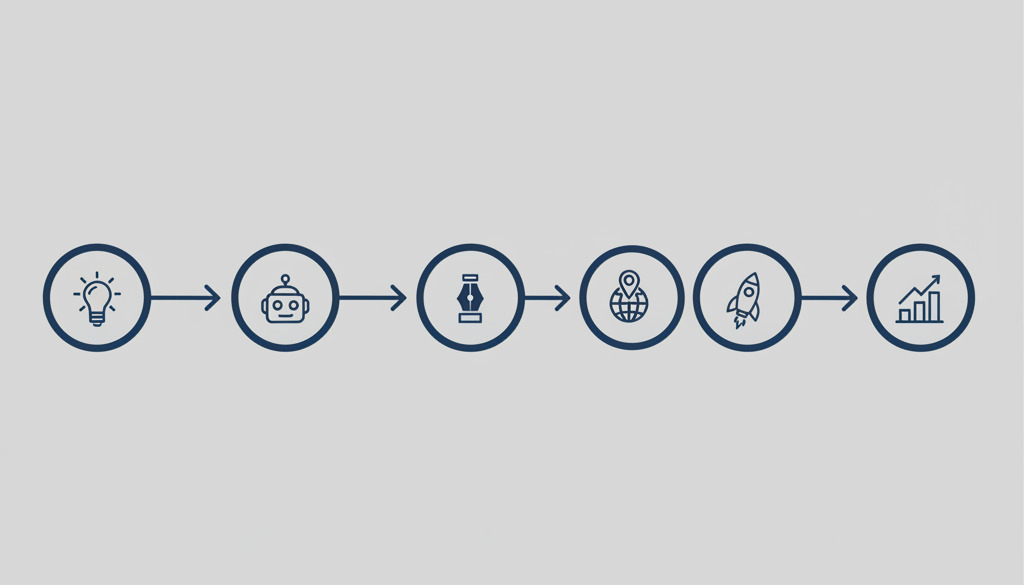
- Strategy First: Define your target audience, conduct localized keyword research, and create a content plan. Do not start a project without a clear goal.
- AI Generation: Input your localized keywords and content briefs into your AI tool. Generate the first draft of the blog post, product page, or other content.
- Human Review and Editing: Pass the AI-generated draft to a native-speaking editor. Their job is to check for factual accuracy, correct any awkward phrasing, and ensure the tone aligns with your brand.
- Cultural Localization: This goes beyond editing. The reviewer should adapt idioms, examples, and cultural references to be relevant to the local audience. For example, referencing a local holiday instead of an American one.
- SEO Optimization: Ensure the localized keywords are naturally integrated, meta descriptions are compelling, and all on-page SEO elements are in place.
- Technical Implementation: Publish the final content on the correct URL and ensure all technical elements, like hreflang tags, are correctly implemented and pointing to the other language variations.
- Review and Iterate: After launch, monitor performance and use the data to refine your strategy for future content.
Cost-Effectiveness and ROI of Multilingual AI Content
Traditionally, a comprehensive multilingual content strategy was prohibitively expensive. You had to hire translators, copywriters, and SEO specialists for each individual market. The costs could spiral quickly, putting it out of reach for most SMBs.
AI-powered content generation fundamentally changes this economic equation. While it doesn’t eliminate costs entirely—you still need to invest in human localization and strategy—it drastically reduces the most expensive component: content creation itself. The cost of generating an article via an AI platform is a fraction of hiring a writer. This allows you to:
- Scale Your Content Budget: Create 5x or 10x the content for the same price.
- Enter More Markets: Test the waters in multiple new regions without a massive upfront investment.
- Achieve ROI Faster: By producing more content and ranking for more keywords, you can drive international traffic and sales more quickly, accelerating your return on investment.
To make this technology accessible, Volteruno even offers the first five blog posts for free, providing a no-risk opportunity to see the impact of AI-driven content firsthand. This allows you to prove the concept and measure the initial results before making a larger commitment.
Common Pitfalls and How to Avoid Them
While the opportunity is immense, the path to multilingual SEO success has its share of potential traps. Being aware of these common pitfalls is the first step to avoiding them.
- Relying on Machine Translation for SEO: Using a simple tool like Google Translate for your entire website is a critical error. It misses nuance, creates awkward grammar, and doesn't account for local searcher intent or cultural context, ultimately harming your SEO efforts. Always use AI as a draft generator and then have human experts localize and refine the content.
- Ignoring Local Keyword Research: Simply translating your existing keywords is a wasted effort. You need to understand the specific terms and phrases your target audience uses in their native language. Tools and native speakers are essential for this.
- Neglecting Technical SEO: Without proper implementation of hreflang tags and a suitable URL structure, search engines won't correctly serve your multilingual content, rendering your efforts ineffective.
- Over-Reliance on AI Without Human Review: AI is a powerful tool for scale, but it lacks the cultural understanding, emotional nuance, and brand voice consistency that human editors provide. Skipping the human element can lead to errors, brand damage, and poor user experience.
- Not Measuring Performance: Launching a multilingual site without tracking key performance indicators (KPIs) means you can't optimize your strategy. Regularly monitor traffic, rankings, and conversions for each target region.
- Trying to Do Too Much Too Soon: Entering too many markets simultaneously without adequate resources can spread you too thin. Prioritize markets based on research and develop a phased rollout strategy. By understanding and avoiding these common mistakes, you can build a more robust and successful multilingual SEO strategy, leveraging AI to achieve global reach more efficiently than ever before.
Keep reading
Hand-picked guides that go deeper — open the one you need next:
- Expand Your Reach: SEO Content in 25 Languages with AI
- Beyond Keywords: Advanced AI SEO Strategies
- AI Keyword Research: Unlock Hidden Opportunities
- Boost Your Business: AI Article Writing for SEO & Traffic