
SEO 2026: Best Practices
Did you know that in the near future, search engine visibility will depend less on where your page ranks and more on whether you are cited as the answer within an AI-generated summary? It’s a startling thought, isn’t it? If you’re a busy business owner, the world of online marketing and Search Engine Optimization (SEO) can already feel like a full-time job you didn’t sign up for.[1] You just want to connect with more customers, not become a tech wizard overnight.
We get it. The rules of SEO seem to change constantly, and the anxiety of trying to keep up is real. But what if we told you that the core of what’s coming is actually more human? It’s less about technical tricks and more about genuine connection. This article is your clear, no-fluff guide to the essential SEO best practices for 2026. We’ll make it all feel manageable, even if you have limited time and a non-technical background. Imagine getting professional SEO content written for your blog in minutes, attracting customers to your website organically. That's what we're aiming to help you understand how to achieve, even before considering our 'magic button' solution!
SEO in 2026: More Than Just Keywords – It's About Connection
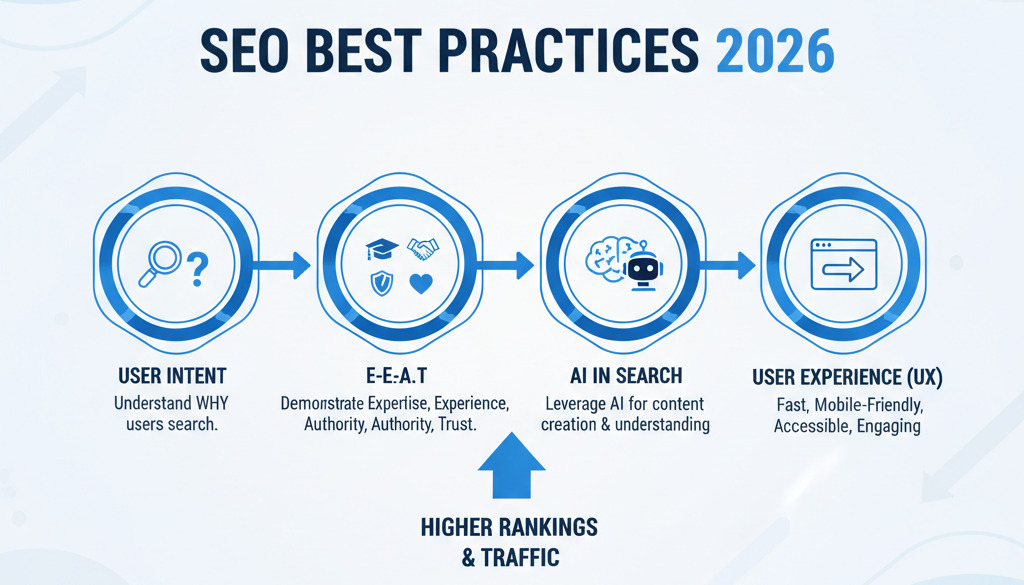
For years, we were taught that SEO was a game of keywords. Find the right terms, sprinkle them on a page, and wait for the traffic to roll in. By 2026, that model is officially outdated. Search engines like Google are now focused on one thing above all else: providing the user with the most helpful, satisfying, and complete answer to their query. This means they are getting incredibly smart about understanding user intent and rewarding content that delivers genuine value.
The "why" behind this shift is simple: search engines want to build trust with their users. They do this by prioritizing content that demonstrates expertise, is helpful, and provides a great user experience. For your business, this is fantastic news. It means your SEO strategy is no longer a separate, technical task. Instead, it's a core part of how you build lasting relationships with your customers. It’s about becoming a trusted resource, not just another link on a results page.
Understanding Your Ideal Customer (And What They're *Really* Searching For)
The first step in modern SEO is to stop thinking about abstract "keywords" and start thinking about real people. What are your customers struggling with? What questions do they have? What problems are they trying to solve when they type something into Google? This is the heart of search intent.
Creating Customer Personas
A customer persona is a semi-fictional sketch of your ideal client. Give them a name, a job, and a story. For example, if you're a local bakery, your persona might be "Busy Brenda," a 45-year-old working mom who needs to order a custom, allergy-friendly birthday cake for her son’s party next weekend. She’s not searching for "bakery." She’s searching for "best gluten-free Minecraft cake near me" or "how to order a custom cake for a kids party." Thinking this way transforms your entire approach.
The "Jobs to Be Done" Framework
A helpful concept is the "Jobs to Be Done" framework. Instead of asking what product a customer wants to buy, ask what "job" they are hiring that product to do. Brenda isn’t just buying a cake; she’s hiring it to make her son’s birthday special and to save her the time and stress of baking. Your website content should speak directly to that job. A blog post on "5 Things to Look For When Ordering a Custom Kids' Cake" would meet her needs perfectly.
Crafting Content That Speaks Directly to Your Audience's Needs
It’s an old saying, but it’s truer than ever: content is king. In 2026, however, not just any content will do. It must be high-quality, relevant, and directly address the search intent we just discussed. Your goal should be to become the most helpful resource for your specific niche.
Think about it: when you solve a potential customer's problem or answer their question with a detailed blog post, a how-to guide, or an informative video, you build instant trust. They begin to see you as an expert. This is far more powerful than just trying to sell them something. When it comes time to buy, who will they think of first? The business that was pushy, or the one that was helpful?
The Power of "Long-Tail" Queries
Instead of focusing on hyper-competitive, one-word keywords like "insurance," focus on more specific, conversational phrases, also known as long-tail keywords. A query like "what type of life insurance do I need as a new parent" is a long-tail query. While fewer people search for this exact phrase, the ones who do are highly qualified and much closer to making a decision. Creating content that answers these specific questions is one of the most effective SEO strategies for small businesses.
Mastering On-Page SEO: The Foundation of Discoverability
On-page SEO refers to the things you do directly on your website pages to help search engines understand and rank your content. Think of it as setting a strong foundation. Even the most amazing content will go unseen if search engines can't figure out what it's about. Luckily, the basics are straightforward.
- Title Tags & Meta Descriptions: These are what users see on the Google results page. They need to be compelling and relevant.
- Clear Headings (H1, H2, H3): Headings structure your content for both human readers and search engine crawlers, making it easier to digest.
- Image Optimization (Alt Text): Alt text describes your images for visually impaired users and helps search engines understand the image content.
- Internal Linking: Linking between relevant pages on your own website helps guide users and spreads ranking power throughout your site.
Title Tags: Your First Impression on Google
Your title tag is arguably the most important piece of on-page SEO. It should be concise (under 60 characters is a good rule of thumb), include your primary keyword phrase, and be enticing enough to make someone click. It’s your page's headline on the search results page.
Meta Descriptions: The Mini-Ad for Your Page
While not a direct ranking factor, the meta description (the short blurb under the title tag) is your chance to "sell the click." It should summarize the page's content in under 160 characters and convince the user that your page has the answer they're looking for. It's a great place to include a subtle call to action, like "Learn more" or "Discover how."
Key Takeaways: On-Page SEO Basics
- Title Tags: Keep them under 60 characters and make them clickable.
- Meta Descriptions: Write compelling summaries under 160 characters to earn the click.
- Headings: Use one H1 per page, followed by H2s and H3s to create a clear structure.
- Alt Text: Always describe your images for accessibility and SEO.
- Internal Links: Connect your content to guide users and boost page authority.
User Experience (UX): The Unsung Hero of SEO
Google wants to send its users to websites that are helpful, trustworthy, and easy to use. This is where User Experience (UX) comes in. If a visitor lands on your site and immediately clicks the "back" button (a "bounce"), it sends a signal to Google that your page wasn't a good match for their query. Conversely, if visitors stay on your site, explore multiple pages, and engage with your content, it signals that you're providing a quality experience.
By 2026, thinking of UX and SEO as separate disciplines is a mistake. A good user experience *is* good SEO.
Is Your Website Mobile-Friendly? A Quick Check
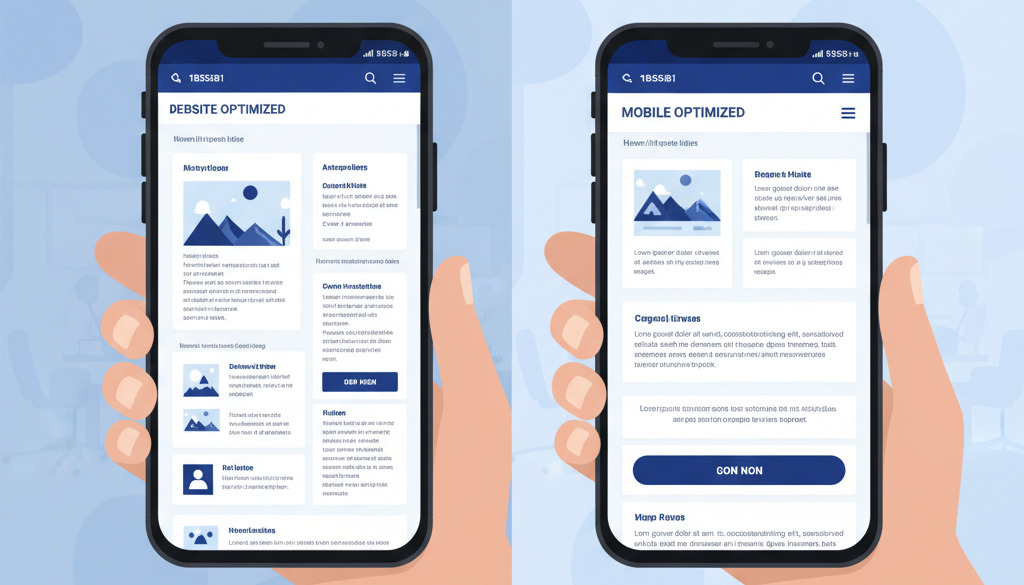
Today, more searches happen on mobile devices than on desktops. Google now operates on a "mobile-first" indexing basis, meaning it primarily looks at the mobile version of your website for ranking purposes. Your site absolutely must look good and function perfectly on a smartphone. You can use Google's own Mobile-Friendly Test tool to see how your site measures up. Common issues include text that's too small to read, links that are too close together, and content that requires horizontal scrolling.
Website Speed: The Need for Speed
We’ve all been there: you click a link and wait... and wait... and wait for the page to load. What do you do? You leave. Page speed is a critical UX and SEO factor. A slow website will frustrate users and hurt your rankings. Simple steps to improve performance include compressing your images before uploading them, using a quality web host, and minimizing bulky code or plugins.
Technical SEO: The Engine Under the Hood (Simplified!)
When you say "technical SEO," many business owners start to get nervous. It sounds complicated, but we want to simplify it for you. Think of technical SEO as ensuring the "engine" of your website is running smoothly so that search engines can easily find, crawl, and understand your content.
- Making Your Site Crawlable: Search engines use "crawlers" (or "spiders") to discover content. A file on your site called `robots.txt` gives them instructions, and an `sitemap.xml` file provides a map of all your important pages.
- Securing Your Site (HTTPS): Having an "https://" address (instead of just "http://") means your site is secure. This is a non-negotiable standard for trust and a confirmed, albeit small, ranking factor.
What is Schema Markup and Why Should I Care?
Schema markup is a type of code you can add to your website to give search engines more context about your content. It’s like creating a "super-summary" that only search engines can read. For example, you can use schema to tell Google that a string of numbers is a phone number, that a piece of text is a review, or that your content is a recipe. For a local business, this is incredibly powerful. You can use local business schema to explicitly state your business name, address, phone number, and hours of operation, making it easier for Google to show you in local search results.
Local SEO: Winning Hearts in Your Neighborhood
For businesses that serve a specific geographic area, local SEO is everything. When someone searches for "plumber near me" or "best coffee shop in Brooklyn," you want to be the business that shows up. The competition isn’t global; it's the business down the street.
Google Business Profile Optimization
Your Google Business Profile (GBP) is the cornerstone of your local search presence. It's the free listing that appears in Google Maps and the local results section of Google search. Claiming and fully optimizing this profile is one of the highest-impact SEO activities you can do. This means:
- Filling out every single section completely.
- Using accurate Name, Address, and Phone number (NAP) details.
- Uploading high-quality photos of your business, products, and team.
- Actively encouraging and responding to customer reviews.
- Using the "Posts" feature to share updates, offers, and events.
Managing Online Reviews
Online reviews are a massive trust signal for both customers and search engines. A steady stream of positive reviews on your GBP and other relevant sites tells Google that you are a legitimate and valued business. It's essential to have a simple process for asking happy customers to leave a review and to respond professionally to all feedback, both positive and negative.
Link Building in 2026: Quality Over Quantity, Always
A "backlink" is a link from another website to yours. For a long time, search engines viewed these as "votes" of confidence. The more votes you had, the more important your site must be. While this is still true in principle, the game has changed dramatically. The old days of buying thousands of spammy, low-quality links are long gone. In 2026, this practice will get your site penalized, not promoted.
Today, the focus is 100% on quality. One single, relevant link from a respected website in your industry is worth more than thousands of junk links. So, how do you get these valuable links? You earn them. You earn them by creating fantastic content that people naturally want to share and reference. You earn them by building genuine relationships with other business owners, bloggers, and journalists in your community. Think of it as digital public relations, not a technical trick.
Voice Search and Conversational Queries: Speaking Naturally
With the rise of smart speakers and voice assistants on our phones, more and more people are "speaking" their searches instead of typing them. This changes the nature of the queries. We type in shorthand ("pizza delivery near me") but we speak in full sentences ("Hey Google, what's the best pizza place that delivers near me?").
To optimize for voice search, your content should be conversational and answer questions directly. Using an FAQ (Frequently Asked Questions) format on your pages is a brilliant strategy. Think about the common questions your customers ask and create detailed, straightforward answers. This type of content is perfectly positioned to be picked up by voice assistants and also has a high chance of appearing in Google's "Featured Snippets" – the answer boxes that often appear at the very top of search results.
Topical Authority: Becoming the Go-To Expert
Imagine two websites. Website A has one blog post about gardening. Website B has 50 in-depth articles covering everything from soil types to pest control to pruning techniques. Which one do you think Google sees as the expert on gardening? This is the essence of topical authority.
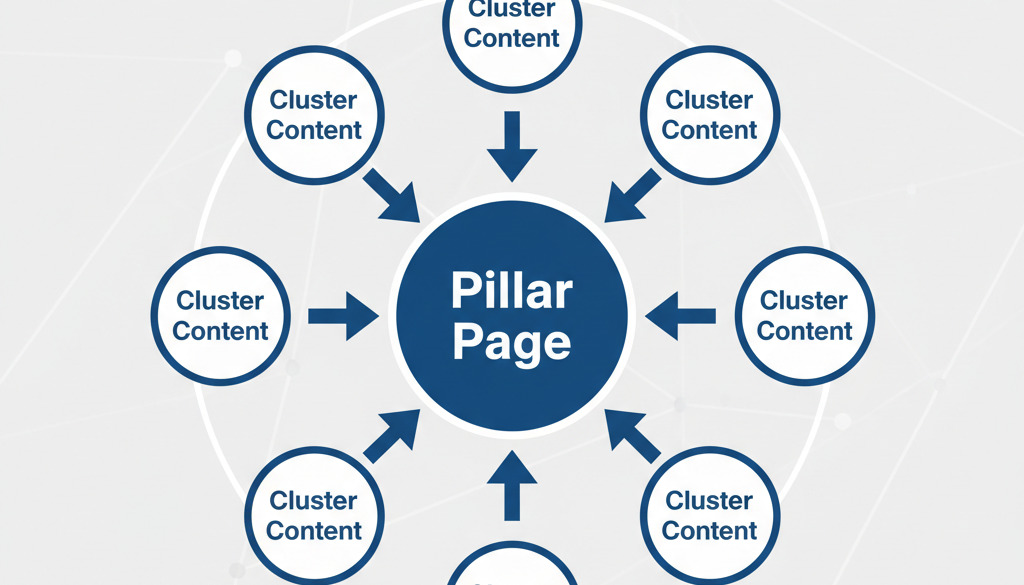
Search engines in 2026 want to rank content from sources that have demonstrated deep knowledge on a particular subject. You can build this authority by creating a "pillar and cluster" content model.
- Pillar Page: A long, comprehensive page that covers a broad topic from top to bottom (e.g., "The Ultimate Guide to Small Business Accounting").
- Cluster Content: A series of shorter, more specific blog posts that link back to the pillar page. Each cluster post dives deeper into a subtopic mentioned in the pillar (e.g., "How to Choose Accounting Software," "Understanding Quarterly Tax Payments," "5 Common Bookkeeping Mistakes").
This structure shows Google that you have covered a topic exhaustively, establishing you as a true authority and a reliable source of information.
E-E-A-T: Expertise, Experience, Authoritativeness, Trustworthiness in Action
E-E-A-T is a set of guidelines Google uses to evaluate content quality. It's especially important for topics that can impact a person's health, happiness, or finances (called "Your Money or Your Life" or YMYL topics). It stands for:
- Experience: Does the content creator have first-hand, real-life experience with the topic?
- Expertise: Does the creator have the necessary knowledge or skill in the field?
- Authoritativeness: Is the creator or website seen as a go-to source for this topic?
- Trustworthiness: Is the site secure, transparent, and honest?
Demonstrating Your Expertise Online
You can't just say you're an expert; you have to show it. This is how you can demonstrate E-E-A-T on your site:
- Detailed Author Bios: Tell your story. Why are you qualified to talk about this subject? List your credentials, years in business, and personal experience.
- Showcase Case Studies & Testimonials: Let your happy customers do the talking for you. Real-world results are powerful proof of your expertise.
- Be Transparent: Have a clear "About Us" page and an easy-to-find contact page. Be open about who you are and what your business stands for.
Content For The AI Era: Working *With* AI, Not Against It
There's no escaping it: Artificial Intelligence (AI) is fundamentally changing the search landscape. Google is already using AI to generate "AI Overviews" at the top of many search results, synthesizing information from multiple websites into a single answer. As one recent analysis noted, "The future of SEO is not about ranking higher. It is about becoming the answer." Your goal is for your content to be so good that AI models *cite* you as a source.
This means using AI as a powerful tool, not a replacement for human knowledge. AI can be incredible for brainstorming ideas, creating outlines, and overcoming writer's block. However, for your content to build trust and rank well, it requires human oversight. You must ensure that any AI-assisted content is fact-checked, edited for your unique brand voice, and infused with your personal experience and expertise. If you want to dive deeper, we have a whole guide exploring how AI can transform your blog strategy in 2026. While AI can help speed up content creation, human expertise ensures your unique brand voice and accuracy shines through – a principle our own AI adheres to, with expert oversight.
Measuring Your Success: What to Track and Why
How do you know if your SEO efforts are actually working? It's crucial to track a few key metrics. Forget about "vanity metrics" that don't translate to business results. Focus on the data that tells you what's really happening.
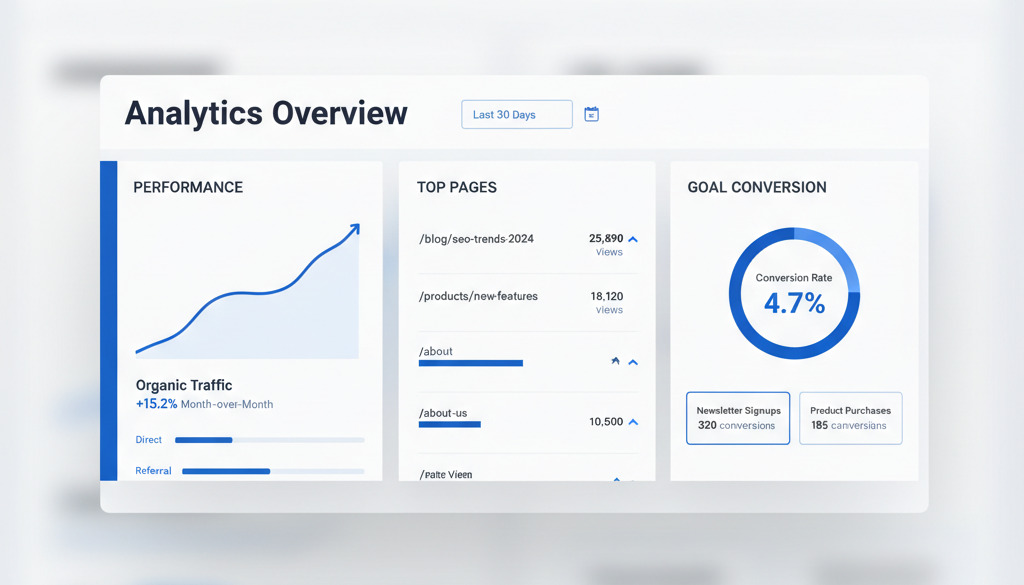
Google Analytics: Understanding Your Visitors
Google Analytics is a free tool that gives you incredible insight into your website's visitors. You don't need to be a data scientist to use it. Focus on a few key reports:
- Traffic Acquisition: This shows you *how* people are finding your website (e.g., "Organic Search," "Direct," "Social"). You want to see the "Organic Search" number grow over time.
- Engagement > Pages and screens: This shows you which of your pages are the most popular. It helps you understand what content is resonating with your audience.
- Conversions: You can set up simple goals, like tracking how many people fill out your contact form. This connects your SEO efforts directly to business leads.
Google Search Console: Your Direct Line to Google
If Google Analytics tells you what happens *on* your site, Google Search Console (another free tool) tells you what happens before they get there. It gives you a direct look at your performance on Google Search. You can see:
- Performance > Queries: The actual search terms people are using to find your site. This is marketing gold!
- Indexing > Pages: Whether Google is having any trouble finding or understanding your pages.
- Experience: Data on your site's mobile usability and page speed.
Staying Ahead of the Curve: Continuous Learning in SEO
If there is one constant in SEO, it is change. The strategies we've outlined here are the foundation for success in 2026, but the digital landscape will continue to evolve. It’s important to stay informed, but don't feel like you have to chase every new trend. The best approach is to follow a few reputable sources for SEO news (like the blogs for Search Engine Land or Google's own Search Central Blog) to stay aware of major shifts.
At a certain point, you may find that your time is better spent running your business than trying to keep up with every algorithm update. When you reach that point, it might be time to seek professional help. Recognizing the complexity and time commitment is the first step toward finding a smarter solution.
Your Action Plan for SEO Success in 2026
We've covered a lot of ground, and it can feel overwhelming. Don't try to do everything at once. The key to success is taking small, consistent steps. Here’s a prioritized action plan for a busy business owner:
- Claim and Fully Optimize Your Google Business Profile. This is the highest-impact, lowest-effort first step for any local business. Do it this week.
- Understand Your Customer. Spend one hour brainstorming the top 10 questions your ideal customer asks. There’s your first list of blog post ideas.
- Perform a Basic On-Page SEO Check. Review the title tags and meta descriptions of your 5 most important pages. Do they accurately reflect the content and entice a click?
- Write One Helpful Piece of Content. Take one of the questions from your brainstorming session and write a genuinely helpful, in-depth blog post that answers it completely. Don’t worry about perfection; focus on being helpful.
- Check Your Mobile Site. Pull up your website on your phone. Is it easy to use? Be honest. If not, make improving it your next major priority.
Implementing these practices can feel daunting, but remember – the goal is to connect with more customers naturally. If you're finding that while understanding these principles is key, finding the time and skill to execute is the challenge, that's precisely where solutions like ours can transform your online presence, writing those professional SEO articles for you in minutes, so you can focus on running your business while customers find you through Google.
Conclusion
The world of SEO in 2026 is less about chasing algorithms and more about embracing a customer-first philosophy. By focusing on understanding user intent, creating genuinely helpful content, demonstrating your experience, and ensuring a great user experience, you align your business with the very direction search engines are heading.[2] The core best practice is to be the best, most helpful, and most trustworthy answer for your potential customers.
This shift toward quality and connection is an incredible opportunity for small businesses that truly care about their customers. Your authentic voice, real-world experience, and deep knowledge are assets that can't be easily replicated. Start with the small, actionable steps we've outlined. With a solid strategy and consistent effort, mastering SEO in 2026 is not only achievable—it's the key to sustainable growth.
Frequently Asked Questions (FAQ)
What is the single most important SEO factor for 2026?
While there's no single "magic bullet," the overarching theme is high-quality, helpful content that satisfies user intent and is supported by a great user experience. If your content is the best answer to a user's question and your site is easy to use, you are aligned with the most critical SEO principles for 2026.
Do I still need to worry about keywords?
Yes, but your focus should shift from single keywords to topics and search intent. Instead of stuffing a keyword, think about all the related questions and subtopics a user interested in that keyword might have. Cover the topic comprehensively to build topical authority.
Can I do SEO myself or do I need to hire an expert?
You can absolutely get started with the foundational elements of SEO yourself, especially local SEO (your Google Business Profile) and content creation. However, as your business grows, the time and expertise required for technical SEO, link building, and advanced content strategy can become significant. Many business owners find success by handling the basics and turning to tools or professionals to scale their efforts and save time.
How long does it take for SEO to work?
SEO is a long-term strategy, not an overnight fix. While you can sometimes see movement for local queries in a few weeks, it typically takes 4 to 12 months to see significant, lasting results from a content and technical SEO strategy. Consistency is the key.
Powered by Volteruno
Keep reading
Hand-picked guides that go deeper — open the one you need next:
- DIY SEO Articles: Generate High-Quality Content with AI Writer
- Expand Your Reach: SEO Content in 25 Languages with AI
- Beyond Keywords: Advanced AI SEO Strategies
- AI Keyword Research: Unlock Hidden Opportunities