
SEO for the Non-Techy: AI Simplifies Content Marketing
Key Takeaways
- SEO is not just for tech experts. It's a crucial business strategy for attracting customers who are actively searching online for your products or services.
- Focus on fundamentals. Understanding keywords, creating high-quality content, and optimizing for local search are the pillars of a successful SEO strategy.
- Content is your greatest asset. Regularly publishing valuable content, like blog posts, establishes your business as an authority and consistently draws in traffic from search engines.
- AI is a powerful ally. Artificial intelligence can automate the most time-consuming parts of SEO, such as content creation, allowing busy business owners to achieve results efficiently.
- Local SEO is critical for growth. Optimizing your Google Business Profile and ensuring your business information is consistent online is essential for attracting nearby customers.
- Measurement is key. Track your progress using simple metrics to understand what's working and connect your SEO efforts directly to business growth.
Introduction: Why Your Business Needs to Be Found Online (And Why SEO Isn't as Scary as You Think)
If the term "Search Engine Optimization" or "SEO" makes you think of complex code and technical jargon, you're not alone. For many established business owners, SEO can seem like an intimidating digital world reserved for developers and marketing gurus. But in today's market, where nearly 68% of all online experiences begin with a search engine, being invisible online is no longer an option. Your customers are looking for you on Google, and if they can't find you, they will find your competitors.
The good news is that SEO isn't black magic. At its core, it's about understanding what your potential customers are looking for and making it easy for them to find your business. This guide is designed specifically for non-technical business owners. We will demystify SEO, breaking it down into clear, actionable steps that you can implement to increase your online visibility, attract more customers, and grow your bottom line—all without needing to become a tech expert.
Understanding the Core Concept: What is SEO and Why Does It Matter for Your Bottom Line?
In the simplest terms, Search Engine Optimization (SEO) is the practice of improving your website to increase its visibility when people search for products or services related to your business in Google, Bing, and other search engines. The better visibility your pages have in search results, the more likely you are to garner attention and attract prospective and existing customers to your business.
But why does this matter for your revenue? Research from BrightEdge shows that organic search is the single largest driver of website traffic for most businesses, accounting for over 53% of all trackable traffic. Unlike paid ads, which disappear the moment you stop paying, a solid SEO strategy builds a sustainable, long-term asset. It's the most cost-effective way to generate high-quality leads—people who are already actively seeking the solutions you provide. More targeted traffic leads directly to more sales, making SEO one of the highest-ROI marketing activities you can undertake.
Demystifying Search Engines: How Google Finds and Ranks Your Website
To understand SEO, it helps to know how search engines work. Think of Google as a massive digital library with an incredibly smart librarian. The process has three main parts:
- Crawling: Search engines send out "bots" or "spiders" to discover new and updated content on the web. These bots follow links from page to page, constantly exploring the internet.
- Indexing: Once a page is discovered, the search engine analyzes its content (text, images, etc.) and stores it in a massive database called an index. This is like the librarian reading a book and deciding where to shelve it.
- Ranking: When a user types a query, the search engine scours its index to find the most relevant and high-quality results. It uses a complex algorithm, or set of rules, to rank these pages, with the goal of providing the most satisfying answer to the user's question.
Your job isn't to "trick" the algorithm. It's to create a website and content that clearly communicates what you do and demonstrates your expertise, making it easy for search engines to understand that you are the best answer for a potential customer's query.
Keywords: The Foundation of Your Online Visibility
Keywords are the words and phrases that people type into search engines. They are the foundation of SEO because they bridge the gap between what your customer is looking for and the content you provide. If you sell "handmade leather boots in Austin," you want your website to appear when someone searches for that exact phrase or something very similar.
Keywords can be short-tail (e.g., "boots") which are broad and highly competitive, or long-tail (e.g., "custom-fit waterproof leather hiking boots for men") which are much more specific. As a business owner, your sweet spot is often in these long-tail keywords. They have lower search volume but much higher purchase intent, meaning the person searching is often closer to making a buying decision.
Identifying Your Most Valuable Keywords
Finding the right keywords doesn't require expensive tools. Start by brainstorming. How would you describe your business? What problems do you solve? Ask your existing customers what terms they would use to find you online. Then, look at your competitors. What terms are they using in their page titles and headings? This can reveal valuable opportunities. Finally, always consider user intent. Is the person looking to learn something, find a specific location, or buy something now? Aligning your content with that intent is critical for success.
On-Page SEO Essentials: Optimizing Your Website's Content
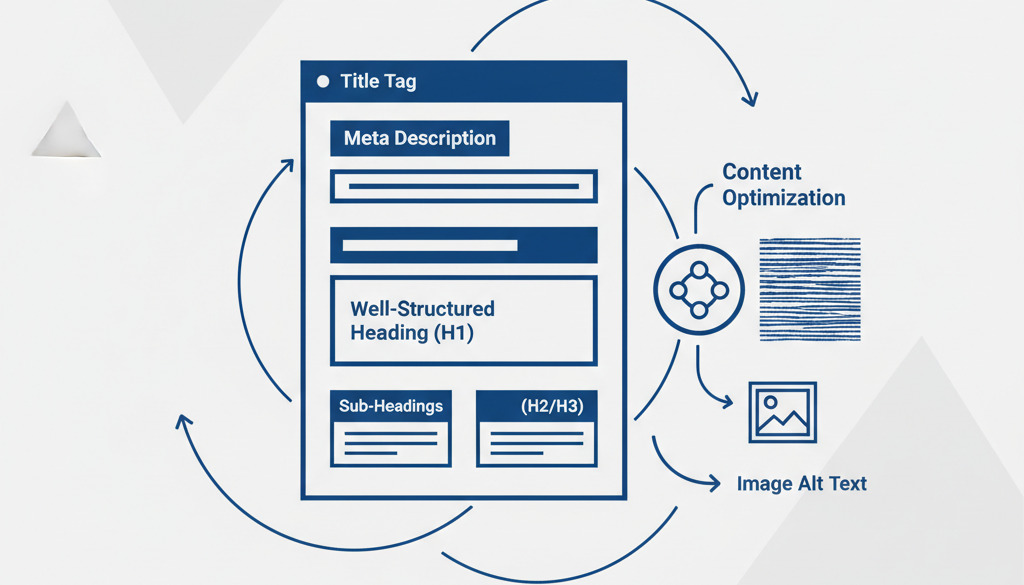
On-page SEO refers to all the optimizations you make directly on your website to make it more relevant and user-friendly. This is where you have the most control. Key elements include your page titles, meta descriptions, and the structure of your content.
Crafting Compelling Titles and Meta Descriptions
The title tag is the blue clickable headline that appears in search results. It's your first impression and a major factor in whether someone clicks on your page. The meta description is the short snippet of text underneath the title. While not a direct ranking factor, a compelling description acts as an advertisement for your page, convincing users to click.
Best practices:
- Include your primary keyword in both the title and description.
- Make the title and description unique for every important page.
- Keep titles under 60 characters and descriptions under 160 characters to avoid them being cut off.
- Write for humans first. Your title should be enticing and your description should clearly state the benefit of clicking.
Structuring Your Content for Readability and Search Engines
No one likes to read a wall of text. Structuring your content with headings (H1, H2, H3) acts as an outline for both your readers and for search engines. Use your main H1 heading for the page's primary topic (and keyword), and use H2s and H3s to break the content into logical, scannable sections. Short paragraphs and bulleted lists also improve readability, keeping visitors on your page longer—a signal to Google that your content is valuable.
Building Authority: The Power of High-Quality Content Creation
Search engines want to rank websites that are trustworthy and authoritative. The single best way to build this authority is by consistently creating and publishing high-quality content that helps your audience. Content demonstrates your expertise and gives search engines more relevant material to index and rank, positioning your business as a leading voice in your industry.
This is where blogging, creating guides, or publishing case studies becomes a powerful SEO tool. Every new piece of content is another chance to rank for new keywords and attract another segment of your audience.
The Strategic Advantage of Blogging
A business blog is not a personal diary; it's a strategic tool for driving organic traffic. Each post can target a specific long-tail keyword or answer a common customer question. Over time, this collection of helpful content establishes your "topical authority," signaling to Google that you are a comprehensive resource on your subject. To learn more about creating content that ranks, exploring a strategic blueprint for SEO optimized blog articles can provide immense value.
For many busy business owners, the idea of writing regular blog posts is overwhelming. This is where modern solutions come into play. Services designed to help you get "More customers from your blog" can be a game-changer. These platforms often use proprietary AI, like the one already trusted by over 500 businesses, to generate professional, SEO-driven articles in minutes. This allows you to reap the benefits of a powerful content strategy and attract customers from Google without the heavy lifting.
Off-Page SEO: Enhancing Your Website's Reputation Beyond Your Site
Off-page SEO involves actions taken outside of your own website to impact your rankings. It's about building your site's credibility and reputation. The most significant off-page signal is backlinks.
A backlink is a link from another website to yours. Search engines view backlinks as votes of confidence. If a reputable, well-known website links to your page, it signals that your content is valuable and trustworthy, which can significantly boost your rankings.
The Art of Earning Quality Backlinks
Not all links are created equal. A link from an authoritative industry blog is far more valuable than a link from a low-quality, spammy directory. The goal is to earn links naturally by creating great content that people want to share. You can also be proactive by guest posting on other blogs, partnering with local businesses for cross-promotion, or getting listed in reputable industry directories.
Technical SEO Made Simple: Essential Checks for Smooth Sailing
While "technical SEO" sounds intimidating, a few key elements have a major impact on user experience and rankings, and they are relatively simple to check.
Ensuring Mobile-First Indexing Compatibility
Today, the majority of Google searches happen on mobile devices. Because of this, Google primarily uses the mobile version of a website for indexing and ranking (this is called "mobile-first indexing"). Your website must be mobile-friendly. It should be easy to read and navigate on a smartphone without pinching or zooming. You can use Google's own Mobile-Friendly Test tool to quickly check your site.
Website Speed: Impact on User Experience and Ranking
How quickly your pages load is a critical ranking factor. If your site is slow, visitors will leave, sending a negative signal to Google. Page speed is all about user experience. Simple ways to improve speed include compressing image files before uploading them and choosing a reliable web hosting provider. You don't need to be a developer to understand that faster is better.[1]
Local SEO: Connecting with Customers in Your Geographic Area
For any business that serves a specific geographic area—from a restaurant to a plumbing service—Local SEO is non-negotiable. It’s a set of practices that helps your business be more visible in local search results on Google. When someone searches "best pizza near me," Local SEO is what helps your pizzeria show up.

Optimizing Your Google Business Profile for Maximum Exposure
Your Google Business Profile (GBP) is your most important asset for Local SEO. It's the free listing that appears in Google Maps and in the "Local Pack" in search results. Claim and fully optimize your profile:
- Fill out every single section with accurate, up-to-date information.
- Upload high-quality photos of your business, products, and team.
- Use Google Posts to share updates, offers, and events.
- Enable the Q&A feature and proactively answer common questions.
Leveraging AI can significantly streamline these an other local search efforts, as detailed in this ultimate guide to Local SEO AI.
Managing Online Reviews and Local Citations
Positive online reviews are a powerful trust signal for both customers and search engines. Encourage your happy customers to leave reviews on Google. Equally important are "citations," or mentions of your business's Name, Address, and Phone number (NAP) across the web in directories like Yelp and industry-specific sites. Consistency is key; your NAP should be identical everywhere it appears.
Measuring Your SEO Success: Key Performance Indicators (KPIs) That Matter
How do you know if your SEO efforts are paying off? You need to track a few key metrics. Forget complex spreadsheets; focus on the data that reflects real business results.
Understanding Google Analytics Basics
Google Analytics is a free tool that provides a wealth of data about your website's visitors. For a business owner, the most important report is often "Acquisition," which shows you where your traffic is coming from. Your goal is to see a steady increase in traffic from the "Organic Search" channel over time. You can also see which pages are most popular, how long people stay on your site, and whether they are taking desired actions (like filling out a contact form).
Tracking Keyword Rankings and Conversions
While you shouldn't obsess over daily ranking fluctuations, it's useful to track your position for a handful of your most important keywords. More importantly, are those rankings leading to business? A "conversion" is a desired action, such as a phone call, a form submission, or a product purchase. The ultimate measure of SEO success is an increase in conversions and revenue.
Common SEO Pitfalls to Avoid
As you begin your SEO journey, be aware of these common mistakes that can sabotage your progress:
- Keyword Stuffing: Forcing keywords into your content unnaturally. Write for humans, not robots.
- Duplicate Content: Copying content from other websites or using the same block of text on multiple pages of your own site. Every page should be unique.
- Ignoring Mobile Users: Having a website that is difficult to use on a smartphone is a critical error in today's mobile-first world.
- Buying Backlinks: Paying for links is a violation of Google's guidelines and can result in severe penalties. Earn them naturally.
- Neglecting Local SEO: If you have a physical location or service area, ignoring your Google Business Profile is like leaving money on the table.
Integrating SEO into Your Business Strategy (Without Becoming a Tech Guru)
Successful SEO isn't a one-and-done project; it's an ongoing part of your business strategy. But it doesn't have to consume your life. The key is to integrate simple, consistent practices into your routine or find efficient ways to delegate.
The "Little and Often" Approach to SEO
Instead of feeling overwhelmed, dedicate a small amount of time each week to SEO. This could include writing one blog post, updating your Google Business Profile with new photos, or reviewing your Google Analytics report. Consistent, focused effort is far more effective than sporadic, all-out campaigns. Instead of trying to become an expert overnight, savvy business owners are leveraging technology to handle the heavy lifting. This is where AI-powered content solutions come in. A service that delivers "More customers from your blog" automates the most time-consuming part of SEO—content creation. As discussed in this guide on AI-powered content automation, by producing consistent, high-quality blog posts, it frees you to focus on running your business, secure in the knowledge that your online presence is growing.

The Future of SEO: Adapting to an Evolving Digital Landscape
The world of search is constantly evolving. The rise of AI, seen in features like Google's AI Overviews, and the increasing popularity of voice search ("Hey Google, find a plumber near me") are changing how people find information. However, this evolution shouldn't be a cause for anxiety. The core principles of SEO remain the same: understand user intent and provide the best possible answer.
As AI becomes more integrated into search, the emphasis on high-quality, well-structured content that directly answers questions will only increase. Businesses that focus on building genuine authority and providing a great user experience will be well-positioned to thrive in the years to come.
When to Seek Expert Help (And How to Choose the Right Partner)
While this guide empowers you to handle many aspects of SEO yourself, there may come a time when you need professional help, especially for more complex technical issues or competitive strategies. Knowing when to delegate is a sign of a smart business owner.
Identifying Your SEO Needs and Goals
Before you hire an agency or consultant, be clear about your goals. Do you want more foot traffic to your store? More online sales? More leads from your contact form? A good SEO partner will focus on your business objectives, not just vanity metrics like traffic. Look for a provider who is transparent, communicates clearly, and can show a track record of delivering measurable results for businesses like yours.
Conclusion: Your Roadmap to Enhanced Online Visibility and Business Growth
SEO is no longer an optional extra; it is a fundamental component of modern business success. But it does not require you to become a technology expert. By focusing on the core principles—understanding your customers' keywords, creating valuable content, optimizing your on-page and local signals, and measuring what matters—you can build a powerful engine for growth.
This journey empowers you to take control of your online destiny, connect with more customers, and build a more resilient business. As you embark on this path, remember that smart tools are available to bridge the gap between your business expertise and the technical demands of SEO. For many, the first step is automating content creation with a powerful AI writer, a solution designed to bring you "More customers from your blog" and build the foundation for lasting online success.
Frequently Asked Questions
1. How long does it take for SEO to work?
SEO is a long-term strategy. While some small changes can yield results in a few weeks, it typically takes 4-6 months to see significant, meaningful impact on traffic and leads. The timeline depends on your industry's competitiveness, your website's current state, and the consistency of your efforts. The key is to view SEO as an investment that builds value over time.
2. Can I do SEO myself without any technical skills?
Absolutely. The foundational elements of SEO, such as keyword research, quality content creation, on-page optimization, and managing your Google Business Profile, do not require coding knowledge. This guide is designed to empower you to handle these crucial aspects yourself. For highly technical issues, you can always hire a specialist for a specific task.
3. What's more important: creating new content or getting backlinks?
In the beginning, creating high-quality content is more important. You cannot earn valuable backlinks without having valuable content for others to link to. Content is the foundation. Once you have built a solid base of helpful articles and pages, you can increase your focus on promoting that content to earn backlinks and build authority.
4. How important is a blog for my business?
A blog is one of the most effective SEO tools for a business. It allows you to target a wide range of long-tail keywords, answer customer questions, demonstrate your expertise, and consistently add fresh, relevant content to your site. All of these activities are highly valued by search engines and directly contribute to higher rankings and more traffic.
5. Will AI replace the need for SEO?
No, AI is not replacing SEO; it is changing it and becoming a part of it. AI tools can automate and simplify tasks like keyword research and content creation, making SEO more accessible. However, the strategic element—understanding your audience, defining your brand voice, and building trust—still requires human oversight. AI is a powerful tool to execute an SEO strategy more efficiently, not a replacement for the strategy itself.
6. How much should I budget for SEO?
The budget for SEO can vary widely. If you are doing most of the work yourself, your primary investment will be your time. If you use tools, such as an AI content generator, costs can be very manageable. Hiring an agency or consultant will be a more significant investment, ranging from a few hundred to several thousand dollars per month, depending on the scope of work. Start by focusing on what you can do yourself and scale up as your business grows.
Keep reading
Hand-picked guides that go deeper — open the one you need next:
- Unlock SEO Success: How AI Transforms Your Blog Content Strategy
- Mastering AI Keyword Research: A Volteruno Guide
- Automate Your Blog: The Power of AI Autopilot Publishing
- AI-Generated SEO: Engaging Content Beyond Keywords