
Unlock SEO Success: How AI Transforms Your Blog Content Strategy

Key Takeaways
- AI is Reshaping Search: AI Overviews are now a major part of search results. The goal is shifting from simply ranking to being cited as a source in AI-generated answers.
- Efficiency and Scale: AI drastically speeds up content creation, allowing you to publish high-quality, optimized content more frequently and consistently than ever before.
- Human Oversight is Non-Negotiable: AI is a powerful assistant, not a replacement for human expertise. Your strategy, fact-checking, and final edits are what guarantee quality and brand alignment.
- Strategy Still Reigns Supreme: AI tools are only as good as the instructions you give them. A solid SEO strategy, including keyword research and understanding user intent, is more critical than ever.
- New Metrics for Success: Beyond traffic and rankings, you must now track metrics like citation frequency in AI Overviews to measure the true impact of your content.
- Accessible Solutions Exist: For business owners short on time, specialized services can manage the entire AI-powered content creation process, turning your blog into a customer acquisition engine.
The modern business landscape demands a robust online presence. For many established business owners, this translates to the daunting task of consistently creating high-quality, search-engine-optimized (SEO) content. You know you need to be visible on Google, but finding the time, resources, and expertise to produce an effective blog that attracts organic traffic feels like a second full-time job. This is a common struggle, but a powerful solution has arrived that is fundamentally changing the rules of digital marketing.
Artificial Intelligence (AI) is rapidly transforming content creation, offering an incredibly efficient solution for achieving SEO success.[1] Recent industry data shows that AI-generated answers, or "AI Overviews," now appear in nearly half of all Google search results. This isn't a future trend; it's the new reality of search. This guide will demystify AI content strategy for SEO, providing you with a clear, actionable roadmap for leveraging this technology to drive real business growth.
The Foundational Role of Content in Modern SEO
In today's digital marketplace, content is not just an optional extra—it is the central pillar of any successful search engine optimization strategy. Gone are the days of trying to trick search engines with "keyword stuffing" and other technical gimmicks. Modern search engines like Google are far more sophisticated. Their primary goal is to understand what a user is truly looking for—their search intent—and deliver the most relevant, valuable, and authoritative answer.
This is where high-quality content comes in. It serves several critical functions:
- It Answers Questions: Your potential customers are asking Google questions every single day. Your content is your opportunity to provide the answers, positioning your business as a helpful expert.
- It Builds Trust and Authority: When you consistently publish insightful, well-researched content, you build trust not only with your audience but also with search engines. Google wants to recommend credible sources, and a strong content library is the best evidence of your authority.
- It Drives Long-Term Value: A single, well-crafted blog post can attract visitors to your website for years to come, generating leads and sales long after it's published. It's an asset that appreciates in value over time.
Understanding the Core Principles of SEO
Before diving into how AI changes the game, it’s essential to grasp the fundamentals of SEO. Think of search engines as vast digital libraries and their algorithms as the librarians. To get your "book" (your website content) recommended, you need to make it easy for the librarian to understand what it's about and why it's a great resource.
Keywords and Search Intent
Keywords are the terms people type into search engines. Strategic keyword research involves identifying the phrases your target audience uses and understanding their intent. Are they looking for information ("how to fix a leaky faucet"), comparing products ("best coffee makers 2024"), or ready to buy ("plumber near me")? Aligning your content with this intent is crucial.
On-Page and Off-Page SEO
On-page SEO refers to optimizations you make on your website. This includes using keywords naturally in your titles, headings, and text, ensuring your site loads quickly, and providing a good user experience. Off-page SEO primarily involves signals from other websites, most notably backlinks. When a reputable site links to your content, it acts as a vote of confidence, boosting your authority in the eyes of search engines.
What is AI Content and How Does it Work?
At its core, AI-generated content is text created by an artificial intelligence model rather than a human writer. This technology isn’t magic; it’s the product of advanced computer science. The primary technologies involved are Natural Language Processing (NLP) and Machine Learning (ML).
Imagine an AI model being fed a massive library containing billions of books, articles, and websites. Through ML, it learns the patterns, structures, grammar, and nuances of human language. NLP is the specific field that allows it to understand and then generate text that is coherent, contextually relevant, and sounds remarkably human. When you provide a prompt, the AI uses this vast training to predict the most logical sequence of words to form sentences and paragraphs that fulfill your request.
The Strategic Advantages of AI in Content Creation for SEO
For a busy business owner, the practical benefits of integrating AI into your content workflow are transformative. This isn't just about novelty; it's about gaining a significant competitive advantage.
Unprecedented Speed and Scalability
A human writer might take several hours or even days to research and write a comprehensive blog post. An AI can generate a well-structured first draft in minutes. This allows you to scale your content production dramatically, filling your blog with helpful articles and targeting a wider range of keywords much faster than was previously possible.
Significant Cost-Effectiveness
Hiring a team of writers can be a significant expense. While AI doesn't eliminate the need for human oversight, it can drastically reduce the cost per article. This makes a robust, high-volume content strategy accessible even for businesses with limited marketing budgets.
Consistency in Voice and Quality
Maintaining a consistent brand voice across dozens or hundreds of articles can be challenging with multiple writers. With the right guidance and prompts, an AI can maintain a specific tone, style, and quality level across all content, strengthening your brand identity.
Identifying the Right Use Cases for AI in Your SEO Content Strategy
The power of AI extends far beyond simply writing entire articles. Smart SEO strategists use AI as a versatile tool throughout the entire content lifecycle.
- Topic Ideation: Feed an AI your core business themes, and it can generate hundreds of blog post ideas, questions your customers are asking, and related keywords you might have missed.
- Outline Generation: Before you write, ask an AI to create a logical, SEO-friendly outline for a given topic. This ensures your article is comprehensive and well-structured from the start.
- Drafting and Expansion: Use AI to write first drafts, expand on bullet points, or rephrase paragraphs to improve clarity.
- Content Optimization: AI tools can help you craft compelling, keyword-optimized meta descriptions and titles. They can also analyze your text and suggest opportunities for adding relevant internal links to other pages on your site.
- Content Repurposing: Turn a long blog post into a series of social media updates, a video script, or a summary for an email newsletter. AI makes it easy to get more value from the content you already have.
AI-Powered Keyword Research and Topic Ideation
While traditional keyword tools are still valuable, AI adds a powerful new layer to the research process, helping you uncover hidden opportunities.
Advanced Keyword Analysis with AI
AI can move beyond simple search volume to analyze the context and intent behind keywords. It can identify long-tail keywords (longer, more specific phrases) that indicate a user is closer to making a purchase. It can also group keywords into topical clusters, helping you build pillar pages and topic authorities that search engines love.
Predicting Content Demand
By analyzing search trends, social media conversations, and competitor content, some AI tools can help predict which topics are likely to gain traction. This allows you to create content that meets emerging demand, giving you a first-mover advantage.
Understanding User Queries Deeply
Modern AI can analyze the top-ranking pages for a given query to deconstruct why they are successful. It can tell you the common subtopics covered, the questions answered, and the general structure of the content. This provides a data-driven blueprint for creating a piece of content that is more comprehensive and valuable than the current top results.
Crafting High-Quality, SEO-Optimized AI Content
Getting a great output from an AI requires skill. You can't simply type "write a blog post about my industry" and expect stellar results. The quality of the output is directly proportional to the quality of the input.
The Art of Prompt Engineering
Prompt engineering is the skill of crafting detailed instructions for an AI to get the exact output you want. A good prompt might include:
- The persona/role for the AI: "Act as an expert SEO content writer for a B2B audience."
- The target audience: "Write for business owners who are not tech-savvy."
- The desired format and tone: "Create a comprehensive guide with a polished, business-like tone. Include H2 and H3 headings."
- Specific keywords and entities to include: "Naturally incorporate the terms 'AI content strategy' and 'search engine visibility'."
Ensuring Accuracy and Factual Correctness
This is one of the most critical steps. AI models can sometimes "hallucinate" or present incorrect information with great confidence. It is absolutely essential for a human to fact-check any statistics, claims, or data points generated by AI before publication. Your brand's credibility is on the line.
Maintaining Brand Voice and Tone
Your brand has a unique personality. To ensure the AI content aligns with it, you can provide it with examples of your existing writing. Show it your best-performing blog posts or your "About Us" page and instruct it to "write in this style." This helps the AI adapt to your specific voice.
The Crucial Role of Human Expertise in AI Content Strategy
The rise of AI has led to fears of it replacing human professionals. However, the reality is that AI works best as a co-pilot, augmenting human expertise, not supplanting it. Some aspects of great content are, for now, uniquely human.

The Editor's Touch: Refining and Enhancing AI Output
An AI can produce a grammatically correct and coherent draft. But a human editor adds the final polish, nuance, and storytelling that truly connects with a reader. Editing involves checking the flow, injecting personal anecdotes or case studies, and ensuring the content isn't just accurate but also engaging and persuasive.
Think of AI as the world's fastest and most knowledgeable research assistant. It can gather and assemble all the raw materials, but you, the expert, are the architect who shapes them into a masterpiece.
Strategic Alignment and Goal Setting
An AI doesn't understand your quarterly business goals or your specific customer lifecycle. A human strategist is essential for directing the AI's efforts. You decide *what* content needs to be created to attract the right kind of customers, support a new product launch, or address a key pain point in your market.
Deep Subject Matter Expertise
If you run a manufacturing business, an AI doesn't have hands-on experience with your machinery. If you're a financial consultant, it doesn't have your years of client experience. Your unique insights, experiences, and proprietary knowledge are what make your content truly authoritative and irreplaceable. Injecting this expertise into AI-generated drafts transforms them from generic articles into high-value assets.
Integrating AI Content into Your Existing SEO Workflow
To truly benefit from AI, you need to build a process around it. Here’s how you can seamlessly fit it into your content operations.
- Content Planning: Use AI for brainstorming and keyword clustering to build out your content calendar for the next quarter.
- Brief Creation: For each topic, create a detailed content brief. This can be done manually or with AI assistance. The brief should include the target keyword, user intent, required subtopics, and a desired structure.
- AI-Assisted Drafting: Use your chosen AI tool and the detailed brief to generate the first draft.
- Human Review and Enrichment: This is where your team or a subject matter expert reviews the draft for accuracy, adds unique insights, personalizes the tone, and ensures it aligns with your brand.
- Optimization and Publishing: Perform a final SEO check (titles, meta description, internal links, images) before publishing the content on your website.
The Power of a Managed Solution: Automating SEO Content Creation
For many business owners, even an AI-assisted workflow can feel overwhelming. The idea of learning prompt engineering and managing an editing process is just another task on an already full plate. This is where specialized, "done-for-you" services come in. For example, a service like More Customers From Your Blog is designed specifically for business owners who know they need professional SEO content but lack the time to create it themselves.
This type of service leverages its own proprietary AI to generate professional, SEO-optimized blog articles in a fraction of the time. The key benefit is straightforward: customers begin to find your business naturally through Google search because your website is consistently populated with high-quality, relevant content that answers their questions. With a proven track record helping hundreds of companies, it removes the operational burden, allowing you to focus on running your business while your online presence grows automatically.
Optimizing AI-Generated Content for the New Search Landscape
As search evolves, so must our optimization tactics. It's no longer enough for an article to just exist; it must be engineered for visibility within AI-driven search results.
Structuring for Citations
The new goal is to have your content cited in Google's AI Overviews. This requires clear, concise, and fact-based writing. Use headings, lists, and tables to structure your data in a way that is easy for AI to parse and extract. Directly answer common questions related to your topic within your text.
Focus on Data and Unique Insights
AI Overviews often synthesize information from multiple sources. To stand out and get cited, your content needs to offer unique value. Include original data, proprietary research, expert quotes, or specific case studies that can't be found elsewhere. Recent data confirms that content depth is rewarded; pages with over 20,000 characters receive significantly more AI citations on average.
Image Optimization and Alt Text
Every element of your page contributes to its context. Ensure all images have descriptive, keyword-rich alt text. This not only helps with accessibility but also gives search engines another signal about the content of your page, reinforcing its relevance.
Measuring the Success of Your AI Content Strategy
To justify your investment in an AI content strategy, you need to track its performance. However, some of the traditional metrics are changing in importance.
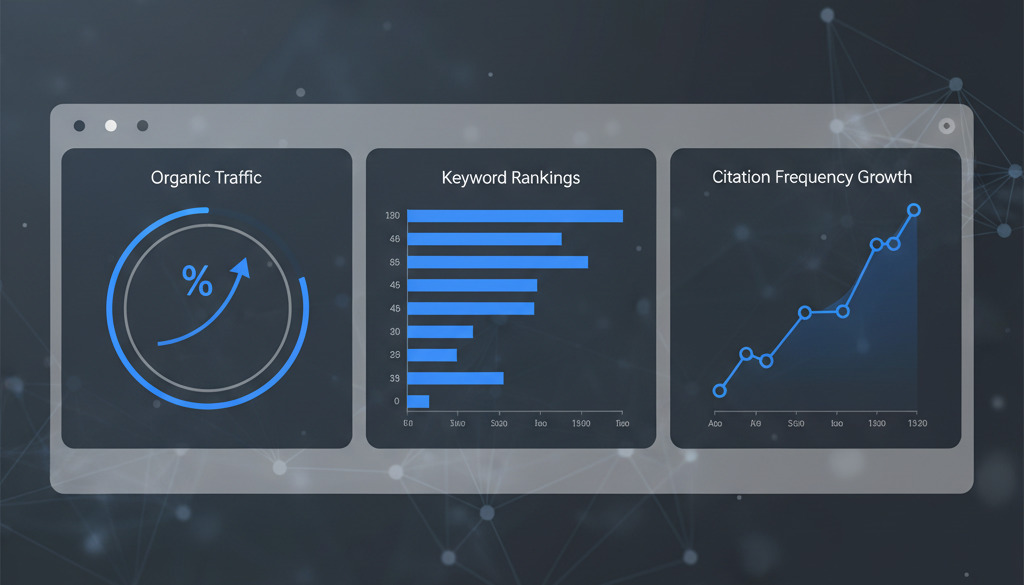
Key Performance Indicators (KPIs) for the AI Era
| Metric | Description | Why It Matters Now |
|---|---|---|
| Citation Frequency | How often your domain is cited as a source in AI Overviews. | This is a primary indicator of visibility and authority in the new search landscape. |
| Organic Traffic | The number of visitors coming to your site from non-paid search results. | While overall clicks may dip due to AI answers, traffic to your key pages should still grow. |
| Keyword Rankings | Your position in the traditional "blue links" for target keywords. | Still important, as research shows a correlation between a top-10 ranking and being cited in AI Overviews. |
| Conversion Rate | The percentage of visitors who complete a desired action (e.g., fill a form, make a purchase). | Data suggests that visitors who click through from an AI Overview may convert at a much higher rate. |
Utilizing Analytics Tools
Tools like Google Search Console and Google Analytics remain essential. In Search Console, you can monitor your impressions, clicks, and average ranking for various queries. In Analytics, you can see how users behave once they land on your site—how long they stay, what pages they visit, and whether they convert.
Addressing Common Concerns and Ethical Considerations
As with any transformative technology, AI raises valid questions and concerns. It's important to approach it with a clear-eyed, responsible strategy.
AI, Originality, and Plagiarism
Reputable AI models are designed to generate original text, not to copy and paste from their training data. However, since they learn from existing content, it's possible to produce text that is unintentionally similar to a source. Always use a plagiarism checker to scan AI-generated drafts as a final quality control step. Furthermore, the real originality comes from the unique human expertise you layer on top of the AI draft.
Transparency with Your Audience
Currently, there's no consensus on whether you must disclose the use of AI in creating content. Google's guidance is clear: they reward good content, regardless of how it's produced. The focus should be on quality, helpfulness, and accuracy. If the content is high-quality and fact-checked by a human expert, its origin is less important than its value to the reader.
Avoiding Algorithmic Penalties
Google’s policies penalize low-quality, spammy content created *at scale* to manipulate rankings. They do not penalize the *use of AI*. If you use AI as a tool to create genuinely helpful, well-researched, and human-refined content, you are operating well within search engine guidelines.
The Future of AI in SEO Content Strategy
The current state of AI is just the beginning. The technology is advancing at an exponential rate, and we can anticipate even more sophisticated capabilities in the near future.
- Hyper-Personalization: AI may soon be able to tailor content experiences to individual users in real-time based on their past behavior and demographic data.
- Predictive Analytics: AI will become even better at forecasting search trends and content gaps, allowing for truly proactive content strategies.
- The Human-AI Partnership: The most successful marketing teams will be those that master the collaborative dance between human creativity and AI efficiency. The "human in the loop" will remain the most critical component for strategy and quality.
Getting Started with AI Content Strategy: A Practical Roadmap
Feeling ready to start? Here is a simple, step-by-step plan for the non-technical business owner.
- Step 1: Define Your Goals. What do you want to achieve? More leads? Higher brand awareness? Be specific. Your goals will dictate your entire strategy.
- Step 2: Choose Your Tools. You can start with widely available tools like ChatGPT or Gemini, or you can opt for a specialized writing assistant. The choice depends on your budget and how hands-on you want to be.
- Step 3: Develop Your Prompting Skills. Invest a few hours in learning how to write clear, detailed prompts. This is the single most important skill for getting quality results from any AI.
- Step 4: Establish Your Editing Process. Define a clear workflow: AI drafts, human reviews, fact-checks, adds unique insights, and gives a final polish. Never publish raw AI output directly.
- Step 5: Test, Measure, and Iterate. Publish your content, track its performance using your analytics tools, and use that data to refine your topics, prompts, and overall strategy.
A Smart Path to More Traffic: The "More Customers From Your Blog" Advantage
If that five-step roadmap still sounds like more work than you have time for, you are not alone. This is precisely the challenge that services like More Customers From Your Blog were created to solve. They offer a direct path to the rewards of a powerful SEO content strategy without the steep learning curve or time commitment.
By using their proprietary AI, they can deliver professional, brand-aligned SEO articles directly to you in minutes—it can feel like magic. The core outcome is what every business owner wants: customers find you on their own through Google. To make it completely risk-free, your first five blog posts are free, allowing you to see the impact for yourself before committing.
Conclusion
The integration of Artificial Intelligence into SEO is not a fleeting trend; it is a fundamental shift in how we create and consume information online. For business owners, this technology presents an unprecedented opportunity to level the playing field. By embracing AI, you can overcome the long-standing hurdles of time, cost, and consistency that once made a powerful content strategy feel out of reach.
However, it is vital to remember that AI is a tool—an incredibly powerful one, but a tool nonetheless. Success in this new era hinges on a strategic partnership between machine efficiency and human insight. Your expertise, your brand's voice, and your commitment to quality are the ingredients that will continue to set you apart. By leveraging AI as your co-pilot, you can not only unlock SEO success but also build a more resilient, visible, and profitable business for the future.
Frequently Asked Questions
1. Will Google penalize my website for using AI-generated content?
No. Google's official stance is that they reward high-quality content that is helpful to users, regardless of how it is produced. Their policies target low-quality, spammy content created at scale to manipulate rankings, not the responsible use of AI as a tool. As long as your content is accurate, original, and human-reviewed for quality, it aligns with Google's guidelines.
2. Can AI completely replace my human writers and content team?
Not for work that requires true quality and authority. AI is best viewed as an assistant or co-pilot. It excels at research, drafting, and summarizing. However, it lacks genuine creativity, personal experience, critical thinking, and deep subject matter expertise. The most effective approach is a human-AI partnership, where AI handles the heavy lifting of drafting, and humans provide strategic direction, fact-checking, and the final polish.
3. How much does it cost to implement an AI content strategy?
The cost can vary dramatically. At the low end, you can use free or low-cost subscription models of general AI tools (like ChatGPT or Gemini) and invest your own time in prompting and editing. Mid-range options include specialized AI writing software with more SEO-focused features. At the higher end, you can use a "done-for-you" service that manages the entire process for you, which offers the highest convenience and often a clear ROI in terms of saved time and business growth.
4. What is the difference between using a general AI tool like ChatGPT and a specialized content service?
A general tool like ChatGPT is a blank slate; it's powerful but requires you to develop all the prompts, strategy, and editing workflows yourself. A specialized service, like More Customers From Your Blog, is an end-to-end solution. It uses AI that is often purpose-built for SEO content and wraps it in a service that includes strategy, optimization, and a streamlined process, designed specifically for business owners who want the results without the hands-on work.
5. How can I ensure the AI-generated content truly matches my unique brand voice?
The key is providing the AI with the right instructions and examples. Before generating a full article, you can "train" it by providing it with samples of your existing content (like your website's home page, a popular blog post, or sales copy) and explicitly instructing it to adopt that tone, style, and vocabulary. The human editing phase is also critical for making final tweaks to ensure it perfectly aligns with your brand personality.
Keep reading
Hand-picked guides that go deeper — open the one you need next:
- Truth About AI SEO Ranking Guarantees: Experts Guide
- AI SEO 90 Days: A Strategic Roadmap for Accelerated Growth
- Local SEO for Plumbers: The Ultimate Guide to More Leads
- Unlock Global Markets: Multilingual AI Content for International SEO