
SEO for the Non-Technical Business Owner: AI Content Guide

Key Takeaways
- SEO is Accessible: You don't need to be a tech wizard to master SEO. Modern AI tools are designed for business owners, not just developers.
- AI is a Content Engine: Artificial Intelligence can break through writer's block and resource limitations, helping you produce high-quality, relevant content consistently.
- Human Oversight is Crucial: AI is a powerful assistant, not a replacement for your business expertise. Always review, edit, and infuse AI-generated content with your unique brand voice and knowledge.
- Search is Changing: The goal is shifting from just ranking first to being the *source of the answer* in AI-generated summaries (like Google's AI Overviews).
- New Metrics for Success: Track your content's performance by looking at its "citation frequency" in AI answers and the high conversion rates of traffic from these sources, not just traditional rankings.
- Actionable Strategy Matters: Creating content is just the first step. AI can also help structure, optimize, and measure your content to ensure it directly contributes to business growth.
SEO Non-Technical AI: Empowering Your Business Growth Through Smart Content
Introduction: Bridging the Gap Between SEO and Business Owners
Search Engine Optimization. For many established business owners, those three words can trigger a mix of confusion, frustration, and the nagging feeling of a missed opportunity. You've built a successful company through expertise, hard work, and strong relationships. But when it comes to the digital world, the rulebook seems to be written in a language you don't speak. The technical jargon, the ever-changing algorithms, and the demand for constant content can feel like an insurmountable barrier.
What if you could harness the immense power of SEO—attracting customers who are actively searching for your solutions—without having to become a coding expert or a digital marketing guru? What if there was a tool that could act as your dedicated content creator, researcher, and strategist, working 24/7 to grow your online presence?
That tool is here, and it’s Artificial Intelligence (AI). This guide is specifically for you: the non-technical, savvy business owner who understands the importance of an online presence but lacks the time and technical inclination to achieve it. We will demystify AI and show you, step-by-step, how it can revolutionize your content strategy, drive organic traffic, and become your most powerful asset for business growth.
Understanding the Core Principles of SEO (The "Why" Beyond the "How")
Before we dive into AI, it’s crucial to understand the fundamental goal of SEO. At its heart, SEO isn't about tricking computers; it's about connection. The single most important objective of SEO is to increase your visibility on search engines like Google to attract qualified leads—people who are actively looking for the products, services, and expertise you provide.
The Role of Search Engines
Think of Google as the world's largest and most efficient referral service. Its job is to understand a user's question or need (a "query") and provide the most relevant, helpful, and authoritative answer available on the internet. To do this, it uses complex algorithms that are constantly evolving. While they used to focus on simple keywords, today's search engines are incredibly sophisticated at understanding *user intent*—the "why" behind the search.
Why High-Quality Content is King
This brings us to the immutable core of all successful SEO: *relevant, high-quality content*. Your website's content is the "answer" you provide to the search engine.[1] If your content is comprehensive, well-structured, and genuinely helpful to the user, the search engine will recognize its value and show it to more people. This is the foundation upon which all other SEO activities are built, and it’s the area where AI is making the most significant impact.
Demystifying Artificial Intelligence for Business Applications
The term "Artificial Intelligence" can conjure up images of science fiction, but in a business context, its meaning is much more practical. At its core, AI is the simulation of human intelligence in machines, programmed to think, learn, and problem-solve. For your business, you don't need to know how it works, only *what it can do for you*.
Generative AI vs. Analytical AI
There are many types of AI, but for our purposes, we can simplify them into two main categories:
- Analytical AI: This type of AI analyzes existing data to find patterns and insights. Your website analytics dashboard uses a form of this.
- Generative AI: This is the game-changer. Generative AI *creates new content*—text, images, ideas—based on the data it has been trained on. It's like having a brilliant junior copywriter, researcher, and brainstorming partner on your team, available instantly.
When we talk about AI for SEO content, we are almost always talking about generative AI. It's the engine that will write your blog posts, suggest your titles, and structure your articles.
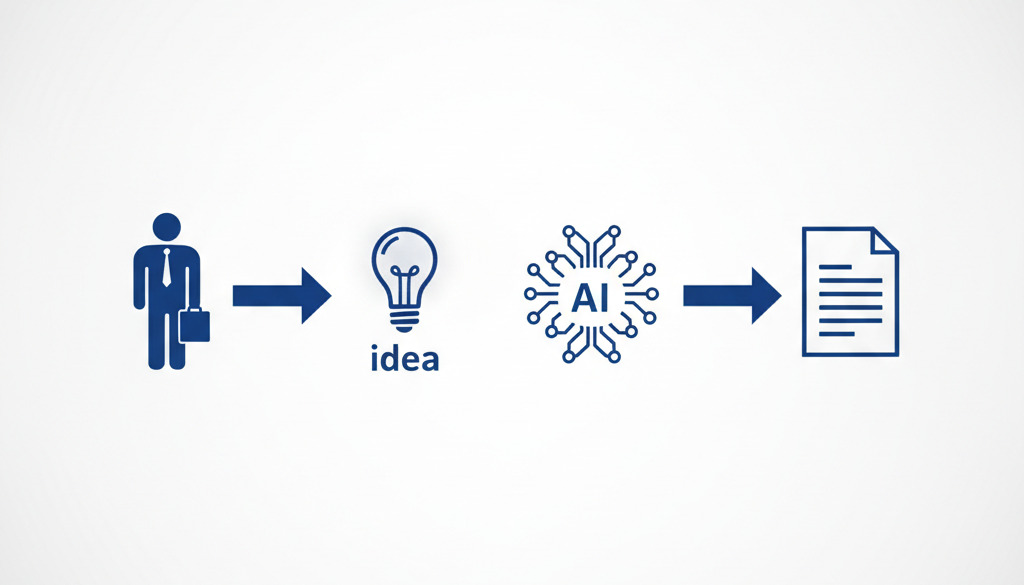
AI's Role in Overcoming Content Creation Bottlenecks
If you're like most SMB owners, your biggest challenge with content is simple: you don’t have the time. The idea of consistently coming up with topics, researching them, and writing thousands of words for a blog is daunting. This is where most content marketing strategies fail before they even start.
Common Hurdles for SMBs
- Time Constraints: You are busy running your business, managing employees, and serving customers. Writing is a time-intensive task.
- Resource Limitations: Hiring a full-time writer or a marketing agency can be expensive and may not be in the budget.
- Lack of Expertise: You're an expert in your field, not necessarily in writing SEO-optimized articles.
- The "Blank Page" Problem: Simply getting started and coming up with fresh ideas is often the hardest part.
AI directly addresses these bottlenecks. It can act as your tireless content generation engine, turning a simple idea into a full-fledged article in minutes. This isn't about replacing human thought; it's about augmenting it. Consider the concept of "assisted writing," where the AI does the heavy lifting of drafting, and you provide the final polish, expertise, and strategic direction.
Keyword Research Reimagined: AI-Powered Insights
Traditionally, keyword research involved using complex tools to find phrases people were searching for, often focusing on high-volume terms. This method has limitations, as it can be generic and miss the nuances of customer intent.
From Keywords to Conversations
AI transforms keyword research from a guessing game into a strategic intelligence operation. Instead of just finding keywords, AI helps you understand the entire search landscape.
- Identifying Hidden Opportunities: AI excels at uncovering *long-tail keywords*—longer, more specific phrases that indicate a user is closer to making a decision. For example, instead of "accountant," an AI might suggest "quarterly tax preparation services for freelance graphic designers." This traffic is less voluminous but far more valuable.
- Understanding User Intent: AI can analyze thousands of search results to determine what users *really* want when they type a query. Are they looking for information, a specific product, or a local service? AI helps you create content that perfectly matches that intent.
- Spying on Competitors: AI tools can analyze your competitors' websites and identify the keywords that are driving traffic for them, revealing gaps in your own strategy that you can exploit.
Crafting Engaging and SEO-Optimized Content with AI
Once you have your strategic keywords, the next step is creating the content. This is where generative AI truly shines for the non-technical business owner. The process becomes streamlined, efficient, and remarkably effective.

Generating an Endless Stream of Ideas
Feed a topic or a keyword into an AI tool, and it can generate dozens of potential blog post titles, outlines, and angles. It can analyze current trends and tell you what questions people are asking online, ensuring your content is always relevant and in demand.
Drafting High-Quality Content in Minutes
From a simple prompt, an AI can draft an entire blog post. This is your first draft, not your final copy. It saves you the 80% of the effort that goes into research and basic writing, allowing you to focus on the critical 20%: adding your personal stories, expert insights, and unique brand voice.
Think of the AI as a new employee. You wouldn't let a new hire publish a blog post without reviewing it first. The same principle applies here. Use the AI-generated draft as a starting point, then edit and refine it to ensure it perfectly represents your brand and meets your high standards of quality.
The Art of Title Tag and Meta Description Optimization with AI
Your *title tag* (the blue link in Google search results) and *meta description* (the small text underneath) are your digital storefront window. They are often the only things a potential customer sees before deciding whether to click on your site. Their importance cannot be overstated.
The problem is, writing compelling, keyword-rich titles and descriptions that stay within Google's character limits is a specific skill. AI eliminates this challenge. You can provide an AI with the text of your article, and it can generate multiple title and description options, optimized for both search engines and human psychology, helping you maximize your click-through rate (CTR).
AI for Structuring Content: Headings, Subheadings, and Readability
Have you ever clicked on a website and been met with a "wall of text"? You probably hit the "back" button immediately. Proper structure is vital for keeping readers engaged and for signaling the importance of different topics to search engines.
AI can instantly structure a piece of content using a logical hierarchy of headings and subheadings (H2, H3, etc.). This has two key benefits:
- Improved User Experience: Headings break up the text, making it easy for readers to scan and find the information they need. This increases *dwell time*—the amount of time visitors spend on your page—which is a positive signal to Google.
- Better SEO Signals: Search engines use headings to understand the main topics and subtopics of your article. A well-structured article is easier for Google to "read" and rank appropriately.
AI's Contribution to On-Page Content Quality and Depth
In the new era of search, dominated by AI-driven answers, content depth is more important than ever. Recent industry data shows a dramatic correlation between content length and the likelihood of being cited in Google's AI Overviews. Simply put, **comprehensive content wins**.
According to a March 2026 analysis, pages with over 20,000 characters (approximately 3,000-4,000 words) were cited far more frequently in AI-generated answers than shorter articles. Creating such in-depth content manually is a monumental task. With AI, it becomes achievable. AI can help you:
- Identify Content Gaps: AI can compare your draft to other top-ranking articles and suggest subtopics or questions you haven't yet addressed.
- Expand on Existing Points: If a section feels thin, AI can help you flesh it out with more detail, examples, or explanations.
- Ensure Keyword Integration: AI can subtly weave relevant keywords and related terms throughout your content without sounding unnatural.
Keep reading
Hand-picked guides that go deeper — open the one you need next:
- Best SEO Tools 2026
- Mastering SEO Optimized Blog Articles: A Strategic Blueprint
- Demystifying SEO: A Non-Technical Guide for Business Owners Using AI
- Boost SEO: How AI Blog Writing Drives Organic Traffic