
AI Content Calendar Scaling: Drive Efficiency and Impact

- Scalability at Speed: AI content calendar scaling allows teams to compress weeks of planning and production into hours, maintaining a high-volume cadence without burning out human resources.
- Data-Driven Strategy: Moving beyond simple lists, AI enables 'cluster-level' planning, ensuring every piece of content supports a larger thematic authority index.
- Dynamic Optimization: AI tools facilitate a shorter content refresh cycle (6-8 months) to combat content decay and adapt to shifting search engine algorithms.
- Human-AI Collaboration: The most effective scaling models treat AI as a 'co-pilot' for ideation and drafting while retaining human oversight for brand voice and strategic alignment.
In the contemporary digital landscape, the volume of content required to maintain brand visibility is staggering. Marketing teams are no longer just competing for keywords; they are competing for sustained attention across a fragmented ecosystem of search engines, social platforms, and specialized community hubs. Traditionally, expanding a content calendar meant linear increases in headcount—hiring more writers, editors, and social media managers. However, AI content calendar scaling has fundamentally changed this calculus.
The challenge today isn't just producing more; it is producing enough high-quality, strategically aligned content to meet the demands of an AI-driven search environment. With research suggesting that nearly 73% of marketers struggle to maintain a consistent posting cadence, the shift toward AI-augmented workflows is no longer optional. It is a business imperative for maintaining competitive relevance in a high-volume marketplace.
The Evolving Content Landscape and the Scaling Imperative
The shift towards data-driven content strategies has redefined what it means to be successful in digital marketing. We have moved from a "page-level" ranking era to a "thematic authority" era. Search engines now prioritize websites that demonstrate comprehensive expertise across entire topic clusters rather than isolated articles. This necessitates a much higher volume of content to "fill out" these clusters effectively.
Manual content calendar management often hits a ceiling. As volume increases, human-intensive processes face resource strain, leading to missed deadlines and inconsistent brand messaging. In a business context, scaling a content calendar refers to the ability to increase output and reach without a proportional increase in operational costs or a decrease in quality. It is about building a content factory that is agile, responsive to trends, and grounded in performance data.
The Cost of Inconsistency
Inconsistency is the primary reason brands lose ground in organic search and social engagement. When a team fails to hit its cadence, search algorithms interpret the lack of activity as waning authority. AI eliminates this bottleneck by automating the administrative and foundational layers of the planning process, allowing strategy to remain the focus even as output doubles or triples.
Understanding AI's Role in Content Calendar Augmentation
To effectively scale, it is crucial to understand that AI is not a single tool but a suite of capabilities powered by Natural Language Processing (NLP) and Machine Learning (ML). NLP allows machines to "read" and "understand" the nuances of existing content, while generative AI facilitates the creation of new assets. ML algorithms excel at pattern recognition, helping teams identify which types of content are likely to perform best based on historical audience behavior.
AI should be viewed as an augmented solution rather than a fully autonomous one. While AI can handle the "heavy lifting" of data analysis and initial drafting, the strategic direction and final polish must remain human-centric. This partnership allows for a level of personalization and speed that was previously impossible, transforming the calendar from a static document into a living, data-responsive engine.
Beyond Generative Text
Scaling goes beyond merely asking a chatbot to write a blog post. It involves using AI to analyze sentiment in competitor comments, forecast seasonal search trends, and predict which content formats (e.g., carousels vs. long-form articles) will yield the best ROI for a specific campaign. This deep analysis informs the calendar before a single word is even written.
Strategic AI Integration for Content Ideation at Scale
The most time-consuming part of content management is often deciding *what* to create next.[1] AI tools excel at identifying content gaps by crawling the web to see what competitors have covered and where they have missed the mark. By analyzing search trends and audience queries in real-time, AI can suggest topic clusters that are ripe for expansion.
For example, a marketing team can use AI to perform a "gap analysis" that compares their current library against the top ten rankings for a primary keyword. The AI then suggests 15-20 sub-topics to build a comprehensive pillar. This strategic ideation ensures that every piece of content added to the calendar serves a specific purpose in building overall domain authority.
Trend Forecasting and Topic Clusters
Modern AI tools can predict "emerging intent"—topics that are trending upward before they reach their peak. By scheduling content around these forecasts, brands can capture early-mover advantages. Topic clustering, another AI hallmark, ensures that the calendar is organized logically, with internal linking structures planned out months in advance.
Leveraging AI for Efficient Content Planning and Workflow Optimization
A functional content calendar must account for more than just dates. It needs to manage status, ownership, keywords, and repurposing plans. AI can automate the distribution of these tasks. By setting predefined criteria—such as writer availability, peak engagement hours, and platform-specific requirements—AI can populate a master calendar in minutes.
Furthermore, AI-driven predictive analytics can suggest the optimal cadence for different channels. While your team might think posting daily on LinkedIn is best, AI may analyze your specific audience data and suggest that three high-quality posts per week actually generate 40% more engagement. This optimization ensures that your scaling efforts are focused on impact rather than just noise.
Establishing a Content Cadence
Consistency is king in 2026. AI helps maintain this by identifying content pillars and themes that can be "drip-fed" to the audience. This structured approach prevents the common "feast or famine" content cycle, ensuring a steady stream of value that keeps the brand top-of-mind for potential customers.
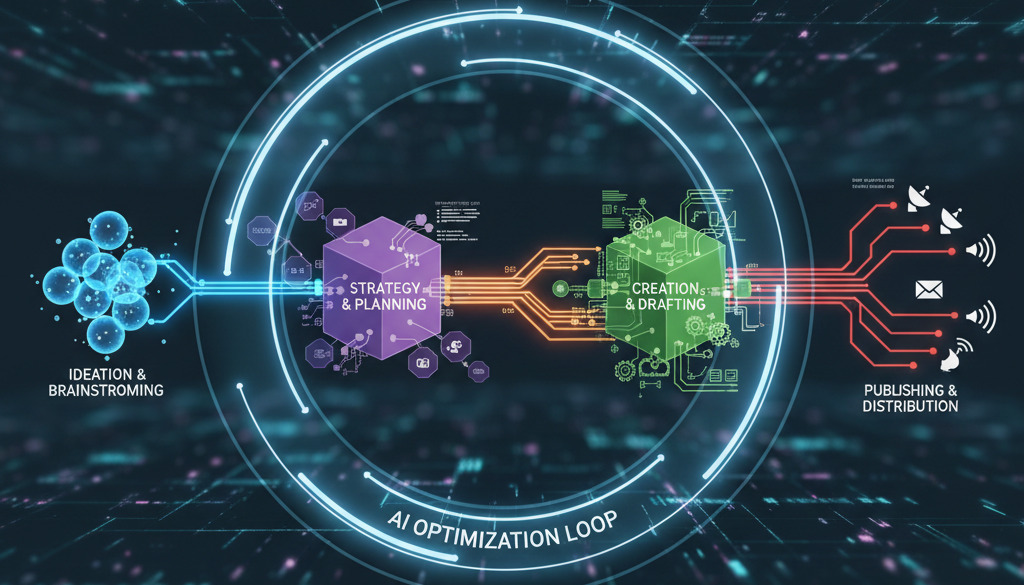
AI-Assisted Content Creation: From Drafts to Polished Assets
Generative AI is a powerhouse for scaling the actual production of assets. It can take a single core idea and instantly draft variations for different platforms: a 1,200-word blog post, a short-form video script for TikTok, a LinkedIn thought-leadership post, and an email newsletter summary. This multi-format scaling allows a small team to have the presence of a global enterprise.
Beyond the primary text, AI handles the metadata that humans often neglect under pressure. Titles, meta descriptions, alt-text for images, and SEO tags can all be generated and optimized simultaneously. This ensures that as your calendar grows, the technical quality of each post remains high, improving its chances of appearing in search engine results and AI snippets.
Maintaining Brand Voice and Quality with AI
The primary risk of scaling with AI is the loss of a unique brand voice. To mitigate this, businesses must implement "Brand Voice Blueprints" within their AI prompts. This involves training the AI on past successful content, specific style guides, and banned phrases to ensure the output sounds like the brand, not a generic machine.
Human editors act as the essential final gatekeepers. In an AI-augmented workflow, the editor's role shifts from "writing and correcting" to "curating and refining." This hybrid approach maintains the speed of AI while ensuring the creative spark and emotional resonance that only a human can provide. Human oversight is the bridge between high-volume output and high-quality impact.
Optimizing Content Distribution with AI-Driven Insights
Once content is created, the next hurdle is ensuring it reaches the right eyes. AI-driven distribution tools analyze audience segments to determine when specific personas are most active. Instead of a "spray and pray" approach, scaling involves a targeted "precision strike" strategy. AI can dynamically adjust the distribution schedule if it detects a shift in audience behavior patterns.
Personalization at scale is now achievable. AI can suggest different headlines and imagery for the same content piece based on the segment it is being delivered to. For instance, a technical audience might see a data-focused headline, while a C-suite audience sees a ROI-focused one. This level of granular optimization significantly boosts conversion rates without skyrocketing the production budget.
A/B Testing and Variant Generation
AI can automatically generate dozens of variants for social media ad copy or email subject lines. By running these variants through automated A/B testing loops, the system identifies the winner and shifts resources toward it in real-time. This iterative process turns the content calendar into a self-optimizing system that learns from every post.
Measuring and Iterating: AI for Data Analysis and Performance Feedback
Scaling is not a one-time event; it is a continuous loop. Traditional analytics often lag, showing you what happened weeks ago. AI provides near-real-time feedback on how content is performing against specific KPIs like time-on-page, click-through rate, and conversion paths. This allows for immediate pivots if a particular content theme is underperforming.
One of the most valuable applications of AI in scaling is identifying "content decay." Content typically loses its ranking power every 6-18 months. AI can monitor your entire library and alert the team when a post's traffic starts to dip, automatically scheduling a "refresh" in the calendar. This proactive maintenance ensures that the volume you have built continues to deliver value over the long term.
Closing the Feedback Loop
The feedback loop is where the "intelligence" in AI truly shines. By analyzing why certain posts succeeded, the AI refines its future ideation and drafting suggestions. If the AI notices that your audience engages most with "how-to" guides featuring original data, it will prioritize those formats in the next month's planning cycle, ensuring that scaling always aligns with audience preference.

Implementing and Managing an AI-Augmented Content Calendar
Transitioning to an AI-augmented system requires more than just a software subscription; it requires a shift in team culture. Change management is critical. Writers and creators may initially fear that AI is a threat to their roles. The goal is to demonstrate that AI handles the tedious aspects—research, formatting, and optimization—leaving them more time for high-level storytelling and strategy.
Organizations should start by integrating AI into a single part of the workflow—perhaps ideation or social media repurposing—before moving to full-scale adoption. Establishing clear ethical guidelines for AI use is also paramount. Transparency regarding AI-generated content and strict data privacy protocols protect the brand's reputation and ensure compliance with evolving digital regulations.
Selecting the Right AI Tools for Your Business Needs
When selecting tools for content calendar scaling, look for platforms that offer end-to-end integration. A tool that generates ideas but doesn't connect to your CMS or social scheduler creates a friction point. Key criteria should include:
- Scalability: Can the tool handle an increase from 10 to 100 posts per month?
- Customization: Can you train it on your specific brand voice?
- Analytics: Does it provide actionable insights rather than just raw data?
- Security: Does the vendor have robust data protection measures?
The Future of AI in Content Calendar Scalability and Beyond
We are moving toward a future of hyper-personalization at scale. Imagine a content calendar that creates unique versions of a blog post for every individual user based on their specific industry and past interactions with your brand. As AI models become more sophisticated, the distinction between "planning" and "execution" will continue to blur, with systems capable of real-time content generation in response to live market events.
The role of the content marketer will evolve from "creator" to "architect." Strategy, empathy, and ethical oversight will become the most valuable skills in the workforce. By embracing AI content calendar scaling today, businesses are not just increasing their output; they are future-proofing their marketing infrastructure for a world where content is the primary currency of brand value.
Conclusion
Scaling a content calendar with AI represents a significant leap forward in marketing efficiency and strategic impact. By automating the high-volume, data-intensive tasks of ideation, planning, and drafting, businesses can maintain a consistent and dominant presence in an increasingly crowded digital landscape. The key to success lies in the synergy between AI's processing power and human creativity. As you move forward, remember that AI is the engine that drives the scale, but your brand’s unique voice and strategic vision must remain the hands on the steering wheel. Embracing this technology today is the surest path to achieving a sustainable competitive advantage in the content-driven world of tomorrow.
Frequently Asked Questions
Is AI-generated content harmful to my SEO rankings?
No, Google has clarified that it rewards high-quality, helpful content regardless of how it is produced. However, scaling too quickly with low-quality, "spammy" AI content that offers no new value can lead to penalties. The secret is using AI to assist in creating expert-level content, not replacing the human quality control process.
How much time can I realistically save by using AI for my content calendar?
Most marketing teams report saving between 50% and 70% of the time previously spent on the administrative and foundational stages of content creation. This includes research, keyword planning, and initial drafting. For social media, specialized AI tools can compress a week's worth of multi-platform planning into just a few hours.
Can AI really capture my brand's unique "voice"?
Yes, provided you give it the right inputs. Modern AI models can be "trained" or "prompt-engineered" using samples of your best content. By creating detailed style guides and using them as persistent instructions for the AI, you can ensure that the output matches your brand's tone, whether it is professional and academic or witty and conversational.
What is "content decay" and how does AI help fix it?
Content decay occurs when an older post starts to lose its relevance and search ranking. AI-driven calendars can monitor your traffic data and automatically flag articles that are underperforming. Since search cycles have shortened to roughly 6-8 months, AI allows you to schedule refreshes systematically, ensuring your total content library remains an evergreen asset.
Do I need an entirely new team to manage an AI content calendar?
Generally, no. The goal of AI content calendar scaling is to empower your existing team to do more with less. Your current writers and editors will transition into AI operators and strategic curators. While some training on prompt engineering and new AI tools is necessary, the core need for human marketing expertise remains as vital as ever.
Keep reading
Hand-picked guides that go deeper — open the one you need next:
- Multi-Language Content: Expand Your Reach with AI Translation
- The AI Blog Autopilot: Set It and Forget It
- Beyond Basic Blogging: Volteruno's AI Article Writer Delivers Expert Content
- The Future of Blogging: AI-Generated Expert Articles
→ Read the full AI Content guide
→ Read the full AI Content guide