
The AI Blog Autopilot: Set It and Forget It

Key Takeaways
- Automate to Elevate: An AI blog autopilot allows business owners to consistently publish high-quality, SEO-optimized content without the daily time commitment.
- Strategy First: The 'set and forget' approach is not completely hands-off. It requires an initial strategic "set" phase where you define your audience, keywords, and goals.
- Reclaim Your Time: By automating content creation, you shift from being a content creator to a strategic overseer, freeing up countless hours to focus on running your business.
- Consistency is King in SEO: AI tools enable a regular publishing schedule, a critical factor for improving search engine rankings and building an engaged audience.
- Measurable ROI: The financial benefit comes from a significant reduction in content creation costs (compared to agencies or freelancers) and an increase in organic traffic and leads.
- Accessible Technology: Platforms like 'More Customers From Your Blog' are designed for non-technical users, making it easy to integrate this powerful technology into your existing website.
AI Blog Autopilot: Set and Forget Your Content Strategy
As a business owner, you wear countless hats. You're the CEO, the head of sales, the customer service manager, and the chief financial officer. On top of all that, you're told you also need to be a prolific content creator. The pressure to consistently write, optimize, and publish high-quality blog posts is immense. It feels like a content treadmill you can never step off of. You know a blog is crucial for attracting customers through Google, but who has the time?
This is a challenge we hear constantly from business owners over 40. You've built a successful enterprise and understand the importance of an online presence, but you're not an online native. The thought of keyword research, SEO optimization, and writing thousands of words each week is daunting, to say the least. You have neither the time nor the inclination for it.
What if you could have a thriving, lead-generating blog without the endless work? Imagine a system you could set up once, based on your business goals, and then let it run, consistently attracting new customers. This is the reality of the AI blog autopilot—a genuine "set it and forget it" solution for your content marketing. Services created specifically for this purpose, such as our platform at Több vásárló a blogodról (which translates to 'More Customers From Your Blog'), are designed to take this entire burden off your shoulders. We write the professional SEO articles for you, using our proprietary AI, allowing customers to find you organically on Google.
In this comprehensive guide, we will demystify the world of AI-powered content automation. You will learn everything you need to know about setting up your own AI blog autopilot, freeing your schedule, and finally putting your website's content strategy on a path to predictable, automated growth.
Understanding the "Set and Forget" Philosophy in Content Marketing
The phrase "set it and forget it" might sound too good to be true, especially in the context of something as nuanced as content marketing. However, when applied correctly with AI, it represents a paradigm shift in how businesses approach content creation. It’s not about abdication of responsibility, but about smart delegation to technology.
Defining "Set and Forget" for Blog Automation
In this context, "set and forget" refers to a system where the intensive, repetitive, and time-consuming tasks of content creation are automated. This includes topic ideation, drafting, SEO optimization, and even scheduling. The "set" phase involves the initial strategic planning. The "forget" phase refers to the day-to-day and week-to-week relief from the content production grind. It means you are no longer the bottleneck in your own marketing efforts.
Strategic Oversight vs. a "Hands-Off" Approach
It's crucial to distinguish this philosophy from a truly "hands-off" or negligent approach. An AI autopilot still requires a human captain to set the destination. You provide the strategic direction: who your customers are, what problems they face, and how your business solves those problems. The AI then handles the heavy lifting of executing that strategy. Think of it like a sophisticated cruise ship autopilot: the captain plots the course, and the system handles the minute-to-minute adjustments to stay on track.
The Benefits for Time-Poor Business Owners
For a busy owner, the advantages are profound:
- Time Liberation: The most immediate benefit is the recovery of valuable time. Hours previously spent struggling to write or managing freelancers can now be reinvested into core business activities like sales, product development, and customer relationships.
- Unwavering Consistency: An AI system doesn’t get tired, sick, or uninspired. It can maintain a rigorous publishing schedule (e.g., multiple posts per week) that is often impossible for a human to sustain alone, which is a massive signal to search engines like Google.
- Scalability: Need to ramp up content production? An AI can scale from one post a month to several posts a day without a proportional increase in effort from you.
The Evolving Landscape of Business Blogging and SEO
Blogging isn't just a digital diary for businesses; it's a powerful engine for growth. For decades, it has remained one of the most effective ways to build brand authority, generate organic traffic, and nurture leads. However, the strategies that worked five years ago are no longer sufficient in today's competitive digital environment.
The Enduring Importance of a Business Blog
A well-maintained blog is your company's digital embassy. It’s a space you own, where you can speak directly to your audience, answer their questions, and build trust. Every article you publish is a new opportunity to rank on Google, a new asset that can attract customers for years to come. For service businesses, a blog demonstrates expertise and provides value upfront, making it a cornerstone of effective lead generation.
Key Shifts in SEO That Demand More Content
Search Engine Optimization (SEO) has become significantly more sophisticated. Google's algorithms increasingly prioritize websites that demonstrate deep expertise and authority on a given topic. This is often referred to as building *topic clusters*. It's no longer enough to have one or two articles about a service you offer. To rank well, you need a comprehensive library of content that covers the topic from every angle, answering every conceivable question a potential customer might have. This shift inherently demands a higher volume of fresh, relevant content.
Today, SEO success is less about keyword tricks and more about becoming a genuine, comprehensive resource for your target audience. This depth of content is precisely where AI automation shines.
Introducing AI: The Engine of Your Blog Autopilot
Artificial Intelligence (AI) has moved from the realm of science fiction into practical business applications.[1] One of its most transformative uses is in content generation. For business owners unfamiliar with the technology, it can seem like a black box, but the concept is surprisingly straightforward and accessible.
What is AI-Powered Content Generation?
At its core, AI content generation uses large language models (LLMs) to produce human-like text. These models have been trained on vast amounts of information from the internet, including books, articles, and websites. When given a prompt or a set of instructions, the AI can generate coherent, contextually relevant, and original text on virtually any subject. It’s not copying and pasting; it’s generating new sentences and paragraphs based on the patterns and information it has learned.
Demystifying the Technology for Business Leaders
You don't need to understand the complexities of neural networks to use an AI writer. The important thing to grasp is that it's a tool that responds to your instructions. The quality of the output is directly related to the quality of the input. This is why the "set" phase is so critical. By providing a clear topic, target keyword, desired tone of voice, and key points to include, you guide the AI to create content that aligns perfectly with your business strategy. Modern AI content platforms have user-friendly interfaces that make this process simple, often just requiring you to fill out a few fields.
The "Set" Phase: Crafting Your AI Blog Strategy
The success of your AI blog autopilot hinges entirely on the quality of your initial strategy. This is where you infuse the system with your business knowledge and customer insights. Rushing this phase will lead to generic content that doesn’t connect with your audience or drive results. Investing time here ensures the AI works for you, not against you.
Defining Your Target Audience and Their Intent
Before you write a single word (or have an AI write it), you must know who you're talking to. For many established business owners, this is second nature. Think about your best customers:
- What are their biggest challenges and pain points?
- What questions do they ask you most often?
- What are their goals and aspirations?
Each blog post should be a direct answer to one of these questions or a guide to solving one of these problems. This focus on search intent is what gets you found on Google by people who are actively looking for your solutions.
Identifying Core Keywords and Topic Clusters
Your strategy should be built around a set of core keywords that are central to your business. These are typically the services you offer or the main products you sell (e.g., "financial advisor for small business," "commercial roof repair," "custom kitchen remodeling"). From these core keywords, you can branch out to create topic clusters—groups of related articles that cover a subject in-depth. For example, under "custom kitchen remodeling," you might plan articles on "choosing the right countertops," "cost of a kitchen remodel in 2026," and "best layouts for small kitchens."
This initial strategic input is the most critical part of the process. Even the most advanced AI cannot read your mind or understand your unique business value proposition without clear direction. This upfront work is what makes the "forget" phase possible.
How 'More Customers From Your Blog' Creates Prolific SEO Content for You
While some AI tools require you to manage the prompts and editing yourself, full-service solutions take care of the entire process. Our platform, known in its original market as Több vásárló a blogodról, was built on the premise that busy business owners need more than just a tool—they need a complete solution. We focus on getting you more customers from your blog by having us write the SEO articles for you.
The Magic of a Done-For-You AI Service
Our approach is unique. After the initial strategy session where we learn about your business and goals, our proprietary artificial intelligence gets to work. It doesn't just generate generic text; it's fine-tuned to create professional, long-form SEO blog articles specifically for your website. The process feels almost like magic to our clients. We handle the keyword research, topic clustering, and content generation, delivering ready-to-publish articles in minutes ("percek alatt," as we say).
Speed, Efficiency, and Proven Success
This model has been incredibly effective. With over 500 companies already using our service, we have a proven track record of helping businesses establish a powerful online presence and attract customers organically. By combining sophisticated AI with a deep understanding of SEO and business marketing, we bridge the gap between technology and real-world results.
Technical Setup: Getting Your AI Blog Autopilot Running
For many business owners who aren't deeply technical, the thought of "integrating an AI solution" can sound intimidating. The good news is that modern platforms are designed for simplicity and ease of use, requiring minimal technical know-how. The goal is to get you up and running quickly, so you can start benefiting from automated content.

The Integration Process Explained
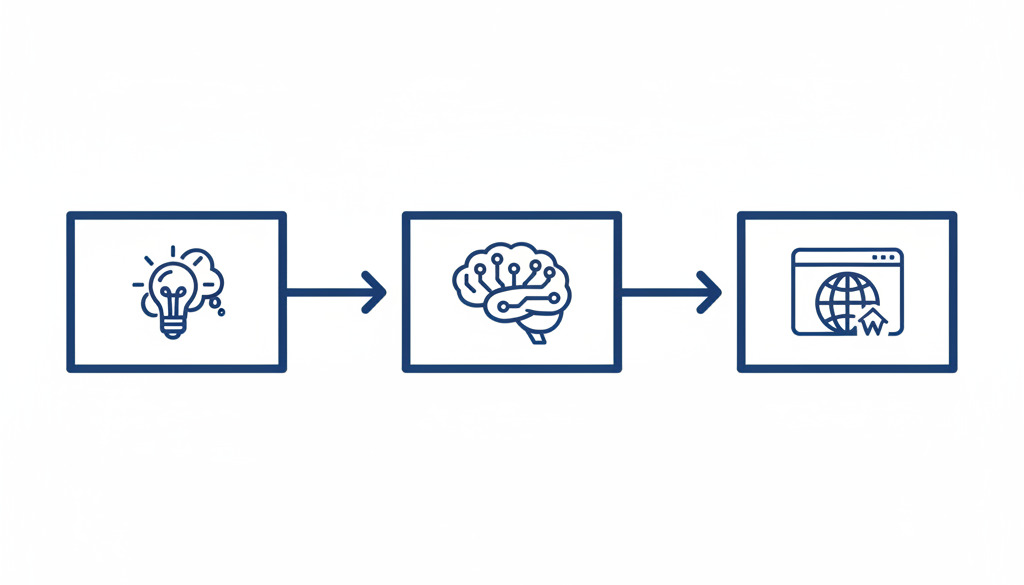
In most cases, setting up your autopilot is straightforward. For platforms that deliver content, like ours, the process is often as simple as copy-and-pasting the finished article into your website's blog editor (like WordPress, Squarespace, or Shopify). Some more advanced systems may offer direct integration via an API, which can automate the publishing process itself. However, for most businesses, a simple copy-paste workflow is more than sufficient and provides a moment for a final human review.
User-Friendliness for the Non-Tech-Savvy
The key is to choose a solution that prioritizes a clean, intuitive user experience. You shouldn't need to understand code or complex software. The entire interface should be built around your business goals, not technical jargon. A good system will guide you through the initial "set" phase with simple forms and clear instructions, making the entire experience feel more like strategic planning than a technical chore.
The "Forget" Component: Minimizing Ongoing Management
This is the part you’ve been waiting for. The "forget" component is where you reap the rewards of your initial strategic setup. It’s about creating a system that works for you in the background, freeing you from the relentless content creation cycle and allowing you to focus on what you do best: running your business.
How an AI Autopilot Frees Up Your Valuable Time
Once your strategy is loaded and the AI is generating content on a regular schedule, your direct involvement drops dramatically. Instead of spending 5-10 hours per week writing, editing, and optimizing, your role might be reduced to a 15-minute review before hitting "publish." This shift is transformative. The mental energy previously consumed by "what should I blog about this week?" is liberated and can be redirected toward higher-value business activities.
The Shift from Creator to Strategic Curator
With an AI autopilot, your role evolves. You are no longer the assembly-line worker, churning out post after post. You become the architect, the strategist, the curator. Your job is to monitor the system's performance, occasionally tweak the strategy based on results, and ensure the content remains aligned with your evolving business goals. This higher-level involvement is far more impactful and requires a fraction of the time.
Ensuring Quality and Relevance: Beyond Automated Generation
A common and valid concern about AI content is whether it can truly capture a brand's voice and expertise. While technology has made incredible leaps, a layer of human oversight is still the best practice for ensuring top-tier quality, relevance, and accuracy. This doesn't have to be a time-consuming process.
Verifying Factual Accuracy and Brand Voice
Before publishing any AI-generated article, a quick review is essential. This check should focus on two key areas:
- Factual Accuracy: Does the article mention specific data, statistics, or processes related to your industry? Take a moment to verify these. While AI is generally accurate, it can occasionally make errors.
- Brand Voice and Tone: Does the article sound like your company? A good AI system allows you to specify the tone (e.g., "professional and expert," "friendly and approachable"). A quick read-through ensures the tone is consistent with your other marketing materials. You can make small edits to inject your unique personality or add a specific company anecdote.
This final review is your opportunity to elevate the content from 95% perfect to 100% yours. A few minutes of polishing can add immense value and ensure the content truly represents your brand's expertise.
Optimizing Your AI-Generated Content for Search Engines
Modern AI content platforms are built with SEO in mind. They don't just write prose; they structure it in a way that is designed to be easily understood and ranked by search engines like Google. This built-in optimization is one of the biggest advantages of using an AI autopilot system.
Built-in On-Page SEO Best Practices
A professional AI content generator will automatically incorporate many on-page SEO factors, including:
- Keyword Integration: The AI will naturally weave your target keyword and related semantic terms throughout the article, including in headings and body text.
- Meta Descriptions & Titles: The system can generate the crucial meta title and description that appear in Google search results, optimized for length and clarity.
- Readability: AI models are excellent at writing clear, concise sentences, which improves readability scores—a factor that search engines consider.
The Importance of Internal and External Linking
While the AI can create the core content, a crucial optimization step during your final review is to add links. Internal links (links to other pages or posts on your website) help search engines understand the structure of your site and guide users to more relevant content. External links (links to reputable, authoritative websites) can signal to Google that your content is well-researched and trustworthy. This is a simple but powerful step to enhance the SEO value of every post.
The Power of Consistent Content Publication
If there’s one "secret" to SEO success, it’s consistency. Search engines favor websites that are regularly updated with fresh, high-quality content. For a solo business owner, this is often the hardest part of content marketing. An AI blog autopilot solves this problem completely.
Why Regularity is Key to SEO Success
Every time you publish a new blog post, Google has a new reason to crawl your website. A consistent publishing schedule—whether it's once a week or three times a week—signals to the algorithm that your site is active and a reliable source of current information. This sustained activity builds ranking momentum over time, much like a flywheel.
The Long-Term Benefits of a Well-Maintained Blog
Think of each blog post as a small investment in a long-term asset. An article you publish today can continue to attract organic traffic, generate leads, and build your brand authority for years to come. A blog with hundreds of articles is a formidable moat against competitors. It becomes a deep, comprehensive resource that makes your website the go-to authority in your niche. An AI autopilot is the most efficient way to build this library of content assets at scale.
Driving Traffic from Your AI-Powered Blog
Publishing the content is a huge step, but it’s not the final one. To maximize the return on your AI-generated articles, you should have a simple strategy for promoting them. This doesn’t have to be complicated or time-consuming; a little effort can go a long way.
Simple Promotion Strategies Across Your Channels
Once an article is published, plan to share it across your existing marketing channels. This could include:
- Social Media: Share a link to the new post on your company's LinkedIn, Facebook, or other relevant social profiles.
- Email Marketing: Include a link to your latest blog posts in your regular customer newsletter. This provides value to your subscribers and drives traffic back to your site.
- Your Email Signature: Add a line like "Read our latest blog post on [Article Topic]" to your email signature.
These simple actions amplify the reach of your content and accelerate the rate at which it starts generating traffic and leads.
Measuring Success: Key Performance Indicators for Your AI Blog
The "set and forget" approach doesn't mean "set and ignore." To ensure your blog autopilot is delivering real business value, it's important to periodically check in on a few key performance indicators (KPIs). This data will help you understand what's working and provide insights for refining your strategy over time.
Tracking Core Website and SEO Metrics
Using a free tool like Google Analytics, you can easily track the health of your blog. Pay attention to these metrics:
- Organic Traffic: Is the number of visitors coming from search engines increasing over time? This is the primary indicator that your SEO efforts are working.
- Keyword Rankings: Are you starting to appear on the first or second page of Google for your target keywords?
- Time on Page: Are people spending a reasonable amount of time reading your articles? This suggests the content is engaging and relevant.
Monitoring Business-Oriented Goals
Ultimately, a business blog needs to contribute to the bottom line. Track these business-focused metrics:
- Leads Generated: How many people have filled out a contact form, signed up for a demo, or called your business after reading a blog post?
- Conversion Rate: What percentage of blog readers take a desired action? This tells you how effective your content is at persuading visitors.
Case Studies: Businesses Thriving with AI Blog Autopilots
The theory is compelling, but the real proof is in the results. Across various industries, businesses are leveraging AI blog automation to achieve tangible growth, save thousands of hours, and dominate their online niches. The story is consistent: small to medium-sized enterprises are now able to compete on content with much larger corporations.
Keep reading
Hand-picked guides that go deeper — open the one you need next:
- The Entrepreneur's Secret Weapon: AI-Powered Blog Autopilot Explained
- Unlock Organic Traffic: AI-Generated Blog Content
- Customizing AI Content: Control Message, Automate Blog
- Become a Content Machine: Mastering Your AI Article Writer
→ Read the full AI Content guide
→ Read the full AI Content guide