
Cost-Effective Content: How AI Saves Your Business Thousands

Key Takeaways
- Significant Cost Reduction: AI content tools can reduce content production costs by 30-40% or more compared to traditional methods like hiring freelancers or agencies.
- Accelerated Production: AI drastically shortens the content lifecycle from weeks to hours, allowing businesses to publish consistently and capitalize on market trends instantly.
- Scalability Without Overhead: AI enables businesses to scale content volume to meet market demands without the proportional costs of hiring more staff.
- Enhanced SEO and ROI: AI-driven content is not just cheaper to make; it drives better business results by improving search engine rankings, generating more organic traffic, and increasing lead conversion rates.
- Strategic Implementation is Key: The best results come from a hybrid model where AI handles the heavy lifting (drafting, research) and human experts provide strategic oversight, editing, and brand voice alignment.
In today's digital-first economy, the mantra for business growth is simple yet relentless: be visible. For most businesses, this visibility is earned through a steady stream of high-quality, valuable content. It’s the engine of modern marketing, attracting customers through search engines, building trust, and guiding them toward a purchase.[1] However, the cost and effort required to feed this engine can be staggering. For many business owners, especially those who aren't digital natives, it represents a significant barrier to growth—a constant drain on time, money, and resources.
The traditional path to content creation is riddled with expenses. Hiring skilled writers, professional editors, and savvy SEO specialists can quickly add up to thousands of dollars per month. The alternative—doing it yourself—consumes your most valuable asset: time. This is the unseen tax on growth that holds countless businesses back. But what if there was a way to produce professional, search-engine-optimized content at a fraction of the cost and in a fraction of the time? This is not a futuristic promise; it's the reality made possible by Artificial Intelligence.
AI content generation has emerged as a transformative solution, democratizing the ability to create high-impact content. It addresses the core pain points of cost and time, offering a technologically advanced yet remarkably accessible way to fuel your marketing efforts. This article explores the financial argument for integrating AI into your content strategy, detailing precisely how it can save your business thousands of dollars annually while accelerating your path to sustainable growth.
Understanding the Financial Landscape: Direct Costs of Content Creation
Before you can appreciate the savings AI offers, you must first understand the financial reality of traditional content creation. Whether you build an in-house team, hire freelance talent, or partner with a content agency, each model comes with a distinct cost structure. For business owners who need to maintain a consistent online presence, these costs are not a one-time expense but a recurring operational line item.
In-House vs. Freelance vs. Agency: A Cost Comparison
Let's break down the typical expenses associated with producing just a few blog posts per month. The numbers reveal a clear story about the resources required to compete in the digital space.
| Content Source | Typical Cost Structure | Estimated Monthly Cost (for 4 blog posts) | Pros & Cons |
|---|---|---|---|
| In-House Writer | Full-time salary, benefits, payroll taxes, software licenses, training. | $5,000 - $8,000+ | Pro: Deep brand knowledge. Con: Highest fixed cost, significant overhead. |
| Freelance Writer | Per-word ($.15-$.50+) or per-project ($300-$1,000+ per article). | $1,200 - $4,000+ | Pro: Flexible, specialized talent. Con: Inconsistent quality, requires management. |
| Content Agency | Monthly retainer, project fees. | $3,000 - $10,000+ | Pro: Full service (strategy, writing, editing, SEO). Con: Expensive, less personal. |
| AI Content Platform | Monthly subscription or per-word/post fee. | $50 - $500 | Pro: Extremely cost-effective, incredibly fast. Con: Requires human editing and strategic direction. |
As the table illustrates, even a modest content plan can become a major expense. An in-house team offers dedicated focus but comes with the hefty price tag of a full-time employee. Freelancers provide flexibility, but finding and managing reliable, high-quality writers is a job in itself. Agencies offer a comprehensive solution but are often priced out of reach for small and medium-sized businesses. In stark contrast, AI content platforms offer a disruptive pricing model that fundamentally changes the economic equation of content marketing.
The Hidden Price Tag: Indirect Costs of Delays and Inefficiencies
The direct costs of writing and editing are only part of the story. The total financial impact of your content strategy is also shaped by a series of indirect costs—hidden expenses that arise from delays, inefficiencies, and poor performance. These factors can quietly drain your budget and stall your growth.

The Opportunity Cost of Waiting
In business, delay is a decision with financial consequences. Every week you *don't* publish a new blog post is a week you miss out on attracting new customers through Google. This is the opportunity cost of waiting. If your content marketing typically generates ten leads a month and each lead is worth $100, a one-month delay in your content pipeline costs you $1,000 in potential revenue. Traditional content workflows are often plagued by these delays, from writer backlogs to lengthy internal review cycles. This slow pace means you can't react quickly to market changes or customer questions, leaving the door open for more agile competitors.
The Ramifications of Subpar Content
Even more costly than delay is the publication of subpar content. What happens when you invest $500 in an article that fails to rank on search engines or engage readers? That $500 is effectively wasted. Low-quality content carries a heavy financial penalty:
- Wasted Resources: Money spent on content that delivers no traffic or leads is a sunk cost.
- Damaged Reputation: Poorly written or inaccurate content can erode customer trust and damage your brand's credibility, leading to long-term revenue loss.
- Negative SEO Impact: Search engines may penalize your site for low-quality, "thin" content, making it harder for *all* your pages to rank in the future.
"The cost of content is not what you pay the writer. It's the return you fail to get from your investment. Ineffective content isn't just an expense; it's a liability."
AI-Powered Efficiency: Optimizing Resource Allocation
Artificial intelligence directly attacks the primary drivers of high content costs: time and manual effort. By automating the most labor-intensive aspects of content creation, AI allows you to reallocate your precious resources—both time and money—toward more strategic activities.
Speed to Market: Accelerating Your Content Pipeline
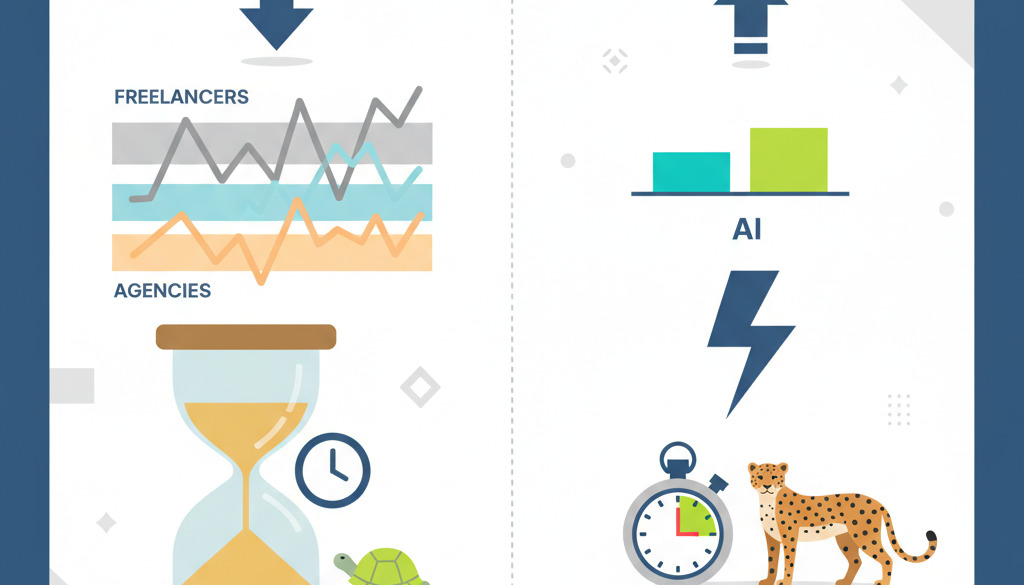
The most immediate and dramatic impact of AI is speed. A human writer might take 4-8 hours to research, outline, and write a 1,500-word article. An AI can generate a comprehensive, well-structured draft on the same topic in *minutes*. This incredible acceleration completely transforms your content pipeline. Instead of a multi-week process involving briefing, drafting, and multiple review rounds, you can move from idea to ready-to-publish post in a single afternoon.
This speed isn’t just about convenience; it’s a competitive advantage. It allows your business to:
- Capitalize on trends: Respond to breaking news or viral topics in your industry while they are still relevant.
- Maintain consistency: Effortlessly publish on a regular schedule, which is a key factor for SEO success.
- Address customer needs promptly: Quickly create content that answers emerging customer questions or concerns.
For business owners who lack the time for content creation, this is a game-changer. Services built on this technology, like the "More Customers From Your Blog" platform, leverage proprietary AI to deliver professional SEO articles in minutes. It removes the primary roadblock for busy entrepreneurs, making consistent publishing almost as easy as flipping a switch.
Scaling Content Production Without Scaling Overhead
Imagine you want to double your content output from one blog post a week to two. In a traditional model, this means doubling your costs—hiring another freelancer or increasing your agency retainer. With AI, you can 2x, 5x, or even 10x your content volume with only a marginal increase in cost. The subscription fee for an AI tool remains largely the same whether you generate five articles or fifty. This allows you to scale your content efforts to match your growth ambitions without the normally associated explosion in overhead. Furthermore, AI makes it incredibly efficient to repurpose existing assets. You can take a single blog post and ask the AI to transform it into a social media thread, a video script, or an email newsletter, maximizing the ROI of every piece you create.
The Tangible Financial Benefits of AI-Generated Content
Beyond efficiency gains, integrating AI into your content workflow translates into direct, measurable financial benefits. These savings go beyond simply cutting checks to writers; they compound over time to create a powerful engine for organic growth and profitability.
Direct Cost Savings on Content Creation
This is the most straightforward financial win. As our earlier comparison table showed, the cost of an AI content subscription is a small fraction of what you would pay for human-created content. Recent statistics from 2026 show that AI tools can reduce production costs by 30-40%. For a business spending $2,000 per month on freelance content, a 40% reduction means saving $800 every month, or $9,600 per year. This is money that can be reinvested into other critical areas of your business.
Many AI-driven services offer an even more direct path to savings. For example, some platforms are so confident in their value that they provide a risk-free entry point. The "More Customers From Your Blog" service, for instance, offers your first five blog posts completely free. This allows you to experience the cost-saving benefits firsthand without any initial investment, making the decision to adopt AI incredibly simple.
Keep reading
Hand-picked guides that go deeper — open the one you need next:
- Mastering the AI Content Creation Process: 2026 Guide
- Content Creation in Minutes: The AI Solution for Busy Entrepreneurs
- Multi-Language Content: Expand Your Reach with AI Translation
- The AI Blog Autopilot: Set It and Forget It
→ Read the full AI Content guide