
AI Content: Cost-Effective Time & Money Saver
Key Takeaways
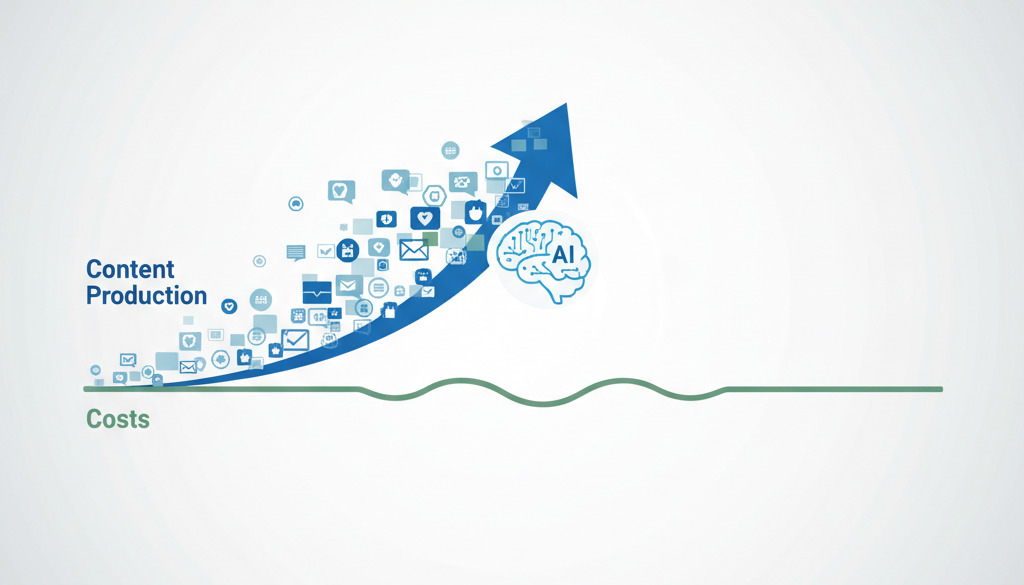
- Drastic Cost Reduction: AI significantly lowers the direct costs of content creation by reducing the need for large teams of writers and editors, turning a high variable cost into a predictable, low subscription or service fee.
- Massive Time Savings: AI automates the most time-consuming parts of content creation, including research, drafting, and optimization, freeing up business owners to focus on core operations instead of managing content workflows.
- Scalability on Demand: AI allows businesses to scale content production from a few articles to hundreds without a proportional increase in cost, enabling them to meet aggressive SEO and marketing goals.
- Increased ROI: By lowering costs and increasing the volume and speed of content deployment, AI improves the overall return on investment for content marketing, driving more organic traffic and leads for less expenditure.
- Human-Augmented Quality: The most effective approach combines AI's efficiency with human strategy and oversight. AI acts as a powerful co-pilot, handling the heavy lifting while humans provide the final polish, creative direction, and strategic insight.
Introduction: The Evolving Cost of Content Creation
For decades, content marketing has been a cornerstone of digital strategy, but it has always come with a significant price tag. The traditional model involves a complex and costly chain of human effort. It requires skilled writers, meticulous editors, creative graphic designers, and dedicated project managers. For many small and medium-sized business (SMB) owners, especially those over 40 who are experts in their trade but not necessarily in online marketing, this process is daunting. The time, financial investment, and management overhead required can feel overwhelming, often pushing content creation to the back burner despite its known importance.[1]
However, the landscape is undergoing a seismic shift, driven by advancements in Artificial Intelligence (AI). AI is no longer a futuristic concept; it is a practical, accessible tool that is revolutionizing content production. This technology acts as a disruptive force, challenging the old, expensive methods and introducing a new paradigm of efficiency and affordability. For business owners who know they need online content but lack the time or inclination to manage the traditional process, AI presents a game-changing opportunity. This article explores the core thesis: when strategically implemented, AI-powered content creation offers a compelling path to significant cost savings, enhanced efficiency, and a vastly improved return on investment (ROI) for your business.
Understanding the True Cost of Human-Generated Content
To appreciate the cost-effectiveness of AI, we must first dissect the full expense of traditional, human-only content creation. The costs extend far beyond a writer's invoice and touch every part of your business operations.
Direct Financial Costs
The most obvious expenses are the direct payments for labor. This includes:
- Freelance Writer Fees: Depending on experience and niche, a single, well-researched blog post of 1,500-2,000 words can cost anywhere from $300 to $1,000 or more.
- In-House Writer Salaries: Hiring a full-time content creator involves a significant salary, benefits, payroll taxes, and overhead, often exceeding $70,000 per year.
- Editor and Proofreader Charges: Ensuring quality requires a second or third pair of eyes, adding another $50-$200 per article to the bill.
- Graphic Designer Fees: Custom images, infographics, and social media assets add another layer of cost to each piece of content produced.
Indirect and Hidden Costs
Beyond the direct payments, a host of indirect costs drain your two most valuable resources: time and money.
- Management Overhead: Time spent finding, vetting, and hiring talent is a significant, often un-tracked, expense. Subsequently, every hour you spend briefing writers, managing deadlines, and coordinating between team members is an hour not spent on growing your business.
- Revision Cycles: Content rarely comes out perfect on the first try. Multiple rounds of revisions and feedback loops create delays and consume valuable time from you and your team.
- Training and Onboarding: New writers, whether freelance or in-house, need time to learn your brand voice, products, and target audience, a period during which their output may not yet meet your standards.
- Opportunity Cost: This is perhaps the biggest hidden expense. As a business owner, your time is best spent on high-level strategy, sales, and customer relationships. Getting bogged down in the minutiae of content creation means sacrificing opportunities in core business functions where you create the most value.
Introducing AI for Content Creation: The Core Proposition
AI-powered content generation tools are sophisticated software platforms that use large language models (LLMs) to understand prompts and produce human-like text. At their core, these tools are trained on vast datasets of information from the internet, allowing them to write, summarize, translate, and brainstorm text on virtually any subject.
How AI Streamlines the Writing Process
The core proposition of AI in content creation is a radical reduction in friction and time. Instead of a multi-day or multi-week process, AI condenses the content workflow into a matter of hours or even minutes. Here’s how:
- Ideation to Draft in Minutes: AI can transform a simple keyword or topic idea into a comprehensive outline and then a complete first draft in less time than it takes to drink a cup of coffee. This eliminates writer's block and the intimidating "blank page" problem.
- Automated Research: AI models can synthesize information from their training data to provide foundational research for an article, saving hours of manual searching.
- Instantaneous Re-writes and Tonal Adjustments: If a paragraph doesn’t fit, AI can rewrite it instantly. If the tone needs to be more professional or more casual, AI can adjust it on the fly.
This represents a fundamental shift in the time and effort required for content production. For the busy business owner, this means content is no longer a laborious, time-consuming chore but an efficient, manageable task.
Quantifying AI Content Savings: Direct Cost Reductions
The most immediate and tangible benefit of adopting AI is the dramatic reduction in direct costs. The math is simple and compelling. Let's compare the scenarios for producing four 1,500-word blog posts per month.
Scenario 1: Traditional Method (Freelance Writer)
- Cost per article: $400 (a conservative estimate)
- Monthly cost: 4 articles x $400 = $1,600
- Annual cost: $1,600 x 12 = $19,200
Scenario 2: AI-Powered Method (AI Tool Subscription + Human Editor)
- AI Tool Subscription: $50 per month
- Freelance Editor (for review and polish): $100 per article x 4 articles = $400 per month
- Total Monthly Cost: $50 + $400 = $450
- Annual Cost: $450 x 12 = $5,400
In this direct comparison, the annual savings amount to $13,800, a reduction of over 70%. For businesses that need more content, the savings become even more pronounced. The cost of AI tools remains fixed, while freelance costs scale with every new article. This predictable, low-cost model transforms content creation from a prohibitive expense into an affordable, scalable marketing function.
The Invisible Savings: Reduced Overhead and Increased Efficiency
While direct cost reduction is impressive, the "invisible" savings in time and operational efficiency are often even more valuable for a business owner.
Minimized Project Management
AI tools don't need to be managed. They don’t have sick days, miss deadlines, or require constant check-ins. The hours spent each week assigning topics, tracking progress, and going back and forth on revisions are almost entirely eliminated. The AI is ready to work 24/7, on-demand. This streamlined workflow means you can manage your entire content pipeline in a fraction of the time, freeing you to focus on strategy rather than execution.
Accelerated Content Deployment
Faster turnaround times mean your content marketing efforts can be more agile and responsive. An idea you have on Monday morning can become a published blog post by Monday afternoon. This speed allows you to capitalize on emerging trends, respond to competitor moves, and get your message in front of your audience while it's still relevant. This agility translates directly into a competitive advantage.
Maximizing Content Output with AI: Scale Without Skyrocketing Costs
One of the most powerful aspects of AI content creation is its inherent scalability. In the traditional model, doubling your content output means doubling your costs. With AI, you can 5x or even 10x your output with only a marginal increase in expense (perhaps a higher-tier subscription).
Meeting the Demands of Modern SEO
Search engines like Google reward websites that consistently publish fresh, high-quality, and relevant content. For many SMBs, producing content at the volume and frequency required to compete in search rankings is simply not feasible. AI solves this problem. It allows you to:
- Build Topic Clusters: Quickly generate a series of interconnected articles around a core topic, establishing your website as an authority in your niche.
- Address Long-Tail Keywords: Create dozens of articles targeting specific, low-competition search queries that attract highly qualified customers.
- Maintain a Consistent Publishing Schedule: Publish new content daily or weekly without fail, signaling to Google that your site is active and valuable.
This ability to scale allows businesses to finally execute an aggressive SEO strategy that was previously out of reach, driving sustainable organic traffic and leads without a proportional budget increase.
Strategic Content Ideation & Research with AI
Effective content starts with a smart strategy, and AI is an incredibly powerful tool for research and ideation. It moves beyond simple writing and becomes a strategic partner in your content planning.
Data-Driven Topic and Keyword Discovery
Modern AI tools can analyze vast amounts of data to uncover content opportunities. Instead of guessing what your audience wants, you can use AI to:
- Identify Gaps in Competitor Content: Input a competitor's website and have the AI identify topics they have not covered thoroughly.
- Generate Keyword Clusters: Provide a core service or product, and the AI can generate a list of related long-tail keywords and question-based queries your customers are searching for. An effective AI content keyword research process is fundamental to this strategy.
- Develop Multiple Content Angles: For any given topic, AI can brainstorm dozens of potential titles, hooks, and angles, allowing you to choose the most compelling direction for your audience.
This data-driven approach removes guesswork, ensuring your content creation efforts are focused on topics that have a high probability of ranking on search engines and resonating with potential customers.
AI for SEO Content: Driving Organic Traffic Cost-Effectively
Creating content that ranks high on Google is both an art and a science. AI is particularly adept at the "science" part of SEO, making it an invaluable asset for driving organic traffic without the high cost of SEO agencies.
Built-in SEO Best Practices
When prompted correctly, AI can seamlessly weave SEO best practices into the content it generates. This includes:
- Natural Keyword Integration: AI can include primary and secondary keywords in a way that reads naturally, avoiding the "keyword stuffing" that can harm search rankings.
- Optimal Structure: It can automatically structure articles with H2 and H3 headings, bullet points, and short paragraphs, which improves readability for both users and search engine crawlers.
- Meeting Search Intent: By analyzing top-ranking content for a given keyword, AI can create articles that effectively answer the user's underlying question.
For business owners who find SEO complex and intimidating, this is a major breakthrough. Services built on this technology provide a hands-off solution. For instance, the More Customers From Your Blog service is designed specifically for this purpose. Their proprietary AI writes professional SEO blog articles for your website in minutes, focusing on getting your business found organically on Google. It’s an ideal solution for businesses that want the benefit of top-tier SEO content without having to learn the technical details themselves.
Enhancing Content Quality and Consistency with AI
Beyond cost and speed, AI offers powerful benefits in maintaining a high standard of quality and a consistent brand voice across all your marketing channels.
Overcoming Human Limitations
Even the best human writers have off days. They can experience writer's block, burnout, or simply struggle to adapt to different tones. AI suffers from none of these issues. It ensures a consistent output every single time. This is invaluable for maintaining a professional and reliable brand image. A unified brand voice builds trust and recognition with your audience, whether they are reading a blog post, a product description, or a social media update.
Adapting to Diverse Content Formats
Modern marketing requires a presence across multiple platforms. AI can instantly adapt a single piece of core content into various formats:
- A long-form blog post can be summarized into a LinkedIn article.
- Key points can be turned into a Twitter thread or a series of Facebook posts.
- The core message can be scripted for a short YouTube video.
This multi-format capability allows you to maximize the reach of every content idea with minimal additional effort, ensuring you get the most value out of your content strategy.
The Human Element: The Crucial Role of AI Augmentation (Not Replacement)
One of the most common misconceptions is that AI is here to replace human writers entirely. The reality, as forward-thinking companies are discovering, is that the most powerful model is one of AI augmentation. AI is not your new writer; it is a fantastically powerful co-pilot for your human strategist—who might just be you.
AI as Co-Pilot, Human as Captain
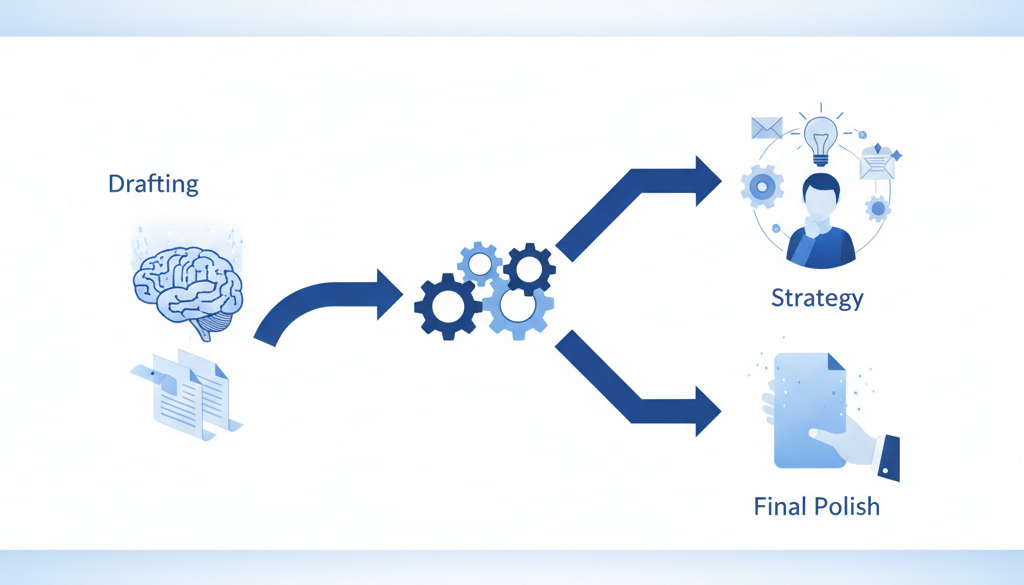
Think of AI as an incredibly efficient first-draft generator. It handles the 80% of the work that is often tedious and time-consuming: the research, the structuring, and the initial writing. This frees up human intelligence to focus on the 20% of work that creates the most value:
- Strategic Direction: Defining the goals of the content and its role in the customer journey.
- Creative Nuance: Infusing the content with unique brand stories, personal anecdotes, and a genuine, human touch.
- Fact-Checking and Final Polish: Ensuring every claim is accurate and the final piece is polished to perfection.
As a recent PwC study found, leading companies are "twice as likely to redesign workflows to incorporate AI rather than simply adding AI tools." They understand that success comes from the synergy of AI efficiency and irreplaceable human creativity.
Addressing Common Concerns: Accuracy, Originality, and Ethical Considerations
For any business owner, especially one new to AI, questions about reliability, originality, and ethics are paramount. It's crucial to approach AI with a clear-eyed strategy for mitigating these potential issues.
Verifying Accuracy
AI models are not infallible. They can sometimes generate inaccurate information or "hallucinate" facts. The human review process is non-negotiable here. Always have a human expert (which could be you or a team member) review AI-generated content for factual accuracy, especially when dealing with statistics, technical details, or specific claims.
Ensuring Originality
Reputable AI content tools are designed to generate original text, not to copy and paste from existing sources. However, because they learn from a massive corpus of data, there's a small chance of generating text that is unintentionally similar to existing content. It is a best practice to run all final drafts through a plagiarism checker like Copyscape to ensure 100% originality before publishing.
Maintaining Transparency and Ethics
The ethical use of AI involves being transparent about its role. While there is no universal requirement to label AI-generated content, building trust with your audience is key. The focus should always be on the quality and value of the information provided, regardless of the tools used to create it. The ultimate responsibility for the content published under your brand name always rests with you.
ROI Measurement: Proving the Cost-Effectiveness of AI Content
Adopting AI is not just about saving money; it's about generating a measurable return. Tracking the right Key Performance Indicators (KPIs) is essential to prove the value of your AI-powered content strategy.
Key KPIs to Track
- Cost Per Article: Calculate your all-in cost (tool subscription + editing time/fees). This number will be dramatically lower than with traditional methods.
- Organic Traffic Growth: Monitor the increase in website visitors from search engines over time.
- Keyword Rankings: Track your position on search engine results pages for your target keywords.
- Lead Generation: Measure how many new leads (e.g., form submissions, phone calls, free trial sign-ups) are generated from your blog content.
- Cost Per Lead: Divide your monthly content cost by the number of leads generated to see how efficiently you are acquiring new prospects.
By comparing these metrics against your previous, human-only content efforts, the ROI will become crystal clear. The ability to produce a higher volume of targeted, SEO-optimized content at a lower cost inevitably leads to a more efficient and profitable marketing engine. Exploring the landscape of tools with a guide to AI article writers for engaging content can further refine this strategy.
Case Study: How Businesses Benefit from AI-Powered Content
Consider the story of "John," a 55-year-old owner of a successful plumbing business. John knew he needed to be online to attract new customers, as more and more people were searching "plumber near me" on Google. He tried hiring a freelance writer but found the process slow and expensive. The writer didn't understand the technical side of his business, and the articles cost him over $500 each for content that didn't seem to bring in any calls.
Frustrated, John felt stuck. He didn't have the time to write articles himself. Then he discovered an AI-powered content service. Instead of managing a writer, he could leverage a platform that did the work for him. He decided to try a service like More Customers From Your Blog, which specifically caters to business owners like him. He was particularly drawn to their "first 5 posts free" offer, as it allowed him to test the service with zero financial risk.
The results were transformative. Within weeks, he had five professional, SEO-optimized articles on his website covering topics like "How to Prevent Frozen Pipes" and "Signs You Need a New Water Heater." The cost was a fraction of what he paid the freelancer, and the process required almost none of his time. Over the next few months, as he continued with the service, he saw his website start to rank on Google for local search terms. The blog was finally doing what it was supposed to do: bringing in new customers.
Implementing AI Content Strategically: A Step-by-Step Approach
Adopting AI is not about flipping a switch; it requires a thoughtful, strategic approach. Here is a simple framework for getting started.
- Define Your Goals: What do you want to achieve? More website traffic? More leads? Better customer education? Your goals will determine the type of content you need.
- Identify High-Impact Areas: Where can AI provide the most immediate value? This might be creating blog posts for SEO, writing product descriptions for your e-commerce store, or generating social media updates. This is one of the key ways AI can transform your blog strategy.
- Choose Your Tool or Service: Decide if you want to use a hands-on AI writing tool (like Jasper or Copy.ai) or a more done-for-you service designed for busy owners. Evaluate options based on features, ease of use, and cost.
- Develop a Simple Workflow: Create a process. It could be as simple as: 1) Choose a topic. 2) Generate a first draft with AI. 3) Spend 30 minutes reviewing, editing, and adding your personal touch. 4) Publish.
- Measure, Learn, and Refine: Use the KPIs mentioned earlier to track your results. See what’s working and double down on it. Your strategy should evolve as you learn what resonates with your audience.

The Future of Content Creation: AI as a Standard Business Practice
The adoption of AI in content creation is not a passing trend; it is the future of digital marketing. According to recent market data, an overwhelming majority of marketers—85%—are already using AI tools in their workflows. This number is only set to grow. In the coming years, leveraging AI for content will become as standard as having a business website.
Companies that resist this shift will find themselves at a significant competitive disadvantage. They will be outpaced in content volume, out-maneuvered in SEO, and ultimately, will be paying far more for less effective marketing. The leading 20% of companies are already capturing nearly 75% of AI's economic gains by using it for growth, not just cost-cutting. For SMB owners, this is a critical moment. Adopting AI isn't just about staying current; it's about securing a path to sustainable, cost-effective growth in an increasingly digital world.
Conclusion: Embracing AI for Sustainable Growth
The evidence is clear: AI-powered content creation offers a powerful solution to one of the biggest challenges facing business owners today. It dramatically reduces costs, saves invaluable time, and allows for unprecedented scalability. By automating the heavy lifting of content production, AI empowers you to execute a top-tier marketing strategy without the traditional burdens of high costs and complex management.
For owners who are masters of their trade but not online marketing, this technology levels the playing field. It removes the barriers of time, expertise, and budget that have long held businesses back. The key is to see AI not as a threat, but as a powerful partner that handles the tedious work, so you can focus on building your business.
If you're ready to stop worrying about content and start reaping its rewards, it's time to explore an AI solution. Services like More Customers From Your Blog are built for this exact need, using their unique artificial intelligence to produce professional SEO articles in minutes. The benefit is simple and profound: more customers find you organically on Google, allowing you to grow your business without taking time away from what you do best.
Frequently Asked Questions
1. Can AI completely replace human content creators?
No, the most effective model is a partnership. AI is best used to handle research, outlining, and first drafts with incredible speed and efficiency. However, human oversight is crucial for strategic direction, fact-checking, adding unique brand voice, infusing personal stories, and ensuring the final product meets high-quality standards. Think of AI as a co-pilot, not the pilot.
2. Is AI-generated content penalized by Google?
Google's official stance is that it rewards high-quality, helpful content that serves the reader, regardless of how it is produced. Google does not penalize content simply because it was created with the help of AI. The focus is on value. As long as the content is original, accurate, and satisfies user intent, it can and will rank well.
3. How much does AI content creation really cost?
The cost varies. Do-it-yourself AI writing tools typically charge a monthly subscription fee ranging from $30 to $100+. For a more hands-off approach, AI content services may charge a monthly retainer or a per-article fee. In all scenarios, the cost is significantly lower—often by 70-90%—compared to hiring in-house writers or paying traditional freelance rates for the same volume of content.
4. How can I ensure the AI content matches my brand's voice?
Consistency is achieved through a combination of proper prompting and human editing. You can "train" AI by providing it with examples of your existing content and developing a style guide that outlines your tone, terminology, and perspective. The final human review and editing phase is where you polish the text to perfectly align with your brand voice and add any specific nuances.
5. Is AI-generated content original and safe from plagiarism?
Leading AI content generation tools are designed to create new, original text based on the patterns they learned during training. They do not copy and paste from their sources. However, to be completely safe and ensure 100% originality, it is always a best practice to run the final content through a reliable plagiarism checker before publishing it to your website.
Keep reading
Hand-picked guides that go deeper — open the one you need next:
- From Zero to Hero: Launch Your Business Blog with AI in Days
- Try Before You Buy: Evaluate One AI Article with Volteruno’s Free Plan
- Publishing AI Content to Any Website Platform
- Multilingual AI Content: Reach 25 Languages
→ Read the full AI Content guide