
Content Marketing for Solo Entrepreneurs: A Scale Guide

In the competitive digital landscape of 2026, content marketing has evolved from a luxury into a fundamental survival mechanism for solo entrepreneurs.[1] While large corporations struggle with bureaucratic approval processes and "sanitized" brand voices, the solo operator possesses an unmatched agility. You are the strategist, the creator, and the face of your brand, allowing for a level of authenticity and speed that a department of fifty cannot replicate.
Content marketing for solo entrepreneurs is the strategic practice of creating and distributing valuable, relevant, and consistent material to attract and retain a clearly defined audience. Ultimately, it is about driving profitable customer action without the heavy overhead of traditional advertising. For the individual business owner, this means transforming your expertise into digital assets that work for you 24/7, building trust and authority even while you sleep.
II. Defining Your Core Audience: The Foundation of Effective Content
The most common mistake solo entrepreneurs make is trying to speak to everyone. In a world of infinite digital noise, a "generalist" approach is a fast track to invisibility. Effective content begins with a narrow, laser-focused definition of who you are serving. For a solo venture, your audience isn't just a demographic; it is a group of people with specific pain points that your unique skills can solve.
To build a robust buyer persona, you must go beyond age and location. Start by identifying the "Three AM Problem"—the specific challenge that keeps your ideal client awake at night. Are they struggling with tax compliance for a small creative agency? Are they trying to transition from a corporate 9-to-5 into freelance consulting? Use tools like SparkToro or engage in "social listening" on platforms like Reddit and LinkedIn to identify the exact language they use to describe their frustrations. When your audience feels like you are reading their minds, your content moves from elective to essential.
III. Crafting Your Compelling Brand Narrative: Authenticity as a Differentiator
As a solo entrepreneur, you aren't just selling a service; you are selling a perspective. Your brand narrative is the "why" behind your business, and in 2026, authenticity is the highest-valued currency. Large brands spent the last year trying to "humanize" their Al-generated content, but you have the advantage of being an actual human with a real story.
Your narrative should bridge the gap between your personal journey and your client's aspirations. Share the failures, the "aha" moments, and the specific philosophy that drives your work. This creates a Unique Value Proposition (UVP) that is impossible to pirate. While a competitor might copy your pricing or your service list, they cannot copy your story. Consistently weaving this narrative into your blog posts, videos, and emails builds a relational bond that transcends the transactional nature of business.
IV. Strategic Content Pillars: Focusing Your Efforts for Maximum Impact
To avoid the "what should I post today?" paralysis, solo entrepreneurs must operate within the framework of content pillars. These are 3 to 5 broad themes that represent your expertise and support your business goals. By staying within these guardrails, you ensure your content remains cohesive and your brand remains recognizable.
- Educational Pillars: How-to guides and tutorials that showcase your technical proficiency.
- Inspirational Pillars: Case studies or personal reflections that show what is possible for the client.
- Problem-Solving Pillars: Direct responses to common industry myths or frequent obstacles your clients face.
For example, a solo freelance bookkeeper might have pillars centered on "Tax Season Readiness," "Scaling for Creatives," and "Financial Mindset." Every piece of content generated—whether a short-form video or a long-form article—must fall into one of these buckets to ensure the marketing effort remains focused and ROI-driven.
V. The Solo Entrepreneur's Content Toolkit: Choosing the Right Formats
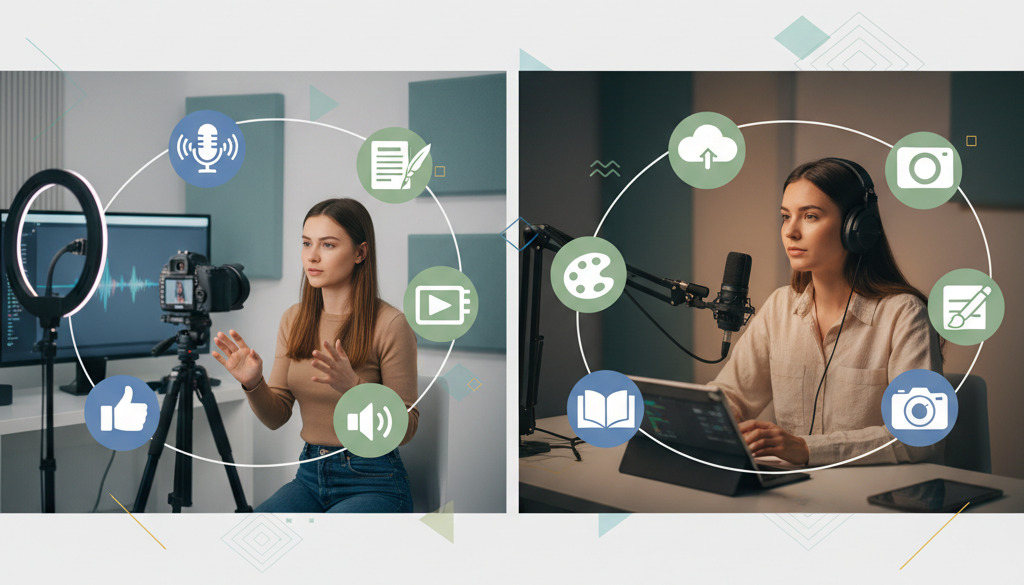
Time is your most scarce resource. Choosing the right content format is not about what is popular, but about what fits your strengths and your audience's habits. Written content, such as long-form blog posts and newsletters, remains the gold standard for SEO and building deep intellectual authority. However, with the rise of AI-driven search (GEO/AEO), visual and audio formats are becoming increasingly critical for visibility.
Short-form video is currently the highest-engagement format for many solo operators, providing a low barrier to entry for building a personal connection. Conversely, podcasts or audio snippets allow you to capture the "windshield time" of busy professionals. The key is to start with one primary format—your "hero" content—and then repurpose it. A single 15-minute video can be transcribed into a blog post, clipped into five social media reels, and summarized for an email newsletter.
VI. Mastering SEO for Solo Operators: Driving Organic Discovery
Search Engine Optimization is no longer just about stuffing keywords into a page; it’s about answering questions comprehensively. For solo entrepreneurs, the strategy should focus on "Long-Tail Keywords"—highly specific phrases with lower search volume but much higher intent. Instead of trying to rank for "marketing," aim for "content marketing for solo graphic designers."
Actionable SEO Checklist for Solo Entrepreneurs:
- Keyword Research: Use free or low-cost tools like AnswerThePublic or Ubersuggest to find what your audience is searching for.
- On-Page Optimization: Ensure your primary keyword is in your H1 tag, your first paragraph, and your meta description.
- Internal Linking: Link your new posts to existing content on your site to help search engines crawl your structure and keep users on your site longer.
- Local SEO: If your business serves a specific geographic area, ensure your Google Business Profile is optimized and consistent with your website data.
VII. Amplifying Your Reach: Distribution and Promotion Strategies
The "publish and pray" method is a recipe for failure. A general rule of thumb for solo operators is the 20/80 rule: spend 20% of your time creating content and 80% of your time promoting it. Your distribution strategy should prioritize the platforms where your audience is already congregating. If you are a B2B consultant, LinkedIn is your headquarters; if you are an artisan, Instagram and Pinterest are your shop windows.
Email marketing remains the most reliable distribution channel because you own the list. Social media algorithms are volatile, but an email inbox is a direct line to your lead. Use "lead magnets"—valuable freebies like checklists, templates, or mini-courses—to entice visitors to trade their email addresses for your expertise. Once they are on your list, nurture them with a regular cadence of helpful content mixed with occasional offers.
VIII. Building Authority and Trust Through Thought Leadership
Thought leadership is the process of providing a unique, often contrarian, perspective that shifts how people think about your industry. For solo entrepreneurs, this is how you move from being a commodity service provider to a high-value consultant. You don't need a massive following to be a thought leader; you need a consistent track record of being right and being helpful.
Expand your reach by appearing where your audience already looks for advice. Guest blogging on established industry sites or appearing as a guest on niche podcasts provides immediate "borrowed authority." When an established voice in your industry introduces you to their audience, the trust transfer is instantaneous. This external validation is often the final push a prospective client needs to move from "lurker" to "customer."
IX. Measuring Success: Key Metrics for Solo Entrepreneurs
You cannot manage what you do not measure. However, solo entrepreneurs should avoid "vanity metrics" like likes or follower counts, which often don't correlate with revenue. Instead, focus on conversion-centric data. Tools like Google Analytics 4 (GA4) or simplified alternatives like Fathom and Plausible allow you to track the journey from a reader to a lead.
Key Performance Indicators (KPIs) to watch:
- Click-Through Rate (CTR): Are your headlines compelling enough to make people click?
- Time on Page: Is your content engaging enough to keep people reading, or are they bouncing immediately?
- Lead Magnet Conversion Rate: What percentage of visitors are signing up for your email list?
- Inquiry Source: How many of your paying clients mention your blog or social media as their first point of contact?

X. Streamlining Content Creation: Efficiency Hacks for the Solo Hustle
The greatest threat to a solo entrepreneur's content strategy is burnout. To stay consistent, you must treat content creation as a repeatable process rather than a creative whim. "Batching" is the most effective way to manage this. Instead of writing one blog post every Monday, set aside one full day a month to write four. This enters you into a "flow state," significantly reducing the switching costs of your brain.
Leverage templates for everything—social media graphics, email layouts, and blog structures. Tools like Canva for design, Notion for project management, and Buffer or Later for scheduling social posts allow you to automate the "hand-off" from creation to publication. By front-loading the effort, you protect your business hours for client work while maintaining a constant marketing presence.
XI. Overcoming Solo Entrepreneur Content Challenges: Common Pitfalls and Solutions
The "Solo Struggle" is real. Creative blocks, the feeling of "shouting into a void," and the sheer volume of work can be daunting. The solution is to prioritize *consistency over intensity*. It is better to publish one high-quality blog post a month for two years than to post every day for two weeks and then disappear for six months. Inconsistency signals unreliability to your audience.
If you find yourself stuck, go back to your customers. Look at your sent emails; often, the best content pieces are long-form answers you've already written to a client's question. Another pitfall is perfectionism. In content marketing, "good and published" is infinitely better than "perfect and in the drafts folder." View your content as a living conversation that you can refine over time based on real-world feedback.
XII. Conclusion: Sustaining Momentum and Scaling Your Content Impact
Content marketing for solo entrepreneurs is a marathon, not a sprint. The compounding effects of high-quality, SEO-optimized, and narrative-driven content will eventually create a "flywheel" effect. As your authority grows, your cost of customer acquisition will drop, and the quality of your leads will rise. You will find yourself working with clients who already understand your value, making the sales process almost effortless.
Stay focused on your core pillars, remain obsessed with your audience's needs, and never lose the personal touch that makes your solo venture unique. By committing to a sustainable content strategy, you aren't just marketing; you are building a legacy of expertise that positions you as the undisputed leader in your niche.
Keep reading
Hand-picked guides that go deeper — open the one you need next:
- AI vs. Human Writers: The Cost-Benefit of Automated Content
- Measuring Success: ROI of AI-Powered Content Marketing for Businesses
- The 'Autopilot' Advantage: Consistent SEO Content
- The Future of Business: Becoming an AI Content Entrepreneur
→ Read the full AI Content guide