
Local SEO AI: A Strategic Guide for Business Growth

In the rapidly evolving landscape of digital marketing, the bridge between a business and its local community is increasingly being built with algorithms. Local Search Engine Optimization (SEO), once a manual process of managing directories and keyword-stuffing location pages, has entered a paradigm shift. As search engines transition into "answer engines," the integration of Artificial Intelligence (AI) has become the primary differentiator between businesses that remain visible and those that fade into digital obscurity.[1]
For businesses serving specific geographic areas—from single-location boutiques to multi-national franchises—the imperative is clear: adapt to AI-driven search or risk irrelevance. Gartner recently predicted a 25% drop in traditional search volume by 2026 as users pivot toward AI-powered conversational interfaces. This shift means that appearing in a list of "blue links" is no longer the ultimate goal. Today, your business must be the specific entity that AI models like ChatGPT, Gemini, and Google’s Search Generative Experience (SGE) trust and recommend. This article explores the transformative role of local SEO AI and how your organization can leverage these tools to dominate the local market.
Understanding the Fundamental Shift: From Manual Optimization to AI-Driven Insights
Historically, Local SEO was a game of stamina. Marketers spent hundreds of hours manually auditing citations, researching static keywords, and responding to reviews. This reactive model was limited by human bandwidth and the inability to process real-time data at scale. You could optimize for "Chicago pizza," but you couldn't easily predict the shifting intent of a user searching for that term during a blizzard versus a summer festival.
AI has fundamentally altered this dynamic by introducing proactive, data-driven automation. Instead of guessing which factors move the needle, AI tools process millions of data points—including traffic patterns, social sentiment, and historical search behavior—to identify the exact levers that influence local rankings. We are moving from optimization (fixing what is broken) to intelligence (predicting what the market wants next).
The core advantage of local SEO AI lies in its ability to handle "Entity Authority." Search engines no longer just see keywords; they see entities (people, places, and things). AI-driven insights allow businesses to solidify their status as a "trusted entity" in the eyes of an algorithm, ensuring that when a query is made, the AI doesn't just find your website—it understands your business's physical presence and reputation.
AI-Powered Keyword Research and Intent Analysis for Local Audiences
Traditional keyword research often focuses on volume. However, in local search, intent is the currency of conversion. AI algorithms are significantly more adept at deciphering the "why" behind a search query. For example, a search for "HVAC repair" at 2:00 PM on a Tuesday suggests a different intent than the same search at 3:00 AM on a Sunday. AI tools can analyze these temporal and situational signals to prioritize keywords that lead to immediate action.
Semantic Search and Local Context
AI has enabled search engines to move toward semantic understanding. This means they understand the relationship between words. If a user searches for "somewhere to fix my screen," an AI-driven local strategy ensures your repair shop appears even if your page doesn't explicitly use that exact phrase, provided your content establishes your entity as a provider of "device repair services."
Predictive Keyword Trends
Leveraging machine learning, businesses can now anticipate local demand. AI tools can analyze historical data to predict when searches for specific services will spike—such as "lawn aeration" in early spring or "tax preparation" in late January—allowing businesses to optimize their content weeks before the competition even notices the trend.
Optimizing Local Content with AI-Driven Relevance and Personalization
Content at the local level must be hyper-specific to resonate. AI-driven content optimization tools analyze high-ranking local competitors to determine the ideal "content density" and thematic elements required to rank. These tools don't just suggest keywords; they suggest the topics that locals care about, such as neighborhood-specific events or local climate considerations for a service business.
Furthermore, AI enables personalization at scale. By analyzing a visitor’s geographic location and previous interactions, AI can dynamically adjust the content on a local landing page. A user in a suburban zip code might see messaging focused on "easy parking and family-friendly service," while a user in the downtown core sees highlights regarding "walking distance and quick turnaround times."
Actionable AI Tools: Platforms like SurferSEO or Frase utilize NLP (Natural Language Processing) to guide content creation, ensuring your local pages contain the specific semantic terms that Google’s AI expects to see for a particular geographic niche. Additionally, AI can automate the generation of Local Business Schema markup, which is critical for helping engines understand your hours, menu, or service area explicitly.
Navigating Google Business Profile (GBP) with AI Assistance
The Google Business Profile (formerly Google My Business) is the heartbeat of local SEO. AI has transformed GBP from a static listing into a dynamic engagement tool. Modern AI platforms can monitor your profile 24/7, alerting you to unauthorized changes by third parties and suggesting "category" updates based on what's driving traffic to similar businesses in your region.
AI for Review Management and Response Generation
Customer reviews are a massive ranking signal. AI-powered sentiment analysis can scan thousands of reviews to identify recurring themes—perhaps customers love your "speed" but find your "waiting room" lacking. Furthermore, Generative AI can assist in drafting personalized, SEO-friendly responses to reviews. By incorporating local keywords naturally into these responses, businesses can improve their relevance while maintaining a high engagement rate without exhausting manual resources.
Dynamic Citation Management
Consistency in Name, Address, and Phone number (NAP) is non-negotiable. AI-driven tools like Yext or BrightLocal use automated "suppression" logic to find and merge duplicate listings across the web, ensuring that AI search models don't find conflicting information that could damage your entity's trust score.
AI's Impact on Local Link Building and Digital PR
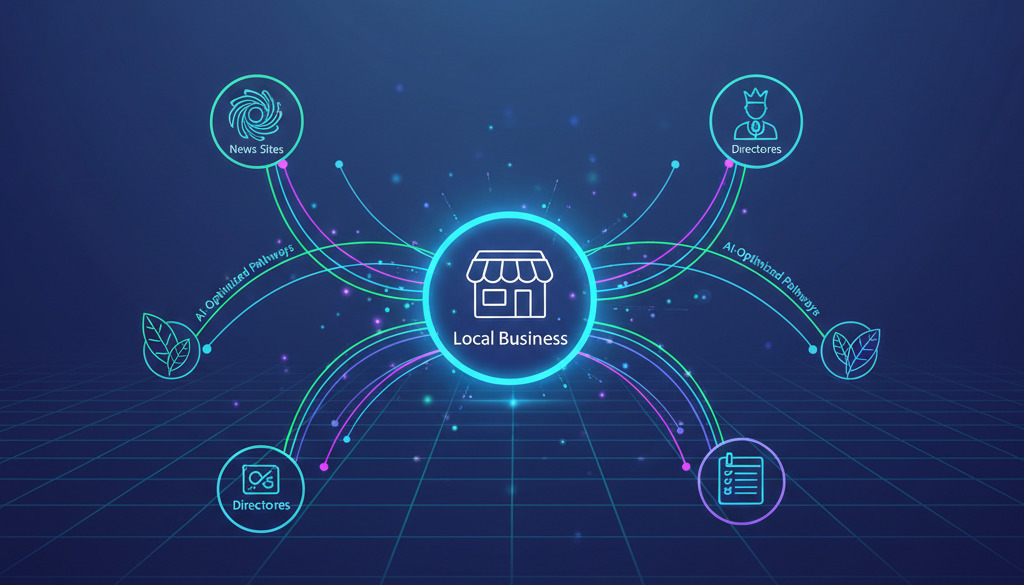
Link building is notoriously difficult in local SEO because the pool of relevant local domains is often small. AI helps bridge this gap by identifying non-obvious link opportunities. By scanning local news sites, blogs, and community portals, AI can identify "unlinked brand mentions"—instances where a local journalist or blogger mentioned your business but didn't link to your site.
Additionally, AI can facilitate "Local Digital PR" by identifying influencers within a specific city or neighborhood. AI tools analyze social media engagement and local relevance to suggest partners who actually have a localized following, rather than just a high follower count. This ensures your outreach efforts are concentrated on the sources that will actually influence the local pack algorithm.
Enhancing Local User Experience through AI-Driven Website Optimization
User experience (UX) is a confirmed ranking factor. For local businesses, this often means speed and ease of contact. AI-driven website audits can identify specific technical bottlenecks that are unique to certain regions—for example, optimizing image delivery for mobile users on slower local cellular networks.
AI-Powered Website Personalization
For multi-location businesses, AI can ensure a user is always directed to the most relevant store page. By using IP detection and past behavior, the website can display the nearest location’s promotions, inventory, and staff bios automatically. This reduces friction and increases the likelihood of a physical visit or local lead conversion.
Conversational AI for Local Customer Service
AI chatbots have evolved beyond simple scripts. Modern conversational AI can handle local-specific FAQs, such as "is there street parking available?" or "do you have the blue widget in stock at the Broadway location?" This instant gratification keeps users on your site and increases engagement signals, which indirectly boosts local search rankings.
AI in Local Search Visibility: Understanding Ranking Factors and Predictive Analytics
The factors that influence the "Local Pack" are increasingly dictated by AI filters that detect spam and evaluate proximity. AI can help a business understand its "ranking radius." By using spatial AI analysis, a business can see exactly where its visibility drops off in a city and adjust its local ad spend or content strategy to "push" into those cold zones.
Predictive analytics also allow businesses to "stress test" their local SEO. Before changing a primary business category or moving locations, AI models can simulate the potential impact on search visibility based on the existing competitive landscape. This data-driven approach removes the "trial and error" phase that often hampers local business growth.
Implicit Signals: AI is now sophisticated enough to interpret implicit signals. For example, if AI observes that users frequently search for your brand after visiting a specific local park or shopping center, it may begin to associate your business with that high-traffic area, even if you aren't physically located inside it.
Measuring ROI and Performance: AI for Advanced Local SEO Analytics
One of the biggest hurdles in Local SEO is attribution. Did the customer call because of the GBP listing, the website, or a local social media ad? AI-driven attribution modeling can track the "omnichannel" journey of a local customer. By integrating data from call-tracking software, GBP insights, and POS systems, AI provides a holistic view of the ROI of your SEO efforts.
Automated Reporting and Insights
Instead of receiving a spreadsheet of rankings once a month, AI provides real-time, narrative-based insights. An AI dashboard might report: "Your visibility dropped in the North End because a new competitor started a high-frequency posting schedule; we recommend updating your GBP photos to regain market share." This turns data into defensive and offensive business strategy.

The Future of Local SEO: Embracing AI as a Core Strategy
The future of local search is increasingly "zero-click." This means users get their answers directly from AI interfaces without ever visiting a website. To survive, businesses must optimize for Generative Engine Optimization (GEO). This involves providing AI models with structured, authoritative data that they can easily digest and present as a definitive answer.
Voice search is also undergoing a renaissance powered by Large Language Models (LLMs). As users move from typing "plumber near me" to speaking "find me a highly-rated plumber who can fix a leak today and takes Apple Pay," businesses that have used AI to optimize their long-tail content and technical schema will be the ones the AI chooses to mention.
Ethical Considerations: As we rely more on AI, transparency and accuracy become paramount. Using AI to generate fake reviews or "ghost" locations is a short-sighted strategy that modern AI filters are designed to penalize severely. High-integrity AI implementation focuses on amplifying the truth of a business, not fabricating it. Sustainable growth in the AI era requires a commitment to data accuracy and genuine customer satisfaction.
Conclusion
Local SEO is no longer a peripheral marketing task; it is a sophisticated technological arms race. AI has redefined the rules of engagement, moving the goalposts from simple visibility to becoming the preferred recommendation of advanced search algorithms. By leveraging local SEO AI for keyword intent, content personalization, and GBP management, businesses can create a robust digital presence that is both resilient to algorithm shifts and deeply connected to their local community.
The journey toward AI integration begins with a mindset shift. Businesses must stop viewing AI as a tool for "cutting corners" and start seeing it as a tool for "expanding reach." Those who invest in AI-driven local strategies today will be the entities that dominate the "answer-first" search landscape of tomorrow. Future-proof your business by embracing the intelligence that is already reshaping the local world.
Keep reading
Hand-picked guides that go deeper — open the one you need next:
- Boost Local Rankings with Volteruno's AI Content
- Small Business SEO: AI Levels the Playing Field
- Professional Content Marketing on a Budget: The AI Advantage
- AI: The Game Changer for Small Business SEO in 2026
→ Read the full Small Business guide